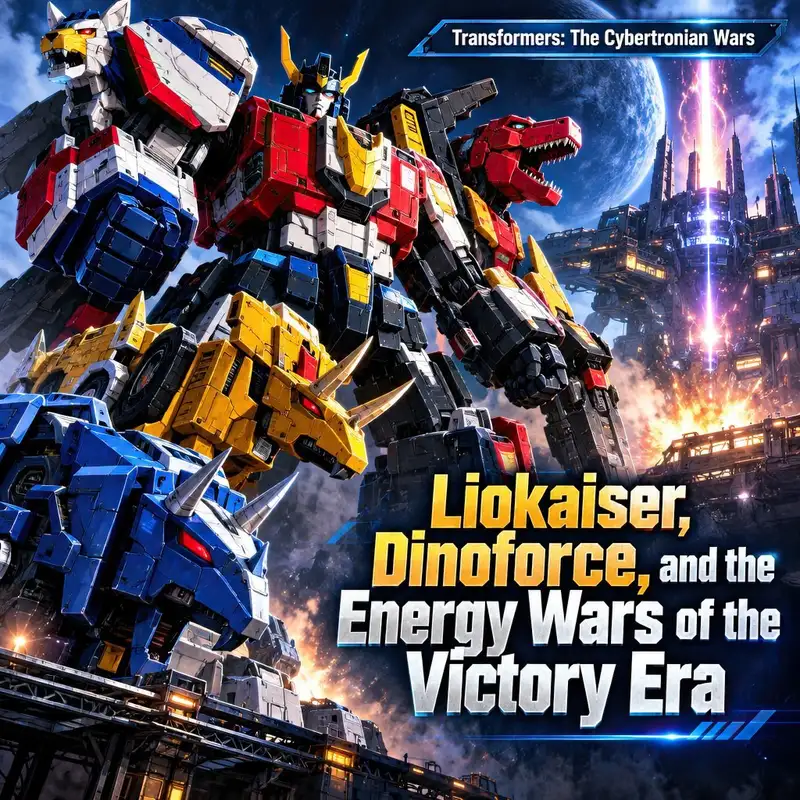
Liokaiser, Dinoforce, and the Energy Wars of the Victory Era
At the Schaefer Energy Complex, the Destron plan worked because it forced the Space Defense Force to make an ugly choice. Liokaiser engaged Star Saber directly, denying the Cybertron commander the freedom to pursue the raiders. The Dinoforce removed the captured energy. At the same time, damage to a tower threatened the civilians below. Star Saber could either remain in the fight or prevent a catastrophe. He chose the tower. The Rescue Team moved to evacuate and stabilize the site. Other Cybertron forces pursued the stolen supply, but the Destrons escaped with it.
That was not a simple defeat, and it was not a simple victory. The Space Defense Force preserved lives and prevented a damaged industrial facility from becoming a mass-casualty disaster. The Destrons still obtained the material they came for. Victory repeatedly returns to that asymmetry. Deathsaurus does not need to conquer every city he attacks. He needs enough successful raids to keep a larger project alive. Star Saber, by contrast, cannot treat a refinery, power station, or research complex as expendable terrain when it supports a civilian population.
This is the Japanese animated history of Transformers: Victory, set after the Masterforce War. Its conflict unfolds across a postwar security order that is broader than Cybertron alone. Cybertrons and peace-oriented alien populations have formed the Space Peace Union, and Earth is among its members. The Space Defense Force, commanded by Star Saber from V Planet, exists to protect that network of worlds, facilities, routes, and populations.
The arrangement is not described as a detailed constitution, and the series does not provide a staff chart for every allied government. But its political meaning is clear enough. A threat against Earth can become a threat to the wider Union. An attack on a refinery on Planet Micro is more than a local crime. It can disrupt a shared system of energy, transport, defense, and mutual confidence. Deathsaurus understands that. His campaign tests whether an alliance built for peace can defend itself when its infrastructure becomes the battlefield.
Deathsaurus’s objective is not primarily territorial occupation. He seeks to recover and restore a fortress sealed in the Dark Nebula. That fortress is not useful as a monument or a symbol. It is meant to become the center of a coercive military strategy. Once restored and properly supplied, it gives Deathsaurus a weapon capable of threatening worlds that his field forces could not simply seize and hold.
The problem is energy. The fortress can be reactivated, but its initial reserves are not enough to sustain its full operation. It needs repeated infusions of strategic energy gathered from across the Union’s territory. In practical terms, that means Deathsaurus must do more than discover powerful resources. He must identify them, seize them, move them, protect them in transit, and concentrate them at a remote fortress without allowing Star Saber’s forces to interrupt the chain.
That requirement gives Victory much of its military logic. The series often appears to present a succession of raids, each focused on a different facility or resource. Look more closely, and those raids form a campaign. The Destrons attack mines, power installations, storage sites, research centers, tankers, shuttles, refineries, and unusual ancient locations. They seek uranium, electrical power, petroleum, solar energy, geothermal energy, transport cargoes, and other strategic sources. The precise fuel varies. The operational purpose does not.
Energy in this war is not one magical substance stored in a conveniently labeled container. It is a distributed system. It comes from extraction, generation, refining, storage, and transport. It supports industry and civilian life before it ever reaches a military objective. A raid on a mine interrupts production. A raid on a tanker interferes with movement. A raid on an electrical system can create panic, blackouts, and physical danger. A threat against a refinery can become a threat against everyone living or working near it.
That is why the Destron campaign is more sophisticated than ordinary theft. It is resource denial combined with resource acquisition. The Destrons gain supplies for the fortress while forcing the Space Defense Force to disperse. Star Saber cannot simply mass every available unit at the Dark Nebula when mines, orbital routes, industrial zones, and population centers all require protection. The defenders must patrol, escort, investigate, respond, evacuate, repair, and fight. Deathsaurus benefits from every demand placed on that system.
The early attacks establish this pattern. The Dinoforce strike the Moon and move toward Earth. Other operations target a beta-uranium mine, energy storage in a jungle region, electrical infrastructure beneath an urban area, and a shuttle carrying valuable power supplies. The locations differ, but each raid asks the same question. Can the Destrons remove the energy before the defenders can stop them, and can they create enough danger that rescue becomes more urgent than pursuit?
The tanker operation makes the logic especially clear. Tankers are more than large containers waiting to be stolen. They are part of a transportation system. By exploiting fuel shortages and attempting to redirect shipping, the Destrons attack the flow of resources rather than only their storage. A force that controls a mine has not necessarily secured its output. A force that captures fuel has not necessarily delivered it. Transport is where an energy campaign becomes vulnerable, because moving resources creates predictable routes, schedules, escorts, and targets.
Deathsaurus therefore needs forces with different roles. He needs intelligence to find opportunities. He needs raiders who can overwhelm local security. He needs elite combatants who can contain the strongest Cybertron defenders. He needs transport capacity, even if the series does not reduce that capacity to charts and tonnage figures. And he needs enough internal discipline to keep the captured energy moving toward the fortress rather than disappearing into rivalry, waste, or local ambition.
The Dinoforce are central to the seizure side of that system. Led by Goryu, they are a six-member Destron assault unit capable of combining into Dinoking. Their individual names matter less than their recurring function. Yokuryu, Rairyu, Goryu, Doryu, Gairyu, and Kakuryu operate as a team designed for direct action. They attack facilities, seize hostages, intimidate local defenders, create diversions, carry off supplies, and remain useful after the first surprise has passed.
That does not mean the Dinoforce are an elite precision organization in the manner of the Breastforce. Their operations can be clumsy. Their plans can be vulnerable to determined resistance. But judging them only by whether they defeat the strongest Cybertron warrior in a duel misses their military value. Raiding forces do not need to be elegant. They need to arrive where defenses are weak, generate disorder quickly, impose a cost on hesitation, and remove the objective before the defender can restore control.
The Dinoforce are particularly suited to operations against civilian and industrial sites because their presence is itself disruptive. A power station cannot simply continue operating while hostile Cybertronians tear through its defenses. A mining operation cannot maintain normal output during a hostage crisis. A refinery cannot safely absorb heavy combat around volatile equipment. Even when the Dinoforce fail to hold a site, they can force the defenders into a rescue and containment mission. That mission consumes time, personnel, and attention.
Their combination into Dinoking gives them a concentrated heavy-combat option. Dinoking can break through resistance, hold ground briefly, or confront larger defenders while the rest of the operation proceeds. Yet Dinoking is not a substitute for strategy. Combining does not reveal the next target. It does not secure a tanker route. It does not make stolen energy safe once it leaves the facility. It gives the Destrons force at the point of contact. Deathsaurus still needs that force integrated into a larger logistical plan.
The Dinoforce also demonstrate a kind of persistence that matters in a long campaign. They continue operating under difficult conditions and maintain a recognizable team identity. Their cohesion is not a trivial point. A resource war creates routine pressure. Raids fail. Cargoes are contested. Commanders blame one another. A unit that can continue to perform seizure, disruption, and transport duties remains useful even when it is not the most impressive formation on the battlefield.
If the Dinoforce are the extraction arm of Deathsaurus’s campaign, the Breastforce are its enforcement arm. They are the Destron leader’s elite field formation, led by Leozack. Drillhorn, Killbison, Jargua, Hellbat, and eventually Gaihawk complete the team that can combine into Liokaiser. Their chest animals function as weapons, but their broader importance lies in the different capabilities they bring to the campaign: assault power, aerial mobility, deception, infiltration, and the ability to concentrate force against the defenders’ best assets.
Leozack is more than a battlefield officer. He is politically ambitious, capable, and valuable enough that Deathsaurus must rely on him despite the risks that such a subordinate presents. That relationship is common in authoritarian military systems. The leader needs talented commanders because a personal dictatorship cannot personally direct every raid across several worlds. Yet every successful commander acquires followers, prestige, and an independent claim on the future. Loyalty is useful. Competence can be dangerous.
The Breastforce expand over the course of the campaign. Gaihawk is recovered from imprisonment on the Moon orbiting Planet Micro. His return provides more than another fighter. It completes the six-member structure necessary for combination. In a campaign where local superiority matters, the difference between five members and six is not cosmetic. It determines whether the Breastforce remain a collection of dangerous specialists or become a weapon that can challenge Star Saber directly.
The road to Liokaiser is also shaped by internal Destron rivalry. Leozack attempts to replace Hellbat with Deathcobra. Hellbat responds by killing Deathcobra and blaming the Cybertrons. The immediate event is a struggle for place within the formation. But its consequence is strategic. Hellbat remains part of the Breastforce, Gaihawk joins the lineup, and the completed team gains the ability to form Liokaiser.
This is not evidence of a smoothly functioning Destron institution. It is evidence of an organization held together by fear, ambition, and practical necessity. Deathsaurus needs the Breastforce. Leozack needs the status that comes from commanding them. Hellbat needs to survive internal competition. The deception surrounding Deathcobra shows that the Destrons are willing to manipulate even their own chain of command for advantage. Such behavior can create short-term capability while steadily damaging trust.
Liokaiser is therefore not merely a larger body assembled for dramatic effect. He is the concentration of six specialists into one decisive battlefield asset. In Victory, he belongs to the Breastforce and to this campaign. He should not be mistaken for a version of another combiner from another Transformers history. His function here is specific. Liokaiser exists to create a window of local dominance, especially at the point where the Space Defense Force’s command presence is strongest.
That effect is demonstrated quickly. In Liokaiser’s first major confrontation with Star Saber, the Breastforce combiner overwhelms the Space Defense Force commander. God Ginrai’s arrival prevents Star Saber’s destruction. The tactical lesson is immediate. Star Saber is formidable, but he is not invulnerable. The Destrons now possess a formation that can hold him in place, defeat him temporarily, or force other Cybertron units to divert to his rescue.
The strategic lesson is more important. Liokaiser does not destroy the Space Defense Force. He does not eliminate the Union’s ability to defend its worlds. But he changes the balance at critical locations. If Star Saber must respond personally to Liokaiser, then he cannot direct every rescue, pursue every transport, or reinforce every threatened installation. If other defenders must intervene to save Star Saber, then fewer remain available to protect the energy objective.
That is how a combined warrior becomes part of a logistical system. Liokaiser is not valuable only because he can hit harder than an individual fighter. He can fix the enemy’s strongest commander in combat. In military terms, fixing an enemy means preventing that force from moving freely to the place where it is needed. A commander held in battle is a commander unable to pursue raiders. A rescue force tied down by Liokaiser is a rescue force unable to intercept a departing energy shipment.
Liokaiser’s invisibility capability adds another dimension. The series and supporting material establish that he can use it to gain a tactical advantage. The exact technical limits are not fully explained, and there is no need to invent them. What matters is the operational effect. Invisibility can assist reconnaissance, ambush, approach, and close assault. It makes the defender’s problem more difficult because a facility may be under threat before its security forces understand where the main attack is coming from.
A capability like that is especially dangerous when paired with the Dinoforce. Dinoking can make noise, break defenses, and draw attention. Liokaiser can appear where the command structure is vulnerable. Or the order can be reversed. Liokaiser can pin Star Saber while the Dinoforce remove the energy. The Destrons do not need every unit to do every task. Their effectiveness comes from assigning heavy raiders, elite combatants, deceptive operators, and transport elements to complementary jobs.
Star Saber’s command burden grows as a result. His authority is not only personal. He leads a wider Space Defense Force that includes specialized formations, space bases, allied facilities, and civilian responsibilities. Yet a dispersed defense system has a permanent problem. It must decide where its commander, elite units, escorts, and rescue teams will be at any moment. Deathsaurus can choose the place of attack. Star Saber must decide what cannot be allowed to fail.
That decision is rarely simple. A military commander may want to destroy the raiding force. A defender responsible for the Space Peace Union must also protect the people caught beneath damaged towers, beside threatened fuel stores, or along the path of an industrial fire. The Destrons exploit that obligation. They turn civilian vulnerability into a form of operational leverage. It does not make Star Saber weak. It makes his mission larger than winning a duel.
The struggle is also a contest over information. Hellbat’s value is not limited to combat. Deception and intelligence are crucial in a campaign built around dispersed energy sources. The Destrons must know which shipment matters, which facility is poorly defended, which installation can be turned into a hazard, and which rumors will delay a response. An energy war cannot be sustained by random attacks. It requires target selection.
The Cybertrons attempt to improve their own awareness. Braver develops a detection device intended to locate the enemy. That is a practical response to a mobile raiding force. A system that can find Destron activity before an attack develops would reduce the advantage gained from surprise, disguise, and dispersed operations. But Leozack steals the device. The incident is a reminder that technology does not create information superiority by itself. It must be secured, protected from espionage, and integrated into an organization that can act on its warnings.
The theft also reveals a basic problem for the Space Defense Force. It is defending an open alliance system. Its facilities, research projects, transport routes, and civilian infrastructure must remain accessible to those they serve. Deathsaurus’s forces can exploit that openness. A fortress in the Dark Nebula can remain hidden and insulated from ordinary life. A refinery, research center, or spaceport cannot. The defender has more to protect and more places where trust can be abused.
The tanker operations underline this vulnerability. Fuel shortages are more than economic inconvenience. They can affect transport, emergency response, industrial production, and public confidence. When the Destrons manipulate or redirect tankers, they force defenders to think about escort duty and route security. A convoy is valuable because it concentrates resources. It is vulnerable for the same reason. A ship carrying strategic energy becomes a target, but it can also become bait, a hostage, or a source of broader disruption if it is lost near populated areas.
The geography of Victory matters here. The war does not remain on Earth. It reaches orbital space, the Moon, Planet Micro, the asteroid belt, the Dark Nebula, and multiple industrial sites. Spacecraft and bases give both sides mobility, but they do not abolish distance. Important facilities remain fixed. Ships travel routes. Energy must still move from its source to its destination. A fortress requires a staging area. The wider the Destron campaign spreads, the more opportunities it creates, but the more connections it must sustain.
Planet Micro demonstrates the stakes beyond Earth. The Destrons attack its oil refinery and industrial infrastructure, showing that the Union’s energy security depends on more than one world. A refinery is both an economic asset and a physical hazard. If Hellbat threatens to destroy it, the defenders cannot treat the site as an abstract objective on a map. A major industrial explosion can endanger workers, nearby communities, transport networks, and the resources needed for recovery.
The response on Micro also shows that the Space Defense Force is not one interchangeable Autobot army. The Brainmasters provide elite combat power. The Multiforce contributes patrol, response, and heavy support. The Rescue Team handles evacuation, repair, and medical assistance. Star Saber provides command and decisive intervention. Galaxy Shuttle and other assets connect theaters and move personnel. The distinction matters because every unit committed to rescue is unavailable for pursuit, and every unit committed to combat may leave civilians exposed.
That division of labor is not inefficiency. It is what a functioning defense organization must do. A force that only fights can destroy an enemy formation and still fail the population it was meant to protect. A force that only rescues can preserve lives in the short term but allow the enemy to accumulate strategic strength. The challenge for Star Saber is to hold both responsibilities together when Deathsaurus is deliberately trying to make them compete.
The Space Peace Union is tested by this competition. An alliance depends on members believing that shared defense will function in a crisis. If one planet’s fuel infrastructure is attacked, other members may have to provide escorts, repair support, emergency supplies, or combat units. If Earth is threatened, the consequences reach beyond Earth. Deathsaurus’s raids therefore challenge not only material security, but political trust. Can the Union still act as a Union when each new emergency demands resources from somewhere else?
Deathsaurus’s answer is coercion. He does not need to persuade the Union that his rule would be legitimate. He needs to demonstrate that its existing order cannot keep its people safe. Every blackout, refinery threat, hostage crisis, and stolen shipment becomes part of that argument. It is an argument made through fear rather than political persuasion, and it depends on the fortress becoming powerful enough to convert disruption into submission.
That goal demands more than ordinary fuel. Atlantis becomes the campaign’s decisive escalation because Deathsaurus believes it contains an energy source greater than those seized in earlier raids. The operation is no longer a matter of infiltrating a plant or intercepting a shipment. It reaches into a lost city and treats an ancient site as a strategic reservoir.
Deathsaurus uses the Ultimate Cannon to raise Atlantis. The result is worldwide tidal waves. The event is often remembered for spectacle, but its military meaning is stark. Strategic extraction has become planetary disaster. The Destrons are willing to alter the physical environment of Earth in order to obtain the energy required for the fortress. Civilian consequences are not an accidental byproduct that interrupts the operation. They are accepted as a price of success.
For the Space Defense Force, the immediate mission is rescue, evacuation, and emergency repair. Water does not distinguish between military and civilian targets. Tidal waves threaten cities, transport routes, power systems, and anyone unable to escape in time. The defenders must protect lives while preventing the Destrons from escaping with the prize. Once again, Deathsaurus imposes a choice. The more severe the civilian crisis, the more difficult it becomes to concentrate combat power against the raiders.
The Destrons gain the energy they need. That is the grim significance of Atlantis. Strategically, the operation achieves Deathsaurus’s objective. He has moved beyond scattered acquisitions and accumulated enough power to fully restore the fortress. The earlier raids were not random episodes of destruction. They were preparation for this moment.
With the Atlantis energy secured, the fortress in the Dark Nebula can be fully recharged. Deathsaurus now transforms his campaign. What began as distributed resource warfare becomes direct planetary coercion. The fortress moves against Earth. It launches meteorite bombs and is converted into a massive weapon aimed at the planet. The sites once attacked for their role in sustaining civilian life are no longer merely targets of disruption. Earth itself becomes the threatened objective.
This is the strategic purpose of the energy campaign revealed in full. Deathsaurus did not collect power merely to enrich the Destrons or sustain routine military operations. He gathered it to activate a singular system capable of changing the political terms of the war. A fortress that can menace Earth forces the Space Peace Union to confront not only raids and sabotage, but the prospect that one concentrated weapon can hold an entire population at risk.
Yet this success also exposes Deathsaurus’s command priorities. The Dinoforce, so useful during the extraction campaign, are abandoned or exposed to the fortress’s own attacks. The message is unmistakable. In Deathsaurus’s system, subordinates are instruments. Their value ends when the larger weapon system becomes available. That may be efficient in the narrowest sense. It is also corrosive. A commander who spends loyal forces carelessly can retain fear, but he weakens the trust and initiative needed when a crisis becomes unpredictable.
The Cybertrons now face several missions at once. They must intercept attacks directed at Earth. They must rescue civilians endangered by the fortress’s weapons. They must repair damage to the planet’s infrastructure. They must fight Destron formations outside the fortress. And they must find a way inside the system that Deathsaurus has spent the entire campaign trying to power and protect. No individual act of courage resolves all of those tasks. The defense requires specialized units acting under intense pressure.
The fortress appears overwhelming because it concentrates power. But concentration has a reciprocal weakness. A distributed campaign can survive the loss of a mine, refinery, or shipment if other sources remain available. A singular fortress depends on a singular power system. The more Deathsaurus makes the fortress the center of his strategy, the more important its internal energy supply becomes. It is no longer only a strength. It is the point where the whole campaign can fail.
Goryu’s cooperation with Jan becomes important in this final phase. It is a localized act, not evidence that every Destron has suddenly surrendered or that the wider conflict has received a complete political settlement. But it provides crucial information about how the fortress can be stopped. The incident also shows what Deathsaurus’s treatment of his own forces has cost him. When subordinates are treated as expendable, some will eventually decide that survival, loyalty to comrades, or simple decency matters more than the leader’s ambition.
Jan attacks the fortress’s power source. That action has a clear operational purpose. It interrupts the energy supply that allows the fortress to function as Deathsaurus’s decisive weapon. The objective is not to outmatch every gun or destroy every section through brute force. It is to disable the system at its dependency point. Once the flow of power is interrupted, the fortress loses the advantage gained through all the earlier raids.
The final battle remains dangerous. Star Saber confronts Deathsaurus. Victory Leo engages Liokaiser during the internal assault and disables or destroys the Breastforce combiner. Victory Saber and the wider Cybertron force then destroy the fortress after its energy system has been interrupted. These actions operate at different levels. A duel affects command. The defeat of Liokaiser removes an elite battlefield asset. The attack on the power source collapses the fortress operation. The destruction of the fortress ends the immediate threat to Earth.
Those results should not be blurred together. The tactical victory is the defeat of key Destron forces within the assault. The operational victory is the collapse of the fortress attack. The strategic victory is Earth’s survival and the destruction of the weapon system Deathsaurus intended to use against the Space Peace Union. What Victory does not provide is a detailed account of every remaining Destron force, every prisoner, every damaged world, or the political settlement that follows. The fortress is destroyed. A complete peace is not fully described.
The distinction matters because it returns us to the central question. Liokaiser and Dinoforce matter in Victory not because the series needs two impressive combined warriors for their own sake. They are the two major instruments of Deathsaurus’s energy strategy. The Dinoforce seize, disrupt, transport, and intimidate. They convert vulnerable facilities and frightened populations into captured resources. Liokaiser creates the combat conditions that make those raids possible when elite defenders arrive.
At Schaefer, that division is almost a diagram of the whole campaign. Liokaiser holds Star Saber in battle. The Dinoforce remove the energy. Civilian danger forces the Space Defense Force to divide its attention. The Destrons gain material success even though they fail to destroy the defenders. Similar logic governs the attacks on transport, refineries, research sites, and eventually Atlantis. Each operation feeds the fortress. Each operation also demonstrates the cost of making civilian infrastructure serve as a military target.
Deathsaurus’s greatest achievement is therefore not merely restoring the fortress, forming Liokaiser, or fielding Dinoking. It is integrating those assets into a sustained resource-extraction campaign across several theaters. He recognizes that power stations, tankers, mines, and ancient energy sites are the real terrain of the war. Control of those systems offers more strategic value than occupying a city without the means to sustain it.
His decisive failure is making the fortress the center of everything. The same concentration of energy that makes it terrifying also makes it dependent. Once its power source is exposed and interrupted, the accumulated raids, the stolen resources, the elite combiner, and the heavy assault force cannot preserve the system. Deathsaurus builds a campaign around coercive power. Star Saber’s forces endure because, even when that choice costs them a pursuit or a shipment, they continue to protect the people whose society the Destrons are trying to terrorize into submission.