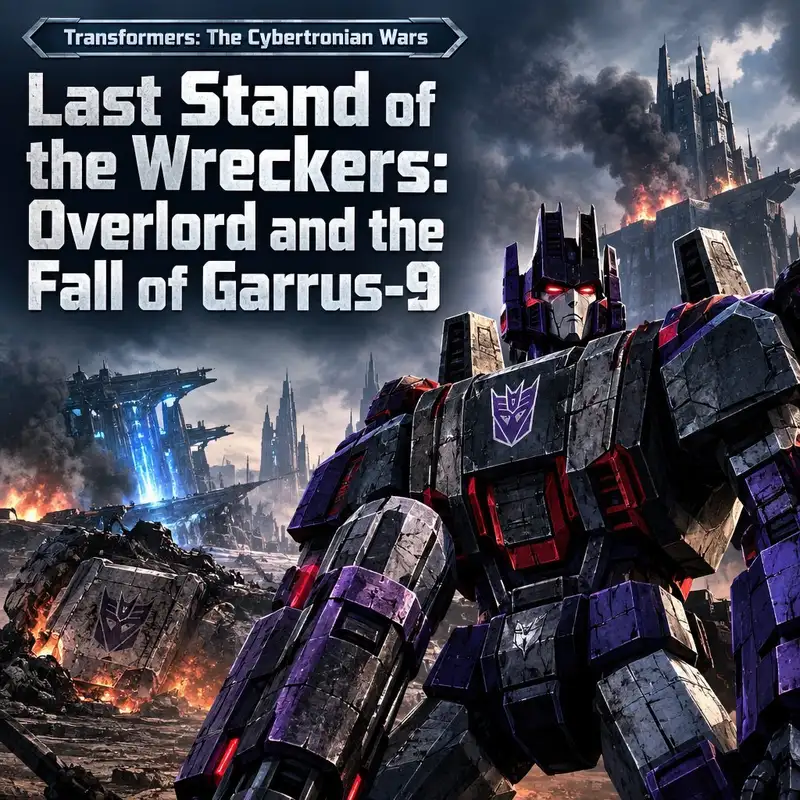
Last Stand of the Wreckers: Overlord and the Fall of Garrus-9
Fortress Maximus was still alive when the Wreckers reached Garrus-9. That fact was not a mercy. The former warden of the Autobot maximum-security prison had been mutilated, restrained, and wired into the sealed chamber of Aequitas, the prison’s judicial supercomputer. His body had become part of the lock. His survival had become another instrument of coercion.
That image explains what Garrus-9 had become. Before its capture, the prison existed to confine dangerous prisoners, preserve evidence, and impose a system of custody under Autobot authority. Its methods were not gentle, and its deterrence technology was already troubling. But it possessed procedures, records, chains of responsibility, and at least the claim that punishment required judgment. Under Overlord, those structures were more than destroyed. They were reversed.
The cells remained. The forcefields remained. The armories, execution mechanisms, torture chambers, and detention systems remained. But the people who had controlled them were imprisoned, mutilated, or killed, while Decepticon inmates became the armed population on which Overlord built his rule. Garrus-9 was no longer a prison in any lawful sense. It was a captured institution turned inside out, a fortress of confinement converted into a stage for terror.
This is the story of that conversion, and of the Wreckers sent to end it. In the I D W continuity that began in two thousand five, the liberation of Garrus-9 was more than a raid against a Decepticon stronghold. It was a rescue operation, an intelligence mission, a battle against a personal dictatorship, and a retrieval effort aimed at evidence the Autobots themselves had reason to fear.
The Wreckers defeated Overlord. They freed Garrus-9 from his immediate control. But the operation also exposed a second crisis, one inside the Autobot war effort. The prison contained records of atrocities committed not by Decepticons, but by Autobots. The force that arrived to restore justice had to confront the possibility that its own institutions had buried unlawful violence in the name of unity, morale, and victory.
Garrus-9 fell during the wider Decepticon offensive associated with the period known as All Hail Megatron. By the time the Wreckers arrived, it had endured roughly three years under Decepticon control. The exact scale of the prison population is not established, and the story does not provide a complete accounting of the dead. It does establish something more important than a number. The people trapped inside had been reduced to resources in Overlord’s system.
Some were prisoners before the takeover. Some had been guards, wardens, or Autobot detainees. Some were Decepticons who had once been confined by the Autobots and then found themselves armed, empowered, and exposed to a new command culture. Not every Decepticon at Garrus-9 necessarily supported Overlord’s methods. One of them, Snare, would eventually help make the liberation possible. But Overlord created an environment in which survival depended on submission, usefulness, and fear.
His authority did not rest on a stable government, a conventional garrison, or a coherent political program. It rested on spectacle. Torture chambers became places of interrogation and performance. Forced combat turned prisoners into objects for the amusement and instruction of the ruling force. Executions demonstrated that no rule existed except the ruler’s will. Garrus-9’s infrastructure gave Overlord a ready-made apparatus of confinement. He supplied the cruelty, the audience, and the strategic purpose.
The distinction carries real consequences. A prison is already a concentrated exercise of power. It controls movement, communication, access to repair, access to weapons, and often access to life itself. When a prison falls to an occupying force, the occupier does not have to build a system of domination from the ground up. The locks, barriers, records, surveillance systems, and separation of populations are already there. The question becomes who controls them, and what restraints remain.
Overlord removed those restraints. Former guards became captives. Captives became targets. A system intended to keep violent prisoners from endangering others became an environment in which violence was rewarded and restraint became a liability. Fortress Maximus, once the warden, was left alive not because Overlord respected the office, but because the warden’s knowledge and physical presence could be exploited.
The damage to Garrus-9 was therefore institutional as well as physical. Its command hierarchy had collapsed. Its rules had become arbitrary. Its medical and repair capacity served the priorities of the new regime. Its prisoners could not rely on the categories that once governed their treatment. A captured fighter, a convicted criminal, a former guard, and an Autobot prisoner might all be thrown into the same machinery of terror.
Overlord’s atrocities were personal, but they were not purposeless. The clearest explanation comes through Shockwave, another figure trapped within the prison’s orbit. Shockwave identifies Garrus-9 as a message. Overlord wanted Megatron to come.
The goal was more than to hold territory. Garrus-9 was not an industrial center whose value depended on mines, shipyards, or a major space bridge. It was a prison, and Overlord made it a signal beacon. The more visible the cruelty, the more difficult it would become for Megatron to ignore. The more prisoners died, the more likely that the Decepticon leader would hear of it. The more horrible the regime became, the more likely that Garrus-9 would become the place where Overlord could force a confrontation with the one opponent he truly wanted.
There was also a specific constraint behind that ambition. Overlord had carried what the story calls an Achilles virus, a condition that created a blind spot in his ability to plan effectively against Megatron. Shockwave removed the virus in exchange for his freedom. The details of the virus do not need to be generalized beyond this story. What matters is its political effect. Once free of that limitation, Overlord could turn his attention toward a rivalry that had become central to his identity.
That helps explain why Garrus-9 was both a fortress and a trap. Overlord was not conducting a normal occupation. He had no durable administrative program for the prison, no effort to turn its population into a functioning polity, and no visible plan to integrate it into a wider Decepticon war economy. He was constructing a personal theater. The prison’s suffering was meant to produce a reaction from a particular audience.
Cruelty can serve strategic signaling without becoming any less cruel. In fact, its usefulness as a signal often depends on its excess. A conventional military victory could be misunderstood as part of Megatron’s wider campaign. A prison regime built around torture, mutilation, public killing, and the destruction of normal custody rules could not. Overlord wanted Garrus-9 to announce his presence in a language he believed Megatron would understand.
But terror systems have weaknesses. They rely on fear, and fear is not loyalty. They depend on subordinates accepting that the ruler’s violence is inevitable, useful, or at least safer than resistance. Snare demonstrated the limits of that arrangement.
Snare was associated with the prison guard force under Decepticon control. He was not presented as a simple convert to the Autobot cause, and it would be a mistake to make him one. His intervention did not erase his place inside the occupation. But he became disillusioned enough with Overlord’s regime to act against it. He freed Impactor, a prisoner with direct knowledge of Garrus-9, and helped him escape.
That decision created the opening the Autobots needed. It was not a full intelligence picture. Impactor could describe the prison’s condition, its occupation, and its dangers. He could identify the urgency of the prisoners’ plight. But the Autobots did not arrive with perfect knowledge of Overlord’s plans, complete maps of every threat, or a clear understanding of the full importance of Aequitas.
Intelligence in a prison war is rarely clean. The escaped witness may be traumatized, self-interested, incomplete, or all three. Impactor was especially difficult because he was both indispensable and compromised. He knew Garrus-9. He had survived it. He could help guide the rescue. But he was also a convicted prisoner, and the reason for his imprisonment would prove central to the mission.
Autobot command nevertheless had to act. Every delay increased the risk to the remaining prisoners. Overlord’s regime was not static. Its violence was part of its operating method. A prison held under such conditions could not be treated as a remote problem to be solved after a more convenient campaign season. The prisoners were being killed, broken, or forced into a system designed to erase the difference between custody and annihilation.
The mission assigned to the Wreckers had three connected objectives. They were to rescue surviving Autobot prisoners. They were to recover Aequitas. And they were to neutralize Overlord.
Each objective was dangerous on its own. Together, they created tensions that would shape the entire operation. Rescue demanded speed. Evidence recovery demanded access to a secured internal system. Neutralizing Overlord demanded a direct confrontation with the most dangerous defender in the prison. The Wreckers could not assume that success in one task would guarantee success in the others.
Springer led the field team. The Wreckers were an Autobot special-operations formation, assembled for missions whose risk level would have been unacceptable for ordinary units. That reputation could inspire confidence, but it could also become a trap. Special operators are not invulnerable. They are simply the personnel command is willing to send into missions where survival may be uncertain and where failure may have consequences far beyond the battlefield.
Ultra Magnus provided senior authority and transport. He brought the team toward Garrus-9, but he would not be present for most of the fighting inside the prison. That distance mattered. Once the Wreckers entered, command decisions would fall on small groups operating with damaged communication, incomplete information, and little room to withdraw.
The team included veterans such as Springer and Kup, specialists such as Perceptor, and fighters including Topspin, Twin Twist, Guzzle, Rotorstorm, Pyro, Ironfist, and Impactor. Verity Carlo, a human ally, also accompanied the force. Her presence was unusual in a place built for Cybertronian detention, but she would become morally important. She was more than a passenger or observer. She provided an outside perspective at moments when the Wreckers were tempted to let urgency erase judgment.
Ironfist entered the mission carrying another vulnerability. He admired the Wreckers. He had invested in their history, their reputation, and their image as the Autobot force that did the impossible when ordinary military structures failed. That sort of belief can build morale. It can also leave a young soldier unprepared for the gap between legend and record.
The concealed political stake was Aequitas. Prowl, operating within Autobot command, had a strong interest in recovering the system. Aequitas was not just a computer sitting in a prison basement. It was an archive of culpability. It held records related to prisoners, judgments, and actions that potentially implicated Autobots as well as Decepticons.
The recovery mission therefore contained a quiet contradiction. The Autobots were going to Garrus-9 to rescue victims of Decepticon terror. They were also going to retrieve evidence that could damage Autobot legitimacy. In wartime, institutions often describe such evidence as dangerous, destabilizing, or useful to the enemy. Those phrases can be true. They can also become excuses for concealment.
Garrus-9’s lattice forcefield made a conventional assault difficult. The Wreckers could not just approach, breach the main entrance, and expect to retain the initiative. They needed a method of insertion that bypassed the most obvious defenses. Ultra Magnus delivered them in drop pods, an approach intended to put the team inside the prison’s defensive envelope before Overlord could concentrate his forces against them.
It was a reasonable plan. It failed immediately.
The pods were shot down. Instead of arriving as a unified assault force, the Wreckers were scattered into separate groups. The operation lost cohesion at the moment it began. Garrus-9’s architecture now worked against the attackers. Corridors, cell blocks, secured chambers, and controlled access points separated the team. A prison is designed to prevent movement between populations. In the hands of an occupier, it can prevent rescuers from reaching those populations in time.
Springer’s group moved toward the prisoner areas and toward Grimlock’s cell. Perceptor’s group moved toward the Aequitas sector and the information hidden there. The division was necessary, but it created risk. Neither group could assume that the other would arrive on schedule. Neither could fully support the other in a fight. And neither knew how rapidly Overlord would respond.
Overlord understood the operational problem before the Wreckers could solve it. Once he learned that they were inside, he ordered the remaining Autobot prisoners executed. This was more than revenge. It was an attempt to deny the Wreckers their rescue objective before they could reach it.
That decision illustrates the difference between a tactical engagement and an operational mission. The Wreckers could win fights in corridors. They could kill guards, evade traps, and reach their assigned sectors. But if prisoners were executed faster than the team could find them, the rescue would fail even if the Wreckers later controlled the facility. A force can seize the battlefield and still arrive too late for the people it was sent to save.
Rotorstorm’s death made that point brutally clear. He confronted Overlord with the confidence of a Wrecker, a skilled combatant who had survived enough war to believe that experience and nerve could carry the moment. Overlord killed him almost at once. The scene is not important because it establishes a precise ranking of combat ability. It is important because it destroys the illusion that elite status protects a unit from a prepared and ruthless defender.
Overlord had home-ground advantage. He knew the prison. He controlled the fear within it. He could dictate when to use direct force and when to let the building’s systems, inmate population, and psychological pressure do the work for him. The Wreckers were not entering an empty fortress. They were entering a hostile environment designed to make every passage, barrier, and captive a source of pressure.
Perceptor’s group found the most disturbing expression of that system in the Aequitas chamber. Fortress Maximus had been turned into a living access mechanism. The former warden had knowledge and status connected to the chamber, and Overlord had exploited both. It was a grotesque inversion of the warden’s role. The person once responsible for lawful confinement had been reduced to a tool for bypassing the prison’s own safeguards.
Aequitas itself was not a superweapon. It was not a mystical oracle and not a simple data repository. It was a judicial system designed to assess culpability and deliver judgment. The story presents it as impartial in function, but that does not mean the listener should imagine it as philosophically flawless or omniscient. Its criteria, data limits, and legal authority are not fully explored. What matters is that it preserves a record that the people around it cannot easily manipulate.
That made it valuable. It also made it dangerous.
Aequitas had been designed to resist unauthorized access. With normal personnel absent and Garrus-9 in collapse, activating the system required an extraordinary measure. A Transformer had to voluntarily extinguish their own spark. The requirement was not routine procedure. It was a last security barrier, an architecture that made the opening of the record personally costly.
The logic is harsh but recognizable. If a system contains evidence capable of condemning powerful people, its designers may try to make unauthorized access nearly impossible. But there is a cost to that kind of protection. When ordinary authority has failed, truth may become accessible only through sacrifice. The institution preserves its integrity by demanding that someone pay for the act of recovery.
At that moment, Twin Twist was being tortured by Stalker. Twin Twist and Topspin possessed a branched spark, a continuity-specific connection through which they could experience one another’s pain. This was not a generic Cybertronian trait. It belonged to these brothers in this setting, and it shaped the decision that followed.
Topspin understood that activating Aequitas would end his own life. He also understood what it meant for Twin Twist. By volunteering, he could open the record, assist the mission, and end his brother’s suffering. The sacrifice killed both of them.
Their deaths were not an abstract proof that the Wreckers were noble. They were the consequence of a prison’s failed security system, Overlord’s cruelty, Stalker’s torture, and the fact that the operation had reached the point where no painless option remained. The Wreckers had come to Garrus-9 expecting risk. They were now discovering what that risk actually meant.
Once Aequitas was activated, the mission turned inward. The system exposed the reason Impactor had been imprisoned in the first place.
The event had occurred on Pova, a neutral world. During a battle there, the Wreckers captured a Decepticon unit known as Squadron X. The prisoners were restrained. Autobot command ordered that they be released because Pova’s neutral status made continued detention politically and legally dangerous. The instruction was clear enough. The prisoners were not to be executed.
Impactor executed them anyway.
The story does not require a fully codified legal framework to identify the nature of the act. These were restrained captives. The action took place in neutral territory. Autobot command had ordered their release. Impactor chose summary killing instead. The available record establishes unlawful execution and grave moral culpability.
Springer witnessed the massacre and reported Impactor. That detail matters because it prevents the Wreckers from becoming a simple fraternity protecting one of their own. Springer had served with Impactor. He understood the pressures of command and combat. But he did not treat those pressures as permission to erase the difference between an enemy fighter in battle and a prisoner under custody.
Impactor’s motives do not excuse him, but they are worth examining. Battlefield trauma, revenge, discipline problems, fear that released captives would return to the war, and a culture that prizes decisive action can all create pressure toward atrocity. A commander may begin to see detainees not as persons under protection, but as future threats, inconvenient evidence, or burdens on a mission. That is precisely why rules governing prisoners matter. They exist because fear and anger produce convincing arguments for abandoning them.
Impactor had crossed that line. Yet the crime was not only his. Aequitas revealed the larger institutional failure. The Wreckers’ heroic history had been edited. Ironfist’s admiration had rested on a version of the past that omitted the worst act committed by one of its celebrated commanders. The war had produced not only violence, but a narrative system capable of concealing violence when disclosure threatened the reputation of the cause.
Ironfist’s disillusionment was therefore more than personal grief. He had wanted the Wreckers to be proof that difficult war could still produce uncomplicated heroes. Aequitas forced him to see the opposite. Even a force fighting against Decepticon tyranny could commit crimes. Even a leader respected by comrades could become a killer of prisoners. Even an institution committed to justice could decide that justice was too dangerous to publicize.
This does not make the Autobots and Overlord morally identical. Overlord had transformed Garrus-9 into an active regime of torture and terror. Impactor’s crime was not the same kind of system. But the comparison is still essential. Both reveal what happens when custody becomes subordinate to expediency, revenge, or personal will.
The revelation came at the worst possible time. The Wreckers still faced a tactical crisis. Garrus-9’s prisoners carried deterrence devices, systems capable of killing them remotely. These were part of the prison’s existing coercive apparatus. In a normal custody structure, such devices were already an alarming form of control. In a battle, they became a potential mass-killing mechanism.
Perceptor considered detonating the deterrence devices to stop the attacking prison population. Militarily, the temptation was obvious. The Wreckers were trapped in a confined environment. They faced hostile fighters who knew the terrain, and their wounded were accumulating. A remote detonation could rapidly reduce an immediate threat.
But it would also kill prisoners without distinguishing among them. It would turn a recovery operation into collective execution. It would kill Impactor without a new judgment, and it would reproduce the logic Garrus-9 had been built to resist: that dangerous people can be reduced to a technical problem and removed when the situation becomes inconvenient.
Ironfist, shattered by what he had learned about Pova, initially supported sacrificing Impactor. His reaction was understandable as anger, but it also showed how quickly moral disgust can become another argument for summary punishment. The revelation of one unlawful execution does not authorize another.
Verity Carlo intervened. Her role was decisive because she refused to let urgency erase the basic question. The Autobots had not come to Garrus-9 to execute everyone they found there. They had come to rescue prisoners and end a terror regime. If they used the deterrence system as a shortcut, they would preserve themselves at the cost of the mission’s moral purpose.
The Wreckers rejected mass detonation. That decision did not solve the tactical problem. It did not save everyone. It did not make Impactor innocent. It simply preserved a boundary that war had already damaged too many times. The difference between justice and vengeance is often clearest when vengeance is efficient.
The price of that refusal was paid during the withdrawal. Pyro remained behind to delay pursuit and was killed. His stand enabled others to move Fortress Maximus and the Aequitas material toward extraction. In a more heroic retelling, this might become a clean act of sacrifice. The actual operational meaning is harsher. The team’s escape depended on someone accepting a mission from which return was unlikely.
Other Wreckers were badly injured. Springer, Kup, and Guzzle were damaged in the fighting. Garrus-9 offered no secure medical rear area. There was no friendly repair bay waiting around the next corridor, no stable line of evacuation, and no certainty that damaged personnel could be recovered before the prison collapsed around them.
This is where special operations mythology meets logistics. A team can be brave, skilled, and determined, but wounded personnel still require transport, protection, repair resources, and time. The survivors became not only fighters but burdens in the most honorable sense of that word. They were comrades whose survival imposed obligations on everyone still able to move.
Ironfist faced an additional danger. He had been injured earlier by a Cerebro-Shell, and the effects were worsening. His body was failing even as the Wreckers struggled to preserve the Aequitas data. Survival from the first engagement did not mean survival from the mission. In war, a casualty can remain alive, conscious, and useful while still moving beyond recovery.
The final obstacle was Overlord. The Wreckers could not just escape and leave him in command of a crippled but still lethal prison. He had to be neutralized. Yet neutralization was not the same thing as killing him.
Springer’s group engaged Overlord directly. Kup and Guzzle were disabled. Springer was severely injured. The fight was not a contest of clean individual skill. It was a desperate attempt by a damaged, fragmented force to stop a commander who still had the prison’s systems, surviving followers, and personal violence at his disposal.
Springer used a large rotary cannon loaded with Garrus-9 deterrence chips. The tactic did not establish that the chips were a universal anti-Cybertronian weapon, or that every prison device could be adapted in the same way. It was an improvisation shaped by this facility, this battle, and this enemy.
Ironfist, carrying the knowledge recovered from Aequitas and the urgency created by the mission’s losses, activated the chips inside Overlord. The result crippled him. It did not erase him, and it did not resolve the wider Decepticon war. But it broke his immediate ability to dominate Garrus-9 through force.
Then Verity delivered the information that destroyed the purpose behind Overlord’s campaign. Megatron had died on Earth three years earlier.
For Overlord, that news was a strategic and personal collapse. He had built Garrus-9 as bait. He had tortured, mutilated, and executed to force Megatron’s attention. He had tried to turn a prison into a declaration of challenge. But the intended audience was gone. The rival he wanted to confront could not arrive.
The revelation did not make Overlord less responsible for what he had done. If anything, it made the emptiness of his project clearer. He had treated thousands of lives, or however many prisoners Garrus-9 contained, as material for a message that no longer had a recipient.
Impactor then faced Overlord. This was the moment when the story could have offered easy redemption. Impactor had been exposed as a killer of prisoners. Overlord was a monster responsible for the prison’s suffering. A summary execution might have looked satisfying. It might even have looked like justice to those who had survived Garrus-9.
Impactor refused to kill him.
That refusal does not absolve Impactor. It does not erase Pova. It does not make him a clean hero, and it does not pretend that placing Overlord into Autobot custody would undo his crimes. What it does is reject the exact logic that Aequitas had exposed. An enemy, however guilty, does not become a disposable object merely because killing him is easy, emotionally satisfying, or tactically convenient.
Overlord was incapacitated and taken into Autobot custody. He was not permanently killed. Garrus-9 was liberated from his rule, but liberation did not cleanse the prison. The walls remained. The deterrence systems remained. The survivors remained damaged. The records remained dangerous.
Ironfist’s final act was to transfer the Aequitas material to a data slug before he died from his earlier injury. The transfer was not resurrection, not a universal memory backup system, and not an escape from loss. It preserved evidence. Ironfist, who had begun as the Wreckers’ admirer and chronicler, ended as the carrier of a truth that threatened the institution he had idealized.
Ultra Magnus recovered the surviving Wreckers and the dead. He also took possession of the data. It eventually passed to Prowl, whose interest in Aequitas had never been merely academic. The records contained evidence capable of damaging Autobot moral authority. They showed that serious crimes had been committed and that the system around those crimes had been willing to suppress or contain the truth.
The Autobots were right to oppose Overlord. They were right to liberate the prisoners of Garrus-9. They were right to refuse collective execution through the deterrence system. But the mission also demonstrated that a just cause does not automatically produce just institutions. Custody, due process, command accountability, and truthful historical records are fragile under wartime pressure. They have to be defended even when defending them is inconvenient, embarrassing, or dangerous.
Garrus-9 was liberated, but not cleansed. Overlord showed how easily a prison can become an engine of terror when custody is replaced by personal domination. Aequitas revealed the corresponding danger within the Autobot cause: institutions that claim to defend justice can lose their legitimacy when they conceal unlawful violence for the sake of unity, morale, or victory. The Wreckers defeated Overlord by refusing, at the end, to become another version of his court.