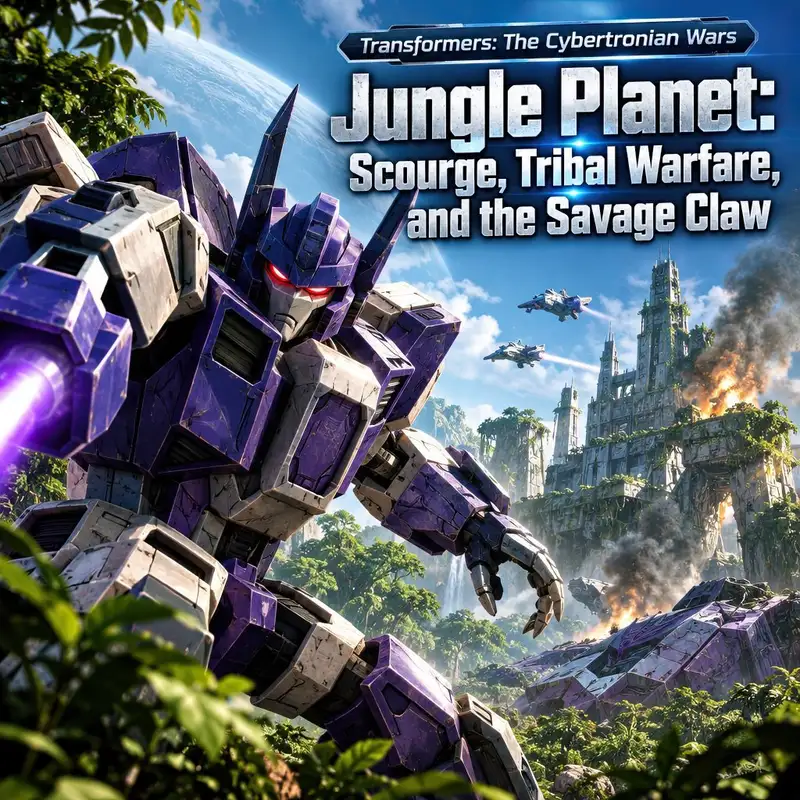
Jungle Planet: Scourge, Tribal Warfare, and the Savage Claw
Scourge had lost the contest for the Cyber Planet Key, and by the logic that had governed Jungle Planet under his rule, there was only one honorable conclusion left. He asked Optimus Prime to end his life. To Scourge, defeat was more than a military setback. It was the collapse of the claim that had made him ruler. If strength gave a warrior the right to command, then a stronger warrior had the right to take everything.
Optimus refused. That refusal was not sentimental. It was a challenge to the political order Scourge had built. Jungle Planet did not need another champion standing over the defeated. It needed defenders who could act together when the danger came from beyond any one warrior’s reach.
This is the Jungle Planet arc of the English-language Transformers: Cybertron series, released during the search for the Cyber Planet Keys. It is not the Beast Wars setting, and its Scourge is not the Decepticon commander from Generation One, the villain from Robots in Disguise, or the Terrorcon leader from Rise of the Beasts. The Japanese production used different names and framing. Here, the world is Jungle Planet, and Scourge is its dominant local warrior.
The phrase tribal warfare can be useful if handled carefully. Jungle Planet is not supplied with a detailed political map, census, constitution, or formal account of every community. It does show localized warrior communities, personal loyalties, apprenticeships, challenges for status, and a culture in which martial reputation carries political weight. That is enough to analyze a system of personal rule. It is not enough to invent an anthropology textbook for a children’s adventure series.
Scourge’s problem was not that he lacked strength. By every immediate measure available to his followers, he possessed an abundance of it. He could defeat challengers, intimidate opponents, and impose his will on a dangerous world. His failure was deeper. He built an order capable of producing obedience, but not cooperation. When Jungle Planet became part of a crisis involving worlds beyond its own forests and ravines, that distinction became decisive.
Jungle Planet rewarded local knowledge. Its terrain was more than scenic decoration around a string of duels. Dense vegetation limited visibility. Ravines and unstable ground broke up movement. Volcanic areas, storms, and hostile plant life created hazards for anyone who assumed that speed alone would solve a mobility problem. A force that knew the paths, the hiding places, and the dangerous approaches held an advantage over newcomers.
Beast modes mattered in that environment. They could offer traction, climbing ability, close pursuit, concealment among terrain that already appeared alive, and a physical presence suited to intimidation or ambush. A lion form did not make a warrior invincible, but it could make movement through Jungle Planet more natural and more dangerous for an enemy unfamiliar with the ground.
That local adaptation had limits. A beast-mode warrior might dominate a ravine, survive a pursuit, or strike from cover, yet still lack the means to coordinate a planetary defense. The series gives no reliable numbers for troop strength, no detailed evidence of a large industrial base, and no reason to imagine Scourge commanding a modern standing army with standardized logistics and permanent institutions. His power was personal before it was bureaucratic.
The distinction matters because personal power can be very effective at the tactical level. A ruler who is physically stronger than rivals can make decisions quickly. There is no committee to persuade, no staff process to delay an order, and no election to lose. In a small, fragmented warrior society, speed of decision can look like strength. But the same system becomes fragile when the ruler is absent, defeated, deceived, or confronted by threats that require distributed action.
Scourge ruled from a temple-like fortress, a visible center of his authority in a world where command was demonstrated as much as announced. Fighters such as Snarl and Undermine operated within his sphere. The show does not establish Undermine as a grand strategist or an independent political leader. He is better understood as one of the local fighters whose position depended on Scourge’s dominance.
The governing principle associated with Scourge was blunt. Might made right. That phrase did more than justify combat. It provided a political theory. The strong were entitled to command. The weak existed under the protection, tolerance, or exploitation of the strong. A challenge was more than a disagreement. It was a test of who deserved to stand above everyone else.
Such a system makes personal courage highly visible. It can even produce a recognizable warrior ethic. A fighter who meets an opponent openly, survives defeat, and continues to stand may earn respect. But respect for courage is not the same thing as justice, and it is not the same thing as durable public order. The weak do not become secure merely because the strong follow rules among themselves.
The series implies the social cost without supplying a catalog of atrocities. We do not need to invent slavery, mass imprisonment, or an elaborate police state to see the harm. Under Scourge’s rule, weaker inhabitants lived with intimidation and insecurity. Protection was conditional. A warrior’s safety depended on strength, proximity to power, or the favor of someone stronger. Those who could not fight on equal terms had little reason to believe the political order belonged to them.
Scourge’s command structure also had a built-in succession problem. His followers obeyed because he was Scourge. They did not appear bound to a durable office, an agreed law, or a shared strategic purpose independent of him. If he won, the system seemed validated. If he lost, everything depended on what the victor chose to do next. That is not institutional resilience. It is a permanent wager on the ruler’s ability to remain the strongest individual in the room.
Backstop represented a different idea of strength. He was an older Jungle Planet warrior, teacher, and moral counterweight to Scourge. The released story establishes that he had influenced Scourge in the past and later guided younger fighters, including Snarl and the stranded Autobot Overhaul. It does not fully document his earlier career, nor does it give us a complete history of his break with Scourge. What matters is the contrast the story makes clear.
For Backstop, strength carried responsibility. A capable warrior was not entitled to dominate everyone nearby. Strength created an obligation to protect those who could not protect themselves. That principle did not require weakness, passivity, or withdrawal from danger. Backstop was not arguing that combat skill had no value on Jungle Planet. He was arguing that combat skill became morally empty when it existed only to establish rank.
His alternative was not a conventional army waiting beyond the trees. Backstop did not command a clearly defined force with banners, depots, staff officers, and a known order of battle. His influence worked through mentorship, trust, memory, and personal relationships. That made his network less impressive at first glance than Scourge’s fortress-centered rule. It also made it more capable of creating loyalty that survived a single duel.
The contrast between Scourge and Backstop was more than one between force and peace. Both understood that Jungle Planet was dangerous. Both knew that fighters needed courage, skill, and the ability to endure hardship. Their disagreement concerned the purpose of power. Scourge saw power as proof of entitlement. Backstop saw it as a duty. One model produced submission. The other could produce mutual obligation.
That political divide became more urgent because Jungle Planet was no longer isolated. The wider crisis began with a black hole threatening the connected worlds of this version of the Transformers story. The Autobots sought the Cyber Planet Keys, ancient objects tied to the restoration of Primus and the effort to save those worlds. A Key on Jungle Planet was therefore not just a local prize or a ceremonial badge of authority.
The Key represented strategic access to a larger survival effort. Whoever controlled it could shape movement, influence the broader campaign, and decide whether Jungle Planet would participate in a collective response or remain trapped in its own internal struggles. Scourge initially understood the Key through the language he already knew. It was another symbol of strength, another object that could reinforce his claim to rule.
Megatron understood its wider value, but not in a way that respected Jungle Planet’s people. He and Starscream reached the planet ahead of the Autobots and looked at Scourge’s position as an opportunity. Megatron did not arrive to build a partnership with local warriors, improve their security, or help them create institutions capable of defending their world. He saw useful instruments. Scourge’s fighters could delay enemies, apply pressure, and help secure the Key.
That was an extractive approach to alliance. Megatron was willing to work with Scourge while Scourge remained useful. The local population did not need to be persuaded that the larger crisis mattered. They only needed to be maneuvered into serving Megatron’s immediate objective. This was not a treaty among equals. It was cooperation of convenience, shaped by deception and unequal information.
Scourge had reason to see opportunity as well. Outside support from powerful Decepticons could strengthen his standing against local opponents. A ruler whose legitimacy rests on personal dominance is always vulnerable to the appearance of weakness. Association with stronger external forces can seem like a way to deter challengers. But it also creates dependence. The ruler begins borrowing authority from outsiders whose interests he cannot control.
Megatron’s presence exposed the weakness in Scourge’s political worldview. If might alone determines right, then there is little basis for resisting a stronger visitor who demands access to the world’s most important resource. Scourge could resist only if he possessed enough personal power to do so. He had no broader political claim to mobilize the planet, no established structure of common defense, and no deep alliance built on shared interest.
The Autobots arrived with a different problem. They had a strategic objective, but they did not understand Jungle Planet well enough to pursue it cleanly. Their information was incomplete. The terrain was unfamiliar. Local customs were unclear. Scourge’s authority, Backstop’s influence, and the loyalties surrounding Snarl could not be understood simply by identifying who appeared strongest in a confrontation.
Overhaul paid the price for that lack of adaptation. Stranded on Jungle Planet after an operation went wrong, he became dependent on local assistance. Backstop rescued him and introduced him to the world’s internal conflict. Overhaul was an Autobot fighter, but he was not yet prepared to operate effectively in this environment. His instincts were individualistic. He expected that determination, speed, and firepower would be enough to establish his place.
Repeated encounters with Scourge proved otherwise. Overhaul challenged him and lost. These defeats were not just action scenes designed to establish a stronger villain. They showed why Scourge’s system still held credibility. In Jungle Planet’s political culture, a challenger who could not defeat the ruler had difficulty offering an alternative. Scourge’s victories reinforced the belief that authority belonged to the strongest warrior.
At the same time, Overhaul’s failures revealed a flaw in his own style. He fought as though defeating Scourge would settle the question. It would not. Even if he had won a duel, he still lacked local relationships, a shared political program, and an understanding of what Jungle Planet’s inhabitants needed beyond a new champion. He was attempting to solve a political problem with the narrowest possible military instrument.
Snarl became important precisely because he stood between worlds. He was associated with Scourge’s order, yet he retained ties to Backstop and responded to acts of courage and protection. He was more than a subordinate waiting to change sides because the plot required it. His position showed that even within an authoritarian warrior hierarchy, loyalties can be more complicated than a faction symbol.
The decisive change in Overhaul came when he acted not to prove himself, but to protect Snarl. In the struggle that followed, Overhaul was badly damaged. The moment matters because his transformation was tied to defense of another fighter rather than naked ambition. The Jungle Planet Cyber Planet Key responded, and Overhaul was reformatted into Leobreaker.
Leobreaker’s lion form made him more suited to the terrain and more formidable in combat. His Cyber Key abilities added to that change. But this was not a general rule of Cybertronian biology. The episode does not establish that any Cybertronian who touches a Key will acquire a locally appropriate beast form, nor that all reformatting works this way. It was a specific event, with specific consequences for one Autobot.
The military effect was immediate. Leobreaker had more mobility, greater presence, and a fighting style that fit Jungle Planet’s close terrain. He was no longer the outsider who had arrived with a form and method poorly suited to the environment. He had become a warrior who could operate on local terms. For Scourge, that made him a more credible rival.
But transformation did not settle Leobreaker’s deeper problem. Power had changed his capabilities faster than it changed his judgment. He had been humiliated by Scourge, and the new body gave him the means to seek revenge. That made him dangerous. It did not automatically make him reliable.
Leobreaker’s anger was understandable, but command cannot be built on understandable anger alone. A fighter driven by revenge may attack at the wrong time, disregard intelligence, ignore coordination, and turn a shared mission into a personal contest. The same traits that make such a warrior brave in close combat can make him a liability in coalition warfare.
That is what happened when Leobreaker disobeyed Optimus Prime and attacked Scourge without authorization. He had greater strength than Overhaul, but he still approached the conflict as a solitary challenger. Scourge defeated him again. The result demonstrated that raw capability and courage, although important, did not guarantee victory. Scourge remained the better fighter in that moment, on ground and under conditions he understood.
Scourge’s response also revealed something more complicated than simple cruelty. He began to respect Leobreaker’s willingness to rise after defeat and challenge him again. This was a real warrior ethic. Scourge could recognize courage in an opponent. Yet that ethic remained incomplete. Respect for a worthy rival does not protect weaker inhabitants, create trust among divided groups, or prepare a planet for an external invasion.
Leobreaker’s defeat should also be read as a command lesson for Optimus. Optimus could not treat local allies as pieces to be placed on a tactical board. He had to understand why they fought, what they feared, and what they needed to know. A leader may preserve operational security by withholding information, but secrecy can become self-defeating when it prevents potential partners from understanding the stakes.
Backstop’s account of Scourge’s past helped clarify the local conflict. Leobreaker’s own history, shared with Snarl, did something similar from the other side. These conversations did not produce a formal peace conference. They did, however, create the beginnings of shared understanding. The conflict was no longer only Scourge against a series of challengers. It became a choice between two models of strength.
Optimus adjusted the mission accordingly. He still needed the Cyber Planet Key. The black hole crisis had not become less urgent. But he recognized that a retrieval operation conducted over the heads of Jungle Planet’s inhabitants would remain fragile. The people living under Scourge’s rule needed to become informed participants in their own defense, not merely terrain guides for an Autobot mission.
That shift created a coalition rather than a simple assault force. Backstop brought local knowledge and moral authority. Snarl represented a connection to fighters inside Scourge’s sphere. Leobreaker brought adapted combat power, even if his anger still required discipline. Override, from Speed Planet, added support from beyond Jungle Planet. Lori, the human member of the group, brought a perspective that cut through assumptions Cybertronian warriors had learned to accept.
None of this amounted to a formal treaty among planetary governments. Lori did not represent Earth’s governments. Override did not arrive as the ambassador of a bureaucratic military alliance. Backstop did not suddenly become the commander of a regular army. The coalition was looser and more personal than that. Its strength came from combining what each participant knew and could do.
This kind of coalition is often less dramatic than a single decisive weapon. It requires explanation, patience, and the willingness to share authority. It can also be difficult to command. Partners may disagree about risk, timing, and objectives. Yet distributed cooperation creates options that personal rule cannot. Local fighters can guide action. Outside allies can provide mobility. Different groups can cover one another’s weaknesses.
Scourge’s model had no equivalent capacity. His followers could respond to his commands, but their relationship to one another was filtered through his dominance. They had not been encouraged to build mutual trust independent of him. In a crisis, that meant the whole structure depended on Scourge remaining physically and psychologically central to every important decision.
The final challenge for the Cyber Planet Key therefore mattered on more than one level. Optimus faced Scourge directly, while Decepticon interference complicated the wider situation. The contest remained personal because Scourge’s legitimacy was personal. He had made himself the center of Jungle Planet’s political order. To challenge the Key was to challenge his claim that he alone embodied strength.
Optimus did not meet Scourge as a simple outsider demanding submission. By this point, he had begun to build ties with people Scourge’s system had divided. He had learned that winning the Key without addressing the planet’s political condition would leave the mission vulnerable. He also had Leobreaker beside him, not as a subordinate tool, but as a local fighter whose growth had become central to the conflict.
Together, Optimus and Leobreaker formed Savage Claw Mode. This was a situational combination, not a permanent third individual and not evidence of a universal Cybertronian combination system. The series presents it as a specific link between two fighters. It should not be treated as though every Autobot could produce the same result through routine engineering.
Its military effect was obvious. Savage Claw gave Optimus and Leobreaker a combined capability that Scourge could not overcome in the decisive contest. But its symbolic importance was even greater. Optimus brought external command experience, a broader strategic purpose, and the responsibility of the Cyber Planet Key mission. Leobreaker brought the adaptation, courage, and local warrior identity shaped by Jungle Planet itself.
Savage Claw was powerful because it was not solitary. It was not one leader proving that he stood above everyone else. It was a partnership made physically visible. Scourge had built authority around the idea that one warrior must dominate. Savage Claw defeated him through an act of coordinated strength, joining different capabilities without erasing either participant.
That does not mean the combination alone solved the political problem. A stronger form can win a duel. It cannot, by itself, create legitimacy. The duel mattered because the coalition around Optimus had already exposed the limits of Scourge’s claim. Backstop’s teaching, Snarl’s divided loyalties, Leobreaker’s transformation through protection, and Optimus’s willingness to share the larger mission had all prepared the ground.
When Scourge asked Optimus to kill him, he was still thinking inside the old system. A defeated ruler had no place. If he could no longer stand above everyone else, then he believed his life had no political meaning. Optimus’s refusal denied that premise. Mercy did not erase Scourge’s record or excuse the insecurity he had imposed on weaker inhabitants. It simply rejected execution as the only imaginable outcome.
There was also a practical calculation. Killing Scourge might have removed a dangerous opponent, but it would not automatically have transformed his followers into partners. It could have created a martyr, triggered retaliation, or left Jungle Planet’s warrior communities even more fragmented. A ruler whose identity rests on strength can be defeated in combat. Changing the culture built around that ruler requires more than a final blow.
Lori’s intervention was important because she challenged Scourge in terms he could understand. Cooperation was not weakness. Accepting help did not mean abandoning honor. A warrior could stand beside others rather than above them. Coming from a human civilian ally, this point carried a useful distance from the established rivalries among Jungle Planet’s fighters. Lori was not competing for Scourge’s title.
The series handles Scourge’s change quickly, as family adventure storytelling often does. It would be inaccurate to describe what follows as a fully documented democratic transition, a constitutional settlement, or a comprehensive reckoning with his earlier rule. No detailed reform program is shown. We do not see laws written, offices created, or a new system of representation established across the planet.
What we do see is more modest, but still significant. Scourge begins to accept the value of allies. He shifts from isolated ruler toward cooperative defender. That is an attitudinal and political change, not a completed reconstruction. It opens a possibility. It does not prove that every consequence of personal warrior rule has been repaired.
The next confrontation with Megatron made that lesson practical. Megatron attempted to seize the Cyber Planet Key, treating Jungle Planet once again as an object to be exploited. This time, the response did not depend on Scourge standing alone at the center of the battlefield. The defenders used decoys, distributed action, tactical withdrawal, and mutual trust to complicate the Decepticon effort.
Those methods mattered because they recognized the difference between holding an object and controlling a situation. A Key could be carried, hidden, contested, or targeted. Its defenders needed information, mobility, and the ability to keep operating when one position became untenable. A force that knows only how to gather around its strongest fighter is easier to disrupt. A force that can disperse and reconnect is harder to break.
When Optimus was nearly defeated, the Matrix activated the Jungle Planet Key and opened a space bridge to Earth, bringing reinforcements. The moment is a reminder that strategic mobility can matter as much as individual combat power. The Key was more than an emblem of local supremacy. It linked Jungle Planet to routes of reinforcement and to the wider effort to survive the black hole crisis.
A space bridge does not remove every military problem. It still depends on access, timing, and a functioning endpoint. Reinforcements must arrive where they are needed and coordinate with those already fighting. But the opening of that route demonstrated a kind of power Scourge’s old system had never been designed to use. It was collective power, based on trust between worlds rather than domination within one community.
Scourge’s later participation in the defense against Galvatron confirms the direction of his change. Jungle Planet did not remain a sealed arena where warriors fought only for status. The larger crisis threatened multiple worlds through the space-bridge network. In that setting, Scourge could no longer define strength only as the ability to defeat the nearest challenger. Survival required cooperation among forces with different histories, forms, and interests.
There is a dry military lesson in all this. A ruler can spend years proving that he is the strongest creature in the jungle, only to discover that the decisive problem is a crisis large enough to require maps, allies, and someone willing to answer a call for help. Personal dominance has its uses. It is simply a poor substitute for strategy.
Jungle Planet’s story is not a rejection of courage or martial skill. Scourge, Backstop, Snarl, Leobreaker, and Optimus all demonstrate that courage matters. The question is what courage serves. Does it protect others, create trust, and make collective survival possible? Or does it merely decide who gets to stand at the top until the next challenger arrives?
Scourge’s defeat proves that strength alone cannot secure a world whose survival depends on trust, shared information, reinforcement, and mutual obligation. Savage Claw matters because it embodies a new kind of power on Jungle Planet: not one warrior standing above everyone else, but a local fighter and an outside commander choosing to fight as partners.