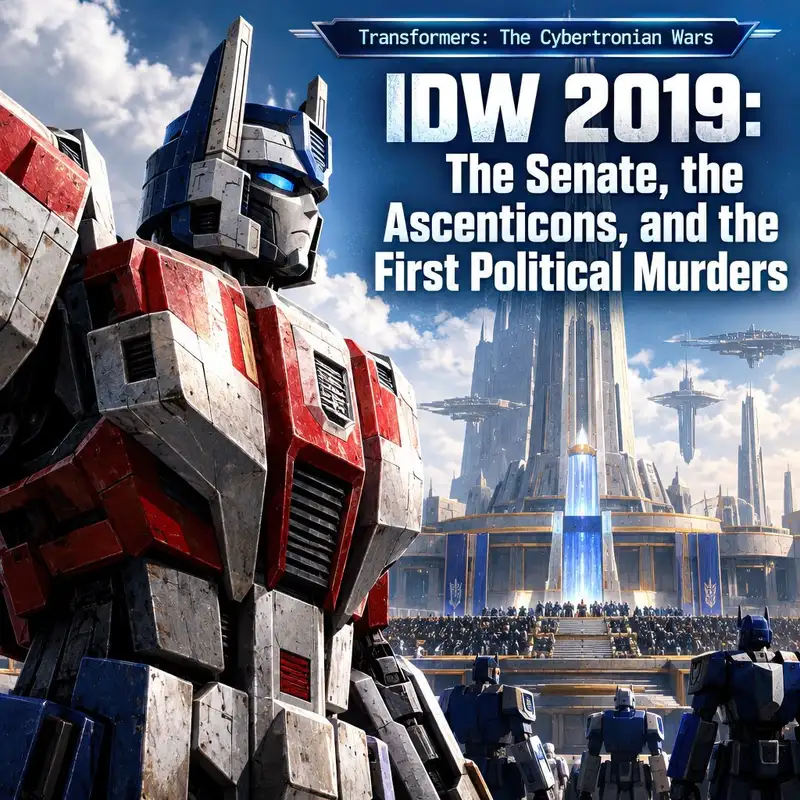
IDW 2019: The Senate, the Ascenticons, and the First Political Murders
Rubble had only recently entered Cybertronian society when he learned what political violence looked like. He traveled through the badlands with Bumblebee toward an Energon transmission station, a place built to move the fuel that sustained cities, industry, repair, and ordinary movement across Cybertron. Windblade joined them because the station’s equipment had begun to behave strangely. They expected a technical problem. They found Brainstorm dead.
In the 2019 I D W comic continuity, that discovery lands with unusual force. This Cybertron has known war before. The War of the Threefold Spark remained within living memory and political memory. But the present is publicly understood as an age of peace. Violence has not vanished from the planet, nor have old resentments, but murder is treated as something shocking enough to interrupt the assumptions of daily life.
Brainstorm’s death therefore matters before anyone knows who caused it. A body at an Energon station is more than a crime scene. It is a challenge to the idea that critical infrastructure, public space, and civilian life remain under reliable protection. The station stands at the intersection of energy, industry, and state authority. If someone can kill there, then the question is not only who died. It is who can still keep Cybertron safe.
Rubble’s presence sharpens that question. He is newly forged, still learning the habits and arguments of the society around him. He has no deep factional allegiance, no old score from the Threefold Spark conflict, and no established place in elite politics. His shock is not naïveté. It is evidence that a political system can teach its newest citizens what normal life is supposed to be, then fail to protect that promise.
Bumblebee and Windblade understand more of the danger than Rubble does, but even they do not yet understand its scale. Their immediate task is practical. Secure the station. Determine what failed. Identify who was present. Preserve whatever evidence has not already been disturbed. Yet every early answer is shaped by a larger problem. Cybertron is entering a period in which evidence will be interpreted through factional suspicion almost as quickly as it can be collected.
The governing institution at the center of that struggle is the Senate, led by Sentinel Prime. The Senate possesses legal authority, public legitimacy, and the machinery of a functioning state. It can direct Security Operations, authorize investigations, set policy, and speak in Cybertron’s name. But its formal powers do not mean that it commands public confidence without question. The political system is already under strain.
Senator Orion Pax sees that strain clearly. In this continuity, Orion is not yet the military and symbolic leader familiar from many other Transformers histories. He is a senator whose earlier life included work as an archivist. That background matters. Archivists deal in records, memory, and the difficult distinction between what happened and what institutions later claim happened. Orion’s politics are shaped by a belief that public order depends on evidence, restraint, and procedures that citizens can trust.
Megatron is also a senator, and he leads the Ascenticons. The Ascenticons are a legal political movement, not yet a conventional army. They draw support from Cybertronians who believe the Senate has become stagnant, complacent, and unable to respond to real dissatisfaction. Their movement offers change, momentum, and a more confrontational challenge to established authority. That appeal cannot be dismissed simply because later events become violent.
The record also makes clear that Orion and Megatron have a prior relationship. After the War of the Threefold Spark, they knew one another well enough for Orion to speak to Megatron with an access few other senators possess. That personal connection does not make them political partners. It makes their conflict more complicated. Orion can recognize Megatron’s intelligence and the frustrations behind his movement while fearing that the methods used around Ascenticon rallies are becoming coercive and unstable.
Megatron’s argument is built on dissatisfaction with the existing order. He presents the Ascenticons as a force against drift and institutional paralysis. The Senate, in his account, has preserved peace without addressing the grievances beneath it. That is a familiar political claim in postwar societies. Stability can look like recovery to those protected by it and like immobility to those excluded from its benefits or unconvinced by its promises.
Formal authority remains with the Senate. Practical influence is beginning to move elsewhere. It is moving toward rallies, symbols, street-level organization, security networks, and the ability to define public anger before institutional debate can absorb it. A parliament can pass resolutions. A mass movement can create pressure in real time. When the two no longer recognize each other as legitimate channels for political change, every incident becomes more combustible.
Brainstorm’s death forces that rivalry into the open. Chromia and Prowl of Security Operations arrive to take command of the investigation. Their work is immediately constrained by the character of the crime. This is not an ordinary society accustomed to frequent homicide, with established routines for handling witnesses, suspects, and public panic. Security Operations has the powers of a state security service, but it is confronting violence that carries political implications far beyond its technical expertise.
Early suspicion falls on The Rise. The Rise is associated with the wider Ascenticon political environment, but it is more than another name for the Ascenticons. It is a clandestine extremist organization with its own operational methods, hidden leadership, and willingness to use violence. The distinction matters because it is the distinction that begins to collapse under public pressure. Once a murder is linked, however tentatively, to a political movement, the question becomes whether the movement can separate itself from those acting in its shadow.
Chromia and Prowl have authority to investigate, but authority is not the same as attribution. They can secure a station. They cannot make incomplete evidence complete. They can identify suspicious networks. They cannot assume that every suspect shares a single command structure. They can act against a known threat. They cannot easily prove who authorized it, who merely knew of it, and who is exploiting it after the fact.
Orion recognizes that Megatron himself may be in danger. If Brainstorm’s murder is intended to inflame public anger, then a public Ascenticon rally offers an obvious target. Orion requests additional security for Megatron’s next appearance. It is an important decision. He is not endorsing Megatron’s politics. He is acknowledging a basic responsibility of government. Political opposition must be protected from assassination if political life is to remain something other than a contest among armed camps.
The rally confirms that the danger is no longer confined to a transmission station. Snipers attack Megatron and Soundwave. The attack has an immediate tactical purpose, whether the shooters intended to kill, intimidate, provoke retaliation, or all three. But its political purpose is larger. Violence against a public opposition leader can transform that leader’s standing. It creates sympathy, anger, fear, and a powerful argument that the state cannot or will not provide security.
Megatron responds by unveiling the Ascenticon Guard. This is presented as a counterterrorism force, a security organization meant to protect the movement and compensate for the failures of the Senate and Security Operations. In the narrowest sense, the decision is understandable. A movement whose leaders have been attacked will seek protection. But the creation of a private guard changes the political structure of the crisis.
A political movement now possesses an armed or security-oriented body operating beneath its own banner. It does not yet make the Ascenticons a full military force. There is no need to exaggerate the Guard into an instant army. Its importance lies elsewhere. It normalizes the idea that security should be provided by factional institutions rather than by public institutions accountable to the whole society.
Quake’s presence in the Guard alarms observers for good reason. He carries a violent reputation connected to the War of the Threefold Spark. In a postwar society, reputation is itself a kind of strategic resource. A figure known for violence can deter enemies and reassure hardliners, but he can also tell civilians and rivals what sort of methods a movement may tolerate. The Senate does not need proof of every future crime to understand why Quake’s involvement raises concern.
Megatron’s choice reveals a broader problem. He wants to present the Ascenticons as a legitimate force for change while using the language and personnel of security exceptionalism. He is attempting to occupy two positions at once. He is the elected senator demanding reform, and he is the leader building an institution prepared to operate when public institutions fail. That combination can be politically potent. It is also difficult to control.
Brainstorm’s funeral shows how quickly grief becomes a battlefield of legitimacy. Before the murder, Brainstorm was an individual with a life, colleagues, and a place in Cybertronian society. Afterward, he becomes a symbol. The Senate needs his death to demonstrate the seriousness of the threat. The Ascenticons need to avoid being collectively blamed for a killing they deny authorizing. The Rise benefits whenever fear and accusation widen the distance between institutions and citizens.
Cyclonus provides a fragment of testimony. He saw Brainstorm arrive at the Energon station shortly before the killing. It is useful, but incomplete. A witness can establish movement, timing, and proximity. A witness cannot necessarily identify the killer or explain motive. Still, in a crisis of attribution, every fragment acquires disproportionate political weight. Partial information is often the most dangerous kind because it can be used to support several incompatible stories.
The funeral is also shaped by a leadership problem. Sentinel Prime is off-world early in the crisis, leaving Orion with temporary responsibility. The arrangement is legal enough, but it exposes the fragility of succession under pressure. A state may have rules for who takes command. It may still struggle when the person acting in that role lacks the full authority, experience, or public recognition of the absent leader.
Orion must balance mourning, investigation, public order, and the rights of political opposition. He cannot allow a funeral to become an opportunity for violence. He also cannot turn it into a display of state control so heavy-handed that it confirms every accusation of Senate arrogance. This is the difficult ground between restraint and paralysis. A government that does too little appears weak. A government that does too much can manufacture the legitimacy crisis it fears.
The people present at the funeral are not one undifferentiated crowd. Some are sincere mourners. Some are friends or colleagues of Brainstorm. Some are Ascenticon activists. Some are political opponents who fear what the movement is becoming. Some are security personnel attempting to prevent disorder. Others are citizens who may have no settled allegiance but understand that a murder once treated as unimaginable has now entered public life.
The funeral therefore does not resolve the crisis. It turns it into a contest over who can speak for the dead and who can promise safety for the living. The Senate speaks the language of order and investigation. Megatron speaks the language of change and protection against a failing system. The Rise operates through secrecy and escalation. These positions are not equal, and they are not fully separate. Their interaction is what makes the situation dangerous.
The next killings expose the failure of that separation. Rubble encounters a Voin connected to Brainstorm’s murder. The Voin is more than a passing witness. The witness carries information that could clarify what happened at the transmission station and potentially identify those responsible. In a functioning security system, such a person would become a priority for protection, debriefing, and secure custody.
Instead, Quake kills the Voin. The act has immediate operational logic. It removes testimony. It warns others against cooperating. It demonstrates that the perpetrators or their allies can act faster than investigators can secure a witness. But the killing also has diplomatic consequences. The Voin is more than another Cybertronian casualty. The death affects Cybertron’s relationship with an outside people and proves that domestic political violence can generate international repercussions.
Rubble becomes an unintended witness to that killing. He is not a hardened investigator, a senator, or an armed operative. He is a newly forged Cybertronian in the wrong place at the worst possible time. His accidental contact with Prowl shows the desperate, fragile nature of the moment. Information is trying to reach Security Operations, but the chain is improvised, exposed, and too slow.
Quake kills Rubble as well. The method matters. Later examination identifies blunt-force trauma in the deaths of the Voin and Rubble. Brainstorm’s death involved different evidence, suggesting a different method and likely a different killer. The distinction prevents the investigation from collapsing three deaths into one neat story. Yet Rubble’s murder changes the moral temperature of the crisis even before the full forensic picture becomes clear.
Brainstorm’s death opens the political emergency. The Voin’s death destroys a potential source of testimony and creates diplomatic danger. Rubble’s death proves that violence is no longer confined to prominent figures, militant networks, or secret operations. A citizen barely introduced to the society around him has been killed because he saw too much. Political violence has reached someone politically peripheral, which is another way of saying it can now reach anyone.
Rubble’s death also reveals the civilian cost of factional politics. When leaders speak of security, reform, instability, and necessary action, the language can become abstract. A dead witness and a dead newly forged citizen make the consequences concrete. Someone had to fail to protect them. Someone chose to silence them. Someone else will now use their deaths to demand greater powers, harsher measures, or deeper loyalty.
The investigation advances through autopsies and forensic comparison. This is a turning point because it challenges the most convenient explanation. Brainstorm’s wounds suggest machinery. The Voin and Rubble died from blunt-force trauma. The available evidence indicates at least two different killers or killing methods. A single organization may still be involved. Several overlapping organizations may be involved. But the murders cannot responsibly be treated as one simple operation with one easily identified hand behind it.
That finding is politically inconvenient for nearly everyone. The Senate would prefer a clear threat it can pursue. The Ascenticons would prefer proof that the killings were entirely external to their movement. The Rise benefits from confusion but risks exposure if investigators become too precise. Citizens would prefer a story that tells them whom to fear. Instead, Cybertron receives a more troubling answer. The crisis involves multiple actors, compromised institutions, and overlapping agendas.
Other signs point toward organized clandestine infrastructure. Rise members disappear during the crackdown. Reports also note roughly two hundred missing Cybertronians, though that number does not establish that all are Rise operatives or even that all disappeared for the same reason. Political disorder produces many kinds of absence: flight, hiding, coercion, secret recruitment, detention, and simple fear. The evidence supports concern. It does not support invented precision.
The Rise is able to function because it does not depend on open rallies or public offices. It uses hidden movement, protected sites, safe houses, and access to resources. Stolen Energon becomes part of the picture. That matters because covert organizations require more than ideology. They need power, transport, maintenance, shelter, communications, and people able to move without attracting immediate attention.
The state’s information problem is made worse by insider access. Barricade, connected to Security Operations, becomes a rogue figure sheltered within the Ascenticon sphere. Records concerning Barricade and Quake are later found to have been purged. This is more than an administrative irregularity. Records are how an institution remembers who was warned about, who was investigated, who moved through its systems, and who had access to force.
The investigation follows these threads toward a bunker beneath Memorial Crater. The location is symbolically appropriate. A memorial is supposed to preserve public memory. A clandestine base beneath one suggests a more cynical use of the past. The Rise is not just hiding from the state. It is operating beneath the visible reminders of Cybertron’s previous violence, drawing energy from the unresolved legacy of war while preparing new forms of conflict.
Cyclonus warns of an impending offensive, and the confrontation around the bunker destroys much of the site and much of the evidence that might have clarified its full structure. This is a familiar intelligence failure in counterinsurgency and political policing. A raid can disrupt an organization while also destroying the documents, equipment, and captured personnel needed to understand it. Tactical action may succeed. Strategic understanding may remain incomplete.
The clearest view of the deeper arrangement comes when Megatron meets Shockwave. Shockwave leads The Rise, and the meeting reveals that the organization was more than a spontaneous eruption of grassroots extremism. It had a political purpose. Its operations were intended to inflame social tensions and create conditions in which Ascenticon support could expand. The strategy was destabilization in service of political gain.
Megatron insists that murder was not part of the agreed plan. That claim must be treated carefully. It does not establish his innocence in any broad moral sense. He has participated in a project designed to worsen public tension for the advantage of his movement. He has accepted a relationship with covert actors who operate beyond ordinary political accountability. But neither does the evidence establish that he personally ordered Brainstorm’s murder, the Voin’s murder, or Rubble’s murder.
The difference is important because it reveals the actual command problem. Megatron is the political leader. Soundwave provides security, communications, and intelligence support within the Ascenticon orbit. Shockwave directs The Rise’s clandestine violence according to his own operational logic. These are connected structures, but they are not identical. A leader can intend to use instability without controlling every operative who believes violence will serve the same cause.
Shockwave’s role shows the cold logic behind the Rise operation. Violence is not treated as a tragedy to be avoided, but as a variable to be managed. Social tension becomes an instrument. Fear becomes a resource. The problem with this approach is not just that it is cruel. It is strategically unstable. Human and Cybertronian societies do not respond to violence with mathematical predictability. Terror can create support, but it can also produce backlash, fractures, defections, and a demand for measures no conspirator can later contain.
Megatron is therefore not just an outsider discovering that radicals have misused his cause. His political project is entangled with their work. At the same time, he is not yet in full command of everything done in its name. This ambiguity is the hinge of the crisis. It allows him to deny direct responsibility while gaining from the weakening of the Senate. It also leaves him vulnerable to the forces he helped unleash.
The Senate’s response becomes increasingly coercive, though not consistently effective. Soundwave blocks Security Operations from entering Ascenticon headquarters while Barricade is sheltered there. This is a direct institutional confrontation. A political organization is using its own space, its personnel, and its security presence to limit a state investigation. The question is no longer only whether a crime occurred. It is whether the Senate can enforce its laws against a movement with growing public support and private protective capacity.
Sentinel Prime favors seizing Barricade by force. From a security perspective, the argument is easy to understand. A rogue operative linked to compromised records and clandestine violence cannot be allowed to remain beyond reach. Yet force against a political headquarters carries risk. It may capture a suspect. It may also transform that suspect into a symbol, provoke wider unrest, and validate claims that the Senate uses law as a weapon against opposition.
Orion attempts negotiation through Megatron. His decision reflects both principle and circumstance. He still believes that political channels must be used before force closes them. He also has personal access to Megatron that might produce a peaceful resolution. But personal trust cannot substitute for institutional guarantees. Megatron is no longer merely an old associate. He is the leader of a movement whose public and covert wings are becoming harder to distinguish.
The result is a violent jailbreak extraction. The Rise removes Barricade and other operatives from the immediate reach of Security Operations. Operationally, the action demonstrates mobility, planning, and a willingness to confront the state directly. Politically, it demonstrates that legal structures can shelter clandestine personnel long enough for a violent network to recover them. The boundary between political protection and operational complicity grows thinner.
At the same time, Cybertron faces another crisis involving the Thraal ambassador, Aovan refugees, and the Titan Lodestar. The details are distinct from the murder investigation, but the institutional response is revealing. The diplomatic incident is contained, yet the ambassador dies. Sentinel orders Nautica to keep the event secret. His reasoning may include fear of panic, diplomatic rupture, or further instability. The order nonetheless shows that the Senate’s response to violence is not transparency alone.
As the crisis deepens, Megatron’s political identity changes. He confronts Shockwave and moves to dissolve The Rise, then absorb its resources. This is not a clean break from clandestine violence. Megatron does not stand outside the organization and simply expose it. His relationship with Shockwave has been transactional from the beginning. What changes is control. He concludes that a covert apparatus operating according to Shockwave’s logic is too dangerous to remain independent.
Absorbing The Rise’s resources is a practical act of revolutionary consolidation. Networks, personnel, safe houses, intelligence, supplies, and operational experience do not disappear because an organization is formally dissolved. They can be redirected. Megatron’s move acknowledges that the political crisis has reached a point where parliamentary opposition alone is no longer sufficient for his ambitions. He needs command over the forces operating beyond the Senate’s rules.
The change in the Ascenticon flag is equally significant. Megatron alters it into the symbol associated with the future Decepticon movement. A symbol does not create an army overnight. It does not instantly produce unified command, industrial capacity, doctrine, or territorial control. But symbols organize identity. They tell supporters that they are no longer merely petitioning for reform inside an existing system. They are becoming a political body defined against that system.
Soundwave’s actions are central to this transition. He manages communications, blocks access, shelters Barricade, and participates in the removal of records that might expose the network. His role demonstrates that intelligence and administration are not peripheral to political violence. The ability to delete files, restrict entry, move information, and determine who knows what can be as valuable as direct battlefield force.
Barricade and Quake represent another side of the same process. Barricade’s position near Security Operations shows the value of insider access. Quake’s killings show the value, and danger, of a direct-action enforcer. Together, they reveal how a movement can exploit both official systems and clandestine coercion. Neither role alone creates a revolution. Combined with political mobilization and leadership, they can make lawful institutions increasingly unable to distinguish opposition from insurrection.
Sentinel responds with warrants for Shockwave, Sixshot, Frenzy, Barricade, Quake, and Soundwave. The warrants are an attempt to restore a line between legal politics and criminal conspiracy. They identify individuals rather than condemning every Ascenticon supporter. That difference is important. A government facing extremism must not make an entire political constituency legally identical to its most violent members. Yet the political reality is already moving faster than the legal categories meant to contain it.
The Senate later turns a debate into a sting operation aimed at capturing Soundwave and publicly denouncing the Ascenticon cause. This is a revealing moment. Legislative space, meant for argument and representation, becomes an instrument of security action. The choice may be defensible as a response to infiltration and obstruction. It also shows how deeply ordinary institutions have been militarized by distrust. Debate is no longer only debate. It is surveillance, entrapment, and a contest for public exposure.
Outside those chambers, unrest broadens. The comic presents anti-Autobot, anti-Decepticon, and anti-Rise actions, a sign that Cybertron’s citizens are not neatly divided into two future war camps. Some reject the Senate. Some fear Megatron’s movement. Some resent the violence of The Rise. Some simply want protection from all armed factions. This complexity matters because civil conflict often begins when the largest part of the population is not committed to any side, but is gradually forced to choose.
Voin warriors arrive seeking revenge for the death of their representative. Their presence demonstrates how quickly an internal security crisis can acquire external actors and external motives. The original murder was already more than a domestic crime. Now it threatens retaliation from beyond Cybertron’s political system. A state struggling to maintain order at home must also consider how its failures are interpreted by allies, visitors, refugees, and potential enemies.
Meanwhile, The Rise attacks an ancient Titan communications facility and awakens Vigilem. This is the clearest sign that the conflict is moving beyond murders, rallies, and police operations. The facility is more than another target. It provides access to dormant strategic infrastructure. A Titan is more than a large combat asset. It is a source of communications, mobility, power, and military potential that can alter the scale at which factions operate.
This is why the early murders matter so much in the 2019 I D W history. Brainstorm’s death did not create Cybertron’s divisions from nothing. The War of the Threefold Spark had already left a difficult inheritance. The Senate faced distrust. Megatron’s movement had already found support by naming stagnation and demanding change. The Rise had already found space in which to organize. The murder made those existing fractures impossible to ignore.
Rubble’s death and the Voin’s death changed the scale of the crisis. They showed that violence would not remain confined to elite politics, secret networks, or symbolic attacks. Witnesses could be eliminated. New citizens could be killed. Diplomatic relationships could be damaged. Every Cybertronian could now understand that factional conflict had become a threat to ordinary life, not just a dispute among senators.
The first political murders changed what politics could be on Cybertron. They converted disagreement into a struggle over security, truth, records, witnesses, and control of force. By the time Vigilem awakened, the planet had not yet crossed every threshold of open war. But it had already learned the habits that make war possible: private coercion, hidden command, compromised institutions, fear of testimony, and the belief that opponents must be defeated rather than persuaded.