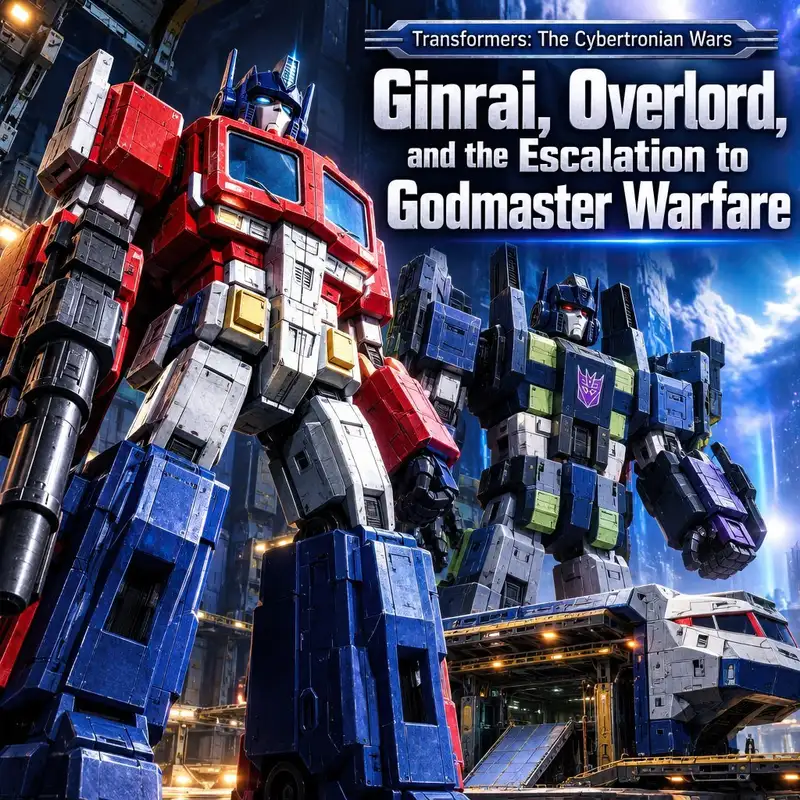
Ginrai, Overlord, and the Escalation to Godmaster Warfare
Hydra and Buster strike an oil refinery in a desert region, where a fire can become a weapon long before it becomes an industrial accident. The refinery matters not because Earth petroleum is established as a simple substitute for Cybertronian energon, but because refineries concentrate workers, fuel, machinery, transport routes, and opportunities for catastrophic damage. The attack forces the Autobots to respond under pressure. That is exactly what Giga and Mega want. Overlord is waiting for Ginrai, and the real objective is to separate the Autobot commander from Godbomber, his indispensable support system.
This is the war portrayed in the Japanese animated series Transformers: Super-God Masterforce, broadcast from nineteen eighty-eight into nineteen eighty-nine. It is a distinct branch of Japanese Generation One animation, and its central military question is unusually human. Ginrai is more than another version of Optimus Prime wearing a familiar truck-based body. He is a human being whose connection to a Transtector, a Cybertronian combat body, makes him a decisive Autobot leader. Overlord is likewise not the later comic-book character who shares his name. In Masterforce, he is the combined fighting form of two human-linked Decepticon leaders, Giga and Mega.
The refinery trap shows how far the conflict has moved beyond its earlier form. At the beginning, hidden beings exploited Earth through disguise, fear, isolated attacks, and the difficulty of determining who was responsible. By the time Overlord hunts Ginrai in the desert, the war has acquired elite formations, specialized support systems, hostage operations, strategic infrastructure targets, a race to field new capabilities, and a Decepticon plan to bring BlackZarak to Earth. The contest is no longer about whether hidden Cybertronians can act among humans. It is about which side can turn human beings, terrestrial infrastructure, and Cybertronian combat bodies into a functioning system of war.
That escalation was more than a matter of larger machines replacing smaller ones. Each new stage changed who could command, who could fight, what had to be protected, and what counted as a military vulnerability. The Godmaster system made human courage, judgment, loyalty, and physical presence part of combat power. A commander could no longer think only about weapons, armor, or the location of a base. He also had to consider the person linked to the machine, the conditions under which that person could be persuaded or coerced, and the moral legitimacy of asking civilians to become combatants.
The Masterforce conflict begins with a much quieter and more ambiguous form of warfare. Ancient Cybertronians known as Pretenders had come to Earth and concealed themselves within human society. The Autobot Pretenders adopted human disguises. Their Decepticon counterparts took forms closer to the monstrous figures of human fear. That distinction was not just decorative. It shaped the political conditions of the war. The Autobots could protect people while remaining concealed, but Decepticon attacks could be made to look irrational, supernatural, or impossible to attribute with confidence.
Metalhawk and the Autobot Pretenders form the first protective framework on Earth. They are not yet operating as the visible army of a declared planetary government. Their work is closer to an emergency defense force, intelligence network, and protective screen around a population that does not fully understand the danger around it. Their challenge is more than defeating an enemy in battle. It is identifying hidden Decepticons, limiting civilian harm, and preventing fear from becoming a weapon in its own right.
The Decepticons understand that uncertainty can be as useful as firepower. If civilians cannot tell whether an attack came from an alien enemy, an unstable human, or an apparent monster, public fear becomes difficult to direct and difficult to calm. The same uncertainty complicates Autobot operations. A concealed protector has limited ability to explain why it is present, demand cooperation from authorities, or openly organize defenses. Disguise offers access and survival, but it does not automatically produce legitimacy.
This early stage of the war also reveals a basic limit of the Pretender model. Hidden Cybertronians can start a conflict, conduct raids, and influence events from the shadows. They cannot easily maintain every rescue operation, secure every city, or establish political authority over a world that does not know what they are. Earth is not empty terrain. It is a populated planet with families, schools, workplaces, roads, emergency services, and institutions that have their own rhythms and vulnerabilities. The war becomes more dangerous when those ordinary systems are pulled into it.
The next transformation comes through the Headmaster Juniors. Shūta, Cab, and Minerva are human participants aligned with the Autobots. Their Decepticon counterparts include Cancer, Wilder, and Bullhorn, youths drawn into the opposing side after gaining access to Transtectors. These are not conventional soldiers recruited from a standing Cybertronian army. They are young people whose daily lives remain tied to human communities even as factional warfare gives them extraordinary combat roles.
That arrangement makes the early Masterforce conflict morally and operationally unstable. The human participants are more than passengers inside armored vehicles. Their choices affect missions, their emotions shape the use of power, and their loyalties can change the balance between rescue and destruction. Cybertronian veterans may bring experience, equipment, and knowledge of the enemy, but they do not fully control the people operating beside them. The chain of command crosses species, cultures, generations, and personal obligations.
For the Autobots, this creates a difficult form of responsibility. A rescue mission may require a Headmaster Junior to enter danger that an older Cybertronian cannot easily navigate. A human participant may recognize local conditions, speak to frightened civilians, or act with an initiative that a concealed alien force lacks. But human access comes with human vulnerability. These fighters have families, friends, schools, and ordinary lives that can be threatened. The Decepticons do not need to defeat them in open combat if they can manipulate their fears, isolate them, or convince them that the Autobots are responsible for the violence around them.
The Decepticon youths also demonstrate that recruitment is not the same as durable loyalty. They are not born as a separate species of enemy. They are human beings placed within a Decepticon military structure and offered power, status, or belonging under conditions of deception and pressure. That gives the conflict a different character from a simple invasion story. The Decepticons are not only attacking Earth. They are building a human-linked force on Earth, using the planet’s own people as part of their military system.
This is why rescue work remains strategically important throughout Masterforce. Protecting children, civilians, hostages, and critical facilities is not a sentimental side mission separate from the war. It is how the Autobots maintain trust, deny the Decepticons opportunities for coercion, and demonstrate what their command structure is for. In a conflict where humans can become the operators of decisive combat bodies, public confidence and personal loyalty are not secondary concerns. They are part of the available military power.
The Godmaster system intensifies that connection. In the series’ own terms, Godmaster power draws on cosmic energy, terrestrial energy, and the energy possessed by human beings. The exact mechanics are presented with the broad dramatic logic of the show rather than as a complete engineering manual. What matters historically is that the system joins a human being to a Transtector in a way that makes human agency central to the resulting combat capability. The human is more than driving a machine. The machine’s effectiveness depends on a living partnership.
That changes the meaning of military strength. In many Cybertronian wars, a new weapon can be treated as an object to capture, replicate, sabotage, or destroy. A Godmaster system cannot be understood only in those terms. It depends on a human operator whose courage, discipline, ambition, and emotional condition matter to the force as a whole. The body is not interchangeable hardware. It is a source of energy, decision, and identity.
The system also raises questions that neither faction can avoid. Who has the right to recruit a human into this kind of war? What happens when a person is pressured into a connection they do not fully understand? Can a commander demand sacrifice from someone whose life began outside the Cybertronian conflict? How much autonomy does the human retain when linked to a powerful combat body? Masterforce does not always pause to provide legal answers. It does, however, make the questions visible through its conflicts.
Ginrai becomes the clearest Autobot example of this new kind of authority. He begins as a human truck driver, not as an ancient Cybertronian officer, hereditary ruler, or established military commander. His involvement begins with the discovery of a mysterious truck and a connection to the wider conflict. The body he acquires is formidable, but the series does not treat that equipment as sufficient proof that he should lead. He must decide whether to accept the responsibility that comes with it.
That decision is made harder by Decepticon pressure on his civilian world. Ginrai’s associates are endangered. Attacks in populated areas produce destruction that can be blamed on him or associated with his presence. The Decepticons understand a problem familiar to any force operating in civilian terrain: if the public sees damage but cannot understand the enemy’s role, the defender may bear the political cost. Ginrai cannot simply win a fight. He has to protect people while facing an enemy that wants observers to see him as the source of disorder.
His authority therefore develops through conduct. Ginrai gains trust not because an ancient institution hands him an unquestioned title, but because he accepts danger on behalf of others and works within the Autobot team. He becomes valuable because he can act decisively while still recognizing that the people around him are not expendable scenery. That is a practical form of legitimacy. It is built under pressure, through repeated evidence that a leader will use power to protect rather than merely to dominate.
This does not make Ginrai flawless or magically solve the command problems around him. He is still learning a war that began before he understood its stakes. He depends on information from other Autobots, on support from human allies, and later on systems that he cannot personally build or maintain. But his rise matters because it establishes a different model of power from the Decepticon approach. Ginrai’s connection to his Transtector becomes credible because it is tied to responsibility. The body amplifies his agency, but it does not replace the need to earn confidence.
As Ginrai’s role grows, the Decepticons shift from dispersed attacks toward more concentrated combat power. The first major capability crisis arrives when Decepticon Pretenders seize children as hostages, capture an Autobot diver, and deploy King Poseidon, the combined warrior formed by the Seacons. This is a calculated escalation. The Decepticons combine coercion against civilians with a force strong enough to overwhelm the earlier rescue-oriented balance.
King Poseidon matters not because the series provides a reliable numerical measure of his strength, but because his arrival demonstrates that the existing Autobot force cannot safely meet every threat with its current organization. A combined warrior concentrates several Decepticon assets into one battlefield problem. It forces the Autobots to confront an enemy that cannot be handled through concealment, local intervention, or courage alone. The civilian hostages make an ordinary assault even more difficult. Firepower must be controlled, and time becomes an enemy.
Super Ginrai emerges in response to that crisis. His new form is not presented as a routine improvement for style or convenience. It answers a demonstrated gap in Autobot capability. The earlier Ginrai can protect and fight, but King Poseidon reveals that the Decepticons can create situations where the existing force lacks the power to rescue hostages and defeat the attacking formation. Super Ginrai gives the Autobots an elite defender capable of meeting that concentrated threat.
Tactically, this is a success. The Autobots regain the ability to contest a class of enemy that had threatened to break their response model. Strategically, it is only a partial answer. One exceptional fighter cannot dismantle a system built around raids, intimidation, hidden recruitment, hostage-taking, and selective concentration of force. Super Ginrai can win a crisis. He cannot by himself provide intelligence, secure every facility, protect every civilian, or prevent the Decepticons from choosing the next point of attack.
The Autobot answer has to become institutional. This is the significance of the Bomber Project. The project is more than an upgrade waiting politely in storage until the script requires it. It represents deliberate force development under wartime pressure. The Autobots recognize that Ginrai’s survival and effectiveness cannot rest forever on a single body configuration. They need a way to strengthen their premier Godmaster while preparing for the Decepticons’ next escalation.
Grand, an important figure in the Autobot space force, provides intelligence that helps initiate the effort. Lightfoot, Ranger, and Road King expand the Autobot Godmaster roster. Their arrival matters because the Autobots are no longer relying on one extraordinary human-linked combatant and a collection of improvised defenders. They are trying to build a broader force with specialized participants, shared responsibility, and the ability to protect the development of new capabilities.
The Bomber Project also exposes a truth often overlooked in stories of dramatic military transformation. Research and construction are vulnerable periods. Before a new system is complete, it requires time, technical skill, secure facilities, intelligence, transport, and protection. An unfinished capability cannot defend itself. The Decepticons understand this. Their attempts to eliminate the Godmasters individually are not random acts of villainy. They are efforts to prevent the Autobots from completing a program that could change the balance of power.
This is the point at which the war begins to resemble an arms race rather than a sequence of isolated emergencies. The Autobots are moving from reactive rescue toward organized industrial preparation. The Decepticons are trying to disrupt that preparation before it becomes operational. Neither side needs exact factory totals for the logic to be clear. A rare system that takes time and expertise to field is strategically significant because it cannot be replaced overnight.
Before the Bomber Project can stabilize the Autobot position, the Decepticons introduce Overlord. Giga and Mega are the human-linked Decepticon leaders associated with this new threat. Their Transtectors take the forms of a tank and an aircraft, giving their system a combination of ground assault and aerial reach. But the real significance lies not in a catalog of weapons or modes. It lies in the fact that two human operators and two combat bodies combine into a single Godmaster fighting form.
Overlord is therefore not a conventional soldier with a larger chassis. He is a concentrated command relationship. Giga and Mega remain relevant within the combined form because Overlord depends on their shared participation, coordination, and will. Their system turns dual human agency into a single battlefield asset. That makes Overlord an answer to Super Ginrai not only in force, but in design philosophy. If the Autobots have produced one human-linked champion, the Decepticons will create a paired system intended to surpass him.
When Overlord defeats Super Ginrai, the effect is larger than a personal loss. The Decepticons demonstrate that the Autobots’ premier field asset can be beaten. That undermines the assumption that Super Ginrai has solved the capability problem exposed by King Poseidon. A military organization built around a single exceptional defender is vulnerable when the enemy fields a counter designed specifically to defeat that defender.
Giga and Mega’s objective is not limited to prestige. They need Ginrai removed long enough to create room for a wider Decepticon plan, including the arrival of BlackZarak. This gives their rivalry with Ginrai an operational purpose. Overlord is a tool for opening time and space around Decepticon strategic buildup. The duel matters because it affects whether the Autobots can interfere with that buildup, not because the conflict has become a private contest detached from the war.
Overlord’s victory also reveals the risks of concentration. The Decepticons have created an extraordinarily capable system, but they have tied much of its political and military value to Giga and Mega. Their pride, judgment, and relationship are not minor details. They are part of the weapon system. A force based on intense personal control can react rapidly and strike hard, but it may also become rigid, vulnerable to internal disagreement, and dependent on leaders who confuse domination with strategy.
For Ginrai, defeat makes the Bomber Project an urgent requirement rather than a desirable improvement. The resulting system, Godbomber, allows the formation of God Ginrai. The importance of Godbomber lies in its role as support and enhancement. It gives Ginrai a new means of meeting the threat exposed by Overlord. Yet it also creates a new dependency. The Autobot commander is now more capable, but his effectiveness rests on a rare system that must be protected, maintained, and available at the critical moment.
The Moon operation shows how much the theater has widened. Decepticon forces seize a weather-observation base and take personnel hostage. The target is no longer a city street, school, or local industrial site. It is an installation beyond Earth, with strategic implications for observation, mobility, and control of a new operational environment. God Ginrai’s deployment to the Moon demonstrates that the conflict has acquired reach as well as intensity.
The hostages at the lunar base preserve an older pattern within the new scale of war. The Decepticons still use civilians and noncombatants to complicate the Autobot response. Even when the battlefield moves beyond Earth’s atmosphere, force cannot be applied without restraint. The Autobots must recover personnel, challenge elite Decepticon systems, and deal with BlackZarak without treating the base as empty terrain. The setting changes, but the political problem remains. Power that ignores those caught inside the conflict may win a strike and lose the purpose of intervention.
God Ginrai’s appearance may look, at first glance, like the end point of the arms race. In fact, it confirms the Decepticon argument that still larger assets are now relevant. If one side fields a rare integrated system capable of meeting Overlord, the other side has an incentive to protect BlackZarak, prepare new attacks, and force the Autobots into situations where Godbomber cannot support Ginrai. The contest becomes less about possession of a powerful body and more about the conditions under which that body can be used.
That brings the story back to the refinery. Hydra and Buster’s attack is more than destruction for its own sake. The strike uses critical infrastructure and civilian danger to pull Autobot forces toward a prepared engagement. Overlord waits for Ginrai in a setting where the Decepticons hope to isolate him from Godbomber. The operation combines diversion, terrain, timing, and an understanding of the Autobot command culture. Ginrai will respond to danger. That moral strength can be turned into a predictable operational pressure point.
The Decepticons repeatedly exploit fixed sites and vulnerable systems. Refineries, weather facilities, bases, and other infrastructure offer more than material targets. They create chokepoints in decision-making. The Autobots must defend them because civilian lives, communications, industrial activity, or strategic access are at stake. The Decepticons can choose when to threaten them, when to use them as bait, and when to turn rescue priorities against the defenders.
This is why the escalation in Masterforce should not be described only through body size or visual spectacle. BlackZarak changes the scale of the war because it becomes a strategic asset around which plans are organized. Its arrival requires preparation, protection, and the suppression of Ginrai. It can reshape the battle space without needing an exact measurement of its height or firepower. The key point is that the Decepticons now possess a capability large enough to alter what the Autobots must plan for, where they must deploy, and what risks they can accept.
At the same time, greater power makes command and identification more difficult. The Masterforce system ties factional warfare to human operators, Master Braces, Transtectors, and forms that can shift in meaning depending on who controls them. A symbol on a body is no longer sufficient proof of allegiance. The problem becomes explicit with Clouder, the final Godmaster, who possesses both Autobot and Decepticon Master Braces and can assume forms associated with both sides.
Clouder’s infiltration mission is a serious intelligence problem, not simply a clever disguise. If one individual can access competing systems, then the Autobots must ask how they authenticate personnel, verify orders, protect facilities, and distinguish apparent loyalty from actual loyalty. Conventional military organizations face similar dilemmas through stolen credentials, double agents, compromised communications, and false identities. Masterforce makes the issue more intimate. The disputed object is not only a code or uniform. It is a human-linked combat identity.
The Decepticons’ ability to send Clouder into the Autobot environment demonstrates the limits of a war built on visible factional forms. The Autobots cannot rely only on recognition. They need judgment, relationships, procedures, and evidence of intent. Yet those safeguards are difficult to maintain under wartime urgency, especially when an enemy can create crises that demand rapid response. A system designed for rescue is often vulnerable to the person who appears to need rescuing.
The conflict reaches its final phase when the Autobots locate the Decepticon base and launch a full attack. This is an attempt to move from defense and disruption toward the destruction of the enemy’s central position. It is a logical operational goal. A base can hold command systems, personnel, equipment, communications, and the infrastructure supporting larger threats. But attacking a fortified center is not the same as ending the political structure behind it.
Devil Z reveals the deeper danger of the Decepticon hierarchy by fusing with BlackZarak and using overwhelming power to disrupt the Autobot assault. The attacking Autobots are trapped inside the base. The exact metaphysical and mechanical nature of Devil Z is less important here than the command reality it exposes. Decepticon power has become concentrated in an authority that does more than direct forces. It seeks to dominate the bodies and systems beneath it.
This is the culmination of the war’s escalation. The conflict began with concealed actors moving through human society. It became a struggle over human-linked combat bodies. It then became an arms race in which Ginrai, Overlord, Godbomber, and BlackZarak were increasingly important. Under Devil Z, the logic of control becomes total. The hierarchy wants not only obedience, but possession. It treats human agency, Transtector bodies, and military power as things to absorb and command.
That approach generates immense force, but it also creates a political weakness. A hierarchy built around domination cannot easily sustain independent judgment. It demands compliance even from those whose initiative makes the Godmaster system effective. The very human will that provides energy and combat power becomes dangerous to a ruler who cannot tolerate autonomy. Devil Z can command fear, but fear is not the same as loyalty. It can immobilize a force, but it cannot reliably make that force choose sacrifice for a shared purpose.
The final confrontation between Ginrai and Overlord makes this contradiction personal. After Ginrai defeats the renewed Darkwings, he permits the other Autobots to advance while he faces Overlord alone. On the surface, it is another duel between the two principal Godmaster rivals. Operationally, it is a decision to hold a dangerous enemy in place while the larger mission continues. Ginrai understands that the war cannot be won merely by defeating Overlord if Devil Z’s larger system remains intact.
Overlord, however, refuses to use weapons. He chooses hand-to-hand combat to demonstrate the strength of the human body within the Godmaster system. This is more than a matter of honor in the abstract. It is an assertion of pride. Giga and Mega have invested their identity in proving that their human-linked force can surpass Ginrai through direct strength. Their doctrine has become personal. The contest is no longer only about what Overlord can achieve for Decepticon strategy, but about what Overlord must prove about himself.
Ginrai responds differently. He does not treat Overlord as a malfunctioning machine that must simply be broken. He tries to persuade him. That attempt is politically significant. Ginrai recognizes that Overlord’s human core is still capable of judgment, even after the destruction Overlord has helped cause. Persuasion does not erase responsibility for earlier Decepticon operations. It does not turn Giga and Mega into innocent victims. But it acknowledges the central fact of Masterforce warfare: these systems depend on people who can still choose.
Devil Z’s betrayal and domination of his own forces finally expose the limits of Decepticon command. The authority that promised strength through control reveals that it sees even its greatest warriors as instruments to be consumed. Overlord’s eventual opposition matters because it breaks the assumption that a powerful body must remain loyal to the hierarchy that armed it. The Decepticon system has produced force, but not durable allegiance.
After Devil Z is destroyed, the surviving Masterforce bodies become independent Transformer life forms. This is one of the most consequential changes in the series, though it should be understood within this continuity alone. It never establishes that every Transtector in every Transformers story was always secretly alive, nor does it provide a universal rule for Cybertronian personhood. In Masterforce, it marks the end of a relationship in which bodies had been treated primarily as vessels for human-linked military power.
That transformation also gives the war a final moral consequence. The struggle began with hidden Cybertronians operating among humans and ended with forms of life that had been bound into a system of conflict gaining independent existence. The war does more than leave damaged bases and defeated enemies. It changes the status of the beings who carried it. A body once treated as equipment becomes someone whose autonomy has to be recognized.
Ginrai’s later fate in Transformers Victory briefly confirms that these changes endure beyond the immediate conflict. After being damaged beyond repair while protecting Star Saber, God Ginrai is rebuilt as Victory Leo. That later event belongs to another chapter of the Japanese animated continuity, not to the main campaign examined here. Its relevance is narrower. Masterforce established that bodies, identities, and command roles could be transformed by war in ways that did not end when the final enemy was defeated.
The escalation of Godmaster warfare was never just an escalation toward larger combat forms. It made the human body, human judgment, and human allegiance part of the battlefield’s decisive infrastructure. Ginrai’s rise showed that authority could be earned through protection, responsibility, and the willingness to use extraordinary power without forgetting who it was meant to defend. Overlord showed that deeper integration could also serve coercion, pride, and a cycle of escalation that made every victory demand a greater answer. Devil Z’s defeat proved that a hierarchy built on possession of bodies and power could generate immense force, but it could not create lasting control over the people and lives it tried to command.