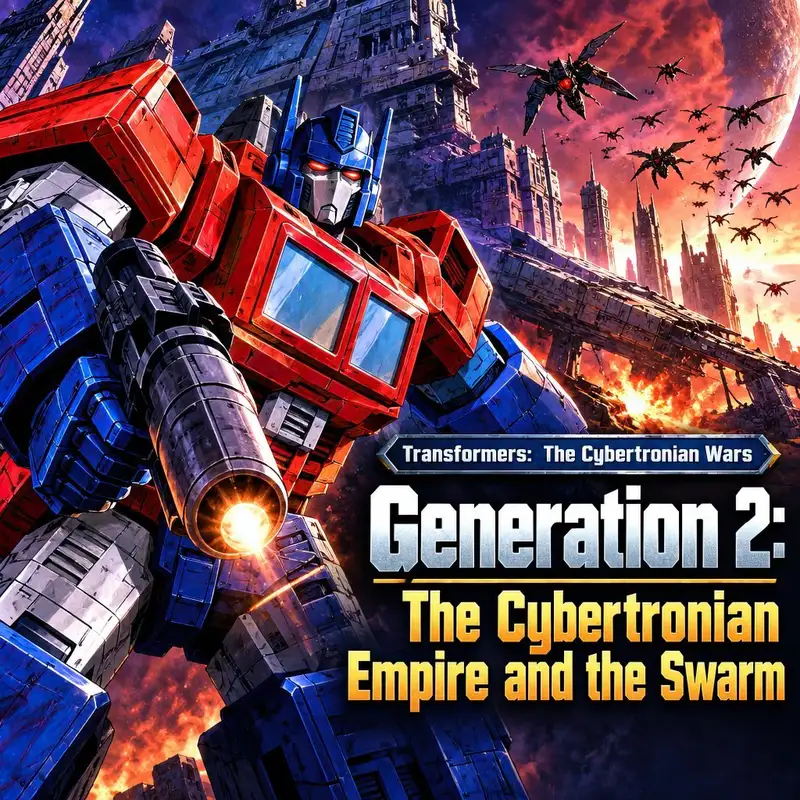
Generation 2: The Cybertronian Empire and the Swarm [Marvel]
Imperial ships were dying in a way their commanders had not prepared to understand. The danger did not arrive as a rival fleet with recognizable weapons, a Decepticon raid, or an Autobot counteroffensive. It came as a spreading black mass that enveloped Cybertronian bodies, ships, and equipment, consuming the very material on which an interstellar war depended. Jhiaxus, the Imperial commander at the center of the crisis, possessed warships, advanced technology, and the confidence of a force that had already remade worlds. None of that mattered if he could not identify the enemy destroying his command.
His first instinct was not to revise his assumptions. He treated the Swarm as deception, an Autobot weapon, or another move in the older conflict that he considered beneath him. That mistake was more than a battlefield error. It exposed the political weakness inside the Empire’s impressive military machinery. A command structure can survive losses. It can survive surprise. What it cannot easily survive is a leader who has made correct information politically unacceptable.
This is Marvel’s Generation Two comic history, published in the early nineteen nineties as a continuation of the American Marvel Transformers story. It is not the future of the Generation One cartoon, and it is not the later history of I D W, Beast Wars, or any other branch that reused these names. Its twelve issues take a familiar civil war between Autobots and Decepticons and place it inside a much larger strategic picture.
At first, the older combatants assume they are returning to familiar business. Optimus Prime leads the Autobots. The Decepticons remain divided, shaped by their own internal rivalries and by the return of Megatron. Megatron had been missing from the old war and reappears in a rebuilt body after the preceding Marvel G I Joe crossover. His return is not just cosmetic. It restores a commander whose authority, ambition, and hatred had long organized Decepticon politics.
That return immediately destabilizes the Decepticon side. Bludgeon and other existing leaders cannot simply continue as if Megatron had never vanished. Megatron, meanwhile, does not return as a humbled veteran interested in coalition government. He returns expecting to reclaim influence and restore Decepticon primacy. In another story, that might have been enough to restart the old war in full.
Generation Two instead asks whether that war still matters as much as its veterans think it does. The answer is uncomfortable. To Jhiaxus and the Cybertronian Empire, Autobots and Decepticons look like survivors of an old provincial struggle. They remain dangerous as individual soldiers and commanders, but they do not control the wider map. They are fighting over the ruins of a political order that a newer expansionist power has already moved beyond.
That does not mean the Empire has transcended conflict. It means it has replaced civil war with conquest. Its power rests on fleets, mobile infrastructure, a growing Cybertronian population, and the ability to alter worlds themselves. The Empire does not just seize territory. It transforms territory so thoroughly that the territory becomes fit for its own civilization and hostile to those who lived there before.
The K-Tor Cluster reveals the scale of that ambition. Grimlock and the Autobots encounter planets that are being cyberformed, reshaped into versions of Cybertron. The process is not presented as simple settlement or engineering assistance. It is strategic colonization. A world is stripped of its previous ecological and social character and reorganized for Cybertronian use.
Cyberforming changes more than a landscape. It changes energy systems, infrastructure, habitability, and the future political ownership of a planet. An occupying power that controls a capital city can still face resistance in rural areas, industrial districts, orbital space, or other continents. A power that remakes the planet itself is trying to eliminate the conditions under which an alternative society can endure.
For the Empire, organic life is not treated as a population with rights, interests, or an independent claim to survival. It is an obstacle, a contaminant, or raw material standing in the way of expansion. That distinction matters. Civilian deaths in this campaign are not just collateral damage from indiscriminate military operations. The removal of non-Cybertronian life is built into the strategic project.
The Empire’s ideology is therefore revealed through its logistics. It needs worlds capable of sustaining its population, industry, and mobility. Cyberforming provides those worlds. But the system also assumes that every existing society can be erased or subordinated in the name of a larger Cybertronian future. The Empire calls itself advanced because it has escaped the old Autobot-Decepticon divide. Its conduct shows that it has escaped restraint instead.
Jhiaxus embodies this doctrine in the field. He is not necessarily the whole Empire, and the comic does not provide a complete map of its government or military structure. But he commands an expeditionary force whose purpose is unmistakable. His mission is expansion through transformation, and his authority rests on the assumption that lesser life forms have no standing against that mission.
The old war had been brutal, but it was also political. Autobots and Decepticons fought over authority, survival, ideology, and control of Cybertronian society. The Empire’s campaign is colder. It does not need to persuade the inhabitants of a target world. It does not need to absorb them into its institutions. It can simply remove them and build a new environment over the remains.
That confidence depends on a particular account of Cybertronian reproduction. In this comic, the process called budding was rediscovered after Optimus Prime and Megatron had been lost aboard the Ark. Budding allowed Cybertronians to expand their numbers rapidly. In practical terms, it offered a solution to the old military problem of replacement. A civilization that can produce more of its own kind can replace losses, populate new worlds, and sustain expansion.
But the comic gives that achievement a darker meaning. The descendants produced through budding are described as lacking, or at least possessing less of, the moral and emotional qualities associated with the older Transformers. That account should be treated carefully. It is this story’s explanation for this generation and this Empire. It is not a universal rule of Cybertronian biology, and it should not be projected onto every version of Transformers history.
Even within Generation Two, the claim carries political weight as much as biological weight. It explains why the newer Cybertronians regard attachment, memory, and restraint as weaknesses. The older Autobots and Decepticons carry the scars of civil war, personal loyalty, rivalry, and moral obligation. The Imperial generation presents itself as freed from those burdens.
Yet freedom from attachment can also mean freedom from responsibility. If a population is created for expansion, taught that worlds exist to be remade, and separated from emotional ties to those it displaces, then reproduction becomes part of imperial doctrine. Budding is not only a way to create new Cybertronians. It is a way to create a social order capable of continuing the Empire’s growth.
Every act of budding, however, leaves behind a black by-product. At first, it is treated as waste. That decision contains the central irony of the series. The Empire can plan fleets, colonization, population growth, and planetary transformation. It cannot be bothered to understand what its own reproductive system discards.
The black residue becomes the Swarm. The comic establishes that the Swarm emerges from the by-product of budding, drifts through space, and consumes metallic Cybertronian life and material. Beyond that, much remains uncertain. The Swarm behaves with devastating force, but the story does not fully establish its consciousness, motive, or final nature. It should not be reduced to a conventional army with a command structure, political program, or clearly stated objective.
What matters militarily is its effect. At close range, the Swarm can overwhelm individual Cybertronians and destroy ships. Armor, weapons, and rank offer little comfort when the threat does not behave like an opponent that can be flanked, intimidated, or negotiated with. A combat force designed to defeat other armed formations finds itself facing a danger for which ordinary firepower may not provide an answer.
In operational terms, the Swarm threatens mobility. Fleets carry troops, supplies, equipment, intelligence, and the capacity to evacuate. When ships are consumed, armies lose more than weapons platforms. They lose transport, reinforcement, repair capacity, and the ability to withdraw from a failing campaign. A force can hold a battlefield and still be strategically finished if it cannot move its survivors or sustain them.
At the highest level, the Swarm turns the Empire’s strengths against it. The Empire expands through Cybertronian population, metallic infrastructure, and interstellar transport. Those same concentrations become targets. The more territory it cyberforms, the more ships it deploys, and the more Cybertronians it produces, the larger the system exposed to the consequence of budding.
The threat is also industrial. The Swarm is more than an enemy discovered beyond the frontier: it is the uncontrolled result of the Empire’s own expansion process. That makes it harder to solve through a normal military victory. Destroying an enemy fleet can end a campaign. Destroying the consequence of one’s own reproduction and industrial growth requires understanding the system that created it.
Before that truth becomes clear, the old factions continue to reach for familiar solutions. Optimus Prime tries to establish contact with Jhiaxus and limit open conflict long enough to understand what the Imperial force represents. He recognizes that the arrival of the Empire has changed the situation, but recognition is not the same as complete intelligence.
Prime uses the Matrix to connect with Cybertron and seek information about the newer Cybertronians. The Matrix offers access to knowledge and moral authority in this Marvel continuity, but it is not an all-purpose intelligence service. Prime receives part of the truth. He learns enough to understand that the Empire’s origins and psychology differ from those of the older Transformers. He does not receive a complete operational manual for defeating the Swarm.
That incomplete knowledge matters. Commanders rarely choose between perfect options. They choose under uncertainty, often with fragments of information arriving too late. Prime understands that the crisis is larger than an Autobot-Decepticon confrontation, but he cannot yet define the threat well enough to build a stable response.
His command also has limits. Grimlock and the Dinobots are powerful combat assets, but power and discipline are not the same thing. Grimlock launches an unauthorized attack on Jhiaxus’s flagship, the Twilight. The decision reflects a familiar military temptation. A visible enemy command ship appears to offer a decisive target, and an aggressive commander believes speed and violence can compensate for uncertainty.
The attack fails. The Autobots are captured, and the operation demonstrates the cost of independent action without sufficient intelligence, coordination, or extraction planning. A strike against an enemy flagship can be strategically valuable. It can also become a trap if the attacker does not know what defenses, reserves, or political consequences await inside.
Grimlock’s failure is not evidence that the Dinobots lack courage or battlefield value. It is evidence that a coalition cannot rely on personal prestige alone. Optimus has moral authority and nominal command, but he cannot fully control every subordinate commander. In a dispersed war, that gap between formal authority and practical control can be as dangerous as an enemy weapon.
Megatron sees the Imperial crisis through a different lens. He has returned to a fractured Decepticon movement and wants to demonstrate that he remains the force capable of restoring its power. An alliance with Optimus Prime would acknowledge that the Decepticons cannot solve the problem on their own. At first, Megatron is unwilling to make that admission.
When Prime proposes cooperation, Megatron takes the Matrix and attempts to confront the Empire independently. His choice is not difficult to understand. He has built his authority on independence, strength, and refusal to submit to Autobot leadership. Accepting Prime’s terms would weaken his position inside the Decepticon camp, especially when his return has already unsettled existing loyalties.
But ambition is not a substitute for strategy. Megatron’s advance force is destroyed in the K-Tor Cluster. Skullgrin returns mortally damaged, carrying the evidence of a failed Decepticon attempt to challenge the Empire alone. The defeat is not a moral awakening. Megatron does not suddenly abandon his history, his ambitions, or his hostility toward Prime.
It is a strategic reassessment. The Empire’s reach, resources, and organized force are too great for a renewed Decepticon war of restoration. The Decepticons understand how to fight Autobots. They understand raids, intimidation, internal rivalry, and struggles for military supremacy. They are less prepared to confront an expanding interstellar system that treats both old factions as relics.
That realization creates the conditions for cooperation. It does not create trust. Megatron joins a temporary alliance because the alternative is destruction. Prime accepts Decepticon assistance because refusing it would leave the Autobots isolated against a threat neither side can manage alone. Survival becomes more important than the old division, at least for the duration of the emergency.
The campaign on Ethos makes that necessity unmistakable. Imperial forces continue their cyberforming project, and the cost falls on the world’s existing life. The Autobots fight to stop the transformation and protect those threatened by it. They suffer serious losses, including Smokescreen and Inferno. The comic never provides a reliable total of dead, damaged, captured, or recoverable personnel, but it makes the scale of the losses clear enough.
Ethos is important because it shows what is at stake beyond Cybertronian factional pride. The Autobots are not just defending a strategic position. They are resisting a process that destroys non-Transformer life in order to create another Imperial world. The battle has a military objective, but it also has a civilian and moral dimension.
The Decepticons arrive as reinforcements under pressure. Their intervention helps prevent the Imperial campaign from becoming a simple extermination operation. Tactically, the alliance allows forces that once targeted one another to direct fire against a common enemy. Operationally, it provides more combat power, more mobility, and more options for responding to Imperial attacks.
Strategically, the alliance acknowledges a shared interest in survival. The Empire’s expansion threatens Autobots and Decepticons alike because it does not recognize their older political conflict as legitimate or meaningful. Both factions are obstacles to be eliminated, absorbed, or rendered irrelevant.
Politically, however, almost nothing has been settled. There is no shared constitution. There is no amnesty process for former enemies. There is no agreed chain of command that permanently combines Autobot and Decepticon forces. There is no mechanism for deciding what happens after the Imperial crisis ends, or for addressing the long record of war between the two factions.
The alliance is therefore a battlefield arrangement, not a peace settlement. Its members can coordinate under fire while still holding incompatible visions of authority. Prime seeks to preserve life and prevent conquest. Megatron seeks survival, influence, and the restoration of Decepticon power on terms he can still shape. Grimlock remains difficult to contain. Other actors pursue their own interests altogether.
Starscream is the clearest example of that instability. He betrays Jhiaxus and gains access to the Warworld, a massive mobile asset of enormous potential military value. The Warworld represents concentrated power: weapons, mobility, protection, and the ability to affect a campaign across great distances. Yet no platform, however formidable, can solve the problem of political purpose.
Starscream’s relationship to the Matrix complicates his role. The Matrix influences him, awakening or imposing an impulse toward the preservation of life. This is not best understood as a simple conversion from selfishness to virtue. The story presents an unusual conflict inside Starscream between established ambition and the moral force associated with the Matrix.
That distinction matters because the change is neither entirely voluntary nor clearly permanent. Starscream remains Starscream. He has not become a reliable statesman, an Autobot, or a settled ally. His altered behavior demonstrates the Matrix’s effect on an individual under extraordinary circumstances. It does not prove that personal ambition can be cured by contact with a sacred object.
The Warworld also demonstrates a broader lesson. Strategic infrastructure is only as useful as the judgment directing it. A powerful mobile fortress can dominate a battle, but it still depends on accurate information, political legitimacy, maintenance, command discipline, and an objective that makes sense. Without those things, it becomes another prize in a struggle among competing personalities.
Jhiaxus responds to mounting pressure in the opposite way. Rather than reconsider the intelligence coming from the field, he escalates coercion. His forces attack San Francisco, killing large numbers of human civilians in an effort to punish or manipulate Optimus Prime. The destruction is not incidental spectacle. It is an act of political violence aimed at forcing a military opponent to submit.
The attack reveals the Empire’s anti-organic ideology in its most direct form. Human civilians are not treated as neutral people caught between alien armies. They are treated as expendable leverage. Their deaths are meant to influence Prime because Jhiaxus assumes that compassion is a weakness to be exploited rather than a principle that defines an enemy’s political identity.
This is also where the difference between technological sophistication and political maturity becomes impossible to ignore. The Empire can cross systems, cyberform worlds, and deploy advanced warships. But its commander uses mass civilian destruction as a substitute for strategic understanding. Such violence can terrorize populations. It can also harden resistance, expose the nature of the regime, and destroy any claim that the Empire represents a superior order.
Jhiaxus’s command climate worsens the problem. He suppresses disagreement and punishes subordinates who question him. That may create immediate obedience, but it removes the feedback a commander needs when reality changes. Officers who fear the consequences of delivering bad news begin to conceal, soften, or delay it. The commander then becomes increasingly dependent on his own assumptions.
The Swarm punishes that failure. Jhiaxus continues to interpret it through the framework of the old war, treating it as an Autobot deception or weapon rather than confronting the possibility that the danger comes from within the Imperial system itself. His fleets can destroy targets. They cannot defeat an enemy they refuse to recognize.
When the Swarm reaches Earth’s sector, the war changes again. The immediate question is no longer how to defeat the Empire or settle the Autobot-Decepticon conflict. It is how to keep anyone alive long enough to understand and withstand the approaching catastrophe. The surviving forces establish a defensive position on Earth, where civilian survival, military protection, and limited resources become inseparable.
Megatron makes a contribution that is strategically important without making him redeemed. He brings rheanimum, a rare gas mined on Tykos, the moon of E’Brutoc. The material offers protection against the Swarm in the immediate crisis. Its value lies not just in its unusual properties, but in the fact that it has been acquired, transported, and made available at the moment when ordinary defenses are failing.
Rheanimum should not be read as ordinary energon, standard armor, or a universal invulnerability system. The comic establishes its immediate defensive use, not a complete doctrine for mass production or permanent protection. Its presence solves a specific survival problem. It does not remove the need for command, planning, or a deeper answer to the Swarm’s existence.
The logistics are the point. A rare resource has little strategic value if it remains in a mine, aboard a lost ship, or under the control of a faction unwilling to share it. Megatron’s decision to bring rheanimum to the combined force shows how existential danger can compel practical cooperation. It does not erase the history that made such cooperation unlikely in the first place.
Optimus Prime then makes the decisive choice. He refuses the protection offered to others and allows the Swarm to consume him. This is not ordinary battlefield sacrifice in the sense of holding a line or absorbing enemy fire. Prime enters the threat because he believes the Matrix may allow him to reach it at a level that weapons and armor cannot.
The outcome is one of the comic’s singular metaphysical events. Through the Matrix, Prime transfers a life-giving moral force into the Swarm. The confrontation transforms the immediate crisis, and Prime is reconstituted afterward. The event saves those facing destruction, but it should not be simplified into routine healing, standard resurrection, or proof that the Matrix can solve any future war.
The Matrix works here because the story places Prime, the Swarm, and the accumulated moral meaning of the Matrix in a unique relationship. The intervention is extraordinary precisely because it cannot be understood as only a repeatable industrial process. It answers a crisis created by an industrial civilization that had lost its moral attachment to life.
Prime’s act also provides the episode’s sharpest contrast. The Empire treats life as material for expansion. The Swarm is born from what the Empire discards. Prime confronts it not by asserting ownership or superior firepower, but by extending the Matrix’s capacity for life and connection. The gesture is powerful, but it does not rebuild institutions, reconcile factions, or erase the damage already done.
The final pages make that limitation clear. Jhiaxus and his expedition are not the whole Empire. Rook reports to Liege Maximo, an authority who remains distant from the immediate catastrophe and unconcerned by the losses already suffered. The comic establishes Liege Maximo as a larger imperial presence, but it never provides a complete genealogy, cosmology, or final account of his power. Later interpretations do not control this story.
What matters is the perspective. Jhiaxus’s defeat does not mean the imperial system has vanished. The destruction of ships and the collapse of one commander’s campaign do not equal the defeat of an interstellar order. The old Autobot-Decepticon war has been interrupted by a larger danger, but it has not been politically resolved. Megatron survives. Prime survives. Their temporary cooperation remains new and fragile.
Generation Two ends with deliberate incompleteness. The Empire remains a threat, the older factions remain divided, and Earth has survived an immediate catastrophe without receiving anything like a durable peace. What the series does settle is the nature of the danger. The Empire has moved beyond the old Autobot-Decepticon categories by embracing expansion without restraint, memory, or moral attachment, and the Swarm reveals the cost of that system in physical form.
Optimus Prime's intervention saves those in immediate danger, while Megatron's cooperation shows that survival can temporarily override even the oldest factional hatred. Liege Maximo's final presence prevents that cooperation from being mistaken for resolution. The crisis ends as a reprieve. The Swarm is not merely an external enemy defeated at the frontier. It is the consequence of a civilization that treated life as expendable material, and its appearance leaves the Empire facing a warning it can no longer dismiss: what a society discards in the name of expansion may eventually return as the force that consumes it.