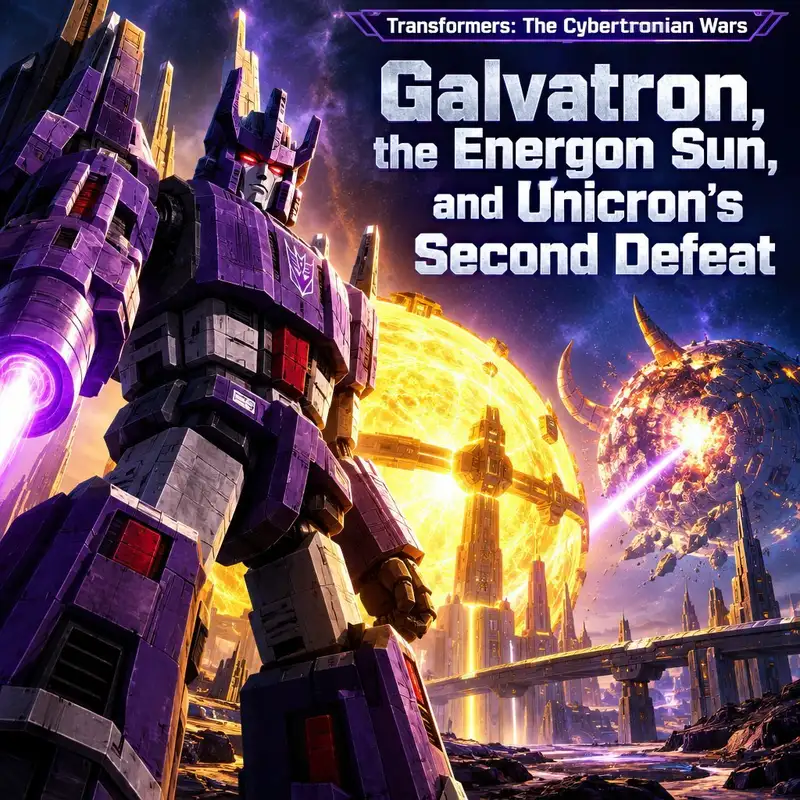
Galvatron, the Energon Sun, and Unicron’s Second Defeat
Cybertron moves through space under Galvatron’s command. In the final campaign of the English-language Transformers: Energon story, the planet is no longer only a homeland, a capital, or a battered industrial center. It has become a maneuvering asset. Galvatron turns Cybertron’s Energon Grid toward Alpha Q’s restored worlds, carrying with it factories, defenses, transport networks, military forces, and an entire population whose survival depends on the same system he is exploiting. It is an extraordinary display of power. It is also a warning that Galvatron’s authority is not as secure as it appears.
His objective is larger than defeating Optimus Prime in battle. Galvatron seeks control of the restored worlds, of the energy that sustains them, and of the surviving power associated with Unicron. He has access to Super Energon, command over Decepticon forces, and influence over Cybertron’s planetary infrastructure. Yet the movement of Cybertron reveals the campaign’s central contradiction. Galvatron seems to be commanding the greatest strategic position available to either faction, but the will driving him toward Unicron may not entirely be his own.
That problem begins with an earlier victory that did not end the war. About a decade after the Unicron conflict depicted in Armada, Autobots, humans, and former Decepticons are attempting an unstable peace built around Energon development. The old factional divide has not vanished, but cooperation is possible in places where shared infrastructure, mining, and defense make it necessary. It is a fragile arrangement. Energon is fuel, industrial power, and a strategic commodity. Whoever controls its production and distribution can shape not only military operations, but ordinary life.
Alpha Q enters this unstable order with a purpose that is neither simply Autobot nor Decepticon. He seeks to restore worlds destroyed by Unicron. To do that, he uses Terrorcons to gather Energon and works through the wreckage left behind by Unicron’s earlier defeat. His campaign is rooted in reconstruction. Worlds consumed by Unicron are not abstract losses. They are homes, political communities, sources of labor and memory, and potential places of refuge for those who survived their destruction.
Megatron returns from Unicron’s remains during this struggle. His return changes Alpha Q’s recovery project into a renewed war. Megatron does not see Unicron’s remnants as evidence that the old catastrophe must never be repeated. He sees opportunity. The remains of a cosmic destroyer offer energy, intimidation, and access to a force that can reshape the balance between Autobots and Decepticons. The calculation is understandable in a narrow military sense. A commander who can seize such power might reverse years of battlefield pressure. But it mistakes possession for control.
The Autobots and Alpha Q eventually force Unicron’s head into the body through the interaction of opposing Energon forces. The event produces a spatial rupture. On the far side, worlds once destroyed by Unicron are restored. The energy radiating from Unicron’s separated head becomes an Energon Sun, providing the renewed worlds with the power needed to endure. The result matters because the war’s central resource is briefly redirected away from conquest. Energy becomes the basis for recovery rather than an instrument of destruction.
This first Energon Sun is more than a spectacular aftereffect of battle. It is reconstruction infrastructure on a cosmic scale. Restored worlds require continuing energy, stable conditions, and time to rebuild societies that have endured annihilation and displacement. Their survival cannot be measured only by whether an enemy has been defeated. A planet restored without power, security, transport, or political stability would remain only a battlefield with a new surface.
The destruction of Unicron’s visible form, however, does not eliminate every danger associated with him. The body can be damaged. The head can be separated. The immediate military threat can be reduced. But Energon never treats Unicron as a conventional weapon platform that becomes harmless once broken apart. A surviving consciousness remains active within the conflict. That distinction becomes decisive. An enemy who can no longer dominate through direct physical force may still dominate through influence, possession, and the ambitions of those who believe they can use him.
Megatron sees the restored worlds as a new reservoir of power. Where Alpha Q sees populations returning from destruction, Megatron sees resources that can support renewed conquest. It is a strategic choice with political consequences. A commander can seize an energy source, but he cannot build a durable order simply by treating every inhabited world as a supply depot. The restored populations need stability. Megatron needs submission. Those goals are not compatible.
His methods make that conflict plain. Megatron uses coercion and mental control to secure obedience from subordinates, including Scorponok. He attempts similar domination over Inferno. This is more than a personal cruelty or a convenient battlefield tactic. It reveals the structure of Megatron’s command. Rather than build a coalition capable of surviving disagreement, he increasingly relies on compulsion. Such systems can produce immediate obedience. They are much less reliable when conditions change, communications fail, or followers decide that the leader’s survival no longer serves their own.
Inferno’s resistance exposes the limit. Even under intense pressure, he resists Megatron’s control, and his sacrifice disrupts the effort to turn willpower itself into a military resource. Inferno’s death does not solve the war. It does show that coercion has costs beyond the immediate moral injury. A force held together by fear may be formidable in combat, but it is vulnerable to defection, sabotage, and refusal. Commanders who remove every space for independent judgment often discover that they have also removed the capacity for resilient action.
The Autobots’ response is built around a different kind of power. Their Energon Towers help distribute and manage energy across the restored worlds. They are more than defensive structures or glowing landmarks. They represent a long-term commitment to sustaining populations, linking worlds, and maintaining a system that can function after the immediate battle ends. The towers can be attacked, disrupted, or exploited. That vulnerability is real. But infrastructure has a political meaning. It creates relationships of support rather than only chains of command.
Megatron’s approach transforms energy into a tool of extraction. The Autobots’ approach tries to make energy the basis of recovery. Neither side is operating in a world free from military necessity. The Autobots still fight, defend installations, and use force to prevent disaster. But the contrast is important. One strategy depends on concentrating power around a leader. The other depends on keeping a wider network alive. In a war shaped by Energon, the side that can sustain repair and cooperation may possess a deeper advantage than the side that can seize the largest stockpile.
The conflict escalates when Unicron regains enough capability to stop being only a ruined source of power. He reclaims his head. Alpha Q is killed in the process. His death removes one of the figures most committed to the restored worlds as an independent political project. It also demonstrates the danger of treating Unicron’s remains as manageable salvage. Alpha Q had reasons to use the remnants. His worlds needed restoration. But the attempt to turn devastation into recovery remained dependent on a force that had not been fully neutralized.
Shockblast then attempts to take control of Unicron. It is one of the clearest failures of judgment in the final campaign. Shockblast has access. He has ambition. He believes that proximity to immense power can become authority over it. But Unicron is not a passive engine waiting for a new operator. His surviving consciousness overwhelms Shockblast. The lesson is simple and severe. Capturing a system does not mean understanding it. Understanding it does not mean controlling it. And control over a weapon is meaningless if the weapon is still making decisions of its own.
Unicron’s importance now lies not only in raw destructive capacity. He operates as a hostile intelligence inside the political and military system around him. He can exploit hunger for power, personal resentment, factional ambition, and the desire to end a war through one decisive advantage. A conventional commander must maintain supply lines, persuade subordinates, transmit orders, and protect a headquarters. Unicron can bypass many of those requirements by making the commander himself into the contested terrain.
Optimus Prime and the Autobots confront Unicron directly only through extraordinary means. Primus empowers Optimus, and Optimus combines with Omega Supreme to form Optimus Supreme. That combined form allows him to engage Unicron at the scale required by the battle. The event is decisive, but it should not be mistaken for normal Autobot doctrine. This is not an industrially reproducible weapons program. It is an exceptional response to an exceptional threat, made possible by conditions that cannot simply be ordered into existence.
The destruction of Unicron’s body removes the most visible military danger. It prevents Unicron from operating as an intact planetary destroyer. Yet the victory remains incomplete because Unicron’s surviving consciousness persists within Megatron. The war has moved from the destruction of a body to the struggle over a mind, or perhaps over the boundary between one will and another. That is the point at which Megatron’s transformation into Galvatron must be understood. It is not a clean promotion, an ordinary reformatting, or simply a larger body with greater firepower.
Drawn by Unicron’s influence, Megatron travels to a subterranean reservoir of Super Energon beneath Cybertron. There he emerges as Galvatron. Super Energon is treated as a distinct and exceptional resource. It does not function merely as ordinary Energon with a more dramatic appearance. It enables transformations of capability that ordinary military infrastructure cannot easily match. It changes Galvatron’s physical power, but its greater significance is strategic. It connects him to Cybertron’s deeper energy systems and to the surviving force that seeks a path back to embodiment.
Galvatron’s rise gives him authority at several levels. Tactically, he becomes a more dangerous combatant. In direct battle, his enhanced form can challenge opponents who previously might have contained Megatron. Operationally, he gains access to the systems that make Cybertron function as a planetary network. Energy grids, towers, transport routes, and deep reserves become part of his campaign. Politically, his transformation gives him symbolic dominance over a Decepticon movement already accustomed to measuring authority through strength.
That symbolism matters, but it is not the same as legitimacy. Galvatron can impress allies and frighten opponents. He can gather Decepticon forces around his new power. He can bring Terrorcons and combiner assets into his orbit. But a faction organized around the exceptional strength of one leader has no reliable answer to the question of what happens when that leader is compromised. Galvatron’s followers may obey him because he is powerful. They do not possess a stable political system capable of checking him, replacing him, or even identifying when his decisions no longer originate with him.
The ancient combiner guardians around the Super Energon reservoir sharpen that division. Bruticus Maximus and Constructicon Maximus align with Galvatron. Superion Maximus supports the Autobots. These combinations add major military weight to both sides, but they also show that the conflict is no longer being decided by individual fighters alone. The struggle involves linked systems of power, ancient assets, and factions competing for access to strategic terrain. A combiner can dominate a battlefield. It cannot, by itself, answer the political question of what the battlefield is for.
Galvatron believes he has taken Unicron’s power for himself. That belief is central to his failure. The relationship runs in the opposite direction. Unicron is using Galvatron’s ambition, body, and authority as a route back to action. Galvatron’s desire for conquest and Unicron’s desire for renewal overlap often enough to make the possession difficult to recognize. Both seek power. Both seek access to Super Energon. Both are drawn toward the restored worlds. But they do not share the same ultimate purpose.
Galvatron still thinks like a Decepticon war leader. He wants control of Cybertron and superiority over Optimus Prime. Unicron’s surviving consciousness seeks survival and reunion. It wants a host body, access to the spark or essence that remains available to it, and the chance to restore its own destructive agency. Galvatron’s power therefore grows at the same time that his autonomy erodes. Every new advantage tightens the link between commander and parasite.
His use of Cybertron’s Energon Grid makes this clear. By moving Cybertron toward the restored worlds, Galvatron weaponizes geography. A planet is not a conventional warship, but in this campaign it becomes a mobile base of operations. It carries energy infrastructure, industrial capacity, military forces, communications, and a population. It can alter the strategic situation simply by arriving where it could not previously be. The movement of Cybertron threatens to bring a vast concentration of power into the region sustained by the Energon Sun.
The operational significance is immense. Galvatron is more than launching an expedition. He is attempting to move the entire center of his war effort. If successful, he can place Cybertron close to the worlds whose energy he wants to control. He can turn proximity into pressure. Restored populations would face not only raids or isolated Decepticon attacks, but the arrival of the industrial and military core of a hostile regime. For Alpha Q’s worlds, this is not an abstract celestial event. It is the approach of occupation.
Yet moving Cybertron does not eliminate dependency. A planet in motion still depends on the systems that make movement possible. The Energon Grid must function. Towers must remain active. Energy must be distributed. Damage must be repaired. Personnel must reach affected sites. A commander who treats infrastructure as a background feature will discover, usually at the worst possible moment, that it is the actual battlefield.
Damage to the Energon Towers releases dangerous Energon gas across Cybertron. The immediate tactical effect is to restrict Autobot operations. Ordinary forces cannot simply advance through hazardous conditions without consequence. The gas turns terrain, atmosphere, and energy distribution into obstacles. It disrupts movement and complicates repair. The Autobot response cannot be limited to firing at Galvatron. The grid itself must be restored before wider operations can succeed.
The operational effect is broader. A damaged Energon system interrupts the ability to coordinate defense, sustain mobility, and preserve safe working conditions. Cybertron’s movement toward the restored worlds becomes more difficult to oppose because those trying to stop it are also trying to keep the planet from becoming uninhabitable. This is one of the harsh realities of civil war. The infrastructure required to resist a hostile leader may also be the infrastructure that keeps civilians alive.
The strategic effect reaches beyond Cybertron. If Galvatron can keep the planet moving while the Energon system remains compromised, he can bring the conflict closer to the restored worlds before the Autobots can stabilize their own base. The civilian effect is just as important. A damaged planetary grid places ordinary Cybertronians inside the battle whether they support Galvatron, Optimus, neither faction, or simply want access to safe energy and repair facilities. When a power network becomes a weapon, the population attached to that network becomes hostage to the campaign.
Kicker and the Omnicons become indispensable during this crisis. Their role is not glamorous in the conventional sense. They do not resolve the campaign by defeating Galvatron in a single duel. They work with the Energon systems that other personnel cannot safely manage under the same conditions. Kicker’s ability to sense Energon and the Omnicons’ specialized handling of it allow them to operate where conventional Autobot action is restricted. They help repair the grid and restore the conditions under which the larger defense can continue.
Their contribution demonstrates the difference between battlefield power and war-winning capability. Galvatron can grow stronger through Super Energon. Optimus can confront him through exceptional combined strength. But neither outcome matters if the underlying systems fail. A military coalition requires scouts, engineers, specialists, transport, repair crews, and personnel able to work in hazardous environments. The Energon Grid campaign is won not only by those who can strike the enemy, but by those who can keep the planet functioning long enough for a strategic choice to remain possible.
At this point, Galvatron’s model of command begins to show its weakness. He can seize control. He can concentrate force. He can exploit fear and personal loyalty. But his campaign depends on a system he is damaging while using it. He treats Cybertron as a weapon, yet Cybertron is also a society. It contains infrastructure that must be maintained, a population that must survive, and a political order that cannot be held together forever through emergency power.
The Decepticons under Galvatron retain significant military capability. Enhanced Terrorcons and combiner allies can impose costs on the Autobots. Galvatron’s own power creates a powerful center of gravity. But the faction’s unity is increasingly personal and coercive. It rests on Galvatron’s ability to command, intimidate, and remain physically dominant. That would be a fragile arrangement even if he were acting entirely on his own judgment. With Unicron influencing his decisions, it becomes a command system with an internal breach at its center.
Galvatron cannot reliably separate his own ambition from Unicron’s survival drive. The distinction matters because a commander must understand his objective before he can organize forces around it. Is Cybertron moving to secure the restored worlds? To harvest their energy? To revive Unicron? To defeat Optimus Prime? Galvatron’s actions point toward all of these aims, but their relationship is increasingly incoherent. The result is tactical aggression without stable political direction.
The Autobot coalition is imperfect, and perfection is not required for it to function. Its strength lies in institutional redundancy rather than moral perfection. Optimus provides leadership. Omega Supreme provides exceptional force. Combiner allies provide additional battlefield capacity. Kicker and the Omnicons contribute specialized Energon support. Engineers and defenders maintain the grid. The coalition can absorb disruption because its members perform different roles toward a shared objective. It is harder to paralyze a force that does not depend on one body, one reserve, or one compromised mind.
Galvatron’s repeated immersion in Super Energon narrows the conflict further. Each immersion increases his physical scale and makes him more formidable in direct combat. The visual spectacle is considerable, but the military meaning is more limited than it first appears. Greater size allows Galvatron to confront Optimus at a new level of force. It does not repair Cybertron’s damaged systems. It does not create loyal institutions. It does not resolve the threat to the restored worlds. And it does not free him from Unicron.
Optimus is enlarged for the final confrontation as well. The duel between them becomes enormous, but it remains the visible surface of a distributed campaign. The Autobots can engage Galvatron only because others have defended infrastructure, restored grid functions, managed Energon hazards, and preserved access to the resources needed for resistance. Giant combat may decide the immediate contest between leaders. It cannot explain the survival of a civilization without the smaller, less visible work happening around it.
Optimus manages to separate or drain Unicron’s influence from Galvatron. For a moment, Galvatron is free enough to recognize the scale of the threat within him. This is not a permanent cure. It is a temporary opening. But it reveals that Galvatron is more than a passive puppet. His identity has been compromised, not erased beyond all possibility of action. The tragedy is that he reaches this clarity only after the campaign he has led has brought Cybertron and the restored worlds to the edge of catastrophe.
Unicron reasserts possession. This is the decisive failure of Galvatron’s earlier strategy. He has accumulated Super Energon, strategic access, military forces, and control over Cybertron’s movement. Yet he cannot secure command of himself. He becomes both commander and battlefield. His body is an asset sought by two opposing wills. The final conflict cannot be solved simply by shooting harder, building a larger weapon, or capturing another tower. Unicron’s remaining advantage is intimate access to Galvatron’s body and decisions.
The Autobots answer with the Sparks of Combination. They combine their sparks with Optimus, restoring or empowering him for the last phase of the confrontation. This is an extraordinary act of collective trust and sacrifice. It should not be treated as a standard battlefield procedure available to every Autobot unit. The conditions are exceptional, and the act carries risks precisely because it involves identity, agency, and the transfer of power between individuals.
Its political meaning is as important as its military effect. Galvatron’s power has concentrated around a single leader who is increasingly unable to distinguish his own will from Unicron’s. The Autobots respond by sharing capability. Their answer is not that one individual must become stronger than every other individual. It is that a coalition can temporarily place part of its strength in a leader while retaining the moral significance of consent and common purpose.
That does not make the process simple or easily repeatable. The combination of sparks is not an industrial weapon system. It cannot be placed into a production schedule, shipped through a supply network, or issued to every field commander. The Autobots are relying on a singular act because the crisis itself is singular. That dependence is dangerous, but it is also more honest than Galvatron’s belief that Super Energon can solve every problem if enough of it is concentrated in one body.
Primus then shapes Super Energon into the basis of a new sun. Again, this must be understood as an extraordinary intervention, not a routine technology. No one is opening a factory for replacement suns. No military planner can reasonably assume that such an event will be available after the next defeat. But in this moment, the energy Galvatron sought to monopolize is redirected toward a different purpose. It becomes a source of continuing life for worlds that Unicron had once destroyed.
The strategic reversal is profound. Galvatron treats energy as the means to dominate Cybertron and resurrect overwhelming force. The new sun transforms that same field of struggle into an instrument of survival. The restored worlds no longer stand only as prizes to be conquered or reservoirs to be drained. They become the intended beneficiaries of the energy released by the conflict. The finale therefore does not end with destruction alone. It makes reconstruction part of the victory.
That reconstruction is what raises the stakes of Galvatron’s final decision. If Unicron can keep using him as a host, the war may continue regardless of which body has been destroyed or which battle has been won. Galvatron’s existence becomes the route through which Unicron can return to active power. He cannot defeat that threat by retaining command over it. He has already learned that the belief in personal mastery was the mechanism through which Unicron gained access to him.
Galvatron regains control long enough to act. He plunges himself into the Energon Sun. The act is self-destruction. It is also resistance to possession, denial of a strategic asset to the enemy, and a final contribution to the life-sustaining outcome that he had previously tried to exploit for conquest. He chooses to remove the host body Unicron needs. In military terms, he denies the enemy access to the most important platform remaining in the conflict: himself.
The tactical result is immediate. Unicron loses an active host. Galvatron’s body can no longer serve as the vessel through which the surviving consciousness resumes direct action. The operational result is equally important. Galvatron’s command collapses. The immediate threat to the restored worlds loses its central force, and Cybertron’s attempted use as a moving instrument of conquest can no longer be sustained by his personal authority.
The strategic result is not that every future danger disappears from the wider franchise. This is not a universal conclusion for every version of Unicron, every Galvatron, or every Cybertronian war. Within the Energon conflict, however, Unicron’s return through Galvatron is prevented. The campaign that began with the effort to seize energy for domination ends with the denial of that energy to the force that would consume worlds.
The political result is severe for the Decepticons. Galvatron’s rule depended heavily on his exceptional power. He had not built a durable governing order that could survive without him. His disappearance leaves the faction without the center that had imposed unity through force. That does not mean every Decepticon immediately changes belief, abandons the war, or accepts Autobot leadership. It does mean that a system organized around one dominant commander loses the source of its cohesion when that commander is gone.
The moral meaning requires care. Galvatron’s final act does not erase his earlier aggression. It does not restore Alpha Q, undo the danger imposed on Cybertron, or excuse the coercive methods that helped carry the war into its final crisis. A last act of resistance is not a blank pardon for everything that came before it. But it does restore something essential at the decisive moment. Galvatron acts against Unicron’s will. He rejects the possession that had converted his hunger for power into a vehicle for someone else’s destruction.
That is why his final decision is both defeat and autonomy. He loses the power he sought. He does not conquer Cybertron. He does not establish rule over the restored worlds. He does not emerge as the victorious commander of a new Decepticon order. Yet he makes the one choice that cannot be reduced to conquest, fear, or Unicron’s influence. He denies the enemy his body, even though the cost is his own existence.
Galvatron’s campaign transformed a factional war into a struggle over planetary mobility, cosmic energy, and personal identity because each of those systems became inseparable. Cybertron’s movement turned a homeland into a weaponized strategic asset. The Energon Grid turned infrastructure into contested terrain. Super Energon turned individual transformation into access to planetary power. Unicron’s surviving consciousness turned command into a problem of internal security. The final battlefield was more than the space around Cybertron. It was Galvatron himself.
He failed because access to power never became independent authority. He could move Cybertron, command major forces, and wield Super Energon, but he could not escape the will that had entered his command structure through his own ambition. Optimus and the Autobots prevailed not simply because they possessed greater force at the end. They preserved enough coalition, infrastructure, specialized skill, and shared purpose to keep fighting a war that could not be won by individual strength alone.
Unicron’s second defeat matters because destruction is not the final measure of victory. The energy at the center of the conflict is redirected from conquest toward survival. Worlds once consumed by war receive a source of life. Galvatron’s last act cannot undo the damage he caused, but it prevents that damage from becoming the foundation of Unicron’s return, and leaves behind a sun where another weapon might have stood.