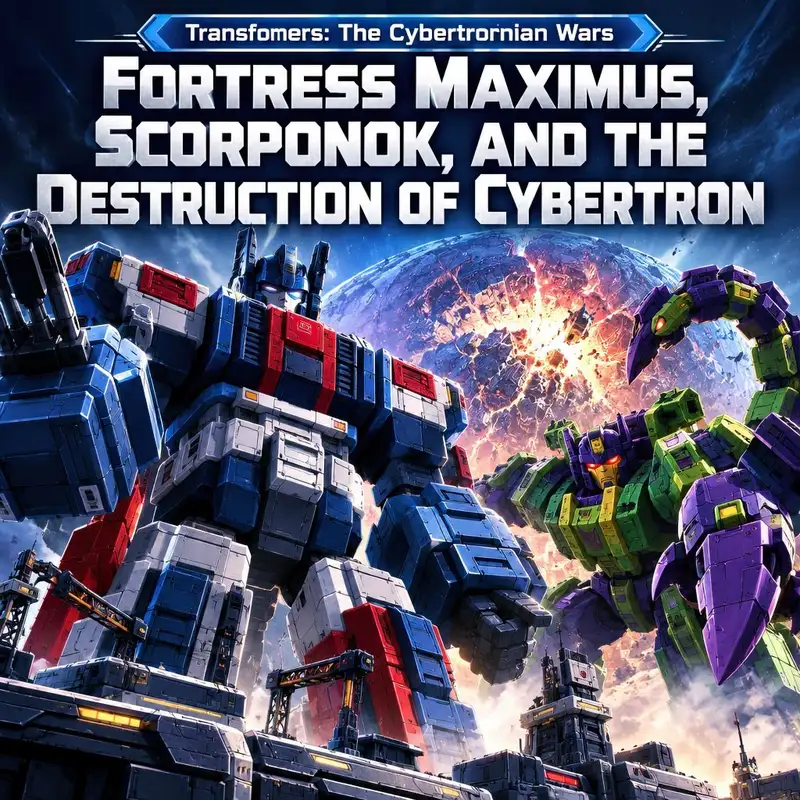
Fortress Maximus, Scorponok, and the Destruction of Cybertron
The explosives were already inside Vector Sigma’s chamber when the Autobot Headmasters found them. That mattered because Vector Sigma was more than another installation that could be abandoned, retaken, or rebuilt after a battle. In the Japanese Generation One history told by Transformers: The Headmasters, it stood at the center of Cybertron’s political and industrial life. If the bombs went off there, the loss would reach far beyond a single command post.
The immediate mission was not to defeat Galvatron in open combat. It was to determine whether the charges could be removed without setting them off. The Autobot Headmasters, including Chromedome, Hardhead, Brainstorm, and Highbrow, had found the sabotage in time to understand the danger. They had not found it in time to solve it. The devices could not be safely disarmed. Under those conditions, evacuation became the only practical operation left.
That decision gives the destruction of Cybertron its proper scale. The Autobots did not choose to surrender their homeworld. They accepted that they could no longer preserve it. A force can lose the ground beneath its feet and still save part of its people, its command structure, and its capacity to resist. That is survival. It is not victory. The distinction would shape every campaign that followed.
Cybertron had been the physical center of the war, but it was also its political center. It contained old institutions, industrial systems, archives, repair capacity, and the symbolic weight of a civilization that both Autobots and Decepticons still claimed to represent. A struggle fought on distant worlds can continue after the loss of a capital. It becomes something different, though. It becomes a war of exile, improvised bases, mobile forces, and contested legitimacy.
The crisis began with Vector Sigma’s instability. In this version of the story, Vector Sigma is Cybertron’s central computer and governing intelligence. It should not be casually equated with every other version of Vector Sigma elsewhere in Transformers history. The series presents it as a system essential to the planet’s survival and administration, not as a universal answer to every question about Cybertronian origins or religion.
After the earlier Matrix crisis and the effort to restore order, Vector Sigma developed a new alloy called Cybertonuron. The story describes it as far stronger than ordinary Cybertronium. The exact comparison shifts between translations, and the number is less important than the strategic meaning. Cybertonuron was not valuable because someone had produced an impressive laboratory claim. It mattered because Vector Sigma appeared to possess a unique process capable of making a superior material.
For a long war, a new alloy can alter more than armor thickness. It can affect repair, fortification, ship construction, weapons, industrial tools, and the confidence of a faction that believes it has found a way out of strategic deadlock. If one side can build more durable forces while the other remains dependent on older materials and damaged infrastructure, the change may reshape the entire campaign. Cybertonuron represented that possibility.
Galvatron understood the opportunity. His immediate objective was not to destroy Vector Sigma or Cybertron. He wanted control of the new material. In military terms, he was attempting to seize a decisive industrial advantage before the Autobots could protect it, integrate it into their production system, or deny it to him. The plan had a clear logic. Possession of Cybertonuron might strengthen Galvatron’s position against the Autobots and, just as importantly, against rivals within his own coalition.
His intelligence advantage came through Soundblaster and the cassette agents operating under him. Their surveillance revealed Vector Sigma’s work and carried that information to Galvatron. It was a genuine intelligence success. They identified a strategic development before it became fully protected, widely distributed, or politically settled. But knowing what matters is not the same as being able to control the people who act on that knowledge.
Rodimus Prime led the Autobot defense of Cybertron. Fortress and the Autobot Headmasters were among the forces committed to protecting Vector Sigma and preventing Galvatron from turning Cybertonuron into a Decepticon monopoly. The battle therefore began as a conventional contest over a strategic facility. One side sought to seize the resource. The other sought to defend it. Neither side initially needed the planet itself to die.
Scorponok did not share Galvatron’s objective. He was a Decepticon Headmaster leader and, at this point, a nominal ally of Galvatron. Nominal is the important word. He worked within the Decepticon military structure, but he retained his own followers, his own ambitions, and enough autonomy to act beyond Galvatron’s effective control. This was more than a personal feud. It was a command problem with planetary consequences.
The series suggests that Scorponok had reason to fear Galvatron intended to remove him from power, possibly through exile. Sixshot provides information that contributes to this fear, although the precise basis for that knowledge is not fully explained. The uncertainty matters. We do not need to invent a hidden intelligence network to see the political effect. Scorponok believed that Galvatron’s success would make Scorponok dispensable.
That belief shaped his decision. If Galvatron obtained Cybertonuron, the Decepticon leader would gain more than better materials. He would gain a new source of prestige, military leverage, and personal authority. A successful seizure of Vector Sigma could have made Galvatron harder to challenge from within. Scorponok therefore treated the resource as a threat. His answer was not to capture it first. His answer was to ensure no one possessed it.
This was strategic denial in its most destructive form. Scorponok intended to deny Cybertonuron to Galvatron and to the Autobots. He also intended to prevent Galvatron from converting industrial success into unchallengeable political supremacy. Finally, he intended to create room for himself. The act was not performed solely to gain future plasma energy, even though plasma energy later became central to his plans. The immediate motive was denial, fear, and ambition.
A commander who destroys a resource rather than capture it is making a harsh calculation. The commander accepts the loss of future production, infrastructure, and civilian security in exchange for preventing an enemy or rival from gaining an advantage. Such operations can be militarily rational in a narrow sense. They are also dangerous because the commander may destroy the very system he later hopes to rule. Scorponok was willing to take that risk.
The sabotage team consisted of Mindwipe, Skullcruncher, and Weirdwolf. Their assignment required access to Vector Sigma’s chamber, secrecy, timing, and compartmentalization. A planetary sabotage operation cannot depend only on explosives. It depends on the target remaining unaware until the moment when response is no longer possible. The operation succeeded because the conspirators reached the center of Cybertron’s system before the defenders could establish a safe countermeasure.
The target was not just a computer. Vector Sigma embodied a concentration of knowledge, industrial process, political authority, and planetary infrastructure. Destroying it meant destroying the place where Cybertonuron was being developed. It meant eliminating a facility that neither faction could simply reproduce on a remote base. It also meant striking at Cybertron’s ability to function as a coherent center of government and production.
There is no need to assign a bomb yield or describe a fictional engineering schematic to understand the result. The weapons were placed where their detonation would destroy Vector Sigma and trigger the wider catastrophe. The series is clear on the essential responsibility. Scorponok ordered and arranged the operation. Mindwipe, Skullcruncher, and Weirdwolf carried it out. What matters is the chain of command that turned internal Decepticon rivalry into planetary destruction.
The Autobot Headmasters discovered the plot, but discovery did not restore control. This is one of the harder lessons of intelligence and counterintelligence. A warning can arrive too late. A commander may know exactly what the enemy intends and still lack the time, access, tools, or technical certainty to prevent it. The Autobots could not safely remove the charges. Their choices narrowed from defense to evacuation.
Evacuation is often misrepresented as a passive act. It is not. It requires commanders to decide whom they can save, which routes remain open, what equipment can move, what facilities must be abandoned, and how to prevent panic from becoming additional loss. The Headmasters story does not provide a reliable population count or a complete record of civilian movement. It does establish the political fact of displacement. Cybertronians had to flee their own world.
Galvatron tried to intervene when Scorponok’s betrayal became clear. His motives were not pure. He wanted to save Cybertron, but he also refused to allow a subordinate to destroy the resource he intended to command. Even so, his attempt demonstrates the failure of Decepticon unity. Galvatron had formal authority. Scorponok had already acted beyond it. By the time the leader moved to stop the sabotage, the operation had escaped his control.
The bombs detonated at Vector Sigma. Cybertron was devastated and left as a burnt-out remnant. Galvatron was caught in the destruction and presumed dead. Later events establish that he survived, but in the immediate aftermath, no one could govern on the assumption that he would return. The apparent death of the Decepticon leader created a vacuum at the exact moment when the war had lost its central world.
The loss cannot be measured only in physical damage. Cybertron’s destruction meant the loss of infrastructure, archives, industrial capacity, repair systems, and a homeland whose political meaning had survived even long war. The series does not give a dependable casualty total, and it would be irresponsible to invent one. What it does show is a civilization transformed into a displaced population, with no clear assurance that the old center could be restored.
For the Autobots, the immediate result was survival without security. They had preserved forces and evacuated people, but they had failed to protect Cybertron. Rodimus Prime faced a problem no battlefield victory could answer. Where would the displaced Cybertronians live? A military organization can operate from ships, stations, and temporary bases. A society needs something more durable. It needs energy, repair, authority, and a place where ordinary life can resume.
Rodimus departed with Kup and Blurr to search for a new homeworld. That decision did not mean he abandoned the Autobot cause. It demonstrated that the loss of Cybertron had expanded the war beyond military command. Rodimus had to think in terms of survival, settlement, and political continuity. Yet his departure also removed the supreme Autobot commander from the immediate theater at a moment when the remaining force needed stable leadership.
The Autobots operated from Athenia after Cybertron’s destruction. Athenia could provide a base of operations, but it was not Cybertron reborn. It could support command, defense, and resistance. It could not automatically replace the lost industrial and symbolic center of Cybertronian life. The difference between a base and a state is considerable. A base can house forces. A state must sustain a people and command legitimacy beyond the next operation.
Fortress therefore assumed a greater leadership burden. He was already the leader of the Autobot Headmasters, but the destruction of Cybertron made that role larger and more difficult. He had to help lead a force whose political center had been destroyed, whose supreme commander had departed on a strategic search, and whose enemies remained active despite the loss of their own apparent leader.
On the Decepticon side, Scorponok moved quickly. He falsely claimed that Galvatron was still alive and had appointed him temporary commander. This was not a lawful succession. It was a political fraud built on confusion, missing leadership, and fractured communications. It succeeded because the Decepticons had lost both their homeworld and their ability to verify authority through normal institutions.
Scorponok’s deception reveals a familiar weakness in highly personalized command systems. When authority rests too heavily on one leader, the leader’s disappearance becomes a strategic event even before anyone knows whether that leader is dead. Subordinates compete to define the story. They claim orders that cannot be checked. They mobilize loyal units before rivals can respond. In such a system, information becomes a weapon of succession.
Scorponok’s takeover gave him practical control over the Decepticon forces, but it did not solve the underlying problem. He had denied Galvatron a decisive resource by destroying Cybertron. He had also destroyed the industrial center he hoped to dominate. His authority depended on continued fear, deception, and the ability to find new sources of energy and military power. A commander can seize an army. Governing a displaced civilization is another matter.
Fortress became increasingly important because the war now required more than a conventional field commander. The Autobots needed someone who could hold together Headmaster forces, defend scattered personnel, and provide a visible center of leadership after the loss of Cybertron. In this Japanese continuity, Fortress has a relationship to a larger transtector that becomes Fortress Maximus. That arrangement should not be confused with the American Rebirth story involving Spike and Cerebros. This is a different history.
Fortress Maximus was more than a larger body available for routine use. His transformation and the use of the Master Sword depended on an exceptional balance of physical and mental energy. The series presents that moment as a crisis response, tied to Fortress’s responsibility for his Headmaster troops. The giant form was not a convenient replacement for strategy. It was a resource-dependent command capability activated under extraordinary pressure.
Giant-scale systems are often described as though size alone decides the battle. It does not. A larger body must still be directed, supplied, protected, and integrated into a force. It needs energy. It may require a particular operator or a synchronized command relationship. It can become a target for concentrated enemy effort. Fortress Maximus increased Autobot capacity, but he also concentrated risk in a system the Autobots could not casually replace.
The Master Sword carried similar limits. It did not represent a universal weapon that could be drawn whenever Fortress needed a dramatic answer. Its activation depended on balance and readiness. In military terms, it was an exceptional capability with demanding conditions for employment. Those conditions made Fortress Maximus valuable, but they also made him dependent on the cohesion and support of the wider Autobot force.
This is why the Autobot Headmasters mattered beyond individual combat skill. They were more than companions standing beside a giant commander. Their relationship to Fortress formed part of the operational system that allowed Fortress Maximus to act. The force depended on trust, coordination, energy, and a shared purpose. After Cybertron’s destruction, that collective structure was one of the Autobots’ remaining sources of strength.
Scorponok pursued a different model. His giant transtector is commonly called MegaZarak in Japanese material. For clarity, Scorponok is the Decepticon commander pursuing the project, while MegaZarak refers to the giant system associated with his rise. The terminology can become complicated across translations and later reference works, but the strategic idea is straightforward. Scorponok sought a form of power that would make his authority difficult to challenge.
MegaZarak was not just a battlefield asset. It was the material expression of Scorponok’s political program. He had taken temporary command through deception. To retain it, he needed coercive power that did not depend on consent from Galvatron’s old followers or on the survival of a shared Decepticon cause. A giant transtector, backed by hidden preparation and new energy sources, offered a way to make personal rule appear inevitable.
Scorponok first had to solve the problem he had created. Cybertron was gone. Vector Sigma and Cybertonuron had been denied to everyone. The war therefore shifted toward new sources of power. Scorponok captured Solar One, a satellite designed to collect solar energy. The operation showed that he understood energy systems as strategic infrastructure. A solar collector could become a military resource if its output could be seized, redirected, and protected.
The harvested energy was transferred toward the hidden Zarak project. This was an effort to build and sustain a new center of Decepticon power away from the ruins of Cybertron. It also illustrates a practical truth about military technology. Capturing an energy source is not the same as winning a war. The energy must be transported, converted, secured, and integrated into a broader system of command, production, and operations.
The destruction of Cybertron also produced plasma energy, which later became a strategic resource in the conflict. Here again, sequence matters. Scorponok did not destroy Cybertron solely to harvest plasma energy. He destroyed it to deny Cybertonuron and prevent Galvatron’s ascendancy. Once the planet had been destroyed, however, the consequences created a new resource contest. Scorponok adapted to that outcome and tried to exploit it.
This is the grim logic of wars built around energy and infrastructure. A destructive action may remove one resource while producing another. The new resource then becomes an incentive for further violence. Plasma energy could be weaponized and used against Fortress Maximus. It could support operations beyond Cybertron itself. The original denial campaign had turned into a wider struggle over how to extract power from damaged worlds and vulnerable systems.
The Mars campaign showed the scale of that shift. Scorponok’s forces used plasma energy in operations that disabled Fortress and contributed to the destruction of Mars. The tactical details vary across the fast-moving series, but the strategic pattern is clear. A war that had begun with a struggle for a superior alloy at Vector Sigma had become a war in which planetary energy and planetary survival were themselves targets.
Destroying Mars did not provide Scorponok with stable political control. It demonstrated his ability to inflict catastrophic damage and to weaponize a resource created by Cybertron’s fall. Those are not the same thing. Destruction can intimidate opponents and destroy alternatives. It can also strip the conqueror of the very territory, infrastructure, and population needed to build a durable order. Scorponok repeatedly favored coercion over governance.
Fortress Maximus and MegaZarak emerged from this crisis as competing models of power. Fortress Maximus represented collective synchronization, defensive leadership, and the effort to preserve a scattered force after the loss of its homeland. He could be powerful because other Autobots supported him, because Headmaster cohesion made his system viable, and because his strength remained connected to a larger purpose than personal survival.
MegaZarak represented the opposite political logic. It was built around concentrated authority, hidden industrial preparation, captured energy, and Scorponok’s effort to turn temporary command into permanent dominance. That does not mean MegaZarak lacked military value. It clearly posed a grave threat. But its meaning was tied to the Decepticon leader who sought to use overwhelming force to settle a succession dispute that had never been resolved through legitimate authority.
It would be a mistake to reduce the rivalry to an unsupported contest of dimensions, armor, or firepower. The series does not need a scale chart to establish what these systems meant. Fortress Maximus was powerful because he increased the Autobots’ ability to resist when their society had been dispersed. MegaZarak was dangerous because Scorponok tried to make military superiority a substitute for political consent.
The later final battle on Earth makes the connection clear. It is not another destruction of Cybertron, and it should not replace the earlier story. It is the consequence of the political and logistical world that Cybertron’s destruction created. By the time of the final Earth campaign, Scorponok had developed a pattern of warfare focused on energy extraction, planetary systems, and the conversion of infrastructure into weapons.
His Death Towers drew energy from Earth’s core. This was infrastructure warfare on a planetary scale. The towers were more than large guns placed for spectacle. They formed an energy network that sought to turn Earth’s internal power into a strategic weapon. Scorponok’s plan depended on taking a living world’s foundational system and converting it into an instrument of coercion.
Fortress Maximus was immobilized in the energy stream. That episode reinforces the limits of giant-force employment. Even a formidable transtector can be neutralized when an enemy controls the energy environment around it. Size does not remove vulnerability. A giant system may be especially dependent on power, coordination, and the ability of supporting forces to protect its operating conditions.
The Autobot response depended on collective action. Through Head Formation and Final Formation, the Autobot forces combined their energy and effort to restore Fortress Maximus. The point is not that unity functions as a vague moral slogan. In this story, collective support had a concrete operational effect. The wider force enabled the giant commander to return to action against an enemy energy network that could not be defeated by isolated heroics.
Fortress Maximus then destroyed the Death Tower system, the Zarak Shield, and MegaZarak. The immediate military result was the defeat of Scorponok’s giant coercive instrument. Yet the deeper meaning was political. Scorponok had tried to construct an order in which access to planetary energy and overwhelming force would guarantee his control. The destruction of MegaZarak showed that no such system was invulnerable when its power depended on a network that others could disrupt.
The Earth finale also demonstrates why planetary destruction and planetary control must be kept separate. Scorponok could threaten worlds, drain their energy, and build systems designed to immobilize even Fortress Maximus. None of that automatically gave him legitimacy, sustainable governance, or a secure future for the Decepticons. His strategy repeatedly created devastation faster than it created a viable political order.
The destruction of Cybertron therefore transformed the war in several stages. First, Cybertonuron made Vector Sigma the center of an industrial contest. Then Soundblaster’s intelligence success brought Galvatron toward that prize. Scorponok’s fear of Galvatron’s growing authority turned the contest into an internal Decepticon crisis. Finally, the sabotage of Vector Sigma destroyed the resource, the installation, and the homeworld around them.
In the short term, Scorponok succeeded. He denied Cybertonuron to Galvatron and the Autobots. He removed Galvatron from immediate command, or appeared to do so. He exploited the confusion to claim temporary leadership over the Decepticons. From the narrow perspective of a rival trying to survive and seize power, the operation worked. It was a successful act of denial and a successful coup attempt.
Operationally, however, Scorponok’s victory was far more costly. He destroyed the industrial center that might have sustained a Decepticon state. He scattered both factions across new bases and worlds. He forced the war into a struggle over captured energy, hidden projects, temporary infrastructure, and planetary extraction. He gained freedom from Galvatron’s immediate supremacy, but he also inherited a conflict without a secure homeland.
The Autobots suffered a strategic disaster, but not annihilation. Their evacuation preserved people and forces. Athenia gave them a place from which to continue. Fortress Maximus gave them an exceptional capability, though one dependent on energy, cooperation, and the commitment of the Autobot community. Their survival did not repair Cybertron. It did preserve the possibility that the war would not be decided solely by Scorponok’s destruction.
Fortress Maximus mattered because he was more than a giant combatant. He was a force multiplier whose effectiveness depended on synchronized leadership and collective support. In a war after Cybertron, that mattered enormously. The Autobots could no longer rely on the stability of their old world. They needed systems that could function through displacement, fractured command, and material scarcity without reducing every political problem to raw coercion.
MegaZarak mattered for the opposite reason. It was Scorponok’s attempt to turn destruction into durable authority. It embodied his belief that hidden preparation, concentrated energy, and overwhelming force could resolve the instability created by his own sabotage. But military power built only around personal control has a weakness. It can intimidate subordinates and devastate worlds, yet still fail to create the trust, institutions, and shared purpose that outlast a commander.
Cybertron’s destruction was not inevitable. It was a deliberate choice by Scorponok to deny a rival the advantage of Cybertonuron. That choice won him a moment of power, but it also changed the nature of the war. The conflict ceased to be anchored to a functioning Cybertronian homeland and became a contest over displaced forces, energy networks, giant systems, and the ruin left behind when ambition chose destruction over a future worth governing.