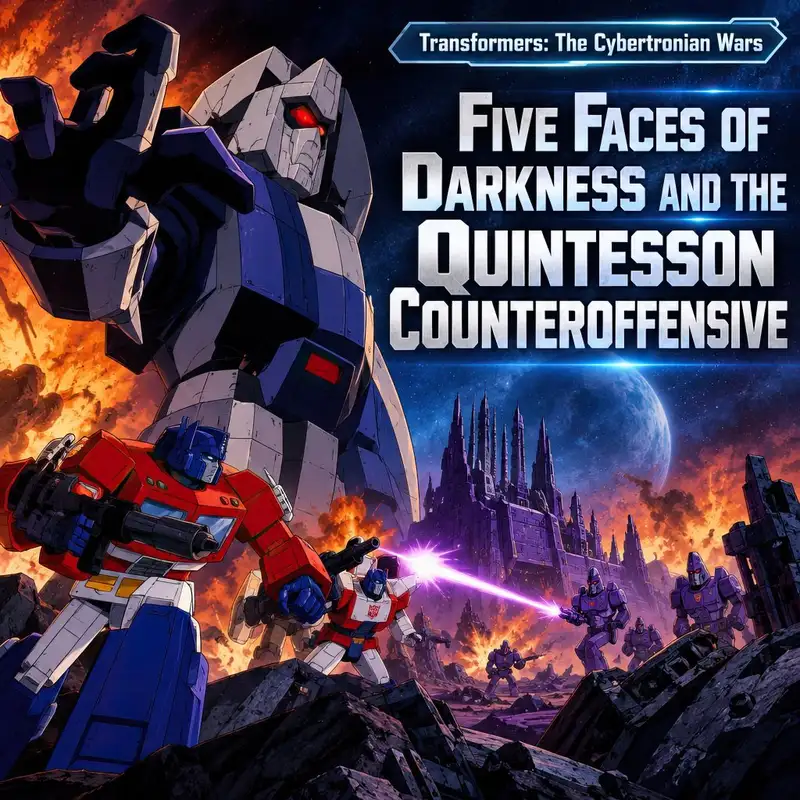
Five Faces of Darkness and the Quintesson Counteroffensive [Cartoon]
The first Galactic Olympics on Cybertron should have been a public proof that the war’s old patterns were breaking. The Autobots had regained the planet after the destruction of Unicron. Rodimus Prime had inherited leadership in the aftermath of a catastrophe that had scattered old command structures and left every survivor measuring the future against an almost unimaginable loss. A sporting festival could not repair the damage, but it could show that Cybertron was again capable of gathering people for something other than mobilization, evacuation, or mourning.
That made it an excellent target. The attack did not begin with an invasion fleet descending on Cybertron. It began with sabotage, confusion, and an apparently limited security breach. A Skuxxoid operative disrupted the event while Sharkticons seized Kup, Ultra Magnus, and Spike Witwicky. The captives mattered for different reasons. Kup was Cybertron’s chief of security. Ultra Magnus was a senior Autobot commander. Spike was a human ally whose presence represented the expanding relationship between Earth and the Autobots. Their disappearance was not random violence. It was the removal of people connected to security, command, and a new political partnership.
Rodimus made the understandable assumption. The Decepticons were the familiar enemy. They had attacked Cybertron, Earth, Autobot City, and almost every other strategic point that mattered in the war. The planet was quarantined while the Autobots searched for the kidnappers. From a defensive perspective, that decision made sense. A major public gathering had been penetrated, senior personnel had vanished, and the Decepticons had every reason to seek revenge after their defeat by the Autobots and Unicron.
But the first Quintesson victory was not military destruction. It was misattribution. Rodimus looked toward the enemy everyone expected. The Quintessons operated behind that expectation. Their campaign began by making the Autobot command system spend time, attention, and security resources on the wrong threat. In war, an adversary does not always need to conceal every action. Sometimes it is enough to make a defender explain the action through an old and familiar danger.
The Decepticons, meanwhile, were in no condition to launch a confident new war by themselves. On Chaar, their scattered force faced an energon shortage severe enough to become a political crisis. Astrotrain returned with only a limited supply, and the result was not disciplined rationing under a stable command. It was competition, resentment, and open conflict among Decepticons who had already been reduced by defeat, exile, and the loss of their leader.
The episodes do not provide a precise inventory of energon reserves, troop strength, or remaining ships. They do not need to. The condition of the force is clear enough. Chaar is not a functioning capital sustaining a healthy military establishment. It is a refuge for a defeated faction whose members are short of energy, uncertain of command, and increasingly vulnerable to anyone offering supply or direction. A faction can possess powerful individuals and still be strategically weak when it cannot feed, repair, organize, or transport them reliably.
Cyclonus understood that the problem was larger than energon. The Decepticons had lost Galvatron after the events surrounding Unicron. Without him, they retained weapons, officers, and ambitions, but not a settled center of authority. Cyclonus therefore regarded Galvatron’s recovery as necessary. He was seeking more than the return of a battlefield commander. He was seeking the restoration of a leader around whom a damaged organization could again arrange itself.
Here, logistics became political leverage. A supply shipment can keep soldiers active for a short period. It cannot, by itself, restore trust or a chain of command. Yet scarcity makes desperate organizations receptive to outside influence. The Quintessons did not need to manufacture a new army from nothing. They needed access to an existing military force that was hungry, angry, divided, and looking for a way back into the war.
The Quintessons’ first direct use of force took place far from Chaar. On Quintessa, the abducted prisoners were subjected to interrogation under a system that combined ceremony, intimidation, and the constant threat of execution. The Quintessons’ judicial process was not a neutral court seeking facts. It was an instrument of domination. Their Sharkticons functioned as guards, captors, and executioners, enforcing the authority of rulers who preferred terror to consent.
Kup’s capture was especially significant because he was identified as Cybertron’s chief of security. Ultra Magnus offered command knowledge and institutional standing. Spike represented a different kind of intelligence opportunity. He was a human connected to the Autobots at a time when Earth had become both a refuge and a strategic partner. The Quintessons already seemed to know a great deal about Cybertronian defenses and about conditions on Earth. The serial does not establish exactly what information was extracted from the prisoners, or by what technical method. It does establish that the Quintessons had prepared carefully.
Their knowledge was not just tactical. They understood that the Autobots had changed through contact with humans. That observation mattered because alliances alter more than military strength. Human partners introduced different priorities, different habits of improvisation, and different political relationships. An enemy that assumes Cybertronians will always act according to old Cybertronian patterns can be surprised by the influence of Earth. The Quintessons saw human contact as a complication. They were right to do so, although they would misunderstand what that complication could mean.
The prisoners also served a psychological purpose. Their captivity told the Autobots that even a restored Cybertron remained penetrable. The Galactic Olympics had exposed a security failure in public. Quintessa now demonstrated the consequences in private. The Quintessons did not need to destroy Cybertronian society immediately. They needed to show that they could reach into it, remove key personnel, and force its leaders to react.
At this point, neither major Cybertronian faction understood the full shape of the threat. The Autobots suspected the Decepticons. The Decepticons were struggling to survive on Chaar. The Quintessons possessed captives, deniable agents, Sharkticon enforcers, and a growing ability to manipulate both sides. Their campaign was not yet a conventional counterattack. It was an intelligence operation preparing the ground for one.
Rodimus gained a different kind of warning after encountering the starving Decepticons on Chaar. The episode presents him not just as a warrior responding to a raid, but as a leader forced to confront a past larger than the immediate crisis. Through the Matrix of Leadership, Rodimus experiences a vision of Cybertron’s ancient history. In this American animated continuity, that vision identifies the Quintessons as the creators and former rulers of Cybertronian life.
The Matrix account describes a society in which Cybertronians were manufactured for assigned purposes. One line produced consumer goods. Another produced military hardware. Over time, those lines became associated with the populations later known as Autobots and Decepticons. The details are presented as the historical revelation of this serial, not as a universal explanation for every version of Cybertron or every Transformers story. Other continuities tell the origin of Cybertronian life very differently. Here, however, the political meaning is immediate.
The Quintessons do not regard independent Cybertronians as a neighboring civilization that became hostile. They see them as former products who escaped the authority of their makers. That memory helps explain the intensity of their counteroffensive. They are not just seeking revenge for a recent defeat. They are attempting to reverse a historic loss of control. Cybertron, in their view, was once a factory world organized around Quintesson rule. Its independent population represents both a practical threat and an intolerable repudiation of their old order.
That history does not make the Quintessons’ campaign inevitable. Ancient domination can become a source of grievance, but it does not dictate a specific military plan. What it does provide is motive. The Quintessons see autonomy itself as the problem. The Autobots and Decepticons may be enemies of one another, but both are descendants of a population the Quintessons believe should never have become self-governing. From that perspective, manipulating Decepticons is not an alliance of equals. It is a temporary use of rebellious tools against other rebellious tools.
Rodimus now understood more about the historical adversary, but history did not reveal the immediate plan. Knowing that the Quintessons wanted Cybertron back did not identify where they would strike, which assets they would use, or how deeply they had penetrated current defenses. This is a recurring difficulty in intelligence work. Strategic motive is valuable. It does not replace operational intelligence. A commander may understand why an enemy wants victory and still not know how that enemy intends to achieve it.
The Autobots did succeed in breaking the immediate Quintesson hold over their prisoners. Springer and Arcee rescued Rodimus and Grimlock, then helped carry the effort onto Quintessa itself. The operation developed from escape into a broader rescue. Kup, Ultra Magnus, and Spike were liberated before the Quintessons could convert their captives into a lasting advantage. The Autobots had denied their enemy an important intelligence and coercion asset.
Yet the escape also revealed the Quintessons’ priorities. Rather than permit the Autobots to depart with knowledge of their plans, the Quintessons destroyed Quintessa with a core bomb. It was an extraordinary denial measure. They sacrificed their own base rather than allow the enemy to exploit it. The destruction does not establish the size of the Quintesson remnant or the full extent of its industrial resources elsewhere. It does show that this particular position was expendable when secrecy was at stake.
The decision has a cold operational logic. A fixed installation can become a liability once compromised. If the enemy has escaped with prisoners, observations, and some understanding of the local system, destroying the site can deny documents, equipment, infrastructure, and perhaps prisoners still held elsewhere. It can also communicate that the attacker is willing to abandon territory rather than surrender initiative. The Quintessons were not trying to defend Quintessa as a homeland. They were trying to preserve a campaign.
For the Autobots, the rescue was real success. Senior personnel were recovered. The immediate threat of the Sharkticon execution system was ended. Rodimus had learned the Quintessons were involved. But the victory came with a warning. The enemy could destroy its own base and continue the operation. The Autobots had escaped a trap. They had not dismantled the network that created it.
While the Autobots were uncovering the Quintesson threat, Cyclonus and Scourge were conducting their own recovery operation. They located Galvatron in the plasma pools of Thrull, where he had survived after being cast into space during the destruction of Unicron. His recovery was not orderly. Galvatron emerged unstable, violent, and immediately dangerous to the officers who had come to retrieve him. Scourge was eventually able to calm him enough for the Decepticons to regain their leader.
That event should not be read as evidence that destruction and recovery follow a simple, repeatable rule for Cybertronians. The serial establishes this particular recovery in these particular circumstances. It never offers a universal system by which any damaged or apparently lost Cybertronian can be restored. What matters strategically is that Galvatron returned when the Decepticons most needed a center of command, and that his return came with serious doubts about his reliability.
Galvatron restored authority through force of personality. Back on Chaar, he reasserted control over the Decepticons. For a faction that had been reduced to quarrels over energon, that mattered. A centralized leader could impose priorities, direct available assets, and give the remaining Decepticons a common objective. But command restoration is not the same thing as command health. Galvatron was powerful, feared, and capable of forcing action. He was not a predictable partner in a coalition.
The Quintessons appear to have understood the first half of that equation. They knew the Decepticons needed energon, leadership, and a route back into relevance. They did not fully account for the kind of leader Galvatron was. He did not return from Thrull prepared to become a subordinate force in another power’s campaign. He returned expecting to dominate every relationship around him.
The meeting on Goo made the flaw in the alliance visible. The Quintessons had supplied the Decepticons with energon and offered a promise of further power. Central to that offer was a supposed Decepticon Matrix of Leadership, presented as a counterpart to the Matrix carried by Rodimus. The serial never establishes that such an artifact existed as a genuine, operational object. It functions first as an inducement and later as part of a deception aimed at manipulating Galvatron.
Galvatron did not accept the Quintessons as benefactors. He treated them as resources to be exploited. His interest was immediate advantage against the Autobots and the restoration of Decepticon power. The Quintessons’ objective was much broader and much more dangerous to the Decepticons themselves. They wanted to eliminate or permanently disable independent Transformers and reclaim Cybertronian society under their own control. The two sides shared an enemy for the moment, but they did not share an end state.
This was coalition warfare without trust, common institutions, or a genuinely common purpose. The Quintessons possessed supply and a hidden plan. Galvatron possessed military assets and the ability to direct them. Neither side could safely reveal everything to the other. The Quintessons concealed the real function of their ultimate weapon. Galvatron assumed he could take whatever power they offered and turn it to his own purposes. Each side believed it was using the other.
That arrangement could produce short-term operational success. It could not produce durable unity. An alliance based on desperation and deception is especially vulnerable when information begins to move outside the compartments designed to contain it. The Quintessons did not need Galvatron to understand their plan. In fact, they preferred that he did not. But they did need him to keep his forces moving in the right direction long enough for their own operation to mature.
The final phase of the counteroffensive was therefore dispersed across several theaters. It was not one battle for Cybertron. Decepticon forces struck at Cybertronian defenses. Trypticon attacked Autobot positions on Earth and then advanced on Autobot City. On Io, the Predacons moved to seize Metroplex’s transformation cog, a component necessary for Metroplex to assume his full combat role. Meanwhile, the Quintessons prepared a mechanism intended to deactivate Transformers across the galaxy.
This was sound operational design in one important sense. It created more crises than the Autobots could comfortably solve at once. A defense system under attack on Cybertron demands attention from central command. Trypticon threatens a major Autobot stronghold and civilian population on Earth. The struggle over Metroplex’s transformation cog determines whether the Autobots can field a strategic heavy asset against Trypticon. Each operation forced the Autobots to divide personnel, transport, communications, and decision-making.
The Quintesson plan also recognized that large battles can serve as distractions. Trypticon was not just sent to destroy property. His attack helped draw attention toward an obvious and urgent threat. The fight over Metroplex’s cog was not just a contest for a spare part. It was an effort to keep the Autobots from restoring the one asset capable of opposing Trypticon on equal terms. The strike on Cybertronian defenses aimed to weaken the planet at the moment the Quintessons intended to move openly.
The strategic objective, however, was not the defeat of Metroplex, the capture of Autobot City, or even a temporary Decepticon victory over Cybertronian defenses. Those were supporting actions. The central Quintesson system was the deactivation mechanism. Its intended effect was to render Transformers inert on a galactic scale, leaving the Quintessons free to land, occupy Cybertron, and reverse the independence their former creations had won.
The serial demonstrates the mechanism’s effect, but not its construction, energy requirements, duration, range limitations, or reproducibility. It should be understood as a unique strategic system, not as ordinary Quintesson technology available to every unit. Its value lay precisely in its asymmetry. The Quintessons lacked the apparent means for a conventional reconquest against an alerted Cybertronian population. The switch promised a way to remove that population from the contest before occupation began.
The mission to Io shows how much could depend on one component. Blurr, Wheelie, and Marissa Faireborn of Earth Defense Command moved to recover Metroplex’s transformation cog before the Predacons could seize it. The task was not glamorous. It was maintenance and recovery under enemy pressure. Yet it had direct strategic importance. Without the cog, Metroplex could not perform the role required to meet Trypticon.
The Predacons possessed local advantage, especially after combining into Predaking. Against a small recovery party, that kind of concentrated force could have ended the mission quickly. The defenders faced not only enemy pressure but the hazards of the local environment. Blurr’s refusal to abandon Wheelie during an attack by Io’s native life forms created risk and delay. It was not a grand strategic decision. It was a local act of responsibility toward a teammate, made under conditions where time mattered.
Marissa Faireborn’s ship was destroyed while assisting the mission. That loss is a reminder that human participation in the Autobot defense network carried real cost. Earth Defense Command was not just an audience for Cybertronian conflict. Its personnel and assets were exposed in operations far beyond Earth’s atmosphere. Marissa’s role did not make her representative of every human government, but it demonstrated that the alliance had practical military consequences.
Sky Lynx’s intervention allowed the recovery party to escape with the cog. The operation did not destroy the Predacons or settle the wider battle. It achieved its mission. That distinction matters. Recovering the component restored an option. It did not guarantee victory. Military organizations often depend on such unglamorous successes: a repaired system, a recovered part, a transport that arrives, a damaged asset returned to service before the enemy can exploit its absence.
The cog became strategically significant because Metroplex was not just another combatant. He was a city-sized Cybertronian asset whose transformation allowed him to fight Trypticon directly. The episode never establishes how many such components existed, how they were manufactured, or whether replacement was easy. The urgent effort to recover this one suggests that it could not just be replaced on demand. In war, the difference between an inactive heavy platform and an active one may rest on a part too small to matter until the moment it is missing.
Pipes installed the cog in Metroplex as Trypticon advanced on Autobot City. The confrontation that followed was the visible centerpiece of the Quintesson counteroffensive. Two giant Cybertronian assets fought through an urban environment, each capable of causing damage on a scale far beyond ordinary soldiers or vehicles. But the real importance of the battle was not spectacle. It was whether Autobot City could be defended while the broader campaign unfolded elsewhere.
The threatened urban area was evacuated before the fight moved through it. The serial gives only a limited view of civilian experience, but that evacuation is important. A city under attack is not just a battlefield feature. It contains residents, infrastructure, repair facilities, transport routes, communications systems, and the accumulated social life of a population already exhausted by war. Moving civilians out of the path of giant combatants does not remove every danger, but it reflects an effort to prevent military necessity from becoming indiscriminate destruction.
Metroplex defeated Trypticon and sent him into the ocean. Tactically, this was a significant Autobot victory. It removed an immediate threat to Autobot City and prevented the Decepticons from turning a major Earth installation into a battlefield advantage. It also validated the Io mission. The recovered cog had enabled the only response capable of meeting Trypticon directly.
But destroying or disabling a visible enemy asset did not end the counteroffensive. The Quintessons had designed their operation so that the Autobots could win local battles and still lose the strategic contest. A commander who sees only the largest fight can mistake a successful defense of one city for the defeat of the entire campaign. The Quintessons were counting on that kind of distraction.
Their secrecy began to fail through Blitzwing. He overheard the Quintessons discussing their true objective and learned that the promised Decepticon Matrix was not the prize Galvatron believed it to be. The real plan was the mass deactivation of Transformers. The Quintessons were not preparing to empower the Decepticons. They were preparing to disable both factions and reclaim Cybertron from a population unable to resist.
Blitzwing’s discovery was the campaign’s decisive intelligence reversal. He had no reason to trust the Autobots, and the Autobots had every reason to distrust a Decepticon officer. Yet the information he carried concerned survival at a level larger than faction rivalry. If the Quintessons succeeded, Decepticon ambitions, Autobot authority, and every argument between them would become irrelevant. A force cannot pursue conquest after it has been reduced to inert bodies under the control of an outside power.
Galvatron rejected Blitzwing’s warning. His response reveals the weakness of personalist command. Galvatron interpreted information through the lens of authority and rivalry. A subordinate’s warning could look like insubordination. A concealed Quintesson scheme could look less important than maintaining his own control over the Decepticons. He was willing to believe in a Matrix that would reinforce his status because it fit his immediate ambition. He was less willing to believe that he had been manipulated.
This was not just a failure of intelligence collection. The intelligence had been obtained. The failure came in evaluation and command reception. An organization can possess correct information and still lose if its leader cannot hear unwelcome news. Galvatron’s authority allowed the Decepticons to act quickly, but it also made the faction dangerously dependent on his judgment at the precise moment his judgment was most distorted by pride and suspicion.
Blitzwing therefore turned to Rodimus and Spike. Their temporary cooperation did not erase the war between Autobots and Decepticons. It reflected a narrower and more urgent convergence of interest. Blitzwing understood that the Quintesson weapon threatened him as much as it threatened the Autobots. Rodimus recognized that the warning had to be acted upon even though it came from a Decepticon. Spike became essential because he remained active in circumstances where the Quintessons expected Transformers themselves to be helpless.
Together, they confronted the Sharkticons and moved against the deactivation system. The struggle was complicated by Galvatron himself. Believing he was dealing with the promised Decepticon Matrix, he activated the mechanism. In doing so, he gave the Quintessons the opening they had sought. The device took effect, and Transformers across the affected scope were rendered inert.
For a brief period, the Quintessons achieved something that conventional warfare had not given them: control of Cybertron without defeating its defenders in battle. They could land on the planet and reclaim it while Autobots and Decepticons alike were unable to resist. In tactical terms, the switch worked. In operational terms, the dispersed attacks had helped create the conditions for its use. The Autobots had been divided between Cybertron, Earth, Io, and the aftermath of earlier crises.
Yet temporary paralysis is not the same thing as durable occupation. The Quintessons had planned to remove Cybertronian agency, but they had not removed every possible actor. Spike remained able to destroy the switch mechanism. That action restored the Transformers before the Quintessons could consolidate their position. The system that had given them their decisive advantage was also a single point of failure. Once it was destroyed, their occupation force lost the foundation of its control.
The Quintessons had reached Cybertron, but they had not built the political or military structures needed to hold it against a revived population. They had no demonstrated constituency among Autobots or Decepticons. They had supplied energon to desperate Decepticons, but supply had not created loyalty. They had promised Galvatron power, but he had not become obedient. They had used Sharkticons as enforcers, but coercive troops are not the same thing as a functioning occupation administration.
Their escape by emergency craft confirmed the nature of their defeat. They were not annihilated, and the serial does not establish the full scope of their remaining resources. But the counteroffensive had failed in its strategic purpose. The Quintessons had not destroyed the Transformers. They had not permanently subordinated Cybertron. They had not converted a moment of helplessness into restored rule.
Galvatron’s reaction exposed the political cost inside the Decepticons as well. He pursued the fleeing Quintessons, but the alliance had already collapsed. Blitzwing prevented a final confrontation between Galvatron and Rodimus, then faced banishment from the Decepticons for his role in exposing the plot. His punishment was a familiar response from a command structure that valued personal obedience over inconvenient truth. Blitzwing had acted to prevent the destruction of his own faction, but that did not make him safe within it.
At close range, the Autobots had stopped the Sharkticons, recovered the transformation cog, restored Metroplex, defeated Trypticon, destroyed the switch, and prevented the immediate takeover of Cybertron. Those were substantial achievements. In operational terms, the Quintessons had briefly overloaded Autobot response through attacks in multiple theaters, but they had failed to retain their critical objective once their deception was exposed.
The Quintessons come close because they understand that a direct invasion is not their best option. They use deception, kidnapping, proxy warfare, strategic sabotage, distributed pressure, and a weapon designed to remove Cybertron's defenders from the field without defeating them one by one. Their plan exploits a postwar society that has been reclaimed but not fully secured. A celebration can be penetrated, senior officials can vanish, Earth can be attacked, and a single missing component can temporarily remove a major defender from the fight.
The plan fails because coercion and compartmentalization are poor substitutes for durable control. Energon can buy Decepticon cooperation, but it cannot make Galvatron obedient. Secrecy can conceal a scheme, but it cannot survive once Blitzwing understands enough to defect from it. The switch can paralyze Cybertron, but paralysis is not government. Once the population can act again, the Quintessons have no legitimate order, unified command, or sustainable occupation to replace what they tried to disable.