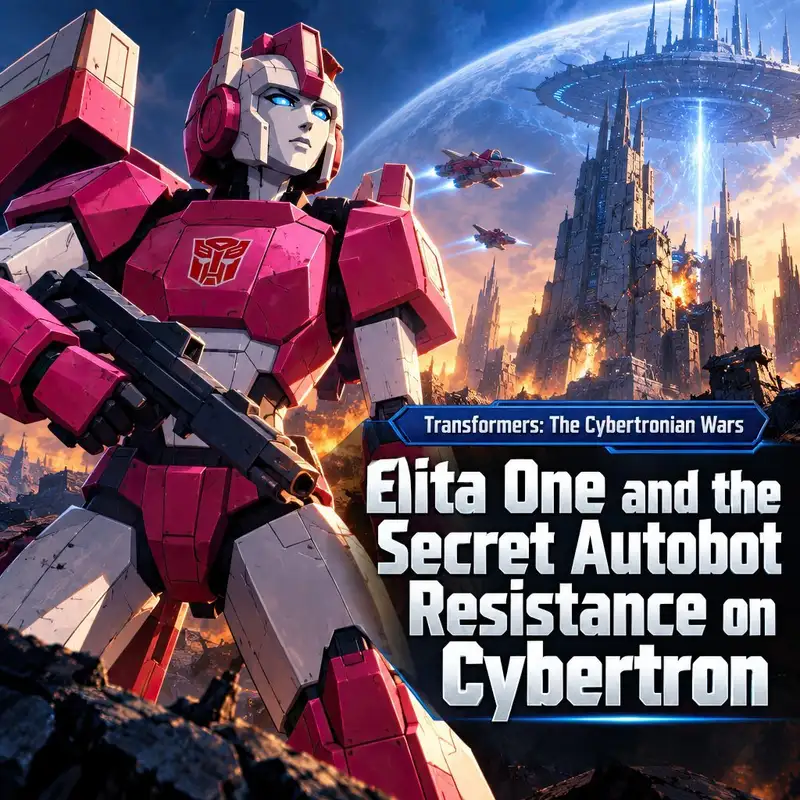
Elita One and the Secret Autobot Resistance on Cybertron
Chromia, Moonracer, and Firestar reach the energon cache inside Shockwave’s headquarters with the kind of urgency that makes caution feel like a luxury. Their hidden force is running low. The energon cubes in front of them are not trophies, and they are not the beginning of a grand offensive. They are fuel, repair capacity, and another chance to remain active on a Cybertron controlled by the Decepticons. Elita One, directing the raid from a distance, gives a simple order. Take only what can be carried. Leave before security notices.
In the American Generation One animated history, this is one of the clearest glimpses of the war continuing on Cybertron while Optimus Prime and much of the familiar Autobot force are based on Earth. The conflict has not ended on their homeworld. It has changed shape. Shockwave controls a major Decepticon headquarters and its stored energon. Elita One’s group operates from concealment, with little margin for damage, delay, or discovery. Their war is not about holding cities. It is about preserving the ability to exist and act.
Elita’s instruction reflects the hard arithmetic of resistance warfare. A small force cannot treat every successful raid as an invitation to take more. Every additional energon cube adds weight, slows extraction, complicates movement, and increases the time spent inside enemy-controlled infrastructure. More importantly, greed can turn a carefully limited operation into a detectable pattern. A force with no secure refinery, no visible supply line, and no obvious reserve base has to think beyond the immediate haul.
Moonracer does reach for more. The decision triggers the alarm, and the mission changes at once. The raiders escape with energon, but the Decepticons now know that Autobots are operating nearby. The tactical objective has been met. The larger problem has just begun. In irregular war, the enemy does not need to stop every raid. Sometimes all it needs is one trail, one sensor contact, or one moment of carelessness that points toward the people who planned it.
That is the central problem behind Elita One’s resistance. How can a small, isolated Autobot force survive on a Cybertron where the Decepticons control the visible machinery of war? The answer is not that Elita commands a hidden army capable of liberating the planet. The episode never establishes a planet-wide Autobot chain of command, a complete resistance network, or even a reliable count of those still active. What it does show is more modest, and in some ways more revealing. A compact group remains alive, organized, and unwilling to surrender.
Elita One is the practical center of that group. She authorizes the energon operation, sets its limits, directs the withdrawal, communicates with Alpha Trion, and accepts personal risk when the organization is threatened. Her authority appears to rest on trust, experience, and continued usefulness under pressure. The episode does not give her a formal rank within a surviving Cybertronian government. It shows something more immediate. When choices must be made, the others look to Elita, and she takes responsibility for the consequences.
Chromia, Moonracer, and Firestar are not presented as anonymous followers. They are field operatives with enough confidence and initiative to infiltrate a guarded Decepticon installation, carry out supplies under pressure, defend their refuge, and continue fighting after the base is attacked. Yet their group is still small. That gives it speed and cohesion. Orders can travel quickly. Members know one another. A leader can judge individual strengths and weaknesses without waiting for a large staff to process the situation.
The same compact structure also creates fragility. A small resistance cell has few replacements, few reserves, and little redundancy. If its headquarters is discovered, it cannot simply shift operations to another regional command. If a specialist is disabled, the group may lose a capability that no one else can replace. If its energon is exhausted, there may be no rear-area depot to draw upon. In a conventional army, a damaged unit can sometimes be withdrawn and rebuilt. Elita’s group has to remain hidden while trying to survive the damage.
Its existence nevertheless matters politically. Shockwave’s authority on Cybertron is substantial. He possesses a headquarters, security systems, stored energon, and access to Decepticon reinforcements. But control of infrastructure is not the same as unquestioned control of a planet. Elita’s group demonstrates that Autobot identity has not disappeared from Cybertron simply because the Decepticons occupy the visible centers of power. The resistance is not strong enough to overthrow that order. It is strong enough to deny the claim that the Decepticons have ended all opposition.
Energon sits at the center of this contest. In this animated continuity, energon is the resource that keeps Cybertronians functioning, fighting, traveling, and recovering from damage. The episode never provides a detailed account of how it is mined, refined, distributed, or rationed across all of Cybertron. It does not need to. The raid itself establishes the key fact. Elita’s force does not have enough. That shortage drives them into a dangerous target, and it narrows every decision that follows.
A resistance can survive a shortage for a time through discipline, concealment, and selective action. It cannot make scarcity disappear. Energon must be found, carried, stored, protected, and used. A cache taken from Shockwave’s headquarters may keep a group active for days or longer, but it does not create a dependable supply system. The difference is crucial. A raid solves an immediate problem. A logistics network solves a continuing one. Elita’s group has the first. The episode gives no evidence that it possesses the second.
That makes Elita’s caution more than simple prudence. She understands that the survival value of the energon must be weighed against the survival value of the organization itself. If taking extra supplies exposes the base, then the force may gain fuel only to lose its shelter, communications point, repair resources, and ability to operate as a unit. A commander in her position cannot judge success by the number of cubes carried away. She must judge it by whether the group remains capable of acting afterward.
Moonracer’s decision should not be reduced to carelessness. She is confronting the same scarcity that compelled the raid in the first place. Field personnel often see the immediate need more sharply than commanders who must consider the wider pattern. More energon means more strength, more mobility, perhaps more time before another desperate operation. Her choice is understandable. It is also costly. Resistance movements often fail not because their members lack courage, but because urgent local needs collide with the discipline required for long-term survival.
The recovered energon later becomes useful in a way none of the raiders could have planned. That does not make the security breach wise in retrospect. It shows the uneven nature of war under scarcity. Resources acquired at unacceptable risk can still prove decisive in an emergency. A commander cannot assume that later good fortune validates an earlier gamble. Elita’s original calculation remains sound. The fact that the extra cache later helps the group escape only proves that battlefield outcomes are often shaped by contingency as much as by intention.
Shockwave’s response reveals the other side of the struggle. On Cybertron, he functions as a Decepticon authority responsible for local security and strategic resources. His surprise at encountering surviving female Autobots is an intelligence failure within this particular episode, not evidence of a universal rule about Cybertronian gender or society. The important point is practical. Shockwave did not know that Elita’s group remained active. Once the raiders expose themselves, he begins to close that gap in knowledge.
The sentinel he deploys is a straightforward counterinsurgency tool. It does not need to understand the full structure of the resistance. It only needs to follow the raiders toward their refuge. This is one of the oldest problems in clandestine warfare. A hidden base can be protected by secrecy, terrain, underground access, and careful movement. But every mission creates a route. Every route can become a pattern. Once an enemy identifies the pattern, secrecy begins to fail.
Shockwave does not need a complete map of Autobot activity to create danger. An approximate location is enough. A force with air-capable troops, heavy weapons, and access to Decepticon command can search, bombard, or collapse the area around a suspected refuge. The resistance, by contrast, cannot afford to wait for certainty. It must act on the possibility that it has been found. That asymmetry is central to Elita’s situation. The Decepticons can spend force and energy to investigate. Elita’s group must conserve both.
Megatron quickly recognizes the wider opportunity. To him, Elita One is not just the commander of an annoying local cell. She is a means of reaching Optimus Prime. The Decepticons understand that Elita and Optimus share a personal connection reaching back to their separation during an earlier attack on Iacon, roughly four million years before the events of this episode. That history belongs to this animated continuity. It is not a universal biography carried from one version of the characters into every other Transformers story.
For Megatron, the relationship has military value because it creates predictability. A leader who cares deeply about someone in danger can be drawn into a trap, even when he recognizes the danger. This is not subtle psychology. It is leverage. Hostages, captured officers, threatened civilians, and endangered comrades have long been used to shape an opponent’s movement. The method works because military leaders are not abstract machines. They make decisions under loyalty, memory, fear, and responsibility.
Elita’s group has now been pushed from a supply crisis into an intelligence crisis. Its headquarters is concealed underground, and concealment offers real advantages. Underground spaces can shelter personnel, hide stores, complicate visual detection, and provide limited protection from direct attack. But a hidden base is not automatically a defensible base. If the enemy has located it closely enough to attack, the underground setting may become a trap. Tunnels collapse. Escape routes narrow. Supplies become buried with the people who need them.
Alpha Trion understands this. He warns Elita that the base must be abandoned and urges her not to use her special power. His role here is important but limited. He is not shown as commander of the resistance, nor as head of a restored Autobot government. He functions as an adviser, technician, and hidden source of support. He provides knowledge and repair capabilities that Elita’s field group cannot duplicate. In a small resistance, such a specialist can be as important as a weapons team.
His advice to relocate is the advice of someone who understands the difference between a refuge and a fortress. A resistance base is valuable while it remains unknown. Once compromised, its value declines rapidly. Keeping it may feel safer than abandoning familiar ground, stored equipment, and established routines. Yet clinging to a discovered base can destroy the force it was meant to protect. The purpose of concealment is not to create a permanent sanctuary. It is to buy time.
Elita appears to understand that principle. The problem is not a failure of judgment. The problem is that the Decepticons act before her group can fully disengage. This is another reality of irregular warfare. A commander may correctly identify the need to move and still lack the time, transport, or secure routes to move everyone and everything. The transition from one hidden position to another is often the most dangerous phase of an underground campaign. A cell is exposed when it leaves cover, and vulnerable when it has not yet reached new cover.
The Decepticon strike force brings together Starscream, Rumble, Astrotrain, and Ramjet. The episode never establishes a detailed order of battle, but it makes the imbalance clear enough. Elita’s group is operating from a single concealed location with limited supplies. The Decepticons can dispatch several combatants, approach from the air, and apply force against the structure itself. The resistance may be better at hiding. The Decepticons are better equipped to make hiding places uninhabitable.
Rumble’s pile-driver arms produce an earthquake that damages and buries the headquarters. The scene is exaggerated in the manner of the cartoon, but its operational meaning is clear. The Decepticons do not need to defeat every Autobot in a clean engagement. They can attack the environment around them. Underground shelter, once an advantage, becomes a liability when the enemy can bring down the ceiling. Structural disruption is especially dangerous to a small force because it threatens personnel, communications, stored supplies, and escape routes at the same time.
There is friction even within the Decepticon operation. Starscream objects to the scale of Rumble’s attack because the mission includes capturing Elita One. Excessive destruction risks killing or burying the very target the force has been sent to seize. This is not just a comic quarrel. It illustrates a familiar command problem. Different members of the same force may pursue different immediate aims. One wants decisive destruction. Another needs an intact prisoner. Without discipline, tactical enthusiasm can interfere with the mission.
The Decepticons achieve a local success. They damage the resistance base and trap or disperse some of its occupants. But they do not confirm the annihilation of Elita’s group. Their own belief that the headquarters has been destroyed is not the same as proof that everyone inside has been eliminated. This distinction matters. In war, commanders often mistake damage to a site for destruction of the force that used it. A resistance can lose shelter, equipment, and freedom of movement while retaining the people needed to continue.
For Elita, the base attack is a severe operational loss. The group has lost a known refuge at the moment it most needs a place to recover, sort its supplies, and treat its damaged personnel. But the Decepticons have also committed themselves to a more ambitious plan. Megatron sees an opportunity to turn Elita’s capture into a trap for Optimus Prime. A local struggle over energon and concealment now becomes an interplanetary command crisis.
The space bridge makes that escalation possible. It allows rapid movement between Earth and Cybertron, compressing distance that would otherwise impose a major strategic barrier. But the bridge is not a neutral road. In this case, it is controlled by the Decepticons. Optimus can use it to reach Cybertron quickly, but he does so through an enemy-controlled avenue. He knows that the situation is dangerous. His decision is courageous. It is also exactly the kind of decision Megatron wants him to make.
Optimus returns because Elita is in immediate danger, and because leaving a fellow Autobot commander behind would carry its own moral and political cost. A leader who abandons trusted allies can preserve force in the short term while losing the confidence that holds a coalition together. Yet personal loyalty creates risk when it overrides planning. Optimus does not arrive with a carefully organized relief expedition, a secured extraction route, or an established force able to seize and hold a bridgehead on Cybertron.
Powerglide, Ironhide, and Inferno follow him without authorization or prior coordination with the larger Autobot force on Earth. Their decision is understandable. They suspect that Optimus is walking into a trap and refuse to leave him unsupported. Their action provides a small but meaningful relief force. It also reveals a weakness in command discipline. When a leader makes a personal rescue decision outside normal planning, loyal subordinates may feel compelled to improvise around it.
That kind of initiative can save lives. It can also multiply danger. The arriving Autobots have no confirmed intelligence picture of the resistance base, the Decepticon force, the available routes, or the condition of Elita’s people. They are entering an enemy-controlled theater through a system the enemy can observe and exploit. The mission succeeds only because a small number of capable individuals improvise under pressure. It is not a model for sustaining a long campaign.
Megatron’s trap works at first. Optimus is captured and placed in immediate danger over an acid vat. The scene presents a clear execution threat, but it also shows the limitations of relying on a single leader. If Optimus is removed, the Earth-based Autobots lose their central commander at the very moment they are operating far from their normal theater. Megatron does not need to defeat every Autobot on Earth. He is attempting to exploit the concentration of moral and practical authority in one person.
Elita responds with the ability Alpha Trion had warned her not to use. The episode portrays her power as a form of suspended animation or time-stopping effect, used to prevent Optimus’s immediate destruction. Its exact mechanism is not explained. Neither its range nor its duration is clearly defined. The story never establishes that Elita can repeat it at will, use it under any condition, or exercise literal control over time as a routine military capability.
What the episode does establish is its cost. Using the power drains Elita’s life force and leaves her near death. For that reason, Alpha Trion’s warning matters. The capability is more than a hidden weapon: it is an emergency measure that consumes the person who uses it. A resistance force with limited medical support cannot casually spend its leader’s life to solve a tactical problem. Elita uses the power because the alternative is Optimus’s death. The decision is sacrifice, not convenience.
Her action saves Optimus from the immediate trap, but it does not solve the wider crisis. Elita’s people remain endangered. Their base has been damaged. Their leader is incapacitated. The Decepticons still possess superior local force and control the surrounding infrastructure. This is one reason exceptional powers rarely settle military problems. They may interrupt a catastrophe. They do not by themselves restore supply, communications, sanctuary, or political control. After the miracle comes the work of escape.
The stolen energon cubes now become part of that escape. The trapped Autobots use the cache to blast a route out of the buried headquarters. It is an improvised engineering solution born of desperation. The energon taken from Shockwave’s stockpile was intended to sustain the group. Under pressure, it becomes a means of breaking through rubble and restoring mobility. This is a useful reminder that logistics and combat are not separate worlds. The same resource can fuel a body, support repairs, or create an escape route.
Moonracer’s earlier decision remains complicated. The extra energon helped create the security breach that led the Decepticons toward the base. It also contributes to the group’s survival after the base is attacked. That does not erase the original command failure. It demonstrates how quickly circumstances can change the value of a resource. In a small force, supplies are never merely supplies. They are reserve power, bargaining leverage, demolition material, medical support, and sometimes the difference between being buried and getting out.
Once the resistance personnel escape and the Earth-based Autobots are in the fight, the balance changes locally. Elita’s group has local knowledge and a strong incentive to survive. Optimus’s team brings additional combat power and creates another problem for the Decepticons to manage. The resulting counterattack forces the Decepticons to withdraw. That is a real tactical result. The immediate assault has been broken. The trapped Autobots have escaped. Optimus is alive. The Decepticons have not eliminated Elita’s group.
It is not the liberation of Cybertron. The Decepticons remain the dominant force on the planet. Shockwave still represents a functioning Decepticon presence with access to infrastructure and strategic resources. The resistance has not seized a city, secured an energon source, or built a conventional army capable of holding ground. Its achievement is survival under assault. In the circumstances, that matters. But good military history depends on keeping the scale of victory clear.
Elita’s own survival now becomes the next urgent problem. Optimus carries her to Alpha Trion, whose hidden facility offers capabilities unavailable to the field force. Alpha Trion is able to repair her only as far as his resources and knowledge permit. The episode then presents a power transfusion from Optimus through a compatible interface. The details are not explained in technical terms. The event should not be read as ordinary Autobot medicine, a routine revival method, or a reproducible procedure for every damaged Cybertronian.
The scene implies a special connection between Alpha Trion, Optimus, and Elita in this continuity. Later material in the same American animated branch offers limited context for Alpha Trion’s role in rebuilding Orion Pax and Ariel into the figures known as Optimus Prime and Elita One. But even within that continuity, the episode does not provide a complete technical blueprint for identity, repair, or life force. The important historical point is not the machinery. It is the scarcity of the expertise.
Elita’s group can conduct raids, hide from patrols, and fight its way out of a collapsed base. It cannot necessarily stabilize a leader whose own emergency capability has nearly destroyed her. For that, it needs Alpha Trion’s hidden knowledge and equipment. This creates another form of vulnerability. Resistance movements often depend on people whose skills cannot be replaced quickly: medics, engineers, cryptographers, guides, mechanics, and custodians of old systems. If they are captured or killed, the whole organization can become less capable overnight.
Alpha Trion’s intervention therefore does more than save Elita. It preserves continuity of command. Elita’s authority is not presented as mystical or absolute, but it is central to the cohesion of her group. She is the person who balances risk against supply, directs operations, and embodies the decision to remain active on Cybertron. Her recovery allows the resistance to continue as something more than a collection of survivors. It restores the person who can turn survival into organized resistance.
Once Elita has recovered, the immediate battle ends with the Decepticons in retreat. Alpha Trion establishes a new secret base for Elita and her companions. This is not a restoration of the old position. It is an acknowledgment that the old position has been compromised. A new base means new routes, new concealment requirements, new storage arrangements, and new security risks. The resistance has not solved the problem of exposure. It has reset the problem under more favorable conditions.
The Earth-based Autobots then return to their own theater, while Elita’s group remains behind on Cybertron. That final separation is the episode’s most important strategic fact. Optimus can intervene in a crisis, but he cannot remain indefinitely and transform Elita’s small group into a conventional occupation force. His principal responsibilities are elsewhere. Elita’s resistance must continue with the resources available on Cybertron, supported by Alpha Trion’s hidden capabilities and by its own discipline.
At close range, the resistance survives. The Decepticon assault fails to destroy it. The trapped Autobots escape. Optimus is saved from execution. Elita survives the cost of using her special power. The Decepticons are pushed back from the immediate fight. These are substantial outcomes for a group that began the episode facing an energon shortage and operating under strict secrecy. Survival is not a trivial achievement when the enemy controls the headquarters, the alarm system, and the route of reinforcement.
In operational terms, the group loses one sanctuary and gains another. That is not the same as emerging stronger without cost. A hidden base is more than a place to sleep or store supplies. It is where a small force can communicate, repair damage, plan operations, and regain cohesion after a mission. Losing it disrupts all of those functions. The new base restores a foothold, but it does not erase the lessons of the old one. Every concealed location must eventually be treated as temporary.
At the highest level, Decepticon control of Cybertron remains intact enough to force the Autobots underground. Elita’s group has not overturned that control. It has shown that the Decepticons do not possess complete political or military monopoly over the planet. That distinction matters. An occupier can dominate major facilities, stockpiles, and transportation systems while still facing resistance in places it cannot fully secure. Elita’s network proves that Autobot opposition remains present inside the system Megatron and Shockwave claim to command.
The intelligence lessons are equally sharp. Elita’s people learn that a successful raid can compromise an entire network if movement is not controlled. Shockwave learns that surviving Autobots remain on Cybertron, even if he does not uncover the full scope of their activity. Megatron learns that Elita can be used to draw Optimus across interplanetary distance. The resistance’s answer is not to defeat Decepticon intelligence once and for all. It is to relocate, conceal itself again, and accept that secrecy must be continuously rebuilt.
The logistical lesson is harsher still. The energon raid buys the resistance time and later provides an escape tool, but it does not remove dependence on enemy-held resources. The group has no demonstrated independent energy base. It has no visible production system and no secure supply route that can support open warfare. That forces Elita to make choices that a larger army might avoid. She must risk raids because the alternative is slow exhaustion. She must limit raids because success can expose the force.
The episode leaves Cybertronian civilians largely outside the frame. It does not document public support for Elita's group, collaboration with the Decepticons, displaced populations, or the broader social effects of occupation, so those details should not be invented. What the story does show is a small armed network preserving an Autobot political and military presence through trust, concealment, skill, and persistence. That force can matter without representing the whole population, keeping a cause alive while larger institutions have collapsed or moved elsewhere.
Elita’s leadership is most visible in her decisions, not in ceremonial authority. She rations risk during the energon raid. She recognizes the danger to the base. She accepts Alpha Trion’s warning even when events give her too little time to act fully on it. She chooses to save Optimus at severe personal cost. Then, after recovery, she does not leave Cybertron with the Earth-based Autobots. She remains where the resistance is needed, despite the loss of the old refuge and the continuing Decepticon advantage.
Elita One's command remains fragile because courage cannot replace logistics. Her force lacks secure supply, medical depth, territorial control, and easy replacement for rare expertise. Personal loyalty brings Optimus back to Cybertron, but also draws him into a trap. Alpha Trion can save Elita because he possesses knowledge almost no one else can provide. The resistance survives by adapting around those weaknesses, yet every operation carries the risk that one lost leader, cache, sanctuary, or specialist could be impossible to replace.
That makes Elita's campaign strategically modest but historically important. She cannot yet liberate Cybertron, hold territory against concentrated Decepticon power, or guarantee a permanent source of energon. She can raid, withdraw, improvise, recover, and remain present. In an occupation, that persistence has value of its own. Elita does not win Cybertron back in one battle. She denies the Decepticons the more complete victory of making resistance disappear.