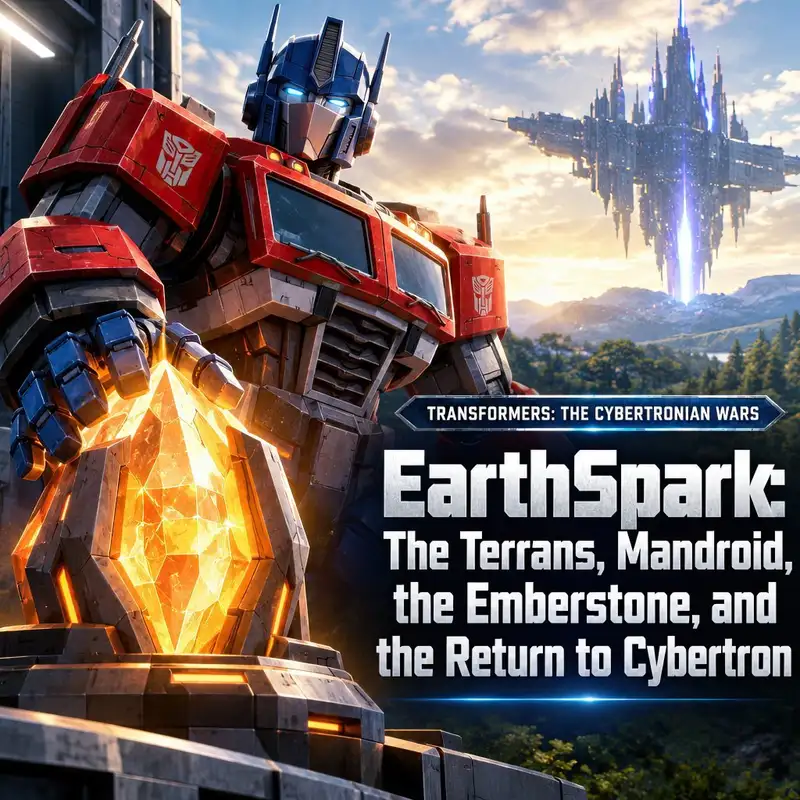
EarthSpark: The Terrans, Mandroid, the Emberstone, and the Return to Cybertron
Robby and Mo Malto reach Cybertron at the worst possible moment to call it a homecoming. Their cyber-sleeves, the devices that once linked them so closely to the Terrans, are gone. Hot Rod has taken the Emberstone ahead of them. And the world waiting beyond their route is not a restored capital of Cybertronian civilization. Near the ruins of Praxus, they find a planet weakened by Energon scarcity, divided by armed loyalties, and haunted by institutions that survived the war more easily than the people who depended on them.
That reversal gives EarthSpark its sharpest political idea. The Earth-born Transformers are trying to save Cybertron, a world they never knew. Meanwhile, many Cybertronians still living on that world have been reduced to dependence on whoever controls fuel, ancient technology, and the routes between worlds. The question is no longer whether Cybertron can be reached. It is whether it can become a place worth reaching.
This is the EarthSpark continuity, a postwar history in which the Autobot-Decepticon conflict has ended on Earth after the destruction of the space bridge to Cybertron. The war remains close enough to shape human fear, Cybertronian politics, and daily security. But it is no longer a simple contest between two uniform armies. Former enemies live alongside one another, human institutions are trying to define their relationship with Cybertronian refugees and allies, and a new generation has appeared outside the old political order.
The Terrans are central to that change. They are not Cybertronian refugees who arrived on Earth in new bodies. They are not Autobots or Decepticons by biological inheritance. They are sentient transforming beings born on Earth through a process linked to the Emberstone, an artifact associated with Quintus Prime. Their existence does not erase Cybertronian history. It exposes how much of that history depended on the assumption that origin, faction, and destiny were all tied to the same planet.
The return to Cybertron makes that challenge impossible to ignore. A homeland can be sacred, familiar, and still unable to protect its people. It can possess ancient authority while lacking legitimate government. It can hold the memory of a civilization while no longer sustaining the conditions needed for that civilization to live. EarthSpark does not treat the Terrans as a replacement for Cybertron. It treats them as a test of whether Cybertron can learn to stop turning life into something to be owned, classified, recruited, or consumed.
That story begins not in a grand Cybertronian archive, but under a small town in Pennsylvania. Beneath the land that becomes Witwicky rests the Emberstone. Its full origin, history, and limits are not laid out as a complete theory of Transformer creation. The series is careful on that point. The Emberstone is associated with Quintus Prime, and it can generate new life, but it is not presented as the one source of all Cybertronians or as a universally understood machine.
What matters first is what happens when Robby and Mo Malto encounter it. Its activation creates Twitch and Thrash from water and local Earth material. Their arrival is extraordinary, but the scene is not organized around military utility. No commander receives new soldiers. No government issues registration forms. No scientist presents a production plan. Two children meet two newly created beings who are conscious, uncertain, energetic, and immediately capable of shaping the emotional life of the household around them.
The Emberstone also creates cyber-sleeves for Robby and Mo. These establish an unusual emotional connection between the human siblings and the Terrans. The connection is significant, but it should not be mistaken for ownership. Robby and Mo do not issue commands into another mind. They do not possess Twitch and Thrash as equipment. The cyber-sleeves create proximity, shared feeling, and a degree of mutual vulnerability. They make the relationship more intimate, not less equal.
The distinction matters because the rest of the series repeatedly asks who has the right to define a new form of life. The easiest answer would have been that the children who activated the Emberstone own what it created. EarthSpark rejects that. The Maltos become family because they accept duties of care, protection, explanation, and shared risk. That is a very different claim from possession. It is less tidy, more demanding, and far more durable.
Twitch and Thrash are born into a world already marked by the old war, but they do not inherit its loyalties automatically. They encounter Autobots, Decepticons, human agencies, military fears, and Cybertronian legends as part of their environment. Those things matter to them. Yet none of them fully defines what the Terrans are. Their first language of belonging is not a military insignia. It is family, neighborhood, school, friendship, and the practical experience of learning how to live safely in a place that did not expect them.
Other Terrans follow. Hashtag, Jawbreaker, and Nightshade broaden the meaning of the group. They do not function as identical products of one process, nor as a ready-made unit with a common temperament. Each develops through different interests, relationships, and choices. That diversity is politically important. It prevents the Terrans from becoming a simple symbol of innocence or a replacement faction waiting to acquire a flag.
The older Cybertronian conflict was organized around powerful inherited identities. Autobot and Decepticon are political and military categories in this continuity, not separate species. But after years of war, those categories have become deeply embedded in reputation, fear, chain of command, and public expectation. A Cybertronian who once wore one symbol may be treated as permanently defined by it. A human who suffered during the war may see all Cybertronians through the threat posed by the most violent among them.
The Terrans arrive before they can be sorted into those familiar files. They have no personal memory of Cybertron’s old institutions. They do not carry the combat record of a former Autobot soldier or a former Decepticon operative. They have to learn the consequences of those identities from the people around them. In doing so, they reveal a difficult truth. A society that can imagine only two inherited camps has little room for people who were never part of either.
The Maltos do not solve that problem by pretending politics do not exist. Dot Malto understands the responsibilities and dangers surrounding Cybertronian activity. Alex provides a home where curiosity and caution must coexist. Robby and Mo grow into the unsettling reality that their closest companions may be drawn into conflicts larger than any family can control. But the household’s answer is not to turn the Terrans into assets. It is to insist that the Terrans are persons before they are strategic possibilities.
That approach creates a form of legitimacy that no relic can manufacture. The Maltos cannot grant the Terrans official citizenship across every human jurisdiction. They cannot settle the legal standing of a new sentient population by themselves. But they show what political recognition looks like at the human scale. It means asking what the Terrans need. It means accepting that their choices may be inconvenient or frightening. It means protecting them without demanding that protection become obedience.
For a time, that family structure gives the Terrans room to develop. Then Dr. Meridian, known as Mandroid, turns their existence into proof of everything he fears. Mandroid is more than a villain who dislikes Transformers. He is a human shaped by the Cybertronian war and by the belief that human survival requires permanent control over Cybertronian presence on Earth. His experience gives his fear a political vocabulary. It does not make his conclusions sound.
Mandroid’s program begins with surveillance, capture, and exploitation of Cybertronian technology. He sees the technological gap between humans and Cybertronians as an unacceptable security risk. There is a real problem beneath that fear. A human community living near powerful alien machines has every reason to worry about weapons, collateral damage, covert movement, and the possibility that another war could begin without warning. The failure comes when Mandroid treats fear as a license to abandon every distinction among allies, civilians, former combatants, and children.
His Arachnamechs and larger mechanized systems demonstrate that human institutions can adapt captured Cybertronian technology into coercive power. But capture is not the same as understanding. Mandroid can weaponize what he has taken. That does not mean humanity has acquired a stable industrial capacity to reproduce Cybertronian civilization. His strength is concentrated in specialized systems, secrecy, and obsession. It is a dangerous capability, but not a sustainable foundation for a secure political order.
Mandroid’s rhetoric is protective. He presents himself as someone defending Earth from a threat others are too naive to see. Yet his conduct moves toward elimination. Cybertronians become targets as a category. The Terrans become unacceptable because their birth proves that Cybertronian life can emerge on Earth beyond human control. The Malto family becomes suspect because it refuses to treat coexistence as surrender. This is how security politics hardens into extremism. The threat is defined so broadly that no peaceful relationship can ever satisfy the policy.
Witwicky suffers under that pressure as a civilian place. It is more than a map location where large machines can fight without consequence. It is a town with homes, schools, roads, local memories, and people who did not volunteer to become the center of an interspecies security crisis. When a hidden conflict turns a community into an operational zone, civilians lose more than physical safety. They lose confidence that ordinary life will remain ordinary.
Mandroid understands the value of intimidation. He also understands the power of hostage-taking. In the first major crisis, he captures Dot Malto and Megatron. The choice is revealing. Dot represents the human family that has embraced the Terrans. Megatron represents the uncomfortable possibility of postwar cooperation between a former Decepticon leader and his old enemy, Optimus Prime. By taking both, Mandroid tries to prove that trust is a weakness and that coexistence can be broken through coercion.
The response comes from a coalition that would have seemed improbable during the war. The Maltos, the Terrans, Autobots, and Megatron act together against Mandroid’s weaponized platform. This is a tactical success. The immediate threat is stopped, hostages are recovered, and Mandroid’s effort to impose a human monopoly on security fails. But the episode’s deeper point is that the coalition succeeds because its members accept mutual dependence rather than denying it.
Megatron’s role matters precisely because the old factional categories remain morally and politically charged. His participation does not erase what he was, nor does it make every Decepticon trustworthy. It demonstrates something more limited and more useful. Postwar peace cannot be built if every former enemy is treated as permanently incapable of changing, and it cannot be protected if change is accepted without judgment. Alliance requires both caution and the willingness to recognize conduct in the present.
The victory over Mandroid does not create a settled peace. His technology, methods, and fears do not vanish because one platform is defeated. The distrust between humans and Cybertronians remains. Decepticon politics remain divided. And the battle destroys the Emberstone. That loss is more than a dramatic broken artifact. It transforms the political problem. What had been one guarded source of new life becomes a scattered field of fragments, each carrying promise, danger, and leverage.
A year later, the fragment hunt has become a contest over the future. The Emberstone pieces are valuable not because anyone has proven they can be used without limit, but because they appear to offer access to immense potential. They may create life. They may provide power. They may determine whether Terrans can remain independent of older Cybertronian institutions. In a postwar environment, that combination makes them irresistible to anyone seeking influence.
The phrase limitless power is always useful to someone who wants a relic. It is less useful to the people who must transport, secure, study, and survive near it. The fragments have to be located. They have to be protected from theft. Their effects have to be understood before activation. A fragment that can change a body, awaken a system, or create a new being is more than an energy source. It is a political hazard. Its custody matters as much as its raw capability.
The destruction of the Emberstone also changes the ethics of creation. A whole artifact had already raised difficult questions. Who could safely use it? Who could decide when life should be created? Could any institution hold such a power without turning persons into a resource? Fragmentation makes those questions more urgent because it distributes power without distributing wisdom. Different actors can now seek separate pieces, pursue separate objectives, and create consequences no one fully controls.
The Chaos Terrans emerge from that damaged environment. Aftermath and Spitfire are created through corrupted Emberstone fragments. Their existence should not be treated as a simple warning that Terrans are inherently unstable or dangerous. They are people whose origins have been shaped by damaged material, conflict, and the pressures of others trying to use them. That makes their situation morally serious. It does not reduce them to monsters.
The precise biological or metaphysical process behind their creation remains only partly explained. EarthSpark establishes that the corrupted fragments matter. It does not offer a complete scientific account of how those fragments alter personality, energy, development, or choice. That uncertainty is important. It prevents an easy conclusion that corruption equals destiny. A damaged origin can create real constraints and risks, but it does not erase personhood or make exploitation acceptable.
The Chaos Terrans expose the false comfort of treating creation as neutral. The Emberstone does not arrive in a peaceful world with a public system of care, consent, and accountability. It exists amid fear, military ambition, factional competition, and incomplete knowledge. Under those conditions, even the creation of life can become part of a struggle for control. The question is no longer only whether the artifact can make a Terran. It is whether anyone around that Terran is prepared to let them become themselves.
Starscream sees the fragments differently. To him, the Emberstone is not primarily a responsibility toward new life. It is an instrument for seizing power. In the aftermath of the war, he leads a Decepticon faction, but that faction should not be mistaken for all Decepticons. Megatron’s postwar choices, Hot Rod’s later defection, and the varied conduct of other Decepticons all show that the old label no longer guarantees a single political program.
Starscream’s plan centers on Terratronus, a massive Earth-born Titan Terran beneath the Witwicky area. Terratronus is not evidence that every planet conceals a giant Transformer, nor is it simply a weapon waiting for whoever can find the right control panel. It is a singular and consequential presence. Its location means that a local community sits above a planetary-scale capability it never asked to host.
By combining the Emberstone’s power with Terratronus, Starscream seeks to transform Earth into a New Cybertron. The phrase sounds restorative. Its content is conquest. Earth is not an empty industrial site waiting to be improved by Cybertronian engineering. It is an inhabited world with human communities, Terrans, ecosystems, governments, and its own claims to political independence. A plan to remake it from above is not reconstruction. It is domination disguised as renewal.
Starscream’s strategy also misunderstands what made Cybertron’s old world fail. A Titan can change terrain. It can threaten cities, interrupt infrastructure, and give its controller enormous leverage. But it cannot produce consent. It cannot repair trust between former enemies. It cannot distribute Energon fairly, rebuild institutions, or persuade civilians that their lives will be safer under a ruler who treats their planet as raw material.
For Witwicky, the threat is immediate. The town faces enclosure, instability, and the possible loss of all local control. Its people are once again caught between actors who speak in planetary terms while imposing danger on ordinary homes. The Terrans face a related danger. A plan supposedly intended to create a new Cybertron would place their own Earth-born identity under the authority of a leader who sees them mainly as proof that the Emberstone can be turned into a political machine.
The effort to stop Starscream confirms a recurring lesson of EarthSpark. Tactical capability and political legitimacy are different things. A force can possess a Titan, a fragment, a captured laboratory, or a temporary alliance. None of those automatically creates a durable right to rule. In fact, attempts to substitute artifacts for legitimacy usually reveal how weak the underlying political project has become.
The later crisis around Witwicky expands beyond one town, but it does not abandon the local stakes. The Chaos Dome divides the area and traps Decepticons inside. Prowl arrives. A crashed Autobot starship and Quintus-related power widen the historical frame. The Hypershuttle becomes part of the struggle over whether isolated communities can reconnect. These events matter because mobility determines politics. The side that can move people, artifacts, information, and aid can shape who remains trapped and who gains a future.
Space bridges, spacecraft, and specialized routes are never merely transportation in this setting. The old bridge’s destruction helped end the conventional war on Earth, but it also cut Earth off from Cybertron. That separation created safety for some and isolation for others. It prevented immediate reinvasion, yet it also meant that Earth-based Cybertronians and Terrans developed their own political reality apart from a homeworld they could no longer easily reach.
The loss of the cyber-sleeves adds another form of separation. Robby and Mo have relied on their link with the Terrans not as a command channel, but as a source of emotional understanding and mutual confidence. When that connection disappears, the absence is personal. It is also operational. The group must act without an advantage it had come to trust. Misunderstanding becomes easier. Separation becomes more painful. The humans must learn how to support the Terrans without assuming they can feel what the Terrans feel.
That is why the journey toward Cybertron is not a ceremonial return. Robby and Mo do not travel as heirs claiming a birthright. They travel as members of a fractured coalition pursuing Hot Rod and the Emberstone, trying to prevent a dangerous concentration of power. The mission carries them toward a world that has become a political vacuum, where old authority has not disappeared so much as become available to whoever can exploit exhaustion.
Cybertron’s condition is devastating because it is both physical and institutional. The loss of the AllSpark and severe Energon depletion have left the planet weakened. Praxus stands in ruins. The Well of Sparks carries immense symbolic weight, but symbolism alone does not operate an energy grid, repair damaged bodies, or feed a population dependent on Energon. Cybertron’s surviving inhabitants are not just waiting for a hero to switch the world back on.
Liege Maximo takes advantage of that vulnerability. This EarthSpark version of Liege is a surviving Prime-era authoritarian, not a figure imported from another Transformers history. His claim rests on ancient status, control of Prime artifacts, access to the Matrix, and the Web of Worlds. He presents himself as the architect of security and future abundance. Yet his system depends on withholding the very resources his followers need to survive.
Energon scarcity becomes his command structure. Those who need fuel must serve those who distribute it. Those who need protection must accept the terms of the force claiming to provide protection. Those who need access to another world must submit to the authority controlling the route. It is a familiar form of rule, even if the machinery is ancient and the stakes extend across planets. Dependency replaces consent.
Liege’s Web of Worlds raises the scale of the danger. He seeks access to inhabited worlds not as equal partners, but as sources to be converted into Energon for his expanding empire. The exact reach and workings of the network are not fully mapped. What is clear is its political logic. Life on other worlds becomes fuel. Territory becomes supply. Travel becomes extraction. A system that claims to save Cybertron does so by placing the survival of other populations beneath Cybertron’s needs.
This is not restoration. It is the old failure, made larger. Cybertron’s damage becomes an excuse for empire, and Energon scarcity becomes an excuse for permanent emergency rule. Liege does not need every survivor to believe in him. He needs enough people to lack alternatives. Hunger, fuel deprivation, and isolation can produce obedience more reliably than ideology.
Hot Rod’s desertion reveals the weakness inside that system. He is not just changing sides in a simple factional drama. His choice demonstrates that Liege’s coalition is held together by coercion and constrained options, not by stable common purpose. Once an alternative becomes credible, the appearance of unity begins to crack. A force built around dependence may look disciplined. It is often brittle, because its members are measuring the cost of staying.
The final alliance against Liege is therefore significant not because it gathers every familiar name into one battle, but because it joins people whose old categories no longer explain their choices. Autobots, Decepticons, Terrans, the Maltos, Prowl, Hot Rod, and other opposing forces act against a system that threatens Earth, Cybertron, and any world caught in the Web of Worlds. Their cooperation does not erase mistrust. It creates a practical answer to it.
The Matrix, the Prime artifacts, the cyber-sleeves, and Terran-human cooperation each play distinct roles. They should not be collapsed into one grand source of power. The Matrix is not the Emberstone. The Emberstone is not the Well of Sparks. The cyber-sleeves are not a Prime artifact, and human family bonds are not a substitute for technology. The final struggle works because different forms of connection and capability are brought together without pretending they are the same thing.
Liege’s defeat is also more than the fall of one powerful individual. His system depends on artifact-backed extraction, control of access, and the belief that no one can survive without him. When the coalition breaks that structure, it proves that alternatives exist. It interrupts his ability to convert worlds into resources. It denies him exclusive control over the future. That is a strategic victory, not just a successful duel.
Still, victory carries damage. Megatron is exposed to the Blades of Time and reverts toward an earlier, more hostile identity. The ending does not confirm his permanent death. It does not prove that every part of his later change has been erased forever. It does not guarantee recovery. What it shows is that personhood in this continuity remains vulnerable to forces that can disturb memory, identity, and the hard-won choices that gave a former enemy a different future.
That unresolved condition matters because EarthSpark has never argued that peace comes from forgetting the past. Megatron’s story shows how difficult transformation can be, especially after a lifetime of war and command. A political order that depends on individuals remaining perfectly healed, perfectly loyal, and perfectly understood will fail. Reconstruction has to account for instability. It has to build institutions that can respond to trauma, betrayal, and uncertainty without immediately returning to collective punishment.
The Terrans offer no magical solution to those problems. They do not arrive on Cybertron with enough power to restore every city or enough wisdom to settle every political dispute. What they offer is a different starting point. They were born outside the old factional inheritance. Their earliest experience of belonging was not recruitment into an army. It was a family learning, often imperfectly, how to care for people it did not fully understand.
That does not make the Maltos rulers of a new Cybertronian future. It makes their example politically useful. They show that authority can be earned through responsibility rather than inherited through title, force, or access to an artifact. They show that a person can be protected without becoming property. They show that difference does not have to become a security category. And they show that shared vulnerability can produce solidarity stronger than fear.
The outcomes of the final conflict are uneven, as real postwar outcomes usually are. Tactically, Liege Maximo is defeated. Operationally, alliances and routes between isolated communities reopen. Strategically, his effort to extend an extractive empire across inhabited worlds is checked. Politically, Cybertron remains a damaged society that must decide who receives Energon, who holds authority, how former enemies are treated, and how civilians can live without dependence on another strongman.
Socially, the Terrans have changed the argument. They demonstrate that Transformer identity need not begin with Cybertron, faction inheritance, or service in a war. They are Earth-born, but that does not make them less real. They are connected to humans, but that does not make them human property. They are linked to Cybertronian life, but they are not required to reproduce Cybertron’s old political failures.
Cybertron’s reconstruction will demand more than reclaiming relics. It will require Energon distribution that cannot be used as a private weapon. It will require repair facilities, secure transport, accountable leadership, and civilian protection. It will require a way for Autobots, Decepticons, Terrans, and those who reject old faction identities to exist without every disagreement becoming a return to war. A world can be technologically restored and still remain politically broken.
The return to Cybertron does not establish the old world as the natural center of Transformer identity. It reveals how badly that world needs to change. The Terrans matter because they were born beyond its inherited divisions, and because their future asks whether a damaged civilization can build belonging without once again turning life itself into a resource to be controlled.