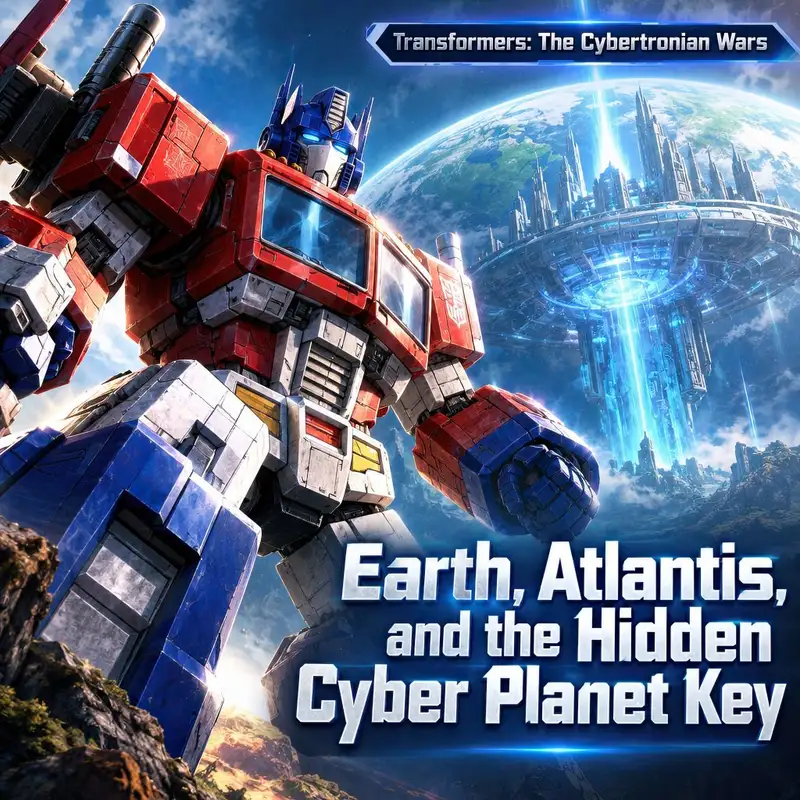
Earth, Atlantis, and the Hidden Cyber Planet Key
Beneath the Arctic ice, Starscream’s campaign reached a point where brute force was less useful than information. He and Sideways were hunting two Autobots who knew Earth in ways the newly arrived refugees did not. Crosswise had guarded an ancient prison. Evac had guarded something more important still: Earth’s Cyber Planet Key. The Decepticons believed that pressure, pursuit, and the threat of released prisoners could force those guardians to reveal its location. The prize was not buried in Atlantis. Atlantis had already yielded a different strategic device, the Omega Lock. Earth’s own Key had been concealed elsewhere, under separate protection, because this planet had been part of a much older Cybertronian design.
In the English-language Transformers: Cybertron history, that distinction matters. Atlantis was an ancient Cybertronian colony vessel. The Omega Lock was hidden aboard that vessel. The Earth Planet Key was guarded independently by Evac in the Arctic region. Each object had a different purpose, a different custodian, and a different role in the campaign. Treating them as one lost treasure obscures why the conflict on Earth became so prolonged. Neither faction could simply discover one ruin, seize one artifact, and solve the wider crisis. They had to reconstruct a damaged system while fighting one another and while trying, at least at first, not to turn Earth into an open battlefield.
The immediate pressure behind that search was the black hole threatening Cybertron and the wider universe. In the English Unicron Trilogy, the danger emerges after Unicron’s destruction in the preceding Energon history. Cybertron had survived one catastrophe only to face another that could not be defeated through ordinary battlefield methods. The Autobots who arrived on Earth were therefore not explorers arriving by choice, nor an occupation force seeking territory. They were evacuees, investigators, and soldiers looking for a solution to a crisis that exceeded the resources already available to them.
That status shaped their early conduct. Optimus Prime commanded a force that needed Earth as a base but had no mandate to rule it. The Autobots could move through human territory, adopt local vehicle forms, and hide among civilian infrastructure, but disguise did not create political permission. Their presence carried risks for the people around them. A fight near a road, a school, a town, or a military installation could expose both Cybertronian activity and the human allies who had become involved in it.
Coby Hansen, Bud Hansen, and Lori were important precisely because the Autobots could not operate on Earth as though it were an empty map. The children understood local roads, local institutions, local expectations, and the practical difference between a concealed alien presence and a public emergency. They also provided technical improvisation and access that Cybertronian refugees did not possess on their own. Their value was more than personal loyalty. They helped bridge the gap between a planetary war and the ordinary human spaces where that war was beginning to intrude.
The Autobots’ original hope was that the crisis could be managed discreetly. That was always a fragile assumption. They had limited knowledge of Earth’s deeper connection to Cybertron, incomplete intelligence on Decepticon plans, and no secure way to know which old systems remained active. Their mission depended on recovering artifacts whose locations had been obscured by time, disaster, and fractured historical memory. In military terms, they had an urgent strategic objective but only partial maps, uncertain lines of communication, and a host population that had not consented to becoming part of the operation.
The principal guide to that older history was Vector Prime. He was more than another Autobot field officer. He carried specialized knowledge of Cybertron’s past and of the system that connected the Cyber Planet Keys to the Omega Lock. His role was advisory, technical, and historical. He could explain why the artifacts mattered, but explanation did not automatically produce control. Ancient infrastructure still had to be located, activated, defended, and understood under combat conditions.
Vector Prime described a project built around four Cyber Planet Keys and the Omega Lock. The keys were associated with Earth, Velocitron, Jungle Planet, and Giant Planet. Together, they were connected to a larger network intended to link distant worlds through space bridges. The system was not designed merely as a collection of relics. It was infrastructure on an interplanetary scale. It created routes, relationships, and points of access between worlds that would otherwise remain divided by vast distances.
That design helps explain why Earth mattered. It was not selected because it happened to be convenient for the modern Autobots. It had been chosen long before their arrival as one of several worlds tied to a distributed Cybertronian network. The planet was a node, not an accident. Its importance was latent rather than obvious. Most humans did not know it. The modern Autobots did not fully understand it at first. But the artifacts and the surviving Cybertronians connected to them revealed that Earth had been integrated into Cybertronian strategic planning in the distant past.
A network spread across multiple worlds also has an important military quality: redundancy. No single ship, city, or commander could control the entire system merely by holding one piece of it. That made the network resilient against a single disaster, but it also made recovery difficult. The parts had to be assembled in the correct relationship. The Omega Lock required the Keys. The Keys had to be found. The routes had to be opened. And every discovery created a new target for an enemy force that understood, at minimum, that the artifacts could shift the balance of power.
Later reference material identifies a group of ancient colony ships associated with that project. The series itself establishes the broader campaign and the surviving evidence without providing a complete operational history for every vessel. That uncertainty is useful to keep in view. The modern Autobots were not recovering a neatly cataloged archive. They were reconstructing a broken strategic system from inscriptions, legends, ruins, and the knowledge held by a very small number of survivors.
The first clues did not arrive as a clear map. The Autobots encountered recurring patterns connected to Atlantis, along with inscriptions that seemed to point toward forgotten Cybertronian activity on Earth. Such evidence was valuable, but it was also easy to misread. One important inscription was not the Omega Lock itself, nor was it a direct path to Earth’s Key. It provided information connected to the Jungle Planet Key. The symbol of Atlantis functioned as part of a larger navigational and historical record, not as a simple marker saying that every answer lay in one underwater location.
That is a familiar intelligence problem. Ancient evidence often survives in fragments. A symbol may identify an expedition, a route, a warning, a cultural memory, or a maintenance system. It does not explain itself. The Autobots had to determine which clues referred to a physical location, which referred to a distant planet, and which represented older layers of history. Megatron’s forces faced the same problem. Both sides possessed enough information to act, but neither possessed enough to avoid mistakes.
The search eventually led to the waters near the Bermuda Triangle. There, the ruins associated in human legend with Atlantis were revealed not to be a lost human civilization or a literal sunken continent. They were the remains of an immense Cybertronian vessel. Atlantis had crashed on Earth in the distant past, and its presence helped create a distorted human memory of an advanced place swallowed by the sea. The legend preserved an echo of a real event, but not a reliable technical record.
The discovery transformed Atlantis from a myth into an operational asset. It was an ancient colony ship, carrying the weight of an earlier Cybertronian project and retaining systems that could still matter in the present crisis. It was also vulnerable. A vessel hidden beneath the sea could be difficult to find, but once found, it became a fixed target. Its value made concealment more difficult, and its age made every activation potentially dangerous. An old ship can contain knowledge, transport capacity, weapons, defenses, and automated safeguards. It can also contain failure points that no surviving operator fully understands.
When Megatron threatened to seize Atlantis, Vector Prime did more than defend the vessel in place. He activated it and moved it away from Earth. That decision was strategically sound. Leaving the ship at the underwater site would have allowed the Decepticons to concentrate on a known objective. Moving it denied them immediate control, preserved the possibility of recovery, and prevented Earth from becoming the permanent location of a fight over a powerful ancient asset.
The relocation also established a limit that matters throughout the series. Cybertronian strategic mobility is extraordinary, but it is not magic without constraints. Atlantis was enormous, ancient, and damaged by its long history beneath the sea. Its emergency warp did not carry it to some unreachable corner of the galaxy. It moved to a nearby hiding place behind the Moon. That position offered concealment while remaining within plausible reach of the original site. The vessel’s mass and condition limited what could be done in an emergency.
Behind the Moon, Atlantis became both refuge and trap. It was close enough for the Autobots to reach, distant enough to keep it temporarily out of human sight, and isolated enough that any fight inside it would be difficult to reinforce or escape. The ship’s survival did not mean it had become a reliable base. It remained contested infrastructure. Its systems had to be awakened, interpreted, and secured before the Autobots could use them with confidence.
The purpose of that operation was the Omega Lock. The device was more than resting in an open compartment waiting for its discoverers. The Autobots had to activate a sequence of pedestals before the Lock emerged. That requirement suggests that the ancient designers had not intended casual access. Whether the sequence was a security measure, an activation ritual, or both, its effect in the present was clear. The device could not be recovered by a simple salvage crew. It required knowledge, timing, and access to the ship’s internal systems.
Megatron understood the value of the moment. Once the Omega Lock emerged, he seized it. His action turned the recovery effort into a contest inside a failing installation. Atlantis’s security system responded after the Lock was removed, and the ship began a self-destruct sequence. The ancient vessel had been built to protect something more significant than its own continued existence. If the Lock could not remain secure, the ship would deny the enemy the wider asset.
That self-destruct sequence changed the character of the fight. Optimus Prime and Megatron were no longer dueling on open ground, where retreat, reinforcement, or maneuver might be possible. They were inside a collapsing ship with a shrinking window for escape. The tactical problem was more than to defeat Megatron. Optimus had to recover the Omega Lock, prevent its loss, and leave the vessel before its destruction removed everyone involved from the campaign.
Optimus succeeded in the most immediate sense. He regained the Omega Lock and escaped Atlantis. Megatron appeared to be destroyed in the explosion. But the later series establishes that Megatron returns as Galvatron, so the event cannot be treated as a confirmed permanent death. What matters at that moment is the uncertainty. The Decepticon command structure had lost its central figure, at least from the perspective of those present. That apparent loss would create opportunities for rivals, especially Starscream, whose ambitions had never been comfortably contained within another commander’s plans.
The operational outcome at Atlantis was mixed. The Autobots obtained the Omega Lock, which was essential to their larger mission. Yet they lost Atlantis itself. The ship could no longer serve as a sanctuary, archive, transport platform, or defensible piece of ancient infrastructure. Optimus had won the device but not preserved the installation. This is the difference between a tactical success and a complete strategic success. The mission objective was secured, but a potentially valuable asset was sacrificed in the process.
The Omega Lock then demonstrated why the fight had mattered. It could open a space bridge toward the worlds associated with the scattered Cyber Planet Keys. In practice, it was a strategic-mobility system. It connected the search on Earth to a wider campaign across distant planets. The Lock did not erase distance by itself. It made access possible through a larger network, provided the necessary conditions could be met and the relevant Keys could be recovered.
The first major route led toward Velocitron, the Speed Planet. The details of that campaign belong to its own history, but its relevance here is straightforward. The Autobots’ recovery of the Speed Planet Key proved that Earth’s investigation had opened a path beyond Earth. The Omega Lock was more than an ancient object to be guarded. It was a mechanism that converted archaeological discovery into operational reach.
The Jungle Planet Key later reinforced that point. When it was inserted into the Omega Lock on Earth, the system established a connection to Primus and delivered an instruction about maintaining balance. The event gave the artifacts moral and cosmic significance, but it did not make them self-operating solutions. The Lock still depended on the Keys, the larger system, and the judgment of the people trying to use it. Possession was not the same as understanding. Activation was not the same as mastery.
For the Autobots, that dependence was strategically uncomfortable. Their survival and the wider effort against the black hole relied on a small number of unique objects scattered across worlds. Such a system can create rapid mobility once activated, but it also creates bottlenecks. Whoever controls a Key, a guardian, or the Lock can delay the entire effort. Whoever steals the assembled artifacts can transform a search mission into a crisis of command and access.
The return to Earth’s own Key exposed another layer of the planet’s past. Atlantis had not arrived empty. It had carried Cybertronians who became the ancestors of an Earth-based population. Their presence did not mean that Earth had been quietly ruled by Cybertron for all of human history. It meant that small, hidden, and long-separated Cybertronian communities had existed here long before Optimus Prime’s modern force arrived as refugees.
Among those ancient inhabitants were Decepticons whose activities became entangled with selected human monster legends. The series presents those stories as distorted cultural memories of frightening Cybertronian beings. It does not establish that every human myth, every monster tale, or every old superstition came from Transformers. The point is narrower and more interesting. Human history had absorbed fragments of Cybertronian contact without understanding what had actually occurred.
Those ancient Earth Decepticons were more than members of Megatron’s modern command transported intact from the contemporary war. They belonged to an older local history. Their imprisonment beneath the Arctic ice had been overseen by Crosswise, an Autobot hunter whose mission was containment. Crosswise was also caught in that frozen prison, leaving a security problem in suspension rather than permanently solved. The Arctic held a buried threat, a guardian, and a history that the new arrivals had not created.
This mattered because containment is never only a matter of walls or ice. It depends on continued custody, knowledge of the prisoners, and a force capable of responding when the prison fails. Crosswise had maintained that role as long as he could. But once Starscream and Sideways entered the picture, the old prison became an intelligence opportunity. The ancient Decepticons could provide manpower, local knowledge, and leverage against the Autobots who knew the location of Earth’s Key.
Starscream’s interest in those prisoners was not purely ideological. He needed forces that answered to him rather than to Megatron. The apparent destruction of Megatron aboard Atlantis created a temporary vacuum at the top of Decepticon command. A centralized organization can look formidable while its leader remains present, but the disappearance of that leader often reveals how much authority was personal rather than institutional. Starscream saw a chance to build a power base before anyone else could define the succession.
Sideways was useful in that effort because he operated as more than a conventional subordinate. He manipulated information, encouraged distrust, and pursued his own advantage through the rivalry around him. In any fractured command environment, such a figure can be disproportionately influential. He does not need to command the largest force. He needs access to the right secrets, the ability to shape what rivals believe, and enough mobility to move between factions without becoming tied to one of them too completely.
The release of the ancient Earth Decepticons gave Starscream a temporary force, but it did not give him full control of Earth. Local fighters and imprisoned veterans are not interchangeable with a disciplined army. They may have their own loyalties, grudges, and understanding of the planet. Their value to Starscream was immediate and tactical. They could widen the search, threaten Crosswise, and make the hidden Key harder for the Autobots to protect. But their presence also intensified the danger to civilians and accelerated human awareness that something extraordinary was happening.
Evac stood at the center of that danger. He was the guardian of Earth’s Cyber Planet Key, and unlike the newly arrived Autobots, he had spent a very long time adapting to the planet. He had adopted successive Earth vehicle forms and assisted humans over generations. That did not mean he had public authority over Earth, nor that every human institution knew his history. It did mean he had acquired local relationships and local legitimacy that Optimus Prime’s refugee command could not claim overnight.
Colonel Franklin’s connection to Evac shows that human awareness was not uniform. Some authorities had encountered evidence of Cybertronian activity before the main Autobot presence became impossible to ignore. Others remained skeptical, uninformed, or focused on immediate threats rather than ancient history. Earth did not possess one unified human policy toward Cybertronians. It had individuals, families, military personnel, and institutions responding from different positions of knowledge and fear.
That complexity matters because Earth was never an empty staging ground. It had its own governments, its own civilians, and its own right to resist being transformed into a battlefield by outsiders. It also had older Cybertronian residents whose loyalties and obligations had developed locally. Evac’s role was more than to hold an artifact until Optimus arrived. He had preserved a responsibility across an immense span of time, while living among the people whose world had become one of the network’s critical nodes.
The Earth Key was therefore guarded separately for a reason. Atlantis had protected the Omega Lock, a device that could connect the larger system. Evac guarded Earth’s credential within that system. Crosswise guarded an Arctic prison containing a distinct local threat. The responsibilities were dispersed. That arrangement complicated any attempt at conquest. An enemy could seize a ship and still lack the Key. An enemy could locate a guardian and still need the Lock. An enemy could release prisoners and still have to force cooperation from the people who knew where the final objective lay.
From the Autobots’ perspective, the separation was frustrating but protective. It prevented a single breach from collapsing the whole network. From Starscream’s perspective, it made coercion attractive. If he could not locate the Key through ordinary reconnaissance, he could hunt Evac and Crosswise. If he could not compel them directly, he could use the ancient Decepticons, Sideways’s manipulation, and the threat of public destruction to narrow their choices.
This was a campaign of intelligence pressure as much as open combat. Starscream did not need complete knowledge at the beginning. He needed enough knowledge to identify likely custodians and enough violence to force movement. Guardians protecting a hidden asset eventually have to travel, communicate, seek assistance, or react to danger. Each action can reveal a pattern. The challenge for Crosswise and Evac was to preserve secrecy while operating under conditions that made secrecy increasingly difficult.
The Autobots faced a related command problem. Optimus Prime had to pursue the Keys and protect the Omega Lock while keeping faith with human allies who had not asked for this war. His force was mobile, capable, and committed, but it was small and dispersed. Every mission away from Earth created risk at home. Every battle on Earth risked exposure. Every attempt to protect the human children could give Decepticons another leverage point.
The situation came to a head when Evac carried the Earth Planet Key toward the Autobots. That movement was necessary. A hidden Key is secure only as long as its guardian can remain hidden. Once the wider network had begun to activate, leaving the Key isolated became dangerous. Yet transporting it created a predictable opportunity for interception. Starscream ambushed Evac, seeking to take the artifact and to break the remaining separation between the Earth Key, the Omega Lock, and the other recovered Keys.
The battle spread toward Coby’s hometown. At that point, the Autobots’ original concealment strategy was no longer merely strained. It was collapsing. A conflict involving ancient Decepticons, a rogue Decepticon commander, local military authorities, and artifacts capable of altering interplanetary access could not remain invisible indefinitely. The more aggressively Starscream pursued his goal, the more Earth’s civilian spaces became part of the battlefield.
Optimus Prime’s response was more than a retreat from danger. It was a judgment about what kind of victory was acceptable. Continuing to fight around Coby’s home might have offered another chance to hold the Decepticons in place, but it would also normalize the use of a civilian community as combat terrain. The Autobots chose to withdraw rather than allow their human allies’ home to become the center of an escalating Cybertronian war.
That decision carried a cost. Withdrawal can preserve civilians while surrendering initiative. It can reduce immediate damage while allowing an enemy to dictate the next phase of operations. In this case, Starscream gained the advantage he needed. He stole the Omega Lock and the accumulated Cyber Planet Keys. The artifacts that had taken the Autobots across worlds to recover were now in the hands of a commander whose ambitions had grown beyond simple loyalty to Megatron’s old structure.
At close range, Starscream’s seizure was a major Decepticon success. He gained physical control of the devices needed to influence the network. Across the wider campaign, he disrupted Autobot mobility and broke the coherence of their search effort. The Autobots could no longer assume that recovery of one Key would advance their mission. Their achievements had become vulnerable to a single hostile concentration of artifacts.
In strategic terms, Earth’s status changed permanently. It was no longer just the place where Cybertronian refugees had hidden while investigating an ancient mystery. It had been revealed as one of the selected worlds in the old space-bridge network. Its Key mattered to the wider struggle. Its ancient ship had held the Omega Lock. Its Arctic region had concealed both a prison and a guardian. Its human population lived on a planet whose buried history had become relevant to an interstellar crisis.
The political consequences were equally important. Human suspicion and military involvement intensified because Cybertronian conflict was no longer confined to rumor, isolated sightings, or quiet cooperation with a few allies. Colonel Franklin and other authorities had to respond to a threat that crossed jurisdictions and categories. It was alien, but it operated in human territory. It involved disguised vehicles, ancient ruins, armed factions, and civilians who could not be expected to distinguish a refugee Autobot from a pursuing Decepticon in the middle of an attack.
For Coby, Bud, Lori, and their community, the transformation was even more immediate. The war had entered spaces that were supposed to remain ordinary. A hometown is not strategically insignificant merely because it has no fortress or spaceport. It matters because people live there. It contains family, routines, roads, schools, and the trust that allows civilians to believe they will not be used as cover by combatants. Once that trust is endangered, an alliance with outsiders becomes harder to sustain.
Earth became strategically indispensable because it had never truly been a random refuge. It was an ancient, deliberately selected point in a distributed Cybertronian infrastructure. Yet the system’s strength lay in separation. Atlantis preserved the Omega Lock. Evac guarded Earth’s Planet Key elsewhere. Crosswise contained an older local threat. Human institutions retained their own authority and their own fears. No single discovery could deliver complete control, but every piece of the system drew the wider war deeper into Earth’s life.
That dispersion prevented either faction from winning through one dramatic discovery. It also ensured that the black-hole crisis could no longer remain hidden from the people living near its consequences. Earth was more than the place where the Autobots found a clue. It was where ancient infrastructure, rival command, human memory, and civilian responsibility converged, turning a temporary sanctuary into a strategic theater that no responsible commander could treat as empty ground.