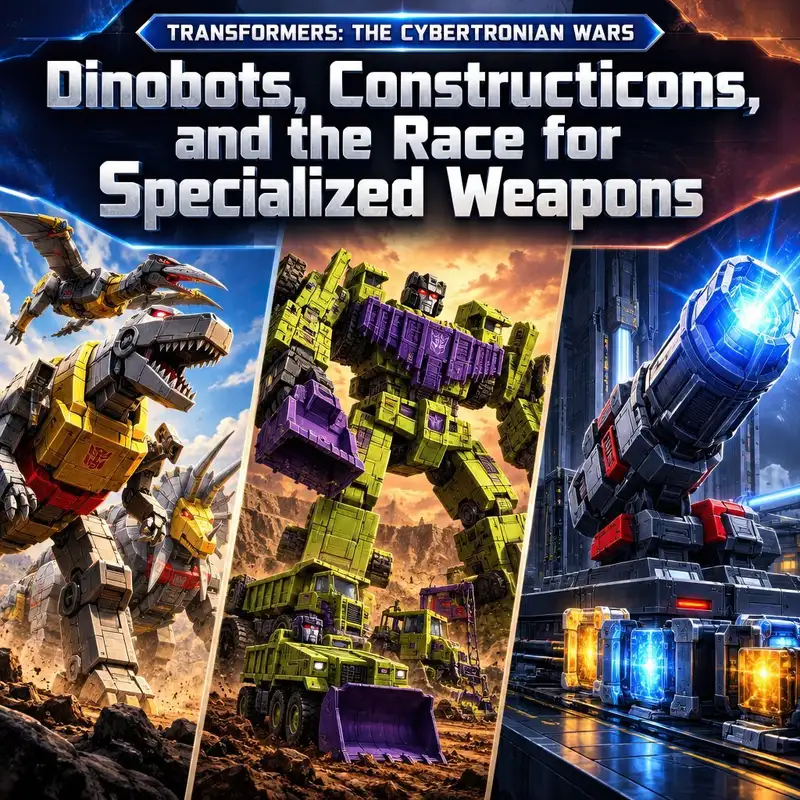
Dinobots, Constructicons, and the Race for Specialized Weapons
Grimlock, Slag, and Sludge had become a danger inside the Autobot base before they had ever faced the Decepticons in battle. Built from dinosaur fossils discovered beneath the base, the three new warriors were immensely strong, difficult to damage, and almost impossible to direct. Their first actions caused destruction among the very Autobots who had created them. Optimus Prime’s response was blunt. Shut them down. With a Decepticon attack approaching, that decision looked almost perverse. Yet Optimus was confronting a problem every military organization eventually faces. It is not enough to create a weapon. Someone must be able to command it.
In the American animated history of the nineteen eighties, the Dinobots and Constructicons were not just colorful specialist teams. They represented competing ways of converting unusual bodies, technical knowledge, and industrial capacity into military advantage. The Dinobots were built as concentrated assault power. The Constructicons brought excavation, construction, and engineering into the Decepticon war effort, then combined into Devastator when direct violence was required. Neither group was a conventional unit, and that was precisely the point. Their value came from doing things ordinary Autobots and Decepticons could not easily do.
This was not a formally declared arms race in the cartoon. No treaty collapsed, no procurement board issued a report, and no one announced a competition for specialized weapons. But the pattern is clear. The Autobots sought battlefield power that could survive and strike hard. Megatron sought forces able to penetrate defenses, seize infrastructure, concentrate power, and exploit weakness. Both factions learned that specialized capability could transform a local battle. Both also learned that power without loyalty, sustainment, intelligence, and control could become a liability.
Wheeljack and Ratchet saw the dinosaur fossils beneath the Autobot base and recognized a possible answer to an immediate military problem. They used those prehistoric forms as templates for new Cybertronian warriors. The result was not an attempt to recreate Earth animals for scientific curiosity. The dinosaur bodies offered an imposing physical design for direct combat. Their large frames, heavy limbs, and fearsome appearance made them suited to smashing through defenses and confronting Decepticon forces at close range.
That choice mattered because alternate modes were not just disguises. A truck, car, aircraft, or construction vehicle could move through particular terrain or use local infrastructure. The Dinobots’ forms served another function. They created shock troops. Their purpose was to absorb punishment, intimidate opponents, and break a fight open through overwhelming direct action. The Autobots had created a unit with a narrow but formidable battlefield role.
They had not, however, created a disciplined military formation. Grimlock, Slag, and Sludge displayed crude judgment and poor restraint. Their strength made the problem worse. A poorly trained scout can get lost. A poorly controlled heavy assault unit can tear apart its own base, damage critical equipment, and endanger the personnel expected to support it. Optimus Prime’s shutdown order was therefore not just distrust of innovation. It was a command judgment about risk to the force.
Wheeljack and Ratchet reached a different conclusion. They believed the approaching Decepticon threat made the Dinobots necessary, even if the new warriors remained unreliable. They improved the unit and returned it to action without Optimus’s authorization. Their decision helped save the Autobots in the immediate crisis. It also established a recurring tension within the Autobot command structure. Technical specialists had decided that battlefield necessity outweighed the commander’s order.
That is often how military institutions acquire their most consequential capabilities. Engineers, medics, intelligence officers, and weapons designers usually see possibilities that commanders cannot fully assess from a distance. Sometimes they are right. The Dinobots demonstrated that Wheeljack and Ratchet had identified a real operational need. But the same episode also showed why command authority exists. A useful weapon can still produce unacceptable risks if its designers, maintainers, and operators disagree about who is responsible for controlling it.
The Dinobots’ arrival changed the immediate tactical balance. Their power gave the Autobots a means to resist a Decepticon assault that had threatened to overwhelm the base. Yet tactical success was not the same as operational usefulness. The Dinobots could hit hard, but they did not independently define objectives, secure a route, protect a supply system, or plan a withdrawal. They remained a small specialized formation dependent on the wider Autobot organization.
They required builders to create them, technicians to improve them, and facilities to repair them. Their usefulness also depended on the rest of the Autobots providing intelligence, command decisions, and a strategic purpose. A unit can be exceptionally effective in a fight and still be unable to sustain a campaign. The Dinobots were not a replacement for the Autobots. They were a demanding addition to the Autobot force.
Grimlock became the central challenge. He had authority among the Dinobots, and he clearly understood his group’s physical superiority. But authority inside a small assault unit is not the same as authority within a broader military coalition. Grimlock resisted Optimus’s leadership, questioned the value of orders, and reacted badly to any suggestion that the Dinobots were expendable tools rather than respected partners. In a lighter adventure series, this behavior can appear comic. In military terms, it was a continuing problem of cohesion and command climate.
The Autobots needed the Dinobots because ordinary caution could not always stop a Decepticon attack. They also needed a way to keep the Dinobots inside a common political and military purpose. Raw power made Grimlock difficult to ignore. It did not make him easy to integrate. That distinction became critical when Megatron encountered a problem of his own.
In the episode known as “War of the Dinobots,” a meteor becomes the center of a struggle because it appears to contain a major energy source. The object is important not just because both sides want power. It is important because control of unusual energy can change what forces are able to do, how long they can operate, and what risks commanders are willing to take. Optimus assigns the Dinobots to guard the meteor. It is an obvious employment for heavy troops. They are placed between the Decepticons and a resource too dangerous to leave undefended.
Megatron does not just order a frontal assault and hope that conventional firepower will defeat them. Instead, he studies the Dinobots as people. He identifies Grimlock’s ambition, Slag’s hostility, and the group’s resentment toward Optimus Prime. This is a more sophisticated form of warfare than a direct clash of weapons. Megatron recognizes that a specialized unit with unresolved loyalties can be manipulated from within.
His approach did not require him to prove that the Dinobots were weak. In fact, their strength was what made the operation worthwhile. If he could turn them against Optimus, he would gain more than several powerful fighters. He could divide the Autobot command structure, compromise the defense of the meteor, and demonstrate that Optimus could not control his own most formidable troops. The political value of that humiliation may have been as important as the immediate military gain.
During this crisis, Snarl and Swoop join the Dinobot group. Their arrival expands the unit from three members to five, but it does not create a reliable formal order of battle. The cartoon establishes them as additional specialized warriors, not as a carefully documented military organization with fixed ranks, doctrine, and support requirements. What matters most is that the Dinobots became more capable while their central weakness remained unresolved. More power did not bring more discipline.
Megatron’s manipulation succeeds for a time. The Dinobots turn against Optimus and deliver him to the Decepticons. The moment is revealing because it shows that the problem was never only technical. The Autobots had built the Dinobots, but they had not fully won their trust. A commander can issue orders, but obedience in a coalition depends on legitimacy, respect, communication, and a shared understanding of purpose.
Grimlock does not allow Slag to kill Optimus. That restraint matters. The Dinobots’ break with Autobot command is real, but it is not identical to a settled commitment to Megatron. Their loyalties remain unstable rather than fully transformed. The unstable energy within the meteor eventually defeats Megatron’s larger plan, and the crisis passes. But the episode leaves behind a serious lesson. An elite unit can become politically dangerous when its role, recognition, and place in the command structure are left uncertain.
The Decepticons pursued a different kind of specialization. In “Heavy Metal War,” the Constructicons appear as a newly fielded Decepticon formation. Their alternate modes are construction vehicles, and their contribution to Megatron’s war is much broader than personal combat ability. Construction equipment can move material, excavate earth, demolish obstacles, and work on large structures. In a war fought across hidden bases, laboratories, energy sites, and fortified installations, those are military capabilities.
The Constructicons use their skills to tunnel toward the Ark and Teletraan One. This is more than a dramatic route into the Autobot base: it is an example of engineering serving infiltration. A force that can penetrate beneath defenses may bypass a perimeter, avoid direct battle, and reach a command or intelligence center that would be difficult to seize openly. The target is more than territory: it is access to the system that allows the Autobots to coordinate, detect threats, and understand the battle.
Their construction forms also imply a larger strategic value. Engineers can build facilities, repair damage, move heavy components, and reshape the physical terrain of war. A fighter can destroy an installation. A construction unit can make one usable, change its purpose, or turn its defenses against its original owners. That makes the Constructicons a more scalable threat than a purely assault-oriented team. They can fight, but they can also help create the conditions under which other Decepticons can fight.
The Constructicons then demonstrate their most obvious battlefield advantage. They combine into Devastator. The cartoon never provides a technical manual for the process, nor does it establish precise limits on the combined form’s duration, intelligence, power supply, or internal command arrangement. What it does establish is practical enough. When the Constructicons become Devastator, they produce a much more formidable immediate combat threat than the individual members can provide separately.
Devastator overwhelms the Dinobots during the struggle around the Ark. That result is significant, but it should not be exaggerated into a permanent verdict on either team. The Dinobots had been designed for shock action. Devastator represented a concentrated combination of six specialized engineers. In that moment, the Decepticons had created a heavier local weapon, one capable of overpowering the Autobots’ own heavy assault troops.
Yet Devastator did not decide the operation. Hound uses a holographic projection to distract him. The Decepticons’ apparent advantage in raw force proves vulnerable to deception. This is not a claim that holograms would always defeat Devastator, or that the combined form lacked intelligence. It is a reminder that battlefield strength does not eliminate the need for situational awareness. A powerful unit can still be misdirected when its information picture is false.
The wider Decepticon plan also collapses because the battle was never only about Devastator. Megatron had staged a supposedly honorable duel with Optimus Prime while secretly drawing on the specialized abilities of other Decepticons. Teletraan One uncovers the deception. Once Optimus can expose the fraud, Megatron loses the political and operational advantage he hoped to gain from the duel. Devastator had achieved a local tactical success. Megatron’s larger operation failed.
This distinction is essential. Tactical success means winning a fight at a particular place. Operational success means achieving the wider purpose of the mission. Strategic success means changing the larger war. Devastator gave the Decepticons an immediate battlefield edge. It did not secure the Ark, destroy the Autobot command system, or end the conflict. The Decepticons had concentrated force, but they had not solved their intelligence problem or protected their deception from discovery.
Megatron’s power-transfer machine reveals another kind of specialization problem. The Constructicons steal components for a device that allows Megatron to absorb the special abilities of his own troops. A temporary advantage over Optimus is only the first step. The plan tries to centralize distributed capability in the person of the Decepticon leader. Megatron wants the power of his specialists without the uncertainty of relying on them as separate actors.
There is a recognizable political logic behind that choice. A leader who gathers every important capability into his own hands can appear decisive. He can also reduce the independence of subordinates who might question him, rival him, or fail at a critical moment. But centralization creates its own vulnerabilities. It makes the entire operation dependent on the leader’s secrecy, the reliability of the machinery, and the success of a single dramatic confrontation.
Megatron’s duel with Optimus is therefore less an act of honor than a controlled performance. The rules matter because the apparent fairness of the contest gives the Decepticon leader a form of legitimacy. If Megatron can defeat Optimus in open combat, he can claim superiority without having to explain the full scale of Decepticon interference. When the hidden power transfer is revealed, the spectacle turns against him. The issue is no longer whether Megatron is stronger. It is whether he can be trusted.
The Autobots do not defeat this scheme by matching Megatron’s concentration of power. They rely on dispersed capabilities. Teletraan One detects the deception. Hound creates the misdirection that neutralizes Devastator’s immediate advantage. Optimus continues the fight once the fraudulent conditions are exposed. This is not an idealized picture of Autobot command. Their own engineers had already bypassed Optimus’s shutdown order in creating the Dinobots. Still, the episode suggests that resilient organizations do not rely on one personality alone. They need engineers, intelligence systems, field improvisation, and commanders who can act on reliable information.
Megatron’s machine also carries a quieter implication. Specialized troops are not just assets on a roster. They have skills, knowledge, and capacities that can be appropriated by a leader. A command culture built entirely on appropriation may produce spectacular moments of power, but it can weaken trust. Subordinates become resources to be drained, not partners in a common mission. The cartoon does not explore every internal consequence of that approach, but the pattern fits Megatron’s broader preference for control through dominance.
“The Master Builders” shifts the contest away from a duel and toward infrastructure. Grapple and Hoist design a solar power tower intended to collect energy. Their project is not a weapon in the usual sense. It does not fire on Decepticons or combine into a larger combat body. Its potential is more important than that. A working energy installation could support repair, manufacturing, communications, and military operations. It could make other weapons possible.
Optimus Prime rejects the plan because he believes the tower would be difficult to defend. That decision can sound like simple caution or an aversion to technical ambition. But the operational concern is valid. Fixed infrastructure has a weakness that mobile fighters do not. Once its location is known, it can be surveilled, infiltrated, captured, sabotaged, or turned against its builders. A power source can be strategically invaluable and still become a liability if the force constructing it cannot protect it.
The Constructicons exploit this disagreement by pretending to defect. They offer their construction expertise to Grapple and Hoist, helping to build the tower. Their deception works because technical cooperation creates trust quickly. Engineers facing a difficult project often need specialized labor, equipment, and knowledge. The Constructicons have precisely the abilities the Autobots require. They understand construction, heavy materials, and the management of a major site.
But technical usefulness is not political reliability. The Constructicons’ assistance gives Megatron access to the project from within. Once the tower is complete, the Decepticons seize it for their own use. The episode demonstrates that a completed facility is not automatically controlled by the faction that conceived it. Ownership depends on security, personnel vetting, communications, and the ability to defend the site when the enemy moves.
The solar tower also shows why industrial warfare cannot be understood as only battles between named warriors. The series offers limited direct testimony from Cybertronian civilians, but its bases, laboratories, work sites, energy systems, and construction projects reveal the underlying terrain of the war. A faction that loses its ability to gather and distribute energy will eventually lose more than a single fight. It may lose repair capacity, mobility, communications, and the ability to sustain forces in the field.
Grapple and Hoist are not wrong to see the tower’s value. Optimus is not wrong to worry about its defense. The failure comes from treating construction as separate from security and political trust. An installation must be designed, built, powered, staffed, guarded, and integrated into a larger plan. The Constructicons succeed because they understand that construction itself is a military capability. They do not just attack the Autobot project. They help create the prize they intend to seize.
The episode known as “Desertion of the Dinobots” brings the argument back to the question of endurance. Both Autobots and Decepticons suffer from Cybertonium depletion. The crisis is not presented as a minor inconvenience or a temporary shortage of ammunition. It causes widespread malfunction and threatens the ability of Cybertronians to continue operating. Whatever Cybertonium’s precise place is in this animated continuity, the practical point is clear. Access to it has become a strategic necessity.
The Decepticons possess an important advantage. Shockwave can obtain Cybertonium from Cybertron through a space bridge. That access does not mean the Decepticons have solved every supply problem. A space bridge still depends on functioning equipment, secure endpoints, and control of the route. But it gives them a line of support unavailable to the Autobots on Earth. In wartime, an external source of essential material can be as decisive as a new weapon system.
The Dinobots’ strength does not exempt them from this dependency. They may be able to withstand punishment and dominate close combat, but they still require functional internal systems, energy access, maintenance, and repair. This is the limit of every specialized weapon. Exceptional performance at the point of contact does not matter if the unit cannot remain operational long enough to reach that point.
The crisis also reveals a political weakness. The Dinobots leave the Autobots because they feel taken for granted. Their departure is not the same thing as a carefully planned ideological defection. It is a response to poor relations between a specialized unit and the command it serves. The Dinobots have repeatedly been called upon when the Autobots need force, yet they do not feel fully respected as members of the larger cause.
That grievance does not justify what follows. The Decepticons capture the Dinobots and alter their memory circuits so that they believe they are loyal to Megatron. This should be understood as a specific operation in this story, not evidence that every Cybertronian can be routinely converted by a simple technical procedure. The episode presents memory alteration as a grave intrusion into identity and allegiance. It turns a unit’s dissatisfaction into coerced service.
The distinction matters. The Dinobots’ resentment is real. Their apparent Decepticon loyalty after capture is not freely chosen. If those two conditions are blurred together, Megatron’s coercion can be mistaken for political persuasion. The episode instead shows how an enemy can exploit an unresolved command problem, then replace voluntary loyalty with forced obedience. That is more than a battlefield trick. It is an attack on the internal cohesion of the opposing force.
Spike, Carly, and Swoop become central to the recovery effort. Their role demonstrates that human allies and less obvious specialists can matter in a conflict dominated by powerful Cybertronians. They help restore the Dinobots’ memories and return Cybertonium to Earth. Their success does not erase the earlier failure of Autobot leadership, but it prevents a temporary crisis from becoming a permanent loss.
The restoration of memory is especially important because it connects sustainment to identity. A military force cannot be maintained only with material. It also depends on personnel remaining themselves, recognizing their allies, understanding their mission, and trusting the institutions around them. In this particular story, damage to memory circuits becomes a strategic danger because it compromises all of those conditions at once.
The Constructicons’ own history, as presented in “The Secret of Omega Supreme,” offers a darker version of the same theme. In that episode, they are not newly built Decepticon specialists on Earth. They are builders from Cybertron’s Crystal City, friends of Omega Supreme, who serves as the city’s Guardian robot. They construct a civic center of life and industry, and Omega’s role is to protect it. This account places construction at the heart of a functioning society rather than merely a Decepticon war machine.
Megatron captures the Constructicons and uses the Robosmasher to reprogram them. Under his control, they lure Omega away from Crystal City and destroy the city they had built. The sequence turns construction into a form of betrayal. The same hands that created infrastructure are used to ruin it. The builders are no longer treated as independent people with ties to their community. They are transformed into instruments of military command.
Omega Supreme responds by having himself rebuilt as a dedicated weapon. His later conflict with Megatron and the Constructicons is therefore not just another Autobot-Decepticon engagement. It is the aftermath of failed guardianship, coercion, and destroyed civic life. Omega’s vendetta is personal, but it also reflects an institutional wound. A guardian failed to save the city entrusted to him. Builders were turned against the work that defined them. The result was a warrior shaped by grief as much as by military necessity.
This account directly conflicts with “Heavy Metal War,” where the Constructicons are presented as newly built on Earth by Megatron. The animated record does not provide a satisfactory way to reconcile the two origins, and there is no need to invent one. The contradiction is part of the released cartoon. One episode gives the Constructicons an Earth-built introduction. Another gives them a Cybertronian past in Crystal City.
What remains consistent is the analytical significance of their role. In both versions, the Constructicons embody the military value of engineering skill. They can excavate, construct, infiltrate, seize installations, and combine into Devastator. In the Crystal City account, that value is made more troubling because their labor and loyalty are taken by coercion. The episode does not allow construction to remain neutral. Whoever controls the builders may control the city, the energy system, or the weapon built from both.
The Dinobots and Constructicons therefore reveal two different forms of militarization. The Dinobots begin as a deliberate Autobot attempt to build unusual assault troops. Their dinosaur forms offer concentrated heavy ground power, but their usefulness is constrained by discipline, maintenance, loyalty, and the willingness of Autobot command to recognize them as more than emergency equipment. The Constructicons represent industrial labor turned toward war. Their skills can shape terrain, access protected sites, construct strategic infrastructure, and form a powerful combined weapon.
On the battlefield, both teams matter greatly. Dinobots can reverse an immediate Decepticon attack. Devastator can overpower the Dinobots in direct combat. Those outcomes are real, but local. The wider war is decided by more than who wins the most dramatic fight. A specialized unit must be delivered to the right place, supplied, repaired, directed, and supported by accurate intelligence.
At campaign scale, the Constructicons’ tunneling, their role in the solar tower project, and the Decepticon access to Cybertonium through Shockwave’s space bridge matter more than any single punch or blast. These are the systems that allow a faction to move, gather energy, penetrate defenses, and sustain a campaign. The Dinobots are powerful because they can break through a crisis. The Constructicons are dangerous because they can help create, capture, or destroy the infrastructure on which every crisis depends.
In strategic terms, neither group resolves the Autobot-Decepticon war. Devastator does not end Autobot resistance. The Dinobots do not give Optimus permanent control of every battlefield. Megatron’s power-transfer machine provides a temporary spectacle, not a durable political settlement. The solar tower becomes a prize, but not a final solution. Cybertonium can sustain operations, but it cannot by itself create loyalty or legitimate command.
The Dinobots and Constructicons expose two different weaknesses in specialized military power. Elite troops cannot be taken for granted simply because they wear the same insignia as their commander, and specialist workers can be corrupted or coerced until their skills serve purposes far removed from the communities that produced them. In both cases, raw capability becomes unstable when trust, identity, and command relationships break down.
Information repeatedly matters more than strength alone. Megatron gains leverage by understanding Grimlock's resentment. Teletraan One exposes deception. Hound's hologram creates an opening against Devastator. The Autobots recover the Dinobots by restoring memory and access to essential material rather than by overpowering them. The lesson is not that specialized weapons fail, but that they never stand alone. Their battlefield value depends on intelligence, repair, supply, command, and enough political trust to keep extraordinary power connected to the force it is supposed to serve.