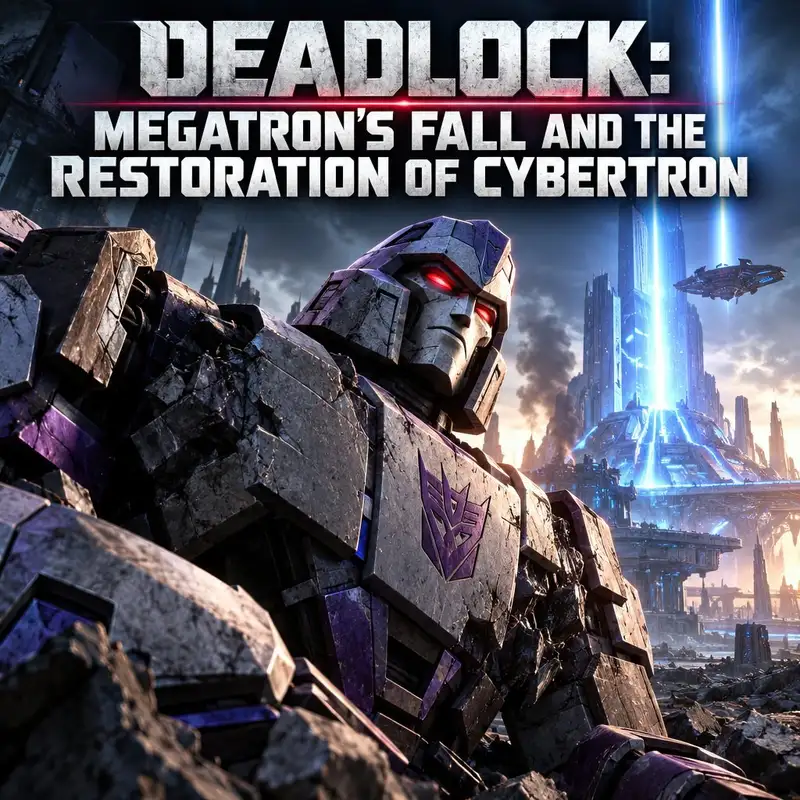
Deadlock: Megatron’s Fall and the Restoration of Cybertron
Aboard the Decepticon warship Nemesis, the restoration of Cybertron has become an instrument of mass death. The rebuilt Omega Lock can revive the Cybertronian homeworld, but Megatron intends to activate it in a way that cyberforms Earth. In the Prime screen continuity, cyberformation does not mean a harmless change of scenery. It means remaking a living planet into a Cybertronian environment, at the cost of the human population already living there. A homeland can be restored. Earth can be destroyed. Megatron intends to achieve both outcomes in one operation.
That is the deadlock at the center of this final battle. Cybertron has been barren and depleted for much of the war. The Autobots have defended Earth partly because it became a refuge, but also because it offered a base from which the possibility of Cybertron’s recovery remained alive. Megatron sees a different opportunity. He does not treat Earth as a sovereign world with its own inhabitants and history. He treats it as material, territory, and a replacement for what the war has ruined.
The Nemesis is therefore more than the location of a climax. It is Megatron’s mobile capital, his command ship, laboratory complex, weapons platform, and political headquarters. It contains Shockwave’s technical authority, Soundwave’s communications capability, Decepticon defenses, and the rebuilt Omega Lock itself. The ship concentrates the tools of Megatron’s rule in one place. That makes it formidable. It also makes it vulnerable. If the Autobots can penetrate the Nemesis, they can threaten not just a single weapon, but the command system behind the weapon.
The immediate Autobot objective is clear. They must rescue Ratchet, prevent the cyberformation of Earth, and either seize or destroy the Omega Lock before Megatron completes his plan. Yet the operation carries a complication that makes simple destruction difficult. The Lock is not just a Decepticon superweapon. It is also the only demonstrated means of restoring Cybertron. The Autobots are not choosing between safety and power. They are choosing whether any restoration is worth trusting while it remains under Megatron’s control.
That dilemma had already shaped Optimus Prime’s decisions before the Nemesis assault. In the previous Omega Lock crisis, Megatron had gained control of the original device on Cybertron. He intended to use it against Earth. Optimus responded by destroying the Lock, even though the destruction denied the Autobots their most immediate chance to revive their own planet. It was a severe strategic sacrifice. Earth survived, but Cybertron remained lifeless.
The decision mattered at several levels. Tactically, it stopped Megatron’s operation. Strategically, it left the Autobots without the system they needed to restore their homeworld. Politically and morally, it established a limit to what Optimus would accept in the name of Cybertronian recovery. He would not exchange one inhabited world for another. That choice did not repair Cybertron, and it did not end the war. It did preserve the difference between liberation and conquest.
There is a temptation to describe that earlier decision as a matter of Optimus choosing sentiment over strategy. The record does not support that reading. Megatron’s proposal required the destruction of a population that had not caused Cybertron’s ruin and had no meaningful ability to consent, resist, or evacuate. A restored Cybertron built on Earth’s graveyard would not have solved the political problem of the war. It would have expanded the war into extermination.
Megatron’s rebuilt Omega Lock is his answer to that earlier loss. By reconstructing the device aboard the Nemesis, he seeks to recover the capability Optimus destroyed and place it entirely within Decepticon hands. The new Lock promises a solution to Cybertron’s devastation, but it also promises Megatron something more important to him: the authority to decide whose world is preserved and whose world is consumed.
That reconstruction depends on coercion as much as technology. The Omega Lock cannot simply be ordered back into existence through Megatron’s personal will or Shockwave’s scientific confidence. Its activation requires stable synthetic Energon, and Ratchet possesses knowledge that Megatron needs. Ratchet is abducted and forced to work on the formula that will make the rebuilt system viable. His technical expertise becomes a strategic resource under enemy control.
This is one of the more revealing features of the crisis. Megatron commands a warship, a military hierarchy, laboratories, and powerful specialists. Even so, he cannot eliminate the need for expertise he does not possess. Authoritarian command can compel labor. It cannot guarantee understanding. A device may be captured, rebuilt, or threatened into operation, but its reliability still depends on people who know how to make it function.
Ratchet’s position is not collaboration. He is a prisoner working under coercion, and the distinction matters. His knowledge helps stabilize the synthetic Energon required for Megatron’s plan, but he searches for an opportunity to undermine that plan. Before he is cut off from the communications system, Ratchet lowers the Nemesis shields and transmits the ship’s coordinates to Optimus Prime. That act creates the opening for the Autobot assault.
It is a narrow advantage, not a guarantee of success. The Nemesis remains a Decepticon warship with interior defenses, experienced personnel, and control of the Omega Lock. The Autobots know where the ship is and have a temporary breach in its protection. They do not gain a complete deck plan, a full account of every defender, or a safe route to Ratchet and the Lock. Intelligence reduces uncertainty. It rarely removes it.
The response is not a reckless rush toward Megatron. It is a boarding operation, organized around a common strategic purpose but carried out through separate tasks. Optimus Prime leads the effort, yet no single combatant can complete the mission alone. Team Prime must infiltrate the ship, rescue Ratchet, fight through the Decepticon defenses, and reach the Omega Lock. Ultra Magnus and the Wreckers provide another assault element. The human allies support the operation through communications, tracking, and Ground Bridge access.
This is a combined Cybertronian and human action, though it should not be mistaken for humanity directing the war. Jack, Miko, Raf, Agent Fowler, and the network around them represent a small group of human allies, not every government or every civilian population on Earth. Their contribution is still important. They understand the local stakes. They have worked with the Autobots long enough to operate within a dangerous and unfamiliar system of alien mobility and communications. At the moment of crisis, that practical knowledge has military value.
Ground Bridges are central to the assault. In this continuity, they allow rapid transit between points that would otherwise be separated by enormous distance. They can move personnel through a ship’s defenses and compress the time required to reinforce, infiltrate, or escape. But they are not magic doors without limits. They require operators, stable endpoints, timing, and coordination. A bridge opened at the wrong moment or into the wrong position can turn mobility into a trap.
The Autobot plan depends on synchronization because the defenders hold the interior lines. The Decepticons are already aboard the Nemesis. They know its systems, its corridors, and the location of the Omega Lock. They can move personnel toward threatened compartments more quickly than an attacking force can build a picture of the ship. The Autobots have surprise and a temporary breach in the shields. The Decepticons retain defensive depth.
The mission also contains a problem common to raids against strategic systems. The target must be stopped without being rendered useless. Destroying the Omega Lock would deny Megatron his weapon, but it could also deny Cybertron its restoration. Capturing it would be ideal, but capture requires control over its activation, its operators, and the surrounding battlefield. The Autobots are attacking a device they may need to preserve, inside a ship they cannot safely allow Megatron to retain.
Megatron’s decision to place so much power aboard the Nemesis reflects the strengths and weaknesses of his command style. Centralization allows rapid action. A leader can issue orders directly, supervise critical research, and ensure that military force protects the project that matters most. It also reduces the room for independent commanders to challenge the mission. When the leader’s will is the system’s organizing principle, hesitation becomes disloyalty and technical disagreement becomes a threat.
The weakness is concentration. The Nemesis holds Megatron, Shockwave, Soundwave, the Omega Lock, and the staff required to operate them. If the headquarters remains secure, this arrangement is efficient. If the headquarters is penetrated, the Decepticons risk losing command, communications, scientific capability, and strategic initiative at once. A tightly centralized force can strike hard. It can also fail suddenly when one crisis reaches the center.
Soundwave’s role becomes especially important in that context. He is not simply another defender with a weapon. He is a communications and infiltration specialist, a Decepticon officer whose effectiveness depends on controlling information and movement. When the Autobots penetrate the Nemesis, Soundwave uses Ground Bridge technology to counter them. His response demonstrates that the same system enabling the Autobot attack can be turned against the attackers.
The human team answers with an unusual act of improvisation. Jack and Raf manipulate the Ground Bridge geometry in a way that displaces Soundwave into the Shadowzone, a parallel dimension created by the interaction of Ground Bridges in these particular circumstances. The result removes Soundwave from the battle at a critical moment. It is a tactical success, but it should not be treated as ordinary doctrine.
The Shadowzone incident does not establish that every Ground Bridge can be used as a reliable weapon, or that any opponent can be banished by opening the right portal. The event depends on specific conditions, access to the system, and rapid decisions by people who understand enough of the problem to act before Soundwave can regain control. It is an exceptional outcome produced by an exceptional moment.
Its operational effect is nevertheless significant. Soundwave’s removal deprives Megatron of a capable defender and disrupts a part of the Decepticon command-and-control system. In a battle for a ship, communications matter as much as firepower. Defenders need to know where the attackers are, which compartments have been breached, where the prisoners are held, and whether the Omega Lock remains secure. Removing a key specialist does not collapse the Nemesis by itself, but it makes Megatron’s centralized structure less resilient.
The operation still has to contend with Shockwave. He remains the Decepticons’ principal technical authority aboard the ship, and he understands the value of the Omega Lock. He is not a passive scientist waiting behind the battle line. He fights to preserve Megatron’s project and to prevent the Autobots from reaching the system that could decide the fate of both worlds.
Another pressure on Megatron comes from Predaking. Predaking is not an Autobot ally during this battle, and the Autobots do not gain control of him. His hostility toward Megatron comes from a different source. He learns that Megatron ordered the destruction of the Predacon project because intelligent, transforming Predacons might become a rival power. Megatron had created or supported a powerful asset, then moved to eliminate it when that asset developed independence.
The political logic is familiar, even in a civilization of transforming mechanical life. Leaders who rely on fear often distrust capable subordinates and independent institutions. A force that cannot be controlled may become a threat. The immediate answer is elimination, intimidation, or fragmentation. That approach can provide short-term security. It can also create enemies who possess intimate knowledge of the regime’s methods and reasons to oppose it.
Predaking’s break with Megatron exposes one limit of Decepticon command. Megatron can direct military units through fear and loyalty, but he cannot guarantee that every powerful being will accept permanent subordination. By attempting to destroy the Predacons rather than negotiate their place in the Decepticon order, he converts a potential military advantage into a source of instability. His authority remains formidable, but it is no longer unquestioned.
That fracture matters because the Nemesis battle is not taking place in isolation. Megatron is fighting the Autobots while managing the consequences of his own internal decisions. The Decepticons still have weapons, specialists, and a warship. But the political system built around Megatron has begun to lose the trust of some of the forces it expected to control. A command structure can survive battlefield pressure. It is less likely to survive battlefield pressure and internal betrayal at the same time.
Even so, the decisive contest remains at the Omega Lock. Smokescreen carries the Star Saber toward the device, attempting to place the weapon where it can either secure the system or destroy it if no other option remains. Shockwave wounds him before he can complete that task. The injury interrupts the plan and creates another dangerous delay. In a raid against a system already close to activation, delay is not neutral. Every lost minute favors the defender.
Bumblebee recovers the Star Saber and continues the effort. The weapon’s importance is not just symbolic. Ratchet has made the hard contingency clear. If the Autobots cannot stop Megatron and secure the Omega Lock, they must destroy it. The Star Saber offers a means to do that. The Autobots are prepared to sacrifice Cybertron’s immediate restoration a second time rather than allow the Lock to become the mechanism of Earth’s destruction.
That contingency reveals the limits of possession. An artifact is not useful merely because it exists. It must be understood, controlled, defended, and operated for a defined purpose. Megatron possesses the rebuilt Lock, but his possession makes it dangerous because his purpose is conquest. The Autobots may reach the Lock, but reaching it does not automatically mean they can use it safely. Between possession and legitimate control lies the entire problem of command.
The Star Saber also changes the meaning of the final confrontation. The battle between Optimus and Megatron is not simply the latest expression of their personal rivalry. It takes place at the control point of a civilization-scale system. Whoever prevails will determine whether the Omega Lock restores Cybertron, destroys Earth, or is destroyed before it can do either. The duel is personal, but its consequences are institutional and planetary.
Megatron understands that the Autobots’ strength is not just their weapons. It is their refusal to accept his terms. He cannot easily persuade them to abandon Earth, so he seeks to force the choice through the Omega Lock. If Earth is cyberformed, the Autobots lose their refuge, their human allies, and the moral basis of their claim to defend life. Megatron would not simply gain territory. He would demonstrate that resistance to his rule carries a catastrophic price.
Bumblebee’s attempt to bring the Star Saber to Optimus becomes the immediate obstacle. Megatron shoots him repeatedly. Bumblebee falls into the active cybermatter surrounding the Omega Lock and appears to die. The scene is painful because it strips away the distance that sometimes protects commanders from the cost of their decisions. The strategic crisis is now expressed through the apparent loss of an individual Autobot who has fought beside the human allies throughout the war.
The event also alters the tactical situation. The Star Saber has not reached Optimus. Megatron remains in control at the critical point. The Autobots have lost, or believe they have lost, one of their most capable scouts and a key courier in the effort to stop the Lock. For a moment, the Decepticon plan appears to have regained momentum through a direct act of violence against the force trying to interrupt it.
Then the Omega Lock’s active cybermatter repairs and revives Bumblebee. His damaged voice is restored as part of the process. The episode establishes the effect clearly enough: Bumblebee survives an injury that appeared fatal, and the active cybermatter restores his body. What it does not establish is a general technology of resurrection available to either faction.
This is an exceptional interaction with an active planetary restoration system. The Omega Lock is not shown as a routine medical facility. It is not a device that can be deployed to every battlefield, used to recover every fallen soldier, or relied upon without limit. Bumblebee’s recovery does not mean Cybertronian casualties have ceased to matter. It means that, at the center of this unique crisis, a system built to restore a world also restores one individual caught within its active process.
The distinction is important because stories of advanced technology can make death seem reversible by default. In this case, the restoration is extraordinary precisely because it occurs at the source of the conflict. Bumblebee is returned by the same system Megatron intended to use for planetary destruction. The event does not cancel the danger of the Omega Lock. It sharpens the question of what such power means when it is controlled by different hands.
Bumblebee’s return gives the Autobots a narrow opening. He has the Star Saber. Megatron remains focused on Optimus and the Lock. The Decepticon command system is under pressure, Soundwave is gone, Predaking has turned against Megatron, and the assault force has reached the device’s control area. None of that guarantees victory. It does create a moment in which Megatron’s control is no longer absolute.
Bumblebee uses the Star Saber to impale Megatron. The Decepticon leader falls from the Omega Lock, his body burning as it descends toward Earth. The image is final in the immediate sense. The commander who planned to cyberform Earth has been physically defeated at the very point from which he intended to impose that outcome. The weapon intended as a contingency against the Lock becomes the means by which the Lock’s controller is removed.
The tactical result is decisive. Megatron is killed in the battle, and the immediate defender at the center of the operation is eliminated. The operational result is equally important. Without Megatron directing the cyberformation plan, the Decepticon effort aboard the Nemesis collapses. The remaining Decepticons withdraw rather than maintain the operation under conditions where their leader is gone, their communications structure has been disrupted, and the Autobots have reached the Omega Lock.
This is not the same as saying every Decepticon has surrendered or that the war’s political origins have vanished. A movement does not disappear simply because its central leader falls. Decepticon forces remain, and the episode does not provide a complete account of their demobilization, their internal factions, or their future status. Megatron’s death breaks the command center of this operation. It does not create a finished peace settlement.
The distinction matters because Megatron’s power had become intensely personal. His authority gave the Decepticons unity, direction, and fear-driven discipline. Removing him creates an immediate opening for the Autobots, but it also leaves unanswered questions. Who commands surviving Decepticon forces? Which officers continue the war? Which followers accept defeat? Which groups pursue their own survival, revenge, or independence? The battle resolves the crisis of the Omega Lock. It does not resolve every consequence of the war that made the Lock necessary.
Only after Megatron is removed can the Autobots activate the Omega Lock without accepting his terms. This is the turning point that answers the central dilemma. The device itself was never morally neutral in effect. Its power could restore Cybertron or destroy Earth, depending on its use. But neither was it inherently doomed to serve Megatron. Once the Autobots secure the system, they can redirect it toward the purpose they had sought without sacrificing the world that sheltered them.
Cybertron is restored. The episode presents the planet’s surface and energy systems as revived, replacing the barren condition that had defined so much of the Autobot struggle. The world that existed as memory, objective, and wound becomes physically viable again. For the Autobots, this is more than the recovery of territory. Cybertron is the center of their civilization, the source of their historical identity, and the place whose loss had shaped their war.
The contrast with Optimus’s earlier sacrifice is exact. When Megatron controlled the first Omega Lock, Optimus destroyed it to save Earth, leaving Cybertron unrecovered. In the final battle, the Autobots gain control of the rebuilt Lock and achieve both objectives. Earth is spared. Cybertron is restored. The apparent contradiction between defending one world and saving another is overcome, but only because the means of restoration has been taken out of Megatron’s hands.
That is why the restoration counts as victory in a way Megatron’s plan never could. It does not just produce a desirable physical outcome. It preserves the people whose destruction Megatron considered acceptable. A restored Cybertron purchased through Earth’s annihilation would have represented the triumph of Decepticon coercion. The restored Cybertron at the end of the battle represents the defeat of that coercion, at least in its immediate and most catastrophic form.
Still, physical restoration is not the same as complete reconstruction. The episode shows Cybertron revived. It does not establish a detailed postwar economy, a restored population, a functioning civil government, a program for repairing every damaged city, or a settlement with former Decepticons. It does not answer questions about prisoners, amnesty, accountability, industry, or the distribution of political power. Those questions remain beyond the final activation of the Lock.
The difference is not a technicality. A planet can regain energy and still lack institutions capable of managing peace. Cities can be restored while their inhabitants remain divided by war. A government can return without legitimacy. Former soldiers can remain armed. Civilian needs can compete with military priorities. Archives, homes, supply networks, and trust do not automatically reappear because a strategic system has revived the ground beneath them.
The Omega Lock solves a particular problem of planetary restoration. It does not solve the political problem of how Cybertronians will live together after a civil war. That work requires decisions about authority, security, representation, justice, and the relationship between those who fought under different symbols. The episode does not pretend that an artifact can perform those tasks. Its ending is hopeful because a world survives, not because every conflict within that world has already been settled.
The Autobots depart Earth aboard the Nemesis, now captured from the Decepticons who had used it as a mobile headquarters. That reversal has practical and symbolic force. A ship that once concentrated Megatron’s power becomes transport for the force that stopped him. Yet capture does not erase the ship’s history. The Nemesis remains a powerful asset whose future use will depend on maintenance, command, technical knowledge, and political restraint.
Ratchet chooses to remain on Earth. His decision carries humanitarian and strategic significance. Earth has survived a near-cyberformation event and a war fought partly within its own infrastructure. The human allies who supported the Autobots remain exposed to the consequences of contact with Cybertronian conflict. Ratchet’s presence offers medical, technical, and personal continuity at a moment when many of the Autobots are returning toward their restored homeworld.
His decision should not be confused with a formal treaty between Earth and Cybertron. The episode does not establish a complete diplomatic settlement, shared defense arrangement, or worldwide political agreement. Ratchet remains because people on Earth still need help and because the relationship built during the war does not vanish when the Nemesis departs. One medic staying behind cannot resolve the legal and political questions created by alien intervention. He can ensure that Earth is not simply abandoned after serving as a battlefield.
For the human allies, Earth’s survival is not abstract. Jack, Miko, Raf, Fowler, and others have watched a conflict from another world enter their communities, their governments, and their daily lives. The destruction of Megatron’s plan prevents their planet from being remade without consent. It does not erase the fear, secrecy, damage, or dependence created by years of hidden war. Survival is the first condition of recovery. It is not recovery itself.
The strategic environment has nevertheless changed. Cybertron is no longer only a lost objective. Megatron is no longer directing the Nemesis from its command center. Soundwave has been displaced, the Decepticon operation has withdrawn, and the Autobots have gained access to their revived homeworld. These are major shifts in capability and morale. They create opportunities that did not exist while Cybertron remained barren and Earth faced immediate cyberformation.
They also create new burdens. Returning to Cybertron means returning to a world shaped by war. The Autobots will need more than a restored surface. They will need command arrangements, repair capacity, security, and a way to address surviving Decepticon power without reproducing the permanent emergency rule that helped make the conflict so destructive. The series does not fill in every answer, and it is better not to invent them.
The appearance of finality in the battle is therefore real but limited. Megatron falls. Cybertron revives. The Autobots leave Earth. Those events close the immediate crisis with unusual clarity. Yet the Prime continuity does not end its story there. The later film Predacons Rising begins after Cybertron’s restoration and demonstrates that the consequences of the war remain active.
That epilogue matters especially for understanding Megatron’s fate. Deadlock establishes his physical death in the battle around the Omega Lock. Predacons Rising later depicts Megatron’s body returning under Unicron’s control. This is not simple evidence that Megatron escaped death unchanged or that his fall was meaningless. It is evidence that, in this continuity, death, bodily survival, and personal agency can become separate questions under extraordinary intervention.
The later crisis also requires cooperation among Autobots, surviving Decepticons, and Predacons. That development reinforces the limitation already visible at the end of Deadlock. Megatron’s defeat removes a leader and breaks an immediate plan, but it does not automatically dissolve every armed faction or settle every relationship created by the war. A common danger can force temporary cooperation without producing reconciliation.
Deadlock is strongest when viewed as a struggle over political control of restoration. Megatron wants to restore Cybertron on terms that make Earth expendable. Optimus and the Autobots refuse that bargain, even when refusal leaves their own world barren. Ratchet’s coerced expertise creates the opening. The assault on the Nemesis disrupts the concentrated Decepticon command system. Bumblebee’s return creates the final breach. Megatron’s fall transfers control of the Omega Lock.
The result is not just that the Autobots possess a powerful machine. It is that they deny Megatron the power to define restoration as conquest. Earth survives because the Autobots prevent cyberformation. Cybertron revives because the Lock is secured rather than destroyed. The achievement is tactical, operational, strategic, and moral at once, but those levels should not be confused with a complete political settlement.
Megatron’s death ends a plan built on centralized coercion, technical exploitation, and planetary violence. It does not erase the institutional damage of the war, the surviving Decepticon forces, or the work required to turn a restored planet into a stable society. Cybertron’s restoration becomes a victory because Earth is spared and the Omega Lock is wrested from conquest, while peace remains a separate task that no artifact can perform.