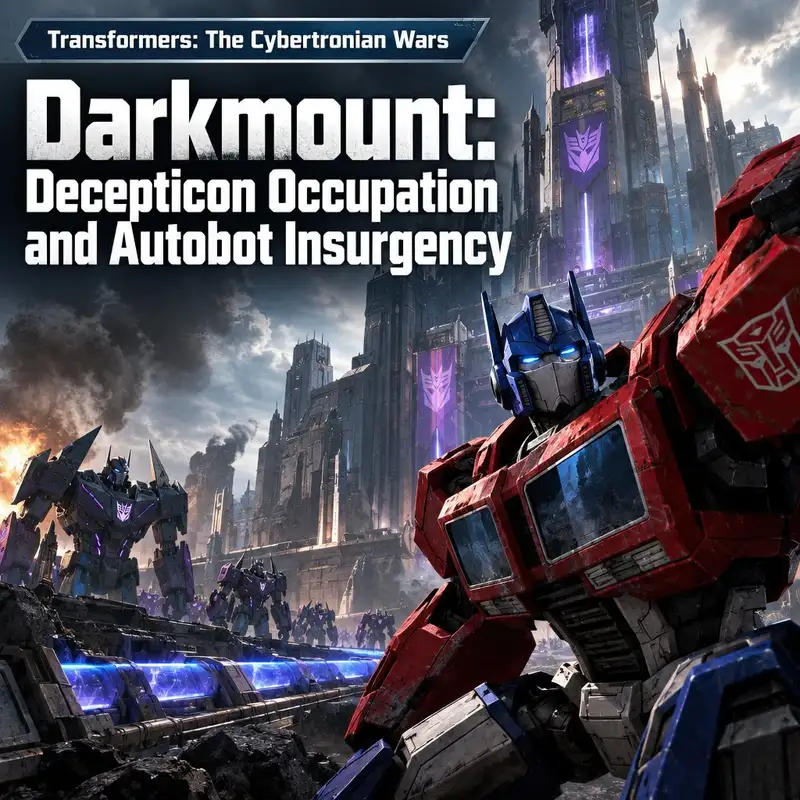
Darkmount: Decepticon Occupation and Autobot Insurgency
The first practical fact of Darkmount was not Megatron’s declaration. It was the cannon fire. Human forces approaching the new Decepticon fortress outside Jasper, Nevada, found that they could not close with it safely. Darkmount’s fusion cannons tore apart the conventional military response and devastated the surrounding area. Whatever their exact technical limits, the effect was unmistakable. A fixed Cybertronian installation had created a zone where aircraft, armor, and ground forces could not just advance, identify targets, and apply ordinary firepower.
Megatron then made the political claim that followed from that military demonstration. Earth, he declared, belonged to the Decepticons. In Transformers Prime, that claim marked the most dangerous point in Megatron’s Earth campaign. The Autobot base had been destroyed. Optimus Prime was missing and critically damaged. Team Prime had scattered. A huge Decepticon fortress stood on American soil, and the human military had been forced back. For a brief moment, it appeared that the long covert war on Earth had become open conquest.
But a fortress can dominate the ground around it without governing the world beyond it. Darkmount’s history is the history of that distinction. Megatron had achieved a sharp battlefield victory and acquired an instrument of terror. He had not yet built the institutions, information networks, supply arrangements, and political control necessary to turn violence into durable rule. The Autobots, meanwhile, had lost almost everything required for conventional operations. Their answer was not a mass uprising or a counterinvasion. It was survival, concealment, reorganization, and a small combined operation designed to destroy the system that made Darkmount powerful.
The fortress had emerged from a larger strategic gamble. In the final struggle of the previous campaign, Megatron gained control of the Omega Lock, an ancient Cybertronian device capable of reshaping planetary environments. His intention was not merely to establish a base on Earth. He meant to use Earth itself as material for a Decepticon future, while restoring Cybertron under Decepticon authority. The plan joined military ambition, resource control, and symbolism. Cybertron had become damaged and lifeless. Earth was rich, inhabited, and strategically useful. Megatron intended to seize one world while remaking another.
At first, the fortress created through the Omega Lock was called New Kaon. The name was a deliberate statement. Kaon was associated with Decepticon identity and power, and Megatron’s choice suggested more than a temporary field headquarters. He was presenting Earth as territory that could be reorganized under Decepticon control. The fortress was meant to become proof that the Decepticons had not just survived their war with the Autobots. They had carried that war to a new planet and imposed their own order there.
Optimus prevented the largest part of that ambition by destroying the Omega Lock. It was a hard decision because the device also represented the possibility of restoring Cybertron. Yet allowing Megatron to activate it on his own terms would have meant accepting the transformation of Earth into an extension of Decepticon rule. The destruction of the Lock denied Megatron his planetary-scale instrument. It also denied the Autobots an easy answer to Cybertron’s condition. Both sides lost something, but Megatron retained the fortress that had already risen.
Afterward, New Kaon became Darkmount. The name mattered less than the function. Darkmount was a command center, an artillery platform, a fortified refuge, and an act of political theater. It gave Megatron a visible seat of power on Earth. Its cannons could threaten any force attempting a conventional attack. Its size and presence announced that the Decepticons no longer considered concealment their primary requirement. They had moved from covert raids and expeditions toward overt intimidation.
That shift carried a certain logic. For much of the Earth campaign, the Decepticons had operated from the Nemesis, pursued artifacts, manipulated human institutions, and hunted the Autobots through limited operations. Darkmount offered a fixed point from which Megatron could project power more directly. It could coordinate searches, receive personnel and equipment, and force human leaders to respond to an obvious threat rather than a hidden one. A military commander facing a dispersed enemy often wants a secure base from which to impose tempo. Megatron had built one in the middle of an enemy country.
He also chose to use it in a revealing way. When human forces approached, Starscream proposed employing Decepticon troops against them. Megatron preferred Darkmount’s cannons. The decision made tactical sense. Directly engaging a human force with dispersed Decepticon units would expose personnel, complicate command, and risk losses in a fight that the fortress could settle at range. The cannons promised a cleaner demonstration of superiority. They turned the battle into a message: the Decepticons possessed weapons humans could not approach and defenses humans could not easily overcome.
Yet the choice also exposed the limits of Megatron’s approach. Concentrated firepower is useful for denial. It can destroy approaching forces, protect a facility, and terrify nearby populations. It cannot, by itself, manage a planet. It cannot determine who remains loyal, who is hiding information, which local institutions will cooperate, or how a conquered population will be governed after the initial shock has passed. Megatron had a weapon that could silence an advancing army. He did not have a demonstrated civil administration for Earth.
The difference is important because occupation is more than the presence of armed forces. A durable occupation requires some method of controlling roads, communications, infrastructure, public order, and resources. It requires a way to distinguish resistance from ordinary civilian movement. It requires local knowledge, personnel, and enough legitimacy or fear to make compliance more reliable than defiance. The Decepticons possessed fear in abundance. The episodes do not show that they possessed the rest.
What Darkmount did establish was a military foothold around Jasper. The town and its surrounding area became the immediate battlefield. Human civilians had to be evacuated. Military forces had to operate under the threat of the fortress’s guns. The damage was not an abstract display of alien power. Jasper’s residents were the first people compelled to live beside Megatron’s claim of conquest. Their homes, routes of escape, and access to safety became part of the operational problem.
Agent Fowler’s role in evacuation and military coordination deserves attention for that reason. Removing civilians from the immediate danger area was not simply a humane act, though it was that. It also gave the human military and the Autobots greater freedom to plan a response. A fortress that can fire into populated ground gains an advantage from civilian vulnerability. Evacuation reduces that advantage. It cannot undo the destruction already inflicted, but it denies the occupier some of the leverage created by fear and proximity.
Megatron’s declaration therefore outran his actual control. Darkmount could dominate a perimeter. It could repel a direct attack. It could threaten cities and military formations. But the series does not show Decepticon taxation, a civilian government, routine policing, political collaborators, an occupation economy, or a functioning system for administering the United States, much less Earth as a whole. The declaration that Earth belonged to the Decepticons was a statement of intent backed by artillery, not evidence that planetary sovereignty had been achieved.
The Decepticons also had no time to develop such a system. Their victory had come at the same moment their adversaries were most dangerous in another sense. Team Prime had been shattered, but it had not been eliminated. The destruction of the Autobot base was a severe command and logistics disaster. It was not the same thing as the destruction of the Autobot force.
The old base had provided much more than shelter. It was a communications hub, repair site, planning center, equipment store, and meeting place for the Autobots and their human partners. It gave a small force the ability to operate with a degree of coordination that its numbers alone would not have allowed. Once it was destroyed, the Autobots lost secure communications, familiar defensive ground, much of their equipment, and any certainty about the condition of their comrades.
They also lost clarity of command. Optimus had disappeared in the collapse, critically damaged and presumed unavailable. For a force built around a small number of specialists, the loss of even one member could matter greatly. The apparent loss of Optimus mattered at several levels. He was a battlefield commander, a political symbol, and the figure around whom the Autobots’ Earth mission had been organized. His absence did not automatically dissolve Autobot loyalty, but it created uncertainty at exactly the moment when the Decepticons were attempting to convince everyone that resistance was finished.
The surviving Autobots responded as a dispersed resistance network rather than as an army. Arcee and Jack moved covertly, attempting to avoid detection while preserving contact with the wider team. Bumblebee, Bulkhead, Ratchet, Wheeljack, and the others faced a basic problem before they could undertake any offensive action. They had to find one another. They had to learn who had survived. They had to recover what equipment they could. They had to determine whether the Decepticons had followed them, compromised their routes, or identified their human allies.
This was not glamorous work, but it was the work that made later action possible. A resistance force that reveals itself immediately after a defeat may provide the enemy with a convenient target list. A scattered force must first become difficult to find. It needs safe movement, temporary shelter, trusted contacts, and communications that do not expose every surviving member. The Autobots had no broad popular insurgency behind them. They had a handful of Cybertronians, several human allies, local military support, and a shrinking margin for error.
Their transformation abilities helped, but did not make the problem simple. Vehicle modes allowed movement through human terrain and offered some degree of concealment. Ground Bridges could bypass roads and checkpoints when they were available. Yet neither capability was a guarantee of safety. A Cybertronian vehicle could still be recognized by behavior, energy signatures, lack of a human driver, or association with known Autobot contacts. Ground Bridge use depended on equipment, coordinates, timing, and a safe destination. The Autobots survived because they used these tools carefully, not because their tools made Decepticon detection impossible.
The survival of Optimus was the most important hidden fact in the opening phase of the occupation. Smokescreen found him beneath the ruins of the destroyed base. The Prime was badly damaged, unable to resume command or defend himself effectively. Leaving him there would have risked eventual discovery by the Decepticons, who were searching the wreckage for survivors, equipment, and artifacts. Moving him openly would have been equally dangerous. Smokescreen had to recover a leader whose body was failing while the enemy believed the battle had left no meaningful Autobot force behind.
His solution depended on the Phase Shifter, a specialized relic that allowed passage through solid obstacles. Smokescreen used it to reach Optimus and extract him from the ruins, then concealed him in an underground cavern. The device was not an all-purpose answer to the Decepticons’ superiority. It did not replace transportation, medical facilities, or a secure base. It required a specific user, a specific circumstance, and considerable nerve. But in this case, it turned an apparently sealed battlefield problem into a recovery mission.
That recovery had consequences far beyond the fate of one wounded commander. By hiding Optimus, Smokescreen preserved the possibility that the Autobots could eventually restore their leadership. He also denied Megatron a powerful psychological victory. A confirmed capture or death would have allowed the Decepticons to demonstrate that their destruction of the base had removed the Autobot leader permanently. Instead, Megatron had destroyed the headquarters but failed to secure the most valuable person likely to be inside it.
The episode sequence does not require us to assume that Megatron knew Optimus had survived. What matters is that Decepticon intelligence remained incomplete. The Decepticons recovered material from the base. They located the stasis pod containing Airachnid and recovered the Forge of Solus Prime, a powerful ancient relic. They searched for signs of Autobot activity. But battlefield wreckage is not the same as complete intelligence. A force can occupy the site of its opponent’s defeat and still miss the one person whose survival will reverse the situation.
The Forge was especially significant because it represented capability under conditions of scarcity. It was not just another weapon lying in the rubble. The Forge of Solus Prime was a unique relic, associated with the creation and restoration of extraordinary Cybertronian technology. In Decepticon hands, it was an asset to be secured and studied. In Autobot hands, it could become a means of restoring damaged systems that ordinary equipment could not repair. The problem for the Autobots was immediate. The Forge had been taken aboard the Nemesis, beyond the reach of their scattered survivors.
This was the larger logistical reality of the post-base period. The Autobots did not simply need courage. They needed tools, weapons, transport, intelligence, and repair capacity. They needed a way to regain the material basis of operations. Their old base had been a compact version of an army’s rear area. Once it was gone, every recovered relic and every surviving piece of equipment became more important.
Meanwhile, Soundwave attempted to turn the Decepticons’ technical superiority into an effective counterinsurgency system. He monitored global communications for signs of Autobot activity. This was a logical approach. The Autobots had human associates, recognizable patterns of behavior, and a demonstrated need to coordinate. Any resistance force must communicate eventually. If the Decepticons could identify those communications, trace them, and dispatch pursuit units quickly enough, they could destroy the Autobots one small group at a time.
Soundwave’s role was therefore more important than simply serving as Megatron’s quiet intelligence officer. Darkmount’s guns could repel a direct assault, but surveillance offered the prospect of finding the enemy before it could organize one. The Decepticon model combined intimidation with technical monitoring and rapid pursuit. It was a plausible method for defeating a small force that lacked a fixed headquarters.
Its weakness was that surveillance is not omniscience. Monitoring communications only helps when the enemy uses channels that can be found, interpreted, and acted upon. The Autobots’ scattered condition forced them to become less predictable. They relied on personal contacts, temporary concealment, cautious movement, and irregular routes. Their human partners could operate within a society the Decepticons understood only imperfectly. Their Ground Bridges could make pursuit difficult when they were used without exposing an obvious pattern.
The Decepticons also faced the ordinary problem of prioritization. A warning, signal, or suspected contact does not automatically reveal whether it is decisive, deceptive, or irrelevant. Forces sent to investigate one lead cannot simultaneously guard every asset, search every route, and support every other mission. The Decepticons had more power than the Autobots, but they had many demands on that power. Fortress security, relic recovery, searches for survivors, human military deterrence, communications monitoring, and the management of specialized personnel all competed for attention.
The arrival of Shockwave made those competing demands clearer. Shockwave had survived on Cybertron and returned with the result of a separate military program: a Predacon specimen. His work did not directly cause Darkmount’s fall. It did, however, reveal that Megatron’s strategic horizon was wider than the Nevada fortress. Megatron was not content to hold a strongpoint. He was pursuing new sources of military advantage, including the possibility of fielding a powerful Cybertronian beast as an asset.
Predaking became part of Darkmount’s wider security environment, a formidable force whose presence complicated any Autobot operation. But the introduction of the Predacon program also showed the problem of trying to do everything at once. Megatron wanted to consolidate his position on Earth, find and destroy the Autobots, recover artifacts, manage rival subordinates, and develop a new weapon system. Each objective had military value. Taken together, they placed strain on command attention and on the specialized assets available to support the occupation.
A fortress can make a commander appear secure while actually increasing his obligations. Darkmount had to be defended. Its guns had to remain operational. Its power systems had to be protected. Its personnel had to be assigned to internal security, external patrols, intelligence work, and response missions. Predaking was useful as a security asset, but using such a valuable and difficult-to-control creature for local defense was itself evidence that the Decepticons did not possess unlimited reliable manpower.
For the Autobots, the turning point began with the restoration of a chain of command. Ultra Magnus arrived on Earth while Optimus remained incapacitated. Magnus was not a replacement Prime, and he did not become the Autobots’ permanent leader. He assumed practical operational command because the circumstances required someone to coordinate a scattered force.
That role suited his strengths. Ultra Magnus valued discipline, clear authority, weapons readiness, and organized planning. The Autobots had survived the first shock of defeat, but survival alone does not produce a campaign. Someone had to establish priorities. Someone had to determine which missions were worth the risk, which personnel were available, and how the group could operate without simply feeding itself into Darkmount’s defenses. Magnus gave the resistance a structure at a moment when structure had become scarce.
His arrival also revealed friction inside the Autobot force. Wheeljack, shaped by Wrecker experience and accustomed to irregular methods, did not naturally respond to rigid command procedure. Smokescreen had courage and unusual capabilities, but he was inexperienced and inclined toward improvisation. Bulkhead carried the instincts of a frontline fighter. Ratchet had to think about wounded personnel, limited equipment, and the practical costs of every risk. Arcee had already been operating in a more covert, decentralized environment. Magnus could not erase those differences by issuing orders.
That tension was not just personal. Resistance warfare requires both discipline and adaptability. Too little coordination produces isolated actions that the enemy can defeat separately. Too much rigidity can prevent a small force from exploiting opportunities, especially when it lacks secure bases and must survive through improvisation. Ultra Magnus improved the Autobots’ ability to act together. He also had to learn that the force under his command was not a parade-ground formation. It was a damaged team fighting from concealment against a stronger enemy.
The recovery of the Forge of Solus Prime became a test of that developing capability. Smokescreen infiltrated the Nemesis using the Phase Shifter and retrieved the relic from Decepticon custody. The mission was important because it showed that the Autobots could still penetrate an enemy system despite their losses. It also illustrated the difference between possessing a valuable object and integrating it into operations. The Forge could not help the Autobots while it remained aboard the Nemesis. It had to be located, reached, removed, and brought to a place where its use could be considered.
Smokescreen’s success was a logistical gain as much as an intelligence victory. A force without a base cannot rely on routine resupply. It must recover, preserve, and improvise. The Forge was not a standard issue repair tool, and the Autobots did not treat it as one. Its uniqueness was precisely why the question of how to use it mattered so much.
Optimus, still badly damaged, refused to spend the Forge’s power on restoring himself immediately. He believed it should be preserved for repairing the Omega Lock. His reasoning was strategic. The Omega Lock represented a possible means of restoring Cybertron, and Cybertron remained the larger objective beyond the immediate crisis on Earth. A commander who uses a unique resource for personal recovery may solve a short-term problem while sacrificing an irreplaceable long-term opportunity.
The decision also imposed a serious risk. Optimus’ absence deprived the Autobots of experience, authority, and combat power at the moment they were preparing to challenge Darkmount. It is easy to praise self-denial after success. At the time, the choice meant asking a small, damaged force to continue under temporary command while its most capable leader remained unable to fight. The Forge was being reserved for a future strategic purpose, but the present danger was already at the gate.
Ultra Magnus’ answer to that present danger was not to attack Darkmount as though the Autobots could seize and hold it by force. That would have been unsound. Darkmount’s cannons dominated the obvious approach routes. The Autobots had neither the numbers nor the support structure for a prolonged assault against a defended fortress. Even if they reached the installation, occupying every section of it would have required more personnel, more time, and more sustainment than Team Prime could provide.
Instead, the Darkmount operation focused on the system that made the fortress decisive. The objective was to neutralize its fusion cannons. Once the guns were disabled, Agent Fowler could coordinate a human air strike against the fortress itself. The plan was limited, but it was limited for a reason. The Autobots did not need to destroy every Decepticon on Earth. They needed to remove the fixed weapon system that prevented the human military from acting.
This was a combined-arms operation in the practical sense. The Autobots would infiltrate, create confusion, and strike internal vulnerabilities. Their mobility, transformation abilities, and knowledge of Cybertronian systems gave them access that human forces lacked. Human aircraft would deliver the external destructive power that the Autobots could not reliably provide alone. Fowler’s contribution was not ceremonial support from the sidelines. Without human coordination and air power, disabling the cannons might only have produced a temporary opening.
The plan also required deception. Predaking had to be drawn away from the fortress through a Ground Bridge, reducing the number of high-value defenders available during the assault. This was a sensible use of limited means. A small force cannot defeat every threat simultaneously. It must create local advantage by removing, misleading, or delaying some of the enemy’s assets.
Still, the operation rested on difficult assumptions. The diversion had to work. The Autobots had to gain internal access. The Decepticons had to be prevented from bringing their full response to bear before the cannons were neutralized. Fowler’s aircraft had to be ready to exploit the opening. A plan built around timing and coordination can be elegant on paper while remaining fragile in execution, especially when the enemy holds the fortress and the attackers possess little margin for recovery.
The first assault failed. Darkmount’s defenses and Decepticon personnel proved capable of overwhelming the infiltrating Autobots. The team was captured. That outcome should not be dismissed simply because the final result favored the Autobots. It demonstrated that Darkmount was genuinely strong at the local tactical level. The fortress had not fallen because a handful of Autobots arrived with a clever plan. Its internal security, defensive depth, and ability to concentrate force made it dangerous even after the attackers had identified the central problem.
Capture also exposed the cost of operating without Optimus. Ultra Magnus had restored coordination, but he could not manufacture additional strength. The Autobots had accepted risk because the alternative was allowing Darkmount’s guns to remain in place indefinitely. Once the operation stalled, the force faced a grim prospect. Their personnel were in enemy hands, the fortress remained intact, and the human strike could not proceed safely.
At that moment, Smokescreen made the decision Optimus had previously refused to make. He used the Forge of Solus Prime on Optimus. The result was exceptional. The Forge restored and upgraded Optimus, but its energy was exhausted in the process. This was not ordinary medical treatment. It did not establish that critically damaged Cybertronians could routinely be revived by any capable medic, nor did it demonstrate a repeatable resurrection system. A unique relic was consumed to meet an immediate crisis.
Smokescreen’s choice can be understood as a judgment about changing circumstances. Preserving the Forge for the Omega Lock had been rational while the Autobots still possessed other paths to action. With the Darkmount assault collapsing and the team captured, the immediate survival of the resistance had become inseparable from the survival of Earth’s defense. A strategic asset kept for a future objective has little value if the force capable of pursuing that objective is destroyed in the present.
Optimus’ return altered the balance inside the fortress. He reached Darkmount, confronted Megatron, and defeated him in the fighting that followed. The duel mattered because Megatron’s personal authority remained central to Decepticon command. But the duel alone did not win the operation. A commander can be defeated in combat while the defensive system around him continues to function. Darkmount fell because Optimus was able to destroy its power core, disabling the infrastructure that sustained the fortress and its weapons.
That was the decisive operational action. The Autobot plan had always depended on turning Darkmount from an untouchable artillery platform into a vulnerable target. Destroying the power core did not erase every Decepticon capability on Earth. It did not capture the Nemesis, eliminate Soundwave’s intelligence work, or end Shockwave’s Predacon program. It did, however, remove the fortress’s ability to dominate the immediate battlespace with its fusion cannons.
Once that opening existed, Fowler’s aircraft could strike. The human air attack destroyed Darkmount. The outcome was a reminder that neither side possessed a complete solution alone. The Decepticons had used a Cybertronian fortress to defeat an approaching human force. The Autobots, working with human military support, then used infiltration and air power to destroy that same fortress. Earth’s defenders had learned that alien technology could not always be met by direct conventional attack. The Autobots had learned that their human allies were not simply civilians to be protected. They were partners with intelligence, logistics, aircraft, and political authority of their own.
For Jasper, the victory came after destruction had already reached the town. The fall of Darkmount ended an immediate threat and prevented the fortress from becoming a more entrenched danger. It did not restore damaged homes or erase the fear created by the attack. That is one of the harder truths about defensive success. Destroying the weapon that threatens civilians is necessary. It does not make the civilians untouched by the war.
Strategically, the Decepticons remained a major threat. Megatron had lost a fortress, not his entire war. Shockwave’s return and the Predacon program pointed toward new dangers. The Decepticon command still possessed mobile assets, intelligence capabilities, and a leader determined to recover the initiative. Darkmount’s destruction was not the liberation of Earth in any final sense. It was the removal of a dangerous position before that position could become the foundation of something larger.
Darkmount failed because Megatron built a fortress before he built control. Its cannons could destroy an approaching army, but they could not supply a government, locate every opponent, replace lost infrastructure, or turn terror into durable authority. The Autobots did not overthrow a planetary regime. They conducted a small, risky, combined human-Cybertronian operation that removed a fixed Decepticon advantage, restored their own command cohesion, and proved that Earth could not be conquered merely by placing a fortress on its soil.