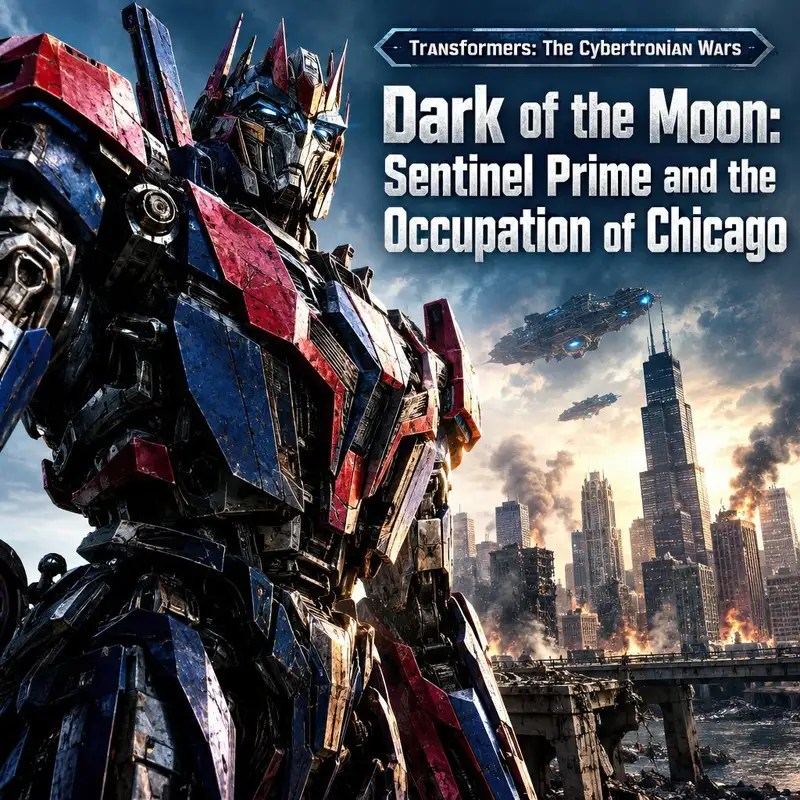
Dark of the Moon: Sentinel Prime and the Occupation of Chicago
Chicago is already lost when its real importance becomes clear. Decepticon aircraft dominate the air above the city. Streets have become killing zones. Buildings are damaged, movement is restricted, and civilians are trapped inside an urban battlespace they did not choose. At the center of it all stands a Cybertronian device whose purpose reaches far beyond Illinois. The control Pillar is the anchor of a Space Bridge network intended to draw the ruined planet Cybertron into Earth’s vicinity. Chicago is not occupied merely for territory. It is being used as the control room for a planetary relocation project.
That fact gives the battle its grim logic. Sentinel Prime presents himself as a leader trying to save his world from extinction. Yet the means chosen to achieve that goal require the conquest of a human city, the coercion of human governments, and the planned conversion of humanity into labor for Cybertronian reconstruction. The operation begins with a claim of survival and ends with a population treated as material. Chicago becomes the place where Sentinel’s argument is tested against its real consequences.
The film does not show a detailed Decepticon civil administration. We do not see a functioning occupation bureaucracy, ration cards, or a complete system of detention and labor allocation. What it does show is enough to establish the character of the occupation zone. The city is isolated by force. Decepticon patrols control movement. Aerial power makes open resistance dangerous. Infrastructure is shattered, and civilians are exposed to attacks intended to break organized defense. This is an occupation built for extraction and strategic control, not for durable government.
The central contradiction is visible from the beginning. Sentinel claims that Cybertron must be restored. But a restored Cybertron would require more than machinery, construction labor, and a way to move a planet. It would require a political order capable of surviving after the emergency. Sentinel’s plan has no such foundation. It depends instead on betrayal, coercion, and a military alliance with Megatron. Chicago is where that technical plan becomes a political catastrophe.
To understand why the city became the center of the crisis, it is necessary to return to the Moon, to the wreck of the Ark, and to a fictional secret hidden beneath one of the most famous events in human spaceflight. In real history, Apollo Eleven launched in July of nineteen sixty-nine, landed on the Moon several days later, and returned safely to Earth. In Dark of the Moon, that public mission conceals a second purpose. American authorities have discovered that something else crashed on the lunar surface.
That object is the Ark, an Autobot spacecraft carrying Sentinel Prime and a set of devices known as the Pillars. The Ark is more than a lost ship from an earlier phase of the war. It is a stranded strategic asset. Sentinel had been trying to preserve technology that could create a Space Bridge, a system able to connect distant points on a scale conventional spacecraft could not match. In a war defined by the separation of worlds, that kind of mobility is more valuable than another weapons platform.
The Decepticons understand this before the Autobots do. They discover the Ark and remove most of the Pillars from the wreck. But they leave Sentinel Prime behind with the control Pillar. That decision reveals the actual structure of the plan. The Pillars are not enough by themselves. Sentinel is needed to activate or direct the system. The Moon therefore becomes both a graveyard and a staging ground. The wreck is preserved until the one leader capable of making the technology useful can be recovered.
This arrangement gives the Decepticons a long-term advantage. They do not need to invade Earth immediately. They can wait for the Autobots to locate the Ark, revive Sentinel, and bring him within reach of the machinery that has already been distributed or concealed. It is a patient form of strategic deception. The essential weapon is not just hidden technology. It is the enemy’s expectation that an old Autobot leader will still behave as an Autobot leader.
When Optimus Prime reaches the Ark and finds Sentinel, his decision to revive him is understandable. Sentinel is not presented as an unknown survivor or an ordinary veteran. He is Optimus’s mentor, a former leader, and a living connection to Cybertron before its destruction. The Autobots are scattered on Earth, their homeworld is damaged beyond ordinary repair, and the Decepticons remain a continuing threat. Recovering a senior commander with knowledge of the Ark and the Pillars appears to offer a possible path toward strategic recovery.
Optimus also possesses the Matrix of Leadership, an artifact that in this film can restore Sentinel to life. Using it is more than an act of sentiment. It is a command decision made under conditions of loss and scarcity. The Autobots need information, legitimacy, and a way to understand what happened to Cybertron. Sentinel appears to offer all three. A commander who refuses to recover every potentially decisive asset because it might be compromised would soon become incapable of acting at all.
But understandable decisions can still become intelligence failures. Sentinel’s return is accepted too readily because his identity carries authority. He is a former leader. He is Optimus’s teacher. He is physically connected to the Ark and the Pillars. Those facts make him appear indispensable. They also make him difficult to question. The Autobots have no visible institution capable of independently verifying his loyalties, auditing his prior contacts, or separating historical prestige from present reliability.
That weakness matters because Sentinel’s authority after his revival is personal and symbolic rather than clearly constitutional. He has not returned to a functioning Cybertronian government. There is no surviving civilian assembly shown evaluating his plans. There is no established chain of command that can determine whether a former Prime remains entitled to direct policy. Sentinel’s influence rests on memory, reputation, technical expertise, and Optimus’s trust. In a crisis, those can be powerful sources of command. They can also bypass the safeguards that prevent one leader’s desperation from becoming everyone else’s fate.
Sentinel’s knowledge of the Pillars makes him valuable to Optimus. The same knowledge makes him valuable to Megatron. The difference is not technical. Both leaders understand that the system could change the balance of the war. The difference lies in what each is prepared to do with that power. Optimus sees a possible means to defend Earth and perhaps preserve Cybertronian life. Sentinel sees a means to restore Cybertron even if the price is the destruction of every principle the Autobots claim to defend.
Sentinel’s bargain with Megatron is not the simple conversion of an Autobot into a Decepticon loyalist. His stated concern is Cybertron’s survival. In his view, the old world is dying, the Autobots have failed to save it, and the available choices have narrowed to submission or extinction. That diagnosis carries emotional force because Cybertron is not an abstraction. It is the world that shaped him, the center of his political identity, and the home whose destruction has defined the war.
Yet an objective does not justify every method used to pursue it. Sentinel agrees to cooperate with Megatron. He accepts the removal of the Autobots from Earth. He accepts an invasion conducted through the Space Bridge. And he accepts the reduction of human beings to a reconstruction workforce. His proposal is not a negotiated refuge for Cybertronian survivors. It is a project of forced relocation, supported by occupation and slavery. The language of restoration conceals a plan to make another world pay the cost.
There is also a deep instability inside Sentinel’s alliance with Megatron. Megatron wants Cybertron restored, but he also wants restored power. He is the Decepticon leader, and the invasion appears at first to offer him the conquest he has long pursued. Sentinel, however, controls the knowledge and authority needed to make the Pillar system work. Once he returns, Megatron is no longer the sole indispensable figure in the operation. The alliance joins two leaders whose interests overlap only as long as neither can dominate the other.
That is the danger of authoritarian coalitions built around emergency powers. They can move quickly because they do not require consent. They can concentrate force because dissent is treated as weakness. But they rarely resolve the question of who will control the victory. Sentinel needs Megatron’s forces to seize Earth. Megatron needs Sentinel’s technology to restore Cybertron. Neither arrangement creates trust. Each merely postpones the struggle for supremacy until the moment the shared enemy appears defeated.
The first unmistakable sign that Sentinel has crossed from compromise into armed collaboration is the killing of Ironhide. Ironhide is not only an Autobot combatant. He is a senior member of Optimus Prime’s force, a trusted defender, and a witness to Sentinel’s betrayal. By killing him, Sentinel removes an immediate obstacle and demonstrates that his new course cannot coexist with the Autobot command structure. Whatever political language he uses afterward, the decision is settled by violence.
Ironhide’s death also reveals the practical meaning of Sentinel’s strategy. He is no longer trying to persuade the Autobots to accept a painful but necessary plan. He is eliminating those who would refuse it. That distinction is essential. Governments and commanders can make harsh decisions during war. They may order withdrawals, abandon positions, or accept sacrifices to prevent a larger defeat. Sentinel does something different. He turns to an enemy army and destroys his own former allies in order to impose a plan they would never authorize.
The next phase is political warfare. The Decepticons pressure Earth’s governments into demanding the Autobots’ departure. The film does not provide a full record of international negotiations, legal authority, or the views of every government involved. It would be wrong to pretend that NEST or one American military command speaks for humanity as a whole. What is clear is that the Decepticons successfully exploit fear and political vulnerability. They make the Autobots appear to be the obstacle between Earth and survival.
This is a major victory before the main invasion even begins. The Autobots are Earth’s most experienced defenders against Decepticon attack. They possess the knowledge, mobility, and combat power that human forces lack. By forcing their exile, the Decepticons remove the strongest available Cybertronian counterweight without having to defeat it openly in battle. The campaign is therefore not just an assault on a city. It is an effort to isolate Earth politically before it is conquered militarily.
The apparent destruction of the departing Autobot transport completes the deception. To human observers, the defenders seem to have been eliminated after leaving Earth. For the Decepticons, the operation appears to remove a dangerous force from the coming invasion. In reality, some Autobots survive. Their survival becomes a concealed reserve, one that will later return to Chicago at the point where the occupying force least expects it. The Decepticons achieve surprise, but not complete annihilation.
The episode’s military logic turns on that distinction. The Decepticons do not need to destroy every possible opponent. They need to create a period in which the defenders are politically discredited, physically dispersed, and believed to be gone. That window is enough to activate the Pillars, bring in reinforcements, and seize a city. Once the Space Bridge system is operating, the geography of the war changes faster than any ordinary fleet could respond.
The Pillars are best understood not as magic objects with unlimited capabilities, but as a strategic mobility system. They enable a bridge between Earth and Cybertron and allow the Decepticons to move forces from their concealed lunar position into the battle. The film establishes their transformative effect. They can bypass the normal distance between worlds. They can support the arrival of a substantial Decepticon force. They can make possible the attempt to bring damaged Cybertron toward Earth.
What the film does not establish is equally important. It does not provide a reliable technical manual for the Pillars. Their exact range, throughput, energy consumption, and limits are not explained in sufficient detail to support precise claims. We do not know how many forces could transit in a given period, how vulnerable every individual Pillar might be, or whether the system could be reproduced. The strategic result is clear without pretending that every engineering question has an answer.
The network’s strength is its ability to collapse distance. Its weakness is concentration. Sentinel is necessary to the plan. The Pillars require deployment and protection. And the system depends on a control point in Chicago. A project intended to reshape the fate of two worlds is therefore tied to a small number of critical nodes. The Decepticons gain extraordinary operational reach, but they also create a center of gravity that an enemy can identify and attack.
The worldwide placement of Pillars expands the threat beyond Chicago. The city is not the only place affected by the network. But it becomes the decisive site because the control Pillar there links local fighting to the larger effort to move Cybertron. A battle in the streets of Chicago now has consequences for a planet hanging in space. The defenders do not need to defeat every Decepticon on Earth in order to stop the operation. They need to break the system that makes the occupation strategically useful.
The film never gives a detailed explanation of why Chicago, rather than another major city, was selected. Any claim to know the original targeting rationale would be speculation. But once the city is seized, its utility is obvious. It is a dense urban environment with infrastructure, communications, tall buildings, enclosed routes, and a civilian population large enough to make military action politically and morally difficult. It is also a recognizable target whose destruction carries a message far beyond its boundaries.
For the Decepticons, the city provides cover and complexity. High-rise structures create firing positions, conceal movement, and complicate air and ground operations. Streets can be blocked, access routes can be controlled, and the built environment forces attackers into narrow corridors. A central control asset can be protected by layers of defenders while the surrounding urban landscape absorbs the shock of battle. The occupation turns ordinary civilian geography into a defensive system.
But urban terrain cuts both ways. It is difficult for an invader to observe everything in a large city. Damaged infrastructure creates obstacles for both sides. Buildings provide concealment for defenders as well as occupiers. Patrols may control major routes without controlling every interior space, stairwell, service tunnel, or ruined block. Civilian movement becomes a security problem rather than a simple fact of life. The Decepticons can impose terror, but terror does not automatically produce reliable intelligence.
Their greatest advantage is also their greatest vulnerability. They concentrate force around the control Pillar because the Pillar matters more than any single district. That concentration makes military sense. No commander would leave the central mechanism of a planetary bridge undefended. Yet it also gives the defenders a clear operational objective. The city is vast. The Decepticon system is not. If the attackers can reach the control point, they can threaten the entire occupation.
For civilians, this is a terrible arrangement. Chicago is not being fought over because it contains some abstract military prize. It is being used because its population and infrastructure can be subordinated to a Cybertronian plan. The people inside the city become hostages to the occupation and obstacles to the counterattack at the same time. The defending forces must move through streets where every strike risks making the civilian cost worse. There is no clean battlefield available to them.
The human response develops through a mixture of personal action, military initiative, and improvised coalition warfare. Sam Witwicky is not a commander in NEST, nor is he a representative of any government. His role is shaped by Carly’s capture and by his connection to Dylan Gould, a human collaborator working with the Decepticons. Sam’s effort to reach Chicago is personal at first. But personal access becomes strategically important when it leads toward information, hostages, and the control system at the heart of the operation.
Dylan is significant because he demonstrates that occupation does not depend entirely on alien force. The Decepticons possess overwhelming firepower, but they still benefit from a human intermediary who understands Earth’s social environment and can help manage access, communications, and manipulation. He is not the architect of Decepticon strategy. Sentinel and Megatron remain the decisive Cybertronian leaders. But collaboration gives the occupying force a human face and a local instrument, which is often useful in any effort to control a foreign population.
At the same time, Robert Epps and other former NEST personnel bring a different kind of human capacity. They understand military organization, weapons, communications, and the practical requirements of entering hostile terrain. Their involvement matters because the counterattack cannot be conducted as a lone rescue mission. It requires people able to connect intelligence with force, to work alongside active military units, and to navigate the confusion created by a city under attack.
Major Lennox, General Morshower, NEST personnel, and other military forces provide the organized framework for the assault. NEST is a joint human-Cybertronian military organization, not the entire American armed forces and certainly not a substitute for every government affected by the invasion. Its importance lies in experience. Its members have fought beside Autobots before. They understand that Cybertronian warfare cannot be answered by ordinary assumptions about armor, aircraft, or command relationships.
The counterattack begins under severe constraints. The city is isolated. The airspace is contested. Communications are strained. The defenders must identify the control mechanism, enter a hostile urban zone, locate civilians and hostages, and coordinate with allies they believed dead or absent. They cannot simply bombard the city from a distance. The objective is not to destroy Chicago in order to deny it to the Decepticons. It is to save the city while disabling the system built inside it.
The reappearance of the surviving Autobots changes the character of the operation. Before their return, the human force faces an enemy with superior Cybertronian mobility, heavy firepower, and control of the central strategic asset. Afterward, the defenders can form a true combined force. Human troops provide local knowledge, small-unit movement, communications, and the ability to operate within human spaces. The Autobots provide the firepower and resilience needed to confront Decepticon positions directly.
This is not a simple division in which humans handle intelligence and Autobots handle combat. Both sides fight, adapt, and take risks. But the coalition works because their capabilities are complementary. Human personnel can move through terrain and institutions built for humans. Autobots can challenge Decepticon forces that would overwhelm conventional units. Neither side possesses the whole answer. The operation succeeds because they regain the ability to act together after the political campaign had separated them.
The Battle of Chicago is therefore not best understood as a sequence of individual duels. It is a combined-arms assault against an urban occupation system. Airborne insertion gets forces into a city the enemy wants sealed off. Small units move through damaged streets and buildings. Military aircraft and heavier support create opportunities where they can. Autobots engage Decepticon defenses that human troops cannot safely confront alone. Every element is constrained by terrain, enemy patrols, uncertain communications, and the need to avoid turning liberation into further devastation.
The defenders also face a command problem. A battle inside a large city fragments information. A unit may know its immediate route but not the status of another block. Aircraft can see some threats while losing sight of those beneath roofs and inside structures. Autobots can change form and move rapidly, but their size and signature can also draw enemy attention. Human troops can infiltrate spaces that larger Cybertronians cannot use easily, but they remain highly vulnerable when discovered.
In that environment, destroying enemy soldiers is not enough. Tactical victories matter only if they open access to the control Pillar. A Decepticon vehicle destroyed in the street may reduce immediate danger, but it does not end the occupation. A defended building cleared by human troops may create a route, but it does not stop Cybertron from approaching Earth. The operational question remains constant: can the defenders reach and disrupt the mechanism that connects Chicago to the larger invasion?
That focus prevents the counterattack from dissolving into a war of attrition. The Decepticons have brought a large force into the city, and the exact balance is not established. The defenders cannot afford to match that force everywhere. Instead, they seek the necessary points in the enemy system. The control Pillar is one of those points. Sentinel is another. And the political cohesion of the Sentinel-Megatron alliance is a third, though the defenders do not initially control that fault line.
The control Pillar is the true center of gravity in Chicago because it ties local military power to the wider Space Bridge plan. As long as it functions, the Decepticons can use their occupation to support an outcome far larger than the city itself. Once it is disrupted, the entire strategic purpose of the invasion begins to fail. The battle becomes a contest over access, protection, and control rather than merely over territory.
Sam’s confrontation with Dylan occurs within this larger struggle. Sam is trying to save Carly, but the rescue is connected to the control site and to the human collaboration that helped the Decepticons operate. Dylan’s death at the Pillar is more than the conclusion of a private feud. It removes a collaborator from the immediate fight and helps bring the human struggle into direct contact with the machinery that must be stopped. The film does not explain every technical detail of the disruption. It does establish the result.
The Space Bridge collapses. Cybertron, which Sentinel had hoped to restore by bringing it toward Earth, is destroyed instead. This outcome must be understood at several levels. Tactically, the defenders have disrupted a vital device. Operationally, they have broken the occupation’s central purpose. Strategically, they have destroyed the plan to restore Cybertron through forced relocation. Industrially and culturally, the loss is catastrophic for all Cybertronians, including the Autobots who fought to stop Sentinel.
As the bridge fails, Sentinel’s alliance with Megatron fails as well. Carly recognizes something that Megatron has refused or been unable to confront. Sentinel does not regard him as an equal partner. The restoration plan has always placed Sentinel at the center because Sentinel alone possesses the authority and knowledge necessary to activate the Pillars. Megatron supplies force, but Sentinel increasingly appears prepared to use that force and then discard the leader who commanded it.
Carly’s intervention is not battlefield power in the ordinary sense. She does not defeat Sentinel through strength or take command of an army. She identifies the political reality beneath the alliance and speaks directly to Megatron’s ambition. Sentinel intends to dominate humanity, but he also intends to dominate the Decepticons. For Megatron, that is intolerable. His final decision is driven by the threat of his own displacement, not by a sudden moral awakening about the people of Chicago.
Megatron attacks Sentinel, and the struggle among the leaders opens a final opportunity for Optimus Prime. Optimus has already watched his mentor betray the Autobots, murder Ironhide, and help construct the occupation of Chicago. He has also fought through a battle in which the survival of Earth and the fate of Cybertron have been tied to decisions made by a small number of leaders. By the end, there is no functioning political process on the battlefield capable of containing either Sentinel or Megatron.
Optimus kills Megatron and then kills Sentinel. The immediate context is one of combat, collapse, and continuing danger. It would be false to describe the moment as a calm legal proceeding or a settled model of postwar justice. But it is also more than an exchange of blows. It is the removal of the two leaders whose alliance made the Space Bridge invasion possible. Their deaths decapitate the command structure of the operation at the moment the technological system sustaining it has already failed.
The consequences are immediate. Chicago is liberated from the Decepticon occupation. The bridge system is gone. Sentinel’s plan is destroyed. Megatron’s bid for power ends with him. The invading force loses the political and technical leadership that connected its military presence to a larger strategic purpose. Individual Decepticons may remain dangerous, but the campaign to restore Cybertron through the conquest of Earth has collapsed.
Yet the victory does not restore the world that existed before the battle. The Autobots remain on Earth because Cybertron is gone. Their position is now one of strategic dependence. They have defended humanity, but they have also become more visibly alien, more politically vulnerable, and more closely associated with destruction on a massive urban scale. They did not cause Sentinel’s invasion, but public fear rarely distinguishes cleanly between competing armed groups when entire cities have suffered.
Earth’s governments have reasons to feel betrayed and frightened. They were pressured into expelling the Autobots, deceived about the threat, and then confronted with a catastrophic occupation. Their military institutions have seen that Cybertronian conflict can arrive suddenly, overwhelm conventional defenses, and turn civilian infrastructure into a battlefield. That fear does not justify treating all Autobots as enemies. But it helps explain why trust after Chicago is fragile rather than secure.
Later events in Age of Extinction establish that the political relationship deteriorates sharply, with government forces turning against the Autobots. That later hostility should not be projected backward as though it were inevitable during the Battle of Chicago itself. In the moment of liberation, the Autobots and human forces are still fighting together. But Chicago leaves behind the conditions from which suspicion can grow: secrecy, shattered confidence, damaged cities, and the knowledge that one Cybertronian leader’s promise of salvation nearly became humanity’s enslavement.
Sentinel Prime fails not because Cybertron was unworthy of saving, nor because the desire to restore a ruined homeland was inherently corrupt. He fails because he treats survival as an engineering problem detached from consent, legitimacy, and moral limits. The Pillars can move armies. They can bridge worlds. They cannot turn conquest into reconstruction or slavery into a stable foundation for a civilization.
Chicago exposes that failure with unusual clarity. Sentinel’s plan depends on one compromised leader, one vulnerable control system, and the coerced submission of a population that has no reason to accept Cybertronian rule. It gains military momentum through deception and terror, then collapses when its political alliance fractures and its technical center is attacked. A restored Cybertron built on occupied Earth would never have been restoration. It would have been a new form of conquest, with a bridge system standing where legitimacy should have been.