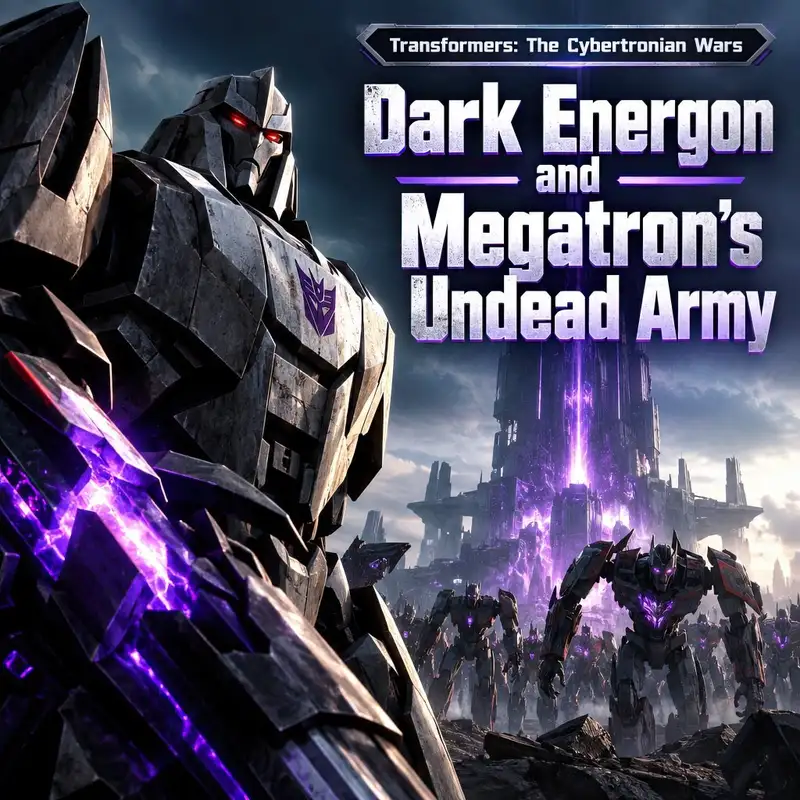
Dark Energon and Megatron’s Undead Army
The Space Bridge was already open when the real scale of Megatron’s plan became clear. From Earth orbit, a Decepticon-built transit system was sending Dark Energon toward Cybertron, the abandoned homeworld of the Cybertronians. The immediate danger was not just that an enemy had opened a route across interplanetary distance. Megatron intended to use that route to reach the dead of Cybertron, animate them, and bring the resulting force to Earth. In Transformers Prime, that made the bridge more than a machine. It was the hinge between a battlefield experiment and a planetary invasion.
The image is deliberately disturbing, but the military problem is more specific than horror. An army assembled from the dead would not need recruitment speeches, training pipelines, pay, ordinary morale, or the consent of those sent into battle. It could absorb losses that would cripple a living force. Yet an army is more than bodies capable of violence. It must be moved, directed, supplied, identified, and prevented from becoming a danger to its own side. Megatron’s Dark Energon plan offered a shortcut around some burdens of war. It did not eliminate war’s larger requirements.
The difference matters because Dark Energon in Transformers Prime has rules of its own. It is not simply a universal form of corrupted energon borrowed from every version of Transformers. The series presents it as a rare and dangerous substance, later connected to Unicron, with effects that reach beyond ordinary fuel or weapons power. It can empower Megatron. It can reanimate dead Cybertronian bodies. It can also corrupt, destabilize, and produce threats that no commander can safely regard as routine troops.
To understand why the Space Bridge became the center of gravity, it is necessary to return to the first body Megatron used to prove that Dark Energon could work at all.
Megatron returned to Earth after an absence of roughly three years. The series does not fully account for every step of his search or travel during that period, and it does not need to. What matters is the change in the Decepticon campaign when he reappears. Before his return, the Decepticons on Earth had not achieved secure control of the planet. The Autobots were few, but they were mobile, difficult to locate, and supported by human allies. Earth also presented a political problem. Open occupation could bring human military power, public panic, and a larger fight than the Decepticons were prepared to manage cleanly.
Megatron needed an asymmetric advantage. A small Autobot team can be difficult to destroy if it can disperse, hide, and choose its moments. A conventional Decepticon buildup would require forces, transport, supply, command arrangements, and a way to hold territory after it was taken. Megatron’s answer was not just to bring more living Decepticons to Earth. It was to find a means of creating military mass from a resource that Cybertron possessed in tragic abundance: its war dead.
This was innovative in a narrow and dangerous sense. Megatron recognized that the long Cybertronian war had left behind more than ruins. It had left damaged infrastructure, abandoned weapons, fractured loyalties, and bodies. A conventional commander would see those bodies as losses, perhaps as evidence of a society exhausted by conflict. Megatron saw them as potential inventory. That decision reveals both the cold logic of his plan and its political meaning. He was not trying to restore Cybertronian citizens to life. He was trying to convert the fallen into tools.
Dark Energon was the instrument that made this possible. At first, its value was not fully known even to those around Megatron. Its effects were visible before its limits were understood, which is often the most dangerous stage of any military technology. A weapon can be deployed long before a force develops doctrine, safeguards, or an honest accounting of its risks. The Decepticons possessed a rare substance with extraordinary effects. That did not mean they possessed a stable system for using it.
The first proof came through Cliffjumper.
Cliffjumper had been an Autobot scout operating on Earth. His death at the hands of Starscream was not presented as the loss of an anonymous combatant. It was the killing of a sentient individual with comrades, a mission, and a place within the Autobot force. Megatron then used Cliffjumper’s body as an experimental subject. The result was the first Terrorcon seen in the series: a reanimated Cybertronian body driven by Dark Energon.
It is important not to call this a resurrection. The Terrorcon that emerged was not Cliffjumper returned to his friends. There is no meaningful sign that his personality, judgment, memory, or agency had been restored. The body moved. It attacked. It displayed violent persistence. But the individual who had been Cliffjumper was absent from the result. Megatron had not reversed death. He had made the dead body useful to his own purposes.
That distinction is biological, moral, and military. Biologically, the experiment showed that Dark Energon could animate a Cybertronian body after death. Morally, it turned a fallen person into a weapon without consent. Militarily, it suggested that casualties might be repurposed instead of mourned, recovered, or buried. In a war already marked by immense destruction, that is a profound escalation. It changes the meaning of a battlefield. The dead are no longer simply losses, evidence, or objects of recovery. They become a potential reserve for whichever side controls the means of reanimation.
Starscream was present in the early crisis and played a direct role in Cliffjumper’s death, but the larger concept belonged to Megatron. There is no reason to describe Starscream as the architect of a full Terrorcon program. His relationship with Megatron was already shaped by fear, ambition, and calculation. He could assist in an experiment without sharing a durable commitment to its strategic logic. That distinction would matter later. A force built around a volatile resource still depends on the loyalty and competence of the living officers who manage it.
For Megatron, Cliffjumper was a proof of concept. The experiment established that Dark Energon could create a violent body from a fallen Cybertronian. It did not establish how many such bodies could be controlled, how long they would remain functional, whether they could be moved safely across space, or whether they could distinguish enemy from ally under changing conditions. Those unanswered questions were not minor details. They were the difference between a terrifying incident and a usable military system.
Megatron also refused to remain outside the experiment. He placed Dark Energon into his own spark chamber, bringing the substance into the core of his own body. The immediate effects were unmistakable. He became more powerful, and later events connected his survival to the Dark Energon within him. But Transformers Prime does not provide a complete technical manual for what occurred inside Megatron’s spark chamber. It would be a mistake to describe the process as a standard enhancement, a universal medical treatment, or a reliable route to immortality.
What the series does establish is that Megatron accepted personal corruption in exchange for power. That choice fit his command style. He had always relied on force, fear, and personal authority to hold together a Decepticon movement containing soldiers, scientists, opportunists, and rivals. Dark Energon promised to magnify that authority. If he alone could endure it, wield it, and create new weapons with it, then he would possess something his subordinates could not easily challenge.
But dependence on a volatile substance is not the same as strength. A commander can become more dangerous in battle while becoming less secure as a leader. The more Megatron’s survival and power were tied to Dark Energon, the more his command depended on a resource that could corrupt his judgment, frighten his followers, and create consequences beyond his control. Personal enhancement may solve an immediate vulnerability. It can also concentrate risk in the person least able to be replaced.
The same tension appeared when Megatron moved from one experimental body to a battlefield resource. Optimus Prime and Ratchet encountered the remains of dead Cybertronians and began to understand what Megatron had discovered. When Megatron used a shard of Dark Energon to reanimate multiple fallen bodies, the threat changed in character. Cliffjumper’s fate had shown that a single corpse could be weaponized. The larger demonstration suggested that the process could be applied to a battlefield of dead.
For the Autobots, this was not an ordinary engagement. They were forced to fight bodies that had once belonged to Cybertronians, beings who may once have possessed loyalties, memories, professions, and lives before the war consumed them. The Terrorcons did not appear to retain those identities. Their aggression was not the return of old soldiers to a cause. It was the use of emptied bodies as instruments of attack.
Tactically, the Terrorcons were formidable in the way that mindless forces can be formidable. They displayed relentless aggression. They did not appear vulnerable to fear, persuasion, or ordinary exhaustion. They could continue advancing through damage that might stop a living combatant concerned with survival. Their presence also imposed a psychological burden on the Autobots. Every fight became a confrontation with the evidence of Cybertron’s dead, now turned against those still trying to protect its future.
Yet the limits were visible from the beginning. The Terrorcons did not demonstrate independent tactical planning. They showed no clear capacity for complex maneuver, disciplined targeting, reconnaissance, or adaptation to a changing operational picture. They were dangerous because they could attack in numbers and because they were difficult to deter. That is not the same as being a professional army. The available evidence suggests that their usefulness depended heavily on Dark Energon influence and direct direction by those who controlled it.
Megatron had discovered a way to create violent mass. He had not demonstrated that he could create an institution.
That difference is easy to overlook because military history often gives too much attention to weapons and too little to the systems that make weapons effective. A force needs people who can receive orders, understand intent, adjust when communications fail, identify objectives, preserve equipment, and distinguish a temporary target from a strategic purpose. Terrorcons appeared to bypass recruitment and perhaps some forms of training. They did not bypass the need for command.
They also did not bypass logistics. Dark Energon itself had to be obtained, transported, stored, and protected. The reanimated bodies still had to reach the battlefield. They needed a route, a target, and some mechanism of coordination. The Decepticons still required ships, facilities, technical personnel, guards, and functioning communications. A force that does not complain about rations may still require an entire system to make it useful.
There was another constraint. Terrorcons had no voluntary loyalty. They did not fight because they believed in Megatron’s political cause, because they expected reward, or because they hoped for a future under Decepticon rule. They had no civic stake in the world they were sent to conquer. That might make them easier to expend. It also made them incapable of building legitimacy. An army of the dead can seize space through terror. It cannot by itself govern a planet, negotiate with a population, or create a political order that survives after the first wave of destruction.
The Space Bridge plan becomes essential at this point. Cybertron’s dead mattered to Megatron not merely because they existed, but because they were far away. He could not turn an abandoned homeworld into an Earth invasion force without solving the problem of distance. The graveyard was on Cybertron. The target was Earth. Between them lay an interplanetary gap that no amount of Dark Energon could erase on its own.
The Autobots gradually assembled the purpose of the Decepticon operation from the evidence available to them. They saw the Dark Energon, the reanimated Cybertronians, and the construction of an orbital Space Bridge. Their assessment was grim. Megatron intended to send Dark Energon through the bridge to Cybertron, animate its dead, and use the same system to bring that force to Earth. The series does not establish an exact number of bodies involved, nor does it show that every fallen Cybertronian on Cybertron was available for reanimation. It did not need to. Even an uncertain number of reanimated bodies could pose an overwhelming crisis if delivered suddenly to a vulnerable planet.
The plan rested on three dependencies. First, Megatron needed Dark Energon. Without the substance, the dead remained dead. Second, he needed a functioning Space Bridge, capable of linking Earth to Cybertron. Third, he needed enough accessible Cybertronian remains on the far end of that link to create a force worth moving. Remove any one of those elements, and the concept failed.
The Space Bridge was therefore not a decorative science-fiction portal. It was the operational center of gravity. It connected resource, force generation, and deployment. It allowed Megatron to bypass the slow and vulnerable process of conventional interplanetary lift. He did not need to load an invasion army into transports, protect those transports from interception, sustain them during a long voyage, and land them under fire. The bridge promised immediate strategic mobility, provided the Decepticons could build, power, secure, and maintain it.
Those requirements are easy to miss because the bridge appears as a single structure. In practice, its construction implies a wider Decepticon system. Someone had to provide technical knowledge. Someone had to secure the site. Someone had to maintain the energy supply, protect the approach, and ensure that the bridge connected to the intended destination. The series does not provide a staffing chart, exact power requirements, or throughput figures. But it clearly establishes that the bridge was specialized infrastructure, not a capability that any Decepticon could activate at will.
That was also its weakness. An army generated across the stars might appear limitless, but its movement depended on a narrow technical link. Megatron had concentrated enormous potential power into one system. If the Space Bridge remained open and stable, the plan could turn Cybertron’s dead into an immediate threat to Earth. If it failed, the dead remained remote, and the invasion concept collapsed with it.
Earth was not incidental terrain in this operation. It was the intended destination of a force able to arrive with little warning through orbital infrastructure. For the human beings living below, the distinction between an alien war and an invasion would have become very small, very quickly. A Terrorcon force would not need to negotiate borders, obtain landing rights, or establish conventional supply depots before causing destruction. It could arrive where Megatron directed it and attack with little regard for civilian boundaries.
The human allies of the Autobots and Agent Fowler were directly involved in the immediate crisis, but they did not represent all human governments or all of Earth’s population. The series does not establish a fully coordinated global response to Megatron’s plan. What it does establish is the vulnerability created by secrecy and surprise. Earth’s defenders had limited warning, incomplete knowledge of Dark Energon, and no practical way to prepare civilian populations for an invasion force emerging from a Cybertronian bridge in orbit.
That uncertainty was part of Megatron’s advantage. He did not need to conquer every human institution before beginning the attack. He needed only to create a breach in Earth’s strategic perimeter and force the Autobots into a defensive battle. The Terrorcons were useful precisely because they could turn that first breach into panic, attrition, and physical destruction.
The Autobots could not answer the threat by trying to destroy every reanimated body on Cybertron. They were too few, too distant, and cut off from the homeworld. Nor could they rely on the Terrorcons to collapse from poor morale or factional infighting. The immediate problem was the bridge. If they could sever the route, Megatron would lose the ability to transform remote bodies into an immediate Earth invasion force.
That conclusion imposed a severe cost. The Space Bridge was not only Megatron’s weapon. It was also the Autobots’ best possible route back to Cybertron. For a small force stranded on Earth, access to their homeworld was more than sentimental. It promised strategic mobility, reconnection with any surviving allies, access to Cybertronian resources, and perhaps a chance to influence the fate of their own civilization directly. Destroying the bridge meant giving up that opportunity.
Optimus Prime’s decision was therefore a denial strategy in its clearest form. He did not need to destroy every Decepticon or solve every mystery surrounding Dark Energon. He needed to deny Megatron the one capability that made the immediate invasion possible. In military terms, he chose to destroy a system of decisive mobility rather than confront the full mass of the enemy force after it had arrived.
Ratchet’s technical analysis helped make that decision possible. The other Autobots contributed through reconnaissance, infiltration, and direct assault. Arcee, Bumblebee, and Bulkhead each served within the small team effort required to reach and disrupt the Decepticon operation. Their human allies supported a crisis that had become far larger than any one individual. But the strategic judgment belonged to Optimus. He had to accept that preserving Earth required sacrificing the most direct path home.
This was not an effortless moral victory. The bridge’s destruction did not end the Decepticon threat. It did not remove Dark Energon from the conflict. It did not restore Cliffjumper or the other dead Cybertronians whose bodies had been used as weapons. It did not repair Cybertron, reconcile its factions, or guarantee that the Autobots would ever return. It was a hard choice because it denied the enemy and denied the Autobots at the same time.
The Autobots survived the battle and sabotaged the bridge. In doing so, they severed the route needed to bring Megatron’s projected army to Earth and destroyed his attempt to convert Cybertron’s accumulated dead into rapid mass force on a new world. The victory also carried a personal cost: deeper isolation from Cybertron, because their own hopes for return had been tied to the same infrastructure.
When the Space Bridge collapsed, Megatron was caught in the event. His apparent destruction did not end the danger. Starscream later found him in space, alive despite damage that would have ended an ordinary Cybertronian. The Dark Energon within Megatron clearly mattered to that survival, but the exact mechanism remains uncertain. The series shows an exceptional result. It does not establish that Dark Energon makes its user invulnerable, nor that any Decepticon could repeat Megatron’s experience safely.
Megatron’s survival also did not make the operation a success. A commander surviving a failed mission is not the same as a commander achieving the mission’s objective. The bridge was gone. The projected Terrorcon invasion had been prevented. The opportunity to move a vast force from Cybertron to Earth had collapsed with the system designed to carry it. Megatron retained his life and eventually resumed command, but he had lost the central mechanism of his plan.
Starscream’s role in finding Megatron is revealing in its own way. The Decepticon command structure was never merely a machine that continued smoothly regardless of personal relationships. It was held together by fear, rivalry, calculation, and the practical dependence of subordinates on Megatron’s authority. Dark Energon could animate bodies, but it could not solve the Decepticons’ recurring political problem: how to create a durable chain of command among living individuals with conflicting ambitions.
Later events in Transformers Prime provide a limited but useful warning about the control problem built into Dark Energon. In the episode “Thirst,” experiments by Knock Out and Starscream involving Synthetic Energon and Dark Energon lead to a Terrorcon outbreak aboard the Nemesis. The circumstances differ from Megatron’s original plan, and the later incident should not be treated as a direct replay of the proposed Earth invasion. Still, it demonstrates that reanimation was not a cleanly controlled military process.
The Terrorcons created in that outbreak did not behave like disciplined Decepticon troops. They became predatory threats within Decepticon space, endangering the very personnel who had helped create the crisis. The lesson is not that Megatron’s original army would certainly have spread without limit or behaved in exactly the same way. The series does not establish that. The lesson is narrower and more important. Dark Energon could create violence faster than Decepticon command could reliably contain it.
That is a familiar danger in military history. A weapon that promises easy force generation can tempt leaders to ignore control, accountability, and second-order effects. The first question becomes, can this be made to attack? The harder question is, can it be stopped, directed, secured, and kept from destroying the force that deployed it? Megatron answered the first question. The later record suggests that the second remained unresolved.
Predacons Rising adds another point of clarification. In that later conflict, Unicron uses Dark Energon to reanimate ancient Predacon remains as Terrorcons. Those creatures are not Megatron’s original undead army, and their controlling agency is not restored Megatron. They belong to a separate event, shaped by Unicron’s actions and a different strategic situation. Their existence reinforces the danger associated with Dark Energon, but they should not be folded into the Space Bridge operation as if one Terrorcon force continued unchanged into another campaign.
The larger assessment of Megatron’s plan begins with a genuine military insight. Living forces are difficult to build and sustain. They must be recruited or persuaded. They require leaders, organization, maintenance, medical support, transport, and some reason to continue fighting when the war turns costly. They can desert, hesitate, argue, question orders, and demand a future worth surviving for. A leader who treats all of that as inconvenience may look for a force that does not need loyalty.
Dark Energon seemed to offer such a force. It converted dead Cybertronian bodies into immediate aggression. It removed the need to win their consent. It appeared to make casualties less meaningful, because damage to the reanimated did not carry the same moral or psychological weight for their commander. It promised military mass without the slow work of building institutions. For a Decepticon leader frustrated by the limits of his available forces, the attraction is obvious.
But the shortcut was incomplete. Dark Energon could animate bodies. It could not automatically provide strategic intelligence, flexible command, secure movement, political legitimacy, or a sustainable occupation system. It could create shock. It could not create a polity. The Terrorcons were an army only in the most limited sense: a collection of bodies capable of being directed toward violence.
Megatron’s plan also depended on scarcity. Dark Energon was not shown as an ordinary commodity that the Decepticons could refine in endless quantities. The operation required access to a rare and corrupting resource. It required a specialized Space Bridge. It required Cybertronian remains at the far end of that bridge. It required Decepticon personnel able to protect and operate the system. A plan that seems to eliminate logistics may simply be hiding its logistics inside a smaller number of fragile, irreplaceable dependencies.
The moral cost was inseparable from the strategic one. Cybertron’s dead were not just raw material. They represented the human, or rather Cybertronian, consequence of the war that Megatron himself had helped sustain. By reanimating them as Terrorcons, he stripped away any remaining recognition of their personhood. He did not offer them restoration, justice, or even factional belonging. He offered only use.
That is why the plan reveals something important about Megatron’s political evolution. Whatever grievances and ambitions had shaped the Decepticon cause before this moment, the Dark Energon army reduced Cybertronian society to a stockpile of usable bodies. The fallen were not citizens to be remembered. They were assets to be activated. The distinction is not rhetorical. It is the difference between leading a movement and consuming the population from which that movement emerged.
The Autobots’ response was limited, but it was strategically sound. They did not defeat every consequence of Dark Energon. They could not restore the dead or guarantee that Megatron would never find another weapon. They did not even secure their own return to Cybertron. What they did was identify the Space Bridge as the mechanism that could turn a terrible experiment into an immediate planetary catastrophe.
By destroying that bridge, Optimus Prime and his team severed the link between Cybertron’s dead and Earth’s vulnerability. They accepted greater distance from their homeworld in order to deny Megatron a force that might have overwhelmed the planet before any wider defense could organize. Dark Energon could animate the dead, but it could not solve the larger problems of moving force, controlling it through a contested system, and turning terror into durable power.