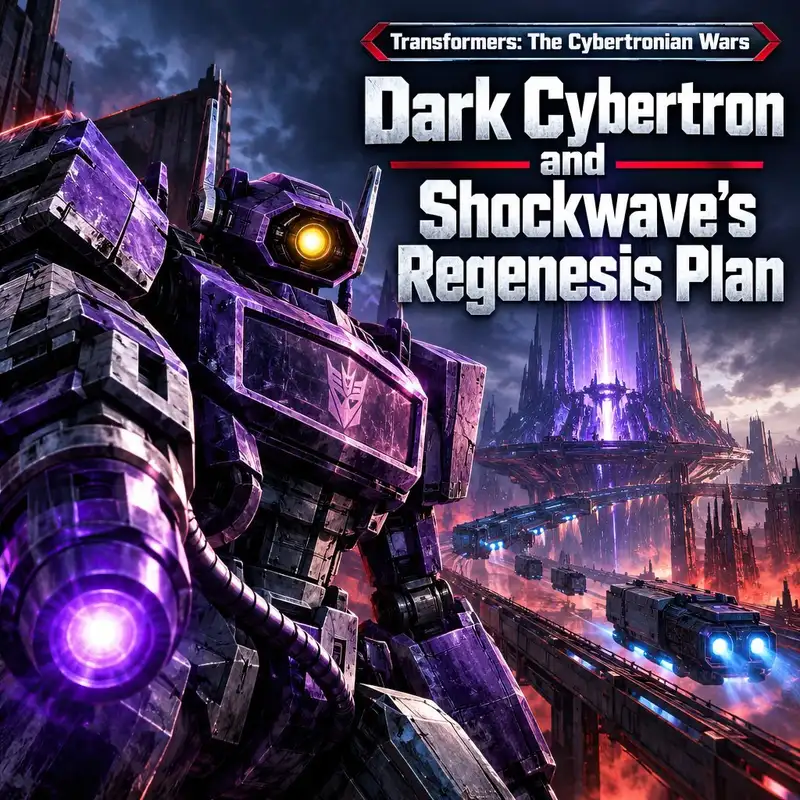
Dark Cybertron and Shockwave’s Regenesis Plan
Cybertron saw dawn where no dawn should have been. The light spread across a world still trying to emerge from civil war, and for a moment it resembled renewal. Then the details became impossible to ignore. This was not sunlight. It was a planetary alarm, triggered when Metrotitan arrived from Gorlam Prime and reacted to an unfamiliar ore. The glow was not a promise that Cybertron had recovered. It was evidence that something had begun to activate beneath the surface of its fragile peace.
In the I D W comic continuity that began in two thousand five, this was the opening of Dark Cybertron. The old Autobot-Decepticon war had formally ended, but ending organized combat had not restored trust, industry, or civic order. Cybertron was a damaged planet with a new government, returning populations, armed former enemies, and institutions still learning the difference between winning a war and governing after one. Into that uncertainty came a crisis prepared long before the current political order existed.
The false sunrise mattered because it exposed a particular kind of vulnerability. Cybertron had defenses against invading fleets, insurgent cells, and familiar military rivals. It had far fewer defenses against infrastructure planted in secret across deep time. No election had authorized it. No postwar command had built it. No current government fully understood it. The first warning was not an enemy transmission or a border incident. It was the planet itself behaving as though someone else still held the controls.
Starscream, Cybertron’s ruler at the time, understood quickly that the event was not natural. That realization did not give him command of the situation. His government was politically real, but it was also precarious. It ruled a society divided by memories of war, faction identity, exile, collaboration, and loss. Starscream could issue orders, but he could not assume that every former Autobot, Decepticon, neutral, or returning colonist accepted the same version of Cybertron’s future.
That distinction is important. A civilian government is not the same thing as a unified strategic command. Cybertron had survived the removal of Optimus Prime from formal leadership, but it had not yet built broad confidence in a replacement system. Its political arguments were still raw. Who had authority over security? What did justice mean after a war that had involved occupation, sabotage, prison camps, secret programs, and mass displacement? Which former combatants could be trusted with weapons, offices, or access to the planet’s infrastructure?
For civilians, the false dawn was more than a mystery for famous leaders to solve. It meant that the world beneath them might no longer be reliable. A functioning energy grid, a city’s transport routes, a repair facility, or a space bridge network depends on assumptions about what the planet will do tomorrow. Dark Cybertron began by undermining those assumptions. The crisis threatened not only combat forces, but the continuity of ordinary life.
The source of that threat was Shockwave. Not the Shockwave of another animated series, film, game, or comic line. This was the Shockwave of I D W’s two thousand five continuity, a Decepticon scientist whose importance rested less on formal rank than on his capacity to plan independently of ordinary faction command. He did more than build weapons for Megatron. He built systems that could outlast governments, wars, and the people who believed they controlled him.
His central project was called Regenesis. At first glance, it began with a strategic diagnosis that was difficult to dismiss. Roughly six hundred thousand meta-cycles before the postwar crisis, Shockwave concluded that Cybertron’s Great War would consume the planet’s natural resources. The war was not only killing soldiers and destroying cities. It was draining energon reserves, damaging industry, exhausting transport systems, and turning repair capacity toward immediate survival instead of long-term renewal.
That was a sustainment problem. Any civilization at war faces one eventually. Armies can seize depots, capture mines, and ration supplies, but none of those measures creates an endless resource base. A conflict that strips its own industrial foundation can continue long after it has lost the ability to support a durable peace. Cybertron’s war had become that kind of conflict. Its leaders could still make operational decisions. They could still win battles. But the wider system was consuming the future needed to recover from them.
Shockwave’s warning did not produce a collective response. The Autobots and Decepticons were too deeply committed to their immediate struggle. That does not mean either faction was incapable of understanding scarcity. It means war narrowed their political horizon. Leaders facing active fronts, damaged cities, defections, and losses rarely have the patience to invest in solutions whose value may not appear for ages. In that environment, the person willing to act alone can appear more farsighted than the institutions too divided to act at all.
Shockwave took that opening and converted it into private authority. He did not pursue conservation, negotiation, demobilization, or a shared resource regime. Those approaches would have required consent, compromise, and the risk that another faction might gain equal access to the result. Instead, he built a system that only he understood. The resource crisis became justification for concealed control.
Regenesis was more than a search for energon. Shockwave refined raw energon into a catalyst and fired that catalyst toward selected worlds. Those worlds were more than marked for later mining. They were altered. The material interacted with local geology over immense spans of time, producing rare ores and reactions that could be regulated rather than harvested immediately. Shockwave later installed global dampers to manage those processes.
The dampers are essential to understanding the project. A stockpile can be seized. A mine can be blockaded. A refinery can be sabotaged. But a network of worlds whose geological development has been shaped, delayed, and regulated over ages is a deeper form of strategic infrastructure. Shockwave was creating future supply sources and controlling when they would mature. He was more than accumulating fuel. He was attempting to manage the conditions under which fuel could exist.
In ordinary military terms, Regenesis promised several advantages. It dispersed resources across multiple locations, reducing dependence on a single vulnerable source. It placed parts of the supply network beyond the immediate reach of Cybertron’s war. It allowed Shockwave to prepare reserves that could become valuable at a chosen moment. And because the project remained secret, it gave him an intelligence advantage over every commander who believed the war’s decisive resources were already known.
But a distributed network is not automatically a usable one. Worlds must be reached. Sites must be identified, secured, and operated. Ore must be understood before it can be safely employed. Transport must remain available. Political authorities must tolerate, or be unable to prevent, the extraction. Regenesis did not make logistics disappear. It moved logistics into the future and concealed the map from everyone except its architect.
That secrecy also changed the project’s moral character. Shockwave did not treat the seeded worlds as societies, ecosystems, or independent places with their own claims. They were variables in a calculation. Their significance lay in what they might someday provide Cybertron. The further he extended the network, the more he made another world’s future subordinate to his own definition of Cybertronian survival.
Prehistoric Earth became one of those worlds. It was not chosen because Shockwave regarded it as a future homeland, nor because he had any special concern for its developing life. Earth was a Regenesis site. Its value was geological and strategic. It provided a location where Shockwave could continue the program away from the immediate pressures of the Cybertronian war.
His activity on that ancient Earth brought him into conflict with the Dynobots. Their pursuit began after Shockwave disrupted an energon-gathering mission, and the encounter forced them into an environment shaped by unstable energon conditions. To endure it, they adopted synthetic organic coverings and dinosaur alternate modes. That adaptation belongs to this specific historical circumstance. It was a local survival measure, not proof that all Cybertronian biology works this way or that every Dinobot in every continuity shares the same origin.
The confrontation ended beneath volcanic material. Shockwave and the Dynobots were buried, while one of Shockwave’s hands remained concealed until modern human archaeologists discovered it in Nevada. The buried hand is a useful image, though not because it makes Shockwave seem supernatural. It demonstrates patience. Regenesis was designed to survive the disappearance of its own operators. The program could wait underground, in planetary crusts and forgotten sites, until conditions were favorable again.
That is what made the later crisis so dangerous. Cybertron’s leaders were not confronting a new invention built during the postwar period. They were confronting the activation of a system whose preparation had begun before their government, before their political settlement, and before many of their assumptions about the war had taken shape. It had been designed to outlive discovery.
At some point, Regenesis ceased to be only a resource project. The ores were connected to a wider pattern involving ancient Cybertronian history and worlds associated with the dispersed legacy of the Thirteen Primes. The core Dark Cybertron story establishes that this network had a significance beyond ordinary extraction. Later material in the same continuity expands parts of that history. What matters here is not a complete catalog of ore-worlds. It is that Shockwave had found a way to connect resource engineering with a much older architecture of myth, movement, and planetary power.
This was the conceptual escalation at the center of Regenesis. A system built to preserve future energy reserves became infrastructure for something far more ambitious. Shockwave no longer treated the ores as the answer to scarcity in a normal strategic sense. They became components in a plan involving time, space, decay, and the fate of reality itself.
The language of anti-entropy is useful here, provided it is not mistaken for a full technical explanation. Shockwave’s problem was decline. Energon ran down. Civilizations consumed resources. Wars destroyed productive capacity. Political orders failed. His solution was not to accept that decline as a condition to be managed. It was to create a state in which change itself could be overcome. That is where planning for survival crossed into planning against existence.
A society can survive scarcity through repair, reform, trade, restraint, innovation, or shared sacrifice. All of those methods require people to remain people. They require disagreement, distribution, negotiation, and the possibility that someone else may decide differently. Shockwave’s version of preservation removed those risks by removing the independence of everyone else. Once every outside world became raw material, survival became indistinguishable from domination.
Dark Cybertron was therefore not a conventional campaign with one front and one chain of command. It unfolded across Cybertron, Gorlam Prime, Metroplex, the Lost Light, the Dead Universe, Crystal City, and the operations surrounding the Necrotitan. These theaters appeared disconnected at first because Shockwave had designed them that way. Each group understood a local crisis. Few understood the whole machine.
This compartmentalization was one of Shockwave’s greatest strengths. He did not need every participant to be loyal in the same way. He needed them to perform a limited function without seeing the final objective. A scientist could pursue a technical task. A local force could fight for its own political bargain. A commander could seek power in one theater. An ancient entity could follow its own ambitions. If each action moved the larger system forward, Shockwave did not require a unified army.
That distinction matters for the forces associated with the Dead Universe. Nova Prime controlled that collapsing reality and held Orion Pax’s group captive. Jhiaxus had his own scientific and temporal importance. Galvatron, Dreadwing, Bludgeon, Waspinator, and others brought different loyalties, fears, and ambitions into the crisis. They were not a single Shockwave command structure in different uniforms. Their motives overlapped with his plan at some points and diverged at others.
The Ammonites show how Shockwave turned local conflict into strategic leverage. They were recruited with promises tied to their own war against the Terradores. That was more than mercenary contracting. It was an example of political manipulation at operational scale. Shockwave did not need to persuade them that Cybertron should be preserved forever. He only needed to offer an outcome they considered worth fighting for and direct their strength against the Lost Light.
Such arrangements can be powerful, but they are also brittle. A system built on partial knowledge depends on keeping every participant inside a narrow compartment. Once they learn that their local objective serves something more dangerous than the bargain they accepted, their cooperation can become unreliable. Shockwave’s plan was resilient against ordinary battlefield losses. It was less resilient against understanding.
The Lost Light crew became important for precisely that reason. They were not a conventional field army. Their value lay in investigation, survival, technical knowledge, and the ability to connect information from places that were supposed to remain separate. The crew encountered the Dead Universe, Metroplex, hostile forces, and evidence that the crisis on Cybertron was not isolated. Their contribution was intelligence in the broadest sense: recognizing a pattern before the pattern completed itself.
The Necrotitan made the threat more visible. Here, Regenesis infrastructure was weaponized directly. The Titan and the ores produced an alchemical plague capable of breaking down Cybertronian metal. The effect was more than another battlefield hazard. It threatened the physical integrity of Cybertronians at a moment when repair systems, evacuation routes, and command networks were already under pressure.
A plague of this kind has effects at several levels. Tactically, it incapacitates individuals and creates immediate panic. Operationally, it overwhelms medics, damages mobility, and forces commanders to divert personnel from other missions. Strategically, it can paralyze a planet by making every concentration of forces, every repair facility, and every attempt at evacuation more difficult. A force that cannot maintain its bodies cannot protect its cities, even if it still possesses weapons.
Metroplex was central to the response because he was more than a giant combatant. In this continuity, he was a Titan, a person of immense scale, and an infrastructure asset whose internal architecture and mobility mattered to the wider defense. His connection to space-bridge functions gave him strategic importance beyond direct firepower. If Metroplex could be compromised, the defenders risked losing not only a powerful ally but a means of movement, access, and coordination.
The infection of Metroplex therefore threatened systems that ordinary soldiers could not replace. A damaged squad can be reinforced. A damaged Titan whose body incorporates crucial infrastructure presents a much harder problem. His internal restructuring, along with the intervention of a combined Autobot-Decepticon force, prevented the plague from producing the outcome Shockwave needed. This was a tactical and operational success. It stopped a weapon from disabling a vital asset.
It did not defeat Regenesis. That distinction is easy to miss in a crisis built around enormous machines and immediate destruction. Destroying or neutralizing the Necrotitan removed one instrument of the plan. It did not remove the distributed network of ores, dampers, ancient preparation, and Dead Universe energy that made the larger project possible. The defenders had survived an attack. They had not yet understood the war.
The Dead Universe revealed the deeper danger. It was more than an enemy-held location or a hostile dimension to be escaped. It was a collapsing reality, a place where ordinary assumptions about stability and survival no longer held. Shockwave intended to use its energy as part of his own system. That made the Dead Universe both a power source and a trap.
Orion Pax’s presence there was important because he entered the crisis not only as an Autobot leader but as a captive participant inside its metaphysical and historical center. He and his group did not possess complete information. They were constrained by Nova Prime’s authority, by the instability of the environment, and by the limited routes available to them. Historical hindsight can identify the broader pattern. The characters inside the Dead Universe had to act with fragments.
This is where mobility becomes more complicated than simply opening a portal. Space bridges, Titan movement, and interdimensional access can give forces extraordinary reach. They can bypass distance, reinforce a threatened world, or provide escape from a collapsing theater. But they also create fixed points of failure. They need access, control, stable endpoints, and participants capable of operating them. A route that saves one force can become a trap if another force controls the exit.
Shockwave understood this. His plan did not eliminate geography. It exploited strategic geography at a scale most commanders could not see. Cybertron, Gorlam Prime, the Dead Universe, and Crystal City were not interchangeable locations. Each contained a necessary component: an ore reaction, a Titan, a portal, a captive group, a machine, or a political distraction. The system depended on their connection.
The defenders began to gain ground once they recognized that connection. The false sunrise, the strange ore, the Necrotitan, the Dead Universe, and the attacks on the Lost Light were not separate catastrophes. They were parts of one architecture. That realization did not make the response easy. It did, however, transform the problem from a series of emergencies into an intelligible campaign.
The full revelation was devastating. Shockwave intended to combine the Regenesis ores with the energy of the Dead Universe and collapse all existence into a single moment. Cybertron would be sustained eternally. But the price of that permanence would be every other world, every other person, every independent future, and every historical possibility outside the preserved instant.
This was not conventional conquest. A conqueror seeks territory, labor, tribute, security, or political submission. Shockwave’s plan made those goals irrelevant. It did not seek to rule other populations. It proposed to abolish the conditions under which other populations could continue to exist. The distinction matters because it explains why ordinary deterrence had so little value. There was no negotiated settlement available if the final objective was the end of all alternatives.
Shockwave’s solution to decline was to end change. A single eternal moment would contain no depletion, no political uncertainty, no resource competition, and no future in which Cybertron might again become vulnerable. It would also contain no consent. A civilization cannot be called preserved merely because its physical substance remains arranged in one frozen configuration. A living society requires time. It requires the possibility of repair, disagreement, memory, adaptation, and choice.
That is the moral failure at the heart of Regenesis. Shockwave began with Cybertron’s survival, but he gradually stripped the word Cybertron of its people. The planet became an abstract object, a system to be maintained at any cost. Cybertronians, humans, Ammonites, Terradores, colonists, allies, enemies, and future generations became expendable inputs. The plan claimed to protect Cybertron by denying that the living beings of Cybertron had any right to determine what survival meant.
This also explains why the plan required such absolute secrecy. No broad political constituency would willingly authorize the destruction of every possible future in exchange for eternal stasis. Shockwave could not build consent, so he built dependency. He prepared the ores in secret, manipulated actors with limited bargains, exploited unstable governments, and used a collapsing reality whose very nature made normal accountability difficult.
The response required cooperation among figures who had every reason to distrust one another. Optimus Prime, Megatron, Autobots, Decepticons, and other survivors confronted a threat that would erase the political causes for which they had fought. Their alliance was not a declaration that the old war had been morally balanced or politically resolved. It was an emergency alignment produced by the fact that Shockwave’s victory would make every other conflict meaningless.
Megatron’s role deserves particular care. He entered this period badly damaged and increasingly dependent on others. That dependence mattered because it challenged a style of command built around personal dominance, fear, and control. It did not erase the violence of his past leadership, nor did it absolve him of the suffering caused by the Decepticon war. But it forced him into a situation where survival depended on cooperation rather than obedience.
That was a real change in military and political terms. A leader accustomed to treating subordinates as instruments must confront a different reality when he can no longer act alone. Reliance can create humility, but it can also create resentment, denial, or a new form of manipulation. Dark Cybertron does not offer a simple verdict on Megatron. It shows the beginnings of a confrontation with responsibility under conditions where there is no longer room for factional self-importance.
For Optimus Prime, the crisis reinforced a different problem. Moral authority is valuable in a coalition, but it does not remove the need to work with compromised allies when the alternative is annihilation. Optimus could oppose Shockwave’s plan without pretending that everyone fighting beside him shared the same political vision. Command under those conditions is not reconciliation. It is the management of necessary cooperation without forgetting what remains unresolved.
Starscream faced the same contradiction from the civilian side. The crisis might appear to validate central authority. A planet under existential threat needs coordination, defense, and emergency action. But emergency unity can also conceal unresolved questions about legitimacy. Starscream’s government had not solved the problems of former Decepticons, former Autobots, neutrals, prisoners, reparations, demobilization, or reconstruction. It had simply been forced to survive a larger danger first.
The military success of this temporary alignment lay in its ability to disrupt Shockwave’s compartments. Individuals who had been isolated by faction, geography, or partial information began to share what they knew. The system Shockwave built was formidable because it had been prepared over ages. It became vulnerable because its components could no longer remain politically and intellectually separate.
The final objective was therefore not just to defeat Shockwave in combat. A planner who builds a system across worlds and eras cannot be stopped only by removing one commander from the field. The machinery itself had to be destroyed. The chronal apparatus at the center of the activation had to be broken before it could collapse reality into the single moment Shockwave intended to preserve.
The destruction succeeded in stopping the immediate plan. It also produced a singularity that consumed Crystal City and apparently destroyed Shockwave. The cost should not be minimized. A city is not an interchangeable battlefield backdrop. It contains infrastructure, memory, labor, shelter, archives, and people whose lives are shaped by decisions made far above them. Dark Cybertron ended its immediate crisis with survival, but survival came through another wound to a planet already damaged by war.
On the battlefield, the defenders defeated a catastrophic mechanism. Across the wider operation, they disrupted the coordinated use of the ores, Titans, portals, and Dead Universe energy. At the broader strategic scale, they prevented Shockwave from abolishing every other reality. Those are immense achievements. They did not, however, rebuild Crystal City, restore trust, or resolve the political questions Cybertron had postponed while facing extinction.
The story also did not end with Shockwave’s apparent destruction. Later material in the same I D W continuity revealed the deeper historical trap. Shockwave survived the singularity by being thrown backward into Cybertron’s distant past. There, he assumed the identity of Onyx Prime and became involved in manipulating ancient events, the history of the Thirteen Primes, the rise of Megatronus, and the myths and political structures that would shape the conditions of his own later existence.
The characters fighting through Dark Cybertron did not possess that full knowledge. For them, the destruction of the apparatus ended the immediate threat. The later revelation changes how historians understand the crisis, not what those participants could reasonably have known at the time. It establishes a stable causal loop: the Shockwave who engineered Regenesis had been shaped by a history that a later version of Shockwave helped construct.
The paradox should not be mistaken for an explanation that makes Shockwave inevitable. The story establishes the loop, but a loop is not the same thing as moral absolution. Shockwave still made choices within the history he inherited and manipulated. He still treated persons as materials. He still converted a resource problem into a plan for universal expendability. Time travel complicates causation. It does not remove responsibility.
Regenesis failed because it could not remain a technical solution once it was built around exclusive control. A distributed sustainment network might have helped address Cybertron’s long-term energy crisis if it had been subject to public oversight, shared knowledge, and limits on what could be done to other worlds. Shockwave rejected those constraints because they introduced uncertainty. He preferred a system in which only one mind defined necessity.
That preference made the project powerful. It prepared across worlds, buried its evidence across ages, and turned separate conflicts into parts of a concealed machine. It also made the project brittle. It relied on isolation, compartmentalization, and a definition of Cybertron that excluded the living people meant to inhabit it. Once those people recognized the pattern and acted across old factional lines, Shockwave’s private monopoly began to fail.
Dark Cybertron is not the story of a scientist whose plan simply became too large. It is the story of a strategist who tried to save Cybertron by deciding that nothing else was permitted to exist.