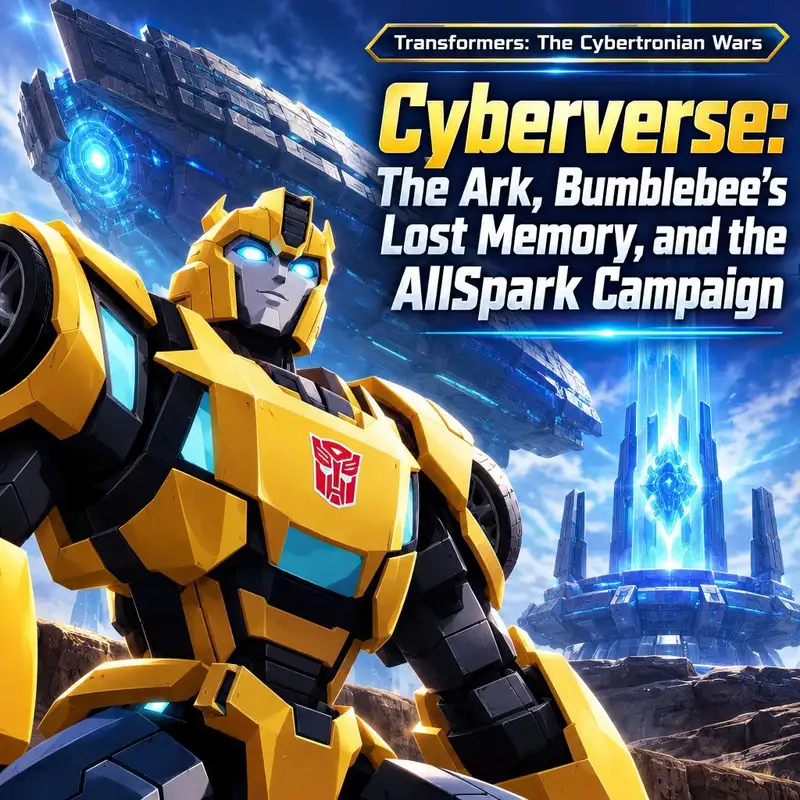
Cyberverse: The Ark, Bumblebee’s Lost Memory, and the AllSpark Campaign
Bumblebee awakens on Earth with the kind of problem no field repair kit can solve. He can move, speak, and fight, but he cannot reliably say who he is, where he came from, who commanded him, or why he was left on an unfamiliar world. Somewhere in his damaged memory are the location of the Ark, the status of Optimus Prime, the fate of a missing Autobot expedition, and the purpose of a mission centered on the AllSpark. A wounded scout has become a compromised archive.
In Transformers: Cyberverse, this is more than a story about an amnesiac hero finding himself. It is a wartime intelligence crisis. The Autobots need Bumblebee’s memories because their surviving force on Earth has no dependable headquarters, no confirmed chain of command, no access to its stasis-bound personnel, and no clear route back to the mission that brought them there. The Decepticons, meanwhile, know enough to pursue the same objective, but not enough to seize it. Both sides are working from incomplete information.
That difference changes the stakes. If Bumblebee had merely forgotten a few names, the problem would be personal. But his memory contains operational knowledge. It includes the Ark’s journey, the decisions that separated the expedition from Cybertron, and clues to the ship’s hidden location. His mind is not just a record of the past. It is a battlefield where each side can gain, corrupt, or lose access to the information needed to shape the next phase of the war.
The AllSpark gives that struggle its strategic weight. In Cyberverse, it is associated with Cybertronian life and with the survival of Cybertron itself. The Autobots are not searching for a curiosity, a ceremonial relic, or a weapon whose capabilities can be neatly listed. They are pursuing something bound to their civilization’s future. That makes the expedition a search mission, but also a political and civilizational one. Recovering the Ark would restore a military force. Recovering the AllSpark could offer something larger: the possibility of restoring a damaged homeworld.
Bumblebee begins this campaign alone, confused, and exposed. He has no reliable way to distinguish a recovered memory from a fragment, a dream, or an implanted lie. That weakness would be dangerous for any soldier. It is especially dangerous when the enemy understands that his damaged mind may hold the location of an entire Autobot force.
Windblade arrives on Earth because she recognizes the larger problem. She is not just looking for a missing friend. She is trying to recover a lost source of intelligence before the Decepticons do. In this continuity, Windblade is a Cityspeaker from Caminus, with abilities that allow her to connect through a Hivemind-like mental link. Those abilities are specific to Cyberverse. They should not be treated as proof that every Cybertronian in every history can enter another being’s mind.
Her role is unusually broad because the surviving Autobot presence is so thin. Windblade is a pilot and field commander. She provides mobility in a world where Bumblebee has no base and little awareness of the wider situation. She is also, in effect, a cognitive specialist. Her connection with Bumblebee offers a means of recovering memories that ordinary conversation cannot reach. At the same time, that connection creates a serious risk. Entering an injured mind is not the same as reading an intact data file.
There is an ethical dimension as well. Bumblebee does not initially recognize Windblade. He cannot fully understand why she is reaching into his memories or what she may find. The series treats their connection as necessary, but not casual. This is not a routine repair procedure performed in a secure medical bay. It is improvised recovery work conducted under enemy pressure, with the patient’s identity and loyalty tied to the information being sought.
At first, their force consists of two Autobots with no known base, limited support, uncertain transport, and no access to the Ark’s records. They can move, but movement is not the same as operational reach. They can fight, but combat cannot substitute for intelligence. The essential question is not whether they are brave enough to continue. It is whether they can reconstruct enough of the expedition’s history to find the people, systems, and resources needed to continue it.
The first recovered memories reveal why the mission mattered in the first place. Cybertron was already at war. The conflict between Autobots and Decepticons had grown beyond political rivalry into a struggle over power, survival, and the future direction of Cybertronian society. Bumblebee’s recollections do not provide a complete history of that war, but they establish the pressures under which the Ark was launched.
They also recover part of Megatron’s earlier political identity. In this version of the story, Megatron had been a gladiator and an advocate for equal rights. That history matters because it helps explain why the Decepticon movement attracted support. A society can produce rebellion when its institutions exclude, degrade, or ignore those who live beneath its formal order. A grievance can be real. A demand for equality can be legitimate. Neither fact guarantees what a movement will become once it organizes for war.
For Bumblebee, these memories recover more than history. They recover his relationship with Optimus Prime and his place within the Autobot cause. That matters because a scout without memory is not just missing information. He is missing the framework that tells him why he should trust certain people, fear certain enemies, or risk himself for a mission whose purpose he cannot recall.
The AllSpark becomes the focal point of that recovered framework. Bumblebee remembers it being carried toward safety during a battle. He remembers Optimus Prime making a consequential choice, throwing the AllSpark through a space bridge rather than allowing it to remain within immediate Decepticon reach. The action removed it from the battlefield, but it also separated Cybertron from something its people regarded as essential.
The later memories show that Optimus regretted the cost of that decision and intended to return the AllSpark to Cybertron. The record does not establish that sending it away permanently doomed the planet. It does establish that Optimus understood the decision as grave, and that he accepted responsibility for its consequences. The expedition aboard the Ark was therefore not wandering through space in search of a lost prize. It was trying to correct a strategic emergency while preserving the possibility of Cybertronian recovery.
Bumblebee remembers the Ark reaching a crisis point. Its energon reserves are running low, forcing Optimus, Bumblebee, and Grimlock to search an uninhabited world for fuel. They find energon there, but the discovery is not a simple solution. The resource is used by cave-dwelling creatures that depend upon it. The Autobots have arrived with a desperate need, but they are not the only living beings with a claim on the source.
Optimus chooses not to seize the energon. From a narrow military perspective, the decision is costly. The Ark needs energy. The crew is searching for the AllSpark under wartime conditions. The Decepticons are pursuing them. A commander who takes the available supply could keep the mission moving, preserve readiness, and reduce the immediate risk to his force. Yet that choice would also condemn or endanger the local creatures whose survival depends on the same resource.
The decision reveals a principle in Optimus’s command. The Autobots cannot defend a civilization by treating every weaker population as expendable whenever circumstances become inconvenient. That restraint is morally significant. It is also operationally expensive. Ethical choices in war do not always produce easy victories. Sometimes they preserve a standard of conduct while narrowing the options available to those who uphold it.
Without sufficient energon, the Ark cannot continue normal operations. Optimus orders the crew into stasis to conserve power while the ship continues scanning for the AllSpark. Stasis protects personnel from immediate energy loss, but it carries its own risks. A force in stasis cannot adapt to new intelligence. It cannot respond quickly to enemy pursuit. It cannot maintain ordinary command relationships. It survives by becoming temporarily unable to act.
The result is mixed. Tactically, the decision preserves the Ark’s personnel. Operationally, it leaves the expedition inert and vulnerable. Strategically, it delays the AllSpark mission at precisely the moment when delay can scatter a force across unfamiliar territory. The crew survives, but the mission’s cohesion is weakened. That is the recurring pattern of Chapter One. Each necessary measure creates a new vulnerability that the Decepticons can exploit.
When the Ark reaches Earth, that vulnerability becomes real. Bumblebee and Grimlock are separated from the ship and enter stasis in different locations. The Ark itself remains hidden. Optimus and much of the expedition are inaccessible. The ship that should serve as transport, command center, shelter, archive, repair facility, and stasis refuge has become a buried absence.
That turns the missing Ark into more than a search-and-rescue problem. Losing the ship means losing access to personnel records, communications systems, stored equipment, and the physical place where the Autobot mission can be organized. A commander may still exist somewhere inside the stasis-bound force, but command is not meaningful if no one can reach the commander, receive orders, or restore the systems that connect a dispersed force.
The Decepticons face a related but different problem. They know the AllSpark is connected to Earth. They know the Autobots came there. They can deploy pursuit elements and interrogate survivors. Yet they do not possess a complete picture. Their early advantage is mobility and aggression, not certainty. That matters because an enemy can be dangerous without being omniscient. Much of the campaign becomes a race to determine who can turn fragments into actionable knowledge first.
One recovered memory points toward an icy mountainside. Windblade follows that lead to the Himalayas, where she finds an empty stasis pod. It is a useful discovery, but only a partial one. The pod confirms that the Ark’s survivors were scattered across Earth. It suggests that the memory has some connection to real terrain. It does not reveal the ship’s location, the status of its crew, or the route to the AllSpark.
The Decepticon pursuit force appears before Windblade can turn the clue into a larger breakthrough. Slipstream and her Seekers serve as aerial reconnaissance, interception, and capture assets. Their flight capability gives them rapid reach across difficult terrain. They can track, harass, isolate, and strike with a speed that the small Autobot cell cannot easily match.
Air power, however, does not solve the central problem. The Seekers can move quickly, but they still need reliable targets. They can pressure Windblade, seize her, and attempt to extract what she knows. They cannot simply fly over the planet and expect the Ark to reveal itself. The buried ship is hidden by terrain, time, and the absence of a functioning Autobot network. Mobility improves pursuit. It does not replace intelligence.
Windblade’s capture changes the stakes. Until this point, Bumblebee’s damaged memory has been the principal source of information. Now Windblade herself becomes a source. She has shared in Bumblebee’s recollections. She has interpreted clues and followed leads. Even if she does not know the Ark’s exact position, she possesses pieces of the path toward it. The Decepticons no longer need to rely on one compromised scout. They can target the specialist trying to recover him.
Shockwave’s intervention makes the threat more serious. His objective is not just to interrogate Bumblebee or force him to disclose a location. He interferes with the psychic connection and inserts a fabricated memory. In that false recollection, Bumblebee appears to have been a Decepticon spy. The purpose is not just to obtain information. It is to break trust inside the Autobot cell.
This is the campaign’s decisive intelligence turning point. A damaged memory is dangerous because it may be incomplete. A falsified memory is more dangerous because it may appear complete. If Bumblebee believes that he was a Decepticon agent, then every recovered recollection becomes suspect. His identity becomes suspect. Windblade’s judgment becomes suspect. The mission can collapse without a shot being fired if the survivors no longer trust their own source.
Shockwave’s operation is a form of cognitive sabotage. It attacks the relationship between evidence and decision. The Autobots need Bumblebee’s memories, but they cannot allow those memories to dictate the mission without verification. The Decepticons understand that a force with no secure headquarters and no chain of command is vulnerable to distrust. One convincing lie can be more efficient than a direct assault if it makes allies turn inward.
The practical response is not to declare all memory useless. That would hand the Decepticons the victory they seek. The response is corroboration. A memory must be checked against terrain, records, surviving witnesses, enemy files, and systems that were not exposed to the same manipulation. In human intelligence work, a single source may be valuable, but a single source should rarely carry the entire burden of a major operational decision. Cyberverse makes the same point through Bumblebee’s struggle.
The Autobots need a second source of information and a method of authentication. They find both in Teletraan-X. Teletraan-X is not Teletraan-1. Teletraan-1 is associated with the Ark’s primary computer system. Teletraan-X is a backup drone connected to that larger architecture. The distinction is important because the little drone is more than the Ark’s entire intelligence system walking around on Earth.
At first, Teletraan-X does not know where the Ark is. If it did, the search would be over. Its value lies elsewhere. It can assist with diagnostics. It can help examine Bumblebee’s memories, connect patterns, and provide a form of technical continuity that the scattered Autobots otherwise lack. It is an intelligence support asset, but also a reminder that institutions depend on systems as well as charismatic leaders.
Before Teletraan-X arrives, the campaign rests heavily on Windblade’s access to Bumblebee’s mind. That creates a dangerous concentration of risk. Windblade can be captured. Bumblebee can be deceived. The mental link itself can be compromised. Teletraan-X does not erase those risks, but it helps distribute the burden of interpretation. The Autobot effort begins to move from private recollection toward shared analysis.
That shift is essential. A resistance cell becomes more durable when knowledge is not held by one person alone. The survivors do not suddenly acquire a large headquarters, a secure fleet, or a fresh supply of personnel. What they gain is a modest intelligence network. Bumblebee contributes memory. Windblade contributes access and initiative. Teletraan-X contributes diagnostics and system knowledge. Each role is limited. Together, they create a structure stronger than any one survivor.
The recovered memories also deepen the picture of Optimus Prime’s leadership. Bumblebee recalls Optimus receiving the Matrix from a dying Alpha Trion. The exact constitutional or religious meaning of the Matrix is not fully developed in this part of Cyberverse, and it would be unwise to import a more elaborate explanation from another continuity. What matters here is the burden attached to the moment. Optimus is not presented as a leader whose authority rests only on rank or combat ability.
Other memories show him rescuing Prowl and confronting the consequences of sending the AllSpark away. Those scenes do not make him flawless. In fact, they suggest the opposite. His leadership includes responsibility for choices that saved one immediate situation while creating another. He does not escape the consequences by claiming that the past is settled. He intends to continue the mission because he recognizes what remains unresolved.
Even with better diagnostics and a clearer sense of purpose, the Autobots still need ground truth. They need another survivor whose experience is independent of Bumblebee’s damaged memory chain. That survivor is Grimlock.
Grimlock is recovered in dinosaur form, deactivated but intact enough to return to the fight. Teletraan-X identifies him as an Autobot who fell from the Ark. His reactivation changes the search team in several ways. Most obviously, he brings considerable physical strength. Yet his most important contribution is not just force. He has been surviving independently, searching for the Ark through his own efforts, and gathering information from a different direction.
Grimlock possesses a bunker and records connected to his search. He also has a relationship with Earth’s dinosaurs, who have assisted him in ways that fit his long isolation on the planet. They are not an Autobot unit. They do not represent a formal force under Grimlock’s command. Their importance is local. They give him familiarity with terrain and a living connection to the environment around him.
His arrival illustrates how dispersed survivors can become useful once their separate knowledge is combined. Bumblebee remembers fragments of the Ark mission. Windblade has pursued those fragments and accessed enemy information. Teletraan-X can diagnose and organize data. Grimlock contributes independent records and a survival history that does not depend on the compromised psychic connection. The search is becoming a network rather than a chain.
That is a major change in operational resilience. A chain breaks when one link fails. A network can survive because different nodes can confirm, challenge, or replace one another. The Autobots are still badly outnumbered and lack a formal base. But they are no longer relying on one damaged scout to carry the whole mission inside his head.
Shockwave responds to this growing Autobot capability by escalating the search. He moves beyond interference, capture, and false memory. His next method makes Earth itself into an instrument of coercion. Using a magnetic disruptor, he attempts to interfere with the planet’s geomagnetic fields, seeking to expose or locate the AllSpark through environmental catastrophe.
For the Autobots, stopping the disruptor is not only a matter of defeating a dangerous device. It is an effort to deny the Decepticons a method of area search. If Shockwave can alter the environment until the AllSpark is exposed, hidden locations cease to be secure. Every cave, mountain, and buried installation becomes vulnerable to the enemy’s willingness to damage the world around it.
The Autobots destroy the disruptor and the vessel supporting it. Tactically, they prevent the immediate catastrophe. Operationally, they deny Shockwave a coercive search tool. Strategically, they learn that the AllSpark race can turn Earth into a battlefield even before the planet’s inhabitants become central political actors in the story. Morally, the episode clarifies the gap between a faction that accepts hard constraints and one prepared to weaponize an entire ecosystem.
Earth’s people remain largely outside the organized political struggle during this arc. There is no mature human-Cybertronian alliance shaping the campaign yet. That absence should not obscure the civilian stakes. A planet’s ecology is not empty terrain. Threatening all life on Earth is a form of violence even when the local population is not present in the command room or participating in the battle.
Shockwave’s failure does not immediately reveal the Ark. But the accumulated intelligence now begins to converge. Bumblebee’s recovered memories provide the original mission history and clues. Windblade’s escape and access to Decepticon files provide enemy information. Teletraan-X offers diagnostic support. Grimlock’s records add an independent line of evidence. Together, they point toward the Pacific Northwest and Mount St. Hilary.
The Ark is not found because one character suddenly remembers a convenient answer. It is found through intelligence fusion. That phrase can sound dry, but it describes one of the most important achievements in the season. Different sources, each incomplete and vulnerable in its own way, are combined until they produce a credible location. The damaged memory becomes useful because it is no longer treated as infallible.
This is the opposite of Shockwave’s preferred method. He tries to dominate the information environment by manipulating one mind, extracting one secret, or coercing one planet. The Autobots build a more resilient process. They test recollection against evidence. They use enemy records without assuming the enemy is truthful. They value machine diagnostics without assuming a machine knows everything. They accept that the answer will come from combination rather than certainty.
The discovery of Mount St. Hilary does not end the operation. It creates a new problem. A hidden ship is only an asset if its defenders can reach it, restore it, and protect it from destruction. The Ark remains buried, its crew still in stasis, while Decepticon forces close in. The search mission has become a recovery-and-denial operation.
Seeker attacks intensify the pressure. The Decepticons also have reinforcements approaching. Their larger fleet is on its way, and the Nemesis will soon arrive on Earth. The Autobots have found their command node just as the enemy begins to convert the planet into a more conventional theater of war. Timing is no longer a matter of convenience. It determines whether the Ark awakens as a base for Autobot recovery or dies as a sealed tomb beneath the mountain.
Grimlock uses his fire-breath to tunnel toward the buried ship. It is an improvised tactical expedient. The Autobots do not suddenly possess a large engineering corps, excavation fleet, or industrial support system. They have a small team, a narrow window of time, and one survivor whose capabilities can physically alter the terrain. The moment is significant because it shows the difference between having a useful asset and having a full logistical system. Grimlock can open a path. He cannot replace the infrastructure the Autobots lost with the Ark.
Shockwave leads the assault on the buried ship. His objective is straightforward. If the Decepticons cannot seize the Ark or exploit its hidden personnel, they can destroy it before the Autobots restore their force. This goes beyond an attack on a vehicle. It is an attack on continuity. The Ark contains the sleeping expedition, the systems needed to coordinate it, and the possibility that Optimus Prime’s mission can resume.
Bumblebee and Teletraan-X reach the Ark amid the assault. This is the point where the campaign’s intelligence work must become action. Knowledge has located the ship, but knowledge alone cannot activate shields, revive personnel, or protect a buried vessel from enemy fire and geological disruption. The survivors must reconnect themselves to the institutional structure they have been trying to recover.
Teletraan-X becomes crucial because Teletraan-1, the Ark’s main computer system, is deactivated. The backup drone uploads itself into the Ark’s systems. This goes beyond a convenient technical trick. It is the restoration of command architecture. The Ark regains access to systems control. Its shields can function. Its stasis-bound personnel can be awakened. The expedition begins to return from a scattered collection of survivors to an organized force.
There is a cost hidden in that success. Teletraan-X ceases to operate as an independent mobile participant in the same way. It becomes part of the ship’s renewed capability. That is fitting. The campaign has moved from improvisation in the field toward the restoration of a base. The little drone’s purpose was never only to accompany Bumblebee and Windblade. It was to preserve a thread of the Ark’s institutional memory until the larger system could live again.
Shockwave attempts to finish the job by triggering a volcanic eruption. The exact geological effects are not established with enough precision to support a real-world model, and the visual scale should not be mistaken for scientific telemetry. What matters is the operational intent. Shockwave seeks to use the environment as a weapon, burying or destroying the Ark before its recovery can be consolidated.
Instead, the circumstances of the eruption help the Autobots repel the Decepticon assault. The outcome is a reminder that battlefield plans depend on more than intent. Terrain, timing, movement, and environmental effects can disrupt even a carefully prepared attack. Shockwave has escalated repeatedly, from cognitive sabotage to planetary coercion to direct destruction. Yet escalation does not guarantee control.
The Ark survives. Its shields are restored. The stasis-bound Autobots awaken. The immediate tactical result is clear: the Decepticon attack fails to destroy the ship, and the Autobots secure the buried installation. Bumblebee’s damaged memory, once a liability that threatened to break the mission, has helped lead the survivors back to the force that can support him.
The mission-level result is equally important. The Ark expedition is no longer lost in the same sense. Its personnel can be reactivated. Its systems can support operations. The Autobot survivors have recovered more than a group of sleeping allies. They have restored the material basis for command, repair, communications, and continued search.
Operationally, the change is profound. Windblade and Bumblebee began as an improvised pair on an unfamiliar planet. They were joined by Teletraan-X and Grimlock, each resolving a different weakness in the search. With the Ark restored, that small cell becomes the advance element of a viable Autobot force. The campaign has shifted from survival and recovery toward sustained resistance.
The strategic result is more limited. Finding the Ark does not recover the AllSpark. It does not restore Cybertron. It does not end the Decepticon war. In fact, the arrival of the Nemesis and Decepticon reinforcements ensures that the conflict on Earth will widen. The Autobots have succeeded in preserving their expedition, but success has made the planet more important to both sides.
The institutional outcome may be the most important of all. The Autobots do not prevail because Bumblebee suddenly remembers everything perfectly. They prevail because they stop treating his memories as a private wound or a single decisive clue. They recover them, question them, test them, supplement them, and combine them with other sources. Windblade provides access. Teletraan-X provides diagnostics and systems continuity. Grimlock provides independent evidence and physical capability. The Ark provides the structure that turns survival into organized action.
Chapter One of Cyberverse therefore frames the AllSpark campaign as a struggle over information as much as territory. The Decepticons try to seize knowledge through pursuit, interrogation, manipulation, and coercion. The Autobots rebuild knowledge through trust, corroboration, and the difficult work of reconnecting isolated survivors. Shockwave can create a false memory. He cannot easily create the network needed to prove it false.
Bumblebee’s recovery remains personal. He regains a sense of his friendships, his commander, his mission, and the political world that formed him. But it is also collective. His identity returns because other Autobots help him place his memories within shared evidence. In that sense, the campaign argues that a person’s history is not held in the mind alone. It also exists in relationships, institutions, records, places, and the people who can challenge a lie.
Finding the Ark restores a force, not peace. It gives the Autobots a ship, a base, a command node, and a revived expedition. It proves that the search for the AllSpark can continue. Yet the same success ensures that Earth will bear the consequences of Cybertron’s unresolved war.