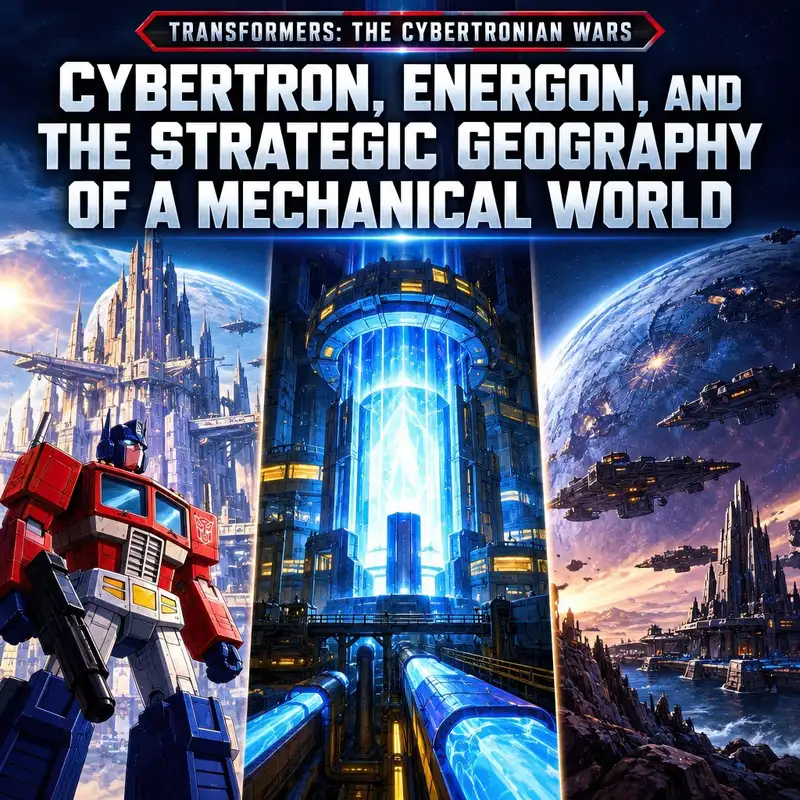
Cybertron, Energon, and the Strategic Geography of a Mechanical World
Near Iacon, Wheeljack and Bumblebee find energy conductors, but not enough of them. The discovery is useful, even hopeful, yet it does not alter the larger diagnosis. Cybertron’s remaining supply cannot sustain the Autobots for long, and it cannot restore a war-damaged world by itself. In the American Generation One animated history, that small cache reveals the real condition of the planet. Cybertron has not just suffered defeats. Its ability to power movement, repair damage, maintain weapons, and support organized life has been worn down by a prolonged civil war.
The series never provides an exact inventory of Cybertron’s reserves, a census of its population, or a neat explanation of every energy system. It does establish something more important for military history. Energon is essential to Cybertronian survival and combat. A shortage therefore affects more than individual endurance. It affects whether a force can patrol, travel, manufacture, repair, communicate, or hold a city. It narrows every commander’s choices.
That makes the energy crisis a strategic problem, not just a fuel problem. A faction can possess fighters, weapons, and famous leaders, yet still lose its freedom of action if it cannot sustain them. A damaged soldier may require energy before repair can even begin. A spacecraft may exist, but not have the reserves to launch. A factory may remain standing while its machines sit idle. Cybertron’s war is therefore shaped by an industrial question. Who can keep the system running after the old sources have failed?
The opening episodes of the cartoon present Cybertron as a mechanical home world scarred by conflict between Autobots and Decepticons. The political origins of that war remain only partly described in this screen continuity. What the episodes make clear is that both factions understand the same hard fact. They cannot settle the conflict on a dying energy base. The war has consumed the conditions that made large-scale war possible.
Scarcity changes the value of geography. A stretch of territory matters only if it contains, protects, or connects something useful. A mine without transport is an isolated hole in the ground. A power source without conversion equipment may not be usable in the form an army needs. A storage depot without defenses is a gift to the next raiding party. A city without energy becomes a liability, no matter how impressive its towers once appeared.
For that reason, control of land and control of productive capacity are not the same thing. A force may drive an enemy from a valley, seize a plant, or hold a road. None of that automatically creates a durable supply chain. It must still locate energy, extract it, convert it into usable energon, store it safely, load it for transport, move it through contested territory, and deliver it to units that can actually employ it. Every stage creates a point of failure.
The cartoon often presents these problems through direct action. A Decepticon raid on an energy installation is exciting because it creates an immediate threat. But the deeper importance lies in what the raid might enable. If Megatron’s forces can turn captured resources into energon cubes, they gain more than a temporary advantage over an Autobot patrol. They gain the prospect of extending operations, repairing losses, and gathering the reserves needed for a larger plan.
The reverse is equally true. When the Autobots disrupt an energon operation, they are not just interfering with Decepticon theft. They are contesting the enemy’s operational endurance. A small engagement can matter far beyond its visible scale if it prevents a shipment, delays a conversion process, or forces the Decepticons to expend scarce energy defending a facility instead of conducting another raid.
Cybertron’s named locations should be understood in that light. The American cartoon gives listeners and viewers cities, installations, mines, shipyards, and energy sites, but it never offers a stable atlas of the entire planet. Its geography is operational rather than cartographic. We know where a place matters in the story. We do not always know its precise position, its population, or its relationship to every other city.
Iacon is the clearest early example. It is associated with the Autobots and serves as an important urban center during the pre-Earth crisis. The series does not fully document whether it is Cybertron’s sole capital, the seat of a planetary government, or simply the most important Autobot-held city shown on screen. It is safer, and more useful, to understand Iacon as a command and logistical node.
A city such as Iacon concentrates capabilities. It can contain storage, communications, repair facilities, technical personnel, archives, launch infrastructure, and the physical shelter needed to keep a force functioning. It also represents something beyond military utility. Cities hold memory. They preserve institutions, habits, expertise, and the ordinary routines that make a society more than a collection of armed units.
That broader civic life remains mostly off-screen in the early cartoon. The series is interested in the immediate war, not in drawing a complete picture of Cybertronian municipal administration. Still, a prolonged energy crisis would have consequences beyond the battlefield. If energon becomes scarce, repair capacity is strained. If repair capacity is strained, damaged personnel accumulate. If transport fails, cities become isolated. If communications and power falter, commanders lose the ability to coordinate forces that may already distrust one another.
The Autobots’ answer is not to wait for Cybertron to recover. They launch the Ark and search beyond their world for new energy sources. This is one of the most consequential decisions in the early Generation One history. The Ark is more than an escape ship: it is an expeditionary response to a planetary logistics failure.
The mission accepts a severe risk. The Autobots are leaving a damaged home world at the moment when their remaining resources are already limited. They must commit personnel, equipment, and energy to a voyage without any guarantee that a usable source exists elsewhere. They must also assume that the Decepticons will understand the importance of the mission and try to stop it.
Megatron does understand. The Decepticon pursuit of the Ark makes strategic sense even before the two ships leave Cybertronian space. The side that finds an external energy base may gain the ability to survive while the other continues to decline. In that circumstance, a spacecraft is more than transport: it is access to a future industrial base.
The battle between the Ark and the pursuing Decepticons ends with neither side achieving the result it intended. Both factions are disabled, and the Ark drifts through space until it crashes on Earth. The Transformers remain dormant there for approximately four million years before being revived in the twentieth century. That long interval belongs to this American animated continuity. It is not a universal measure of every Transformers war, but within this history it turns a failed expedition into a delayed opening of an entirely new theater.
Earth offers what Cybertron no longer reliably provides: accessible energy and a developed industrial environment. The Decepticons do not initially arrive as occupiers trying to administer every human state or conquer every continent. Their first concern is extraction. Earth is valuable because its resources can be captured and converted into a form useful to Cybertronian forces.
That distinction matters. Conquest is expensive. It requires garrisons, administration, intelligence, transport, and a political system capable of controlling a population. Extraction can begin with less. A force needs access to a power plant, a mine, a dam, a refinery, or another productive site. It needs the ability to intimidate or remove local resistance. It needs time to process what it takes. Then it needs a way to move the resulting energon before the enemy disrupts the operation.
The Decepticons pursue energy at human facilities including a solar power plant and the Ruby Crystal Mines. These sites are not interchangeable. A solar installation represents concentrated electrical generation. A mineral source represents raw material with potential value after extraction and processing. The series never establishes that every Earth mineral or form of fuel can become energon without difficulty. What it does show is that Megatron’s forces can exploit certain resources and convert them into energon cubes.
Those cubes are visually simple, but strategically they are the end product of a complicated chain. They represent successful capture, conversion, storage, and preparation for movement. A cube on the ground is not yet a strategic reserve. It must be protected from sabotage, loaded onto transport, and delivered to a place where it can sustain military activity.
For that reason, the Decepticons’ early Earth campaign is more than a string of raids. It is an attempt to create an extraction system under combat conditions. Megatron’s forces must locate suitable sites, overcome the Autobots, avoid or suppress human interference, operate unfamiliar machinery or impose Cybertronian equipment on local terrain, and then defend whatever they produce. Every success invites a counterattack because the Autobots understand what the energy will become.
Human workers and nearby civilians are not just scenery in this process. The cartoon often moves quickly past their experience, but the danger is clear. A power plant or mine is part of civilian infrastructure before it becomes a Cybertronian objective. Seizing it threatens workers, disrupts local systems, and turns places built for human use into military targets. The show does not provide a detailed account of national governments, evacuation plans, or long-term displacement. It does establish the basic moral fact that resource war is conducted in places where other people live and work.
For the Autobots, Earth creates a difficult defensive mission. They are trying to prevent the Decepticons from converting human resources into war power, but they must do so without treating the planet as their own possession. Their disguise, their relationship with a small group of human allies, and their repeated interventions all reflect that constraint. They need to fight a strategic war while operating within a civilian environment they do not fully control.
The Decepticons possess a different problem. They can gather energy on Earth, but their larger war is still tied to Cybertron. Shockwave remains on the home world during the early Earth campaign. He serves as Megatron’s principal Decepticon connection to Cybertron, providing communications, technical support, and a continuing link to the conflict left behind. The episodes do not require us to call him governor of the planet or assume that he controls all Cybertronian society. His importance is logistical and institutional.
Communication alone does not solve separation. A report can cross distance without moving a single energon cube, replacement part, or damaged soldier. Megatron may know what Shockwave needs on Cybertron, and Shockwave may know what Megatron has captured on Earth, but neither can turn information into supply without a transport system. The Decepticons are no longer merely raiders on an alien planet. They are an expeditionary force cut off from their industrial base.
That problem is solved, at least in part, by the space bridge. In “Transport to Oblivion,” the Decepticons construct a system capable of linking Earth and Cybertron. Its stated purpose is to move energon cubes between the two worlds. It also permits travel by Cybertronians themselves. This changes the operational geometry of the war.
Before the bridge, distance is the Decepticons’ central limitation. Earth may have usable resources, but those resources are separated from Cybertron by interplanetary space. The Ark had crossed that distance only through a long voyage that ended in disaster. The space bridge offers a different model. Instead of carrying cargo across the void by ship, it creates a corridor between fixed points.
That does not make it magic in the strategic sense. The bridge depends on machinery at both ends. It operates under timing and alignment limits. Early passage through it is shown to be dangerous. Its endpoint is not just wherever a commander wishes it to be. The system must be built, maintained, defended, and synchronized. The bridge reduces one problem, but concentrates several others.
Its importance lies in repeatability. A stranded force can survive on local raids. A force with a functioning interplanetary route can begin planning a campaign. Energon seized on Earth can become supply on Cybertron. Personnel can move between theaters. Instructions can be backed by physical reinforcement. A local extraction operation becomes part of a wider war economy.
Megatron’s achievement is therefore not just a technical trick. He is trying to connect Earth’s captured resources to Cybertron’s damaged industrial system. If that connection holds, the Decepticons gain a means to sustain war across worlds. They no longer need to choose between a depleted homeland and an isolated Earth base. They can make each world serve the other.
The Autobots recognize the danger through reconnaissance rather than through a grand strategic briefing. Bumblebee and Spike observe the Decepticon operation and discover the bridge. Their role demonstrates an old intelligence principle. Important infrastructure is often revealed by activity around it. Cargo movement, unusual security, technical construction, and the presence of senior personnel can expose a capability long before its full purpose is understood.
Megatron responds by altering Bumblebee’s memory. In the immediate situation, the act is intended to misdirect the Autobots and protect the operation. At the larger level, it demonstrates the danger of corrupted testimony in a technological war. A scout may return physically intact and still be unable to provide reliable information. Commanders who assume that every returning witness is accurate can make disastrous decisions.
The episode never establishes memory alteration as a routine power available to every Cybertronian in every circumstance. It does establish that, in this case, Decepticon technology can attack not only a soldier’s body but the information carried by that soldier. That is an intelligence threat with operational consequences. If the enemy can manipulate what a scout remembers, then reconnaissance requires corroboration, secure procedures, and skepticism.
The space bridge also creates a vulnerability precisely because it is so valuable. Any system capable of moving an interplanetary cargo problem into one room creates an unusually important room. The Decepticons must guard the bridge, its controls, its power source, and its endpoint. The Autobots need not defeat every Decepticon everywhere. They can seek to interrupt the corridor that makes the broader campaign possible.
This distinction between tactical damage and operational denial is crucial. Destroying a piece of equipment may win a fight. Denying a transport route can isolate an entire force. If the bridge fails, energon gathered on Earth may no longer reach Cybertron. If its Cybertronian end is compromised, Megatron’s local success becomes strategically sterile. If its Earth end is exposed, the Decepticons lose both a logistics hub and a point of return.
The bridge does not abolish distance. It makes distance dependent on infrastructure. That is different, and in some ways more dangerous. A conventional voyage spreads risk across space and time. A bridge concentrates risk at fixed nodes. It enables rapid movement, but it also gives enemies identifiable targets, predictable windows of activity, and opportunities for sabotage.
The Decepticons later push the same technology toward a far more ambitious use. In “The Ultimate Doom,” they employ space-bridge capability to bring Cybertron into Earth’s vicinity. The consequence is no longer a contest over shipments. Geography itself becomes a weapon. The proximity of one world to another creates environmental and planetary consequences severe enough to threaten Earth on a global scale.
The series never provides reliable orbital mechanics, exact distances, planetary masses, or a scientific model that can be calculated from the animation. It is unnecessary to invent one. The strategic fact is clear enough. Cybertron’s location can be manipulated through Decepticon infrastructure, and that manipulation becomes coercive leverage against an entire inhabited planet.
This is an escalation from logistics to planetary pressure. A bridge that begins as a means of moving energon can become an instrument for repositioning the source of the war itself. The Decepticons are no longer only extracting from Earth. They are attempting to alter the physical relationship between Earth and Cybertron so that the two worlds are forced into the same crisis.
The episode reveals a recurring problem in strategic mobility. Infrastructure built for supply can be repurposed for coercion. A rail line can move food or armies. A port can carry trade or invasion forces. A space bridge can transport energon cubes or make a planet into a weapon. The capability does not determine the purpose. Commanders and political leaders do.
It also reveals why controlling a technology does not by itself produce stable rule. Bringing Cybertron near Earth gives Megatron enormous leverage, but leverage is not legitimacy. The plan threatens the very environment on which human civilization depends. It creates resistance rather than consent. It may terrify opponents into temporary submission, but it does not build the institutions required to govern two worlds.
Cybertron’s cities show another side of strategic geography. In “The Secret of Omega Supreme,” the flashback to Crystal City presents a major urban space whose value is not limited to immediate military production. Its architecture, its population of workers and residents, and its guardian all point toward a civic world that existed alongside the war machine.
Crystal City matters because cities are not just concentrations of metal and energy. They are concentrations of skill. Engineers, builders, technicians, archivists, repair crews, and ordinary residents create social networks that cannot be replaced simply by occupying the ground after a battle. Destroying such a place damages physical infrastructure, but it also damages institutional memory and trust.
Omega Supreme serves as Crystal City’s guardian. His later history shows how war can turn protective systems into military instruments. Megatron alters the Constructicons’ loyalties, and the resulting betrayal enables the destruction of the city. The episode is not a complete history of Cybertronian labor or urban government. It does, however, show that allegiance, technical expertise, and infrastructure can all be militarized.
The Constructicons are especially important in this regard. Their value is not only that they can fight. Their skills are tied to construction, demolition, and the remaking of physical space. When a war absorbs such personnel into a factional command structure, cities become more vulnerable and armies become more capable of reshaping terrain to suit military needs.
The loss of Crystal City is therefore not just the loss of a battlefield. It is the loss of a place that could shelter, repair, organize, and remember. The cartoon does not quantify the civilian cost, and it would be wrong to invent a population total or a full account of survivors. Yet the strategic implication remains. A war that destroys civic infrastructure weakens the society both factions claim to be fighting over.
Resource geography extends beyond Cybertron and Earth. Later episodes show that energon conditions differ sharply from world to world. In “Fight or Flee,” Paradron appears as a peaceful Cybertronian settlement with abundant energon. Its existence demonstrates that scarcity is not evenly distributed across all inhabited space. A world can possess the reserves that another world lacks.
Abundance, however, does not create security by itself. Paradron’s resources make it attractive. A peaceful settlement may become a target, a refuge, a bargaining chip, or an object of dependency. If a resource-rich world lacks strong defenses, political unity, or secure transport, its abundance can invite predation rather than guarantee independence.
The lesson is broader than Paradron. Energy does not matter only where it is found. It matters who can protect it, convert it, transport it, and decide who receives it. A settlement with abundant energon but no secure route to allies may remain strategically isolated. A faction with little local supply but control of a transport network may exert influence far beyond its own territory.
That connection between resources and autonomy appears again after the Decepticons suffer defeat and accept energon offered by the Quintessons in “Five Faces of Darkness.” The offer is useful because depleted forces need supply. It is also politically dangerous because the provider gains leverage. A faction dependent on another power for energon may retain its name, its weapons, and its leaders while losing freedom of action.
Alliance politics often begins with this kind of necessity. One side needs fuel, repair parts, sanctuary, or transport. Another side offers them, usually with expectations attached. The Decepticons’ willingness to accept Quintesson energon shows that military defeat is not only about lost territory or destroyed troops. It can force a faction into relationships it would otherwise reject.
The cartoon never provides a complete galactic energy map, and it never establishes that every world with energon can supply Cybertronian forces in the same way. It does establish uneven access. Some places are depleted. Some have abundance. Some can be reached only through dangerous routes or political bargains. This unevenness gives geography its strategic force.
Returning to the small cache near Iacon, the central problem becomes clearer. Cybertron’s energy crisis is not just that useful power has disappeared. Power still exists in different places and forms. The crisis is that neither faction can reliably connect enough of that power to the systems required for survival and war.
On the battlefield, energon sites and shipments shape local engagements. A solar plant, mine, or cache can become the immediate objective of a battle. A successful Autobot intervention may deny the Decepticons a valuable load. A Decepticon raid may force the Autobots to divert scarce personnel to protect civilian infrastructure. These fights matter, but they are only the visible edge of a larger contest.
At campaign scale, the Ark and the space bridge determine whether forces can reach distant theaters and remain there. The Ark represents the difficult choice to seek survival through expeditionary movement. The bridge represents a more mature, more dangerous answer: a fixed interplanetary corridor that can connect extraction with the home front. Both are mobility systems. Both reshape what commanders can attempt.
In strategic terms, interplanetary energy networks determine whether a faction can continue the war at all. An army cannot live indefinitely on isolated raids. It needs a system that turns resources into sustained combat power. The Decepticons’ space bridge matters because it promises exactly that. It transforms Earth from a temporary source of plunder into a potential supply base for Cybertronian war.
At the level of government, infrastructure grants leverage but not automatic authority. A commander who controls energy can influence soldiers, cities, and allies. A faction that controls a bridge can decide who travels, who receives supply, and who remains isolated. Yet control through scarcity is unstable. It breeds resistance, encourages sabotage, and makes the infrastructure itself a target. A bridge can move troops quickly, but it cannot make frightened populations accept the power of those troops.
The cost of scarcity reaches beyond armies. Damaged cities and seized facilities weaken repair systems, interrupt technical knowledge, and erode the civic networks required for reconstruction. Cybertron is strategically important here not only because it is home, but because it is an industrial system. Its cities hold expertise. Its facilities connect energy to production. Its spacecraft and bridges connect distant resources to the war. Destroying that system threatens the machinery through which either faction can survive.
Energon scarcity therefore becomes a problem of geography and access. Energy matters only if a faction can find it, convert it, move it, protect it, and reconnect it to a damaged industrial base. The Decepticon space bridge changes the conflict for exactly that reason. It does not make distance meaningless. It makes captured resources on Earth usable in Cybertron's war, turning supply lines, transport technology, and control of infrastructure into the foundation of a sustained interplanetary campaign.