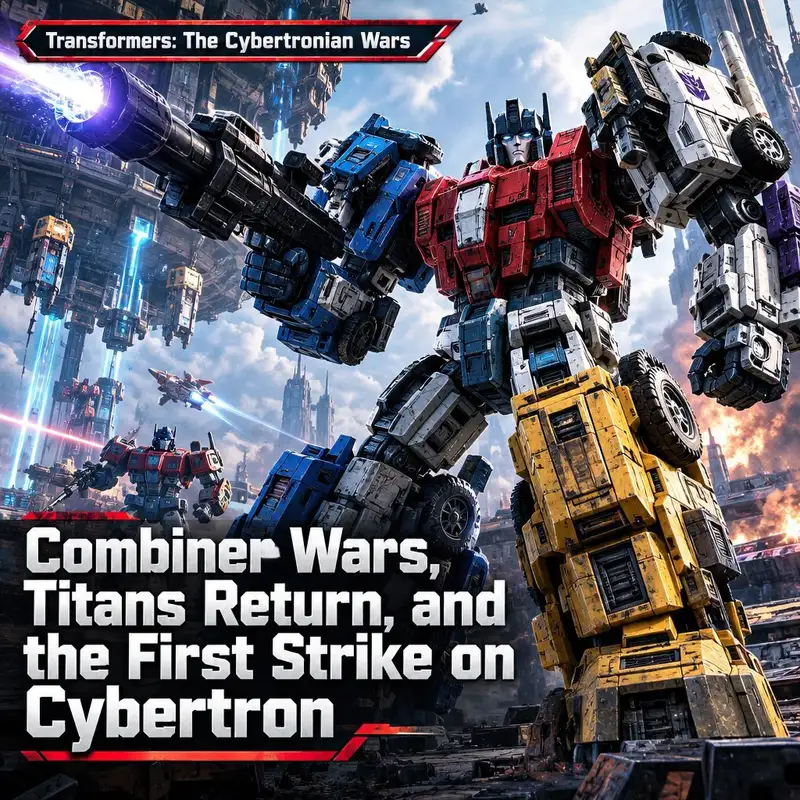
Combiner Wars, Titans Return, and the First Strike on Cybertron
A postwar government faces a familiar and dangerous proposition. Its opponents have demonstrated a weapon system it cannot match. The council chamber is told that restraint may invite defeat, that delay may leave cities undefended, and that extraordinary power must be brought under state control before someone else uses it first. In the animated Combiner Wars, that system is the Enigma of Combination. The decision to use it is presented as a defensive necessity. Within hours, it becomes a warning about what happens when a nervous political elite mistakes possession of a weapon for authority over it.
This is not one uninterrupted Prime Wars history. The Machinima animated series and the 2005 I D W comics shared branding, characters, and ideas shaped by the same broad toyline era, but they tell separate stories with separate political settlements, technologies, and biographies. Their common subject is postwar insecurity. The old Autobot-Decepticon conflict has either ended or receded, yet Cybertron remains armed, traumatized, and uncertain about who has the right to govern the forces that survived it.
Combiners and Titans matter here because they are more than stronger individual combatants. A combiner concentrates several beings into one military asset, raising questions about consent, command, maintenance, and who bears responsibility when that power is deployed. A Titan can function as a person, a city, a transport system, and a weapon platform at once. Neither belongs comfortably inside an ordinary chain of command. A government may claim custody of such power, but custody is not the same as understanding, and understanding is not the same as legitimacy.
In the Machinima animated history, that problem first comes into focus at Caminus. Menasor attacks the colony, and the fighting brings the cost of Cybertron’s unstable peace directly to its outskirts. Computron is apparently destroyed in the battle. Maxima dies. For Windblade, a Cityspeaker of Caminus, this is not an abstract argument about strategic balance. Her home has been attacked, and a fellow defender has been lost. The demand for stronger protection has an immediate emotional and political force.
Caminus is more than a distant battlefield in this story. It is a distinct society with its own leadership and interests, represented by the Mistress of Flame. Its vulnerability exposes the limits of a postwar settlement centered on Cybertron. A capital can speak of deterrence and collective security. A colony under attack asks a simpler question. Who will defend us now, with what forces, and under whose command? Those questions become sharper because the available answer is not a conventional fleet or a newly trained army. It is an ancient and poorly understood capability.
The Enigma of Combination is treated as an exceptional artifact associated with the creation or activation of combiners. It is not presented as an industrial process the Council can reproduce, regulate, or distribute at scale. That distinction is crucial. A government that develops a weapon can, at least in theory, train operators, establish supply chains, inspect production, and create rules for use. The Council has none of those comforts. It has a singular object, incomplete knowledge, and the fear that others may use it first.
On Cybertron, authority rests with a Council that includes Starscream, Rodimus Prime, and the Mistress of Flame. It is an uneasy arrangement. Starscream carries the political instincts of a survivor and an opportunist. Rodimus Prime brings the prestige and impatience of a heroic figure who sees action as proof of leadership. The Mistress of Flame must consider the safety of Caminus as well as the larger political order. Their disagreement is more than personal. They are trying to govern after a war that has left them with powerful symbols and weak institutions.
The Council sees the Enigma as a way to close a capability gap. Menasor’s attack has demonstrated what a combiner can do. A defensive government naturally considers building or controlling a comparable force. But deterrence depends on more than matching an enemy’s weapon. It depends on disciplined command, credible limits, and a political system that can prevent its own security apparatus from becoming the next threat. The Council has not solved those problems before it reaches for the Enigma.
The dispute soon expands beyond the Council. Devastator seeks the Enigma. Menasor remains a danger. Computron’s fate hangs over the conflict. Victorion enters as a representative of the combiners themselves. Her position complicates the state’s assumption that combination technology is simply public property to be seized and assigned. If combiners are sentient political actors, then treating them as equipment is more than tactically crude. It is a claim that their bodies, identities, and military potential belong to whoever controls the artifact.
That is a serious problem in any postwar society. Governments routinely argue that security requires centralized control over weapons. Citizens and soldiers may answer that a state which monopolizes force without accountability can become the most dangerous armed faction in the system. Combiner Wars translates that argument into Cybertronian terms. The question is not only who can activate a combiner. It is who may order one into battle, who may compel cooperation, and whether an ancient system can be governed by institutions that have not yet learned to govern themselves.
Starscream sees the opportunity before anyone else can build a stable answer to those questions. He activates the Enigma and uses it to take control of Menasor, Computron, Devastator, and Victorion. The result is the Ultimate Combiner, an overwhelming concentration of force that also becomes physically and psychologically unstable. Starscream does more than steal a weapon. He attempts to turn several living strategic assets into an extension of his own authority.
Tactically, the result is obvious. A combined form of that scale can overpower ordinary opponents and threaten an entire urban center. Operationally, it throws the defense of the Council city into crisis. Commanders can no longer treat the situation as a contest for custody of an artifact. They must protect civilian infrastructure, preserve communications, coordinate defenders, and prevent a political coup from becoming an urban catastrophe.
Politically, Starscream’s move is even more damaging. The Council’s own defensive logic has helped produce the threat it now faces. It had treated the Enigma as an instrument to be controlled from above. Starscream demonstrates that the real weakness lies not in the artifact alone, but in the chain of accountability surrounding it. If one member of the ruling structure can seize extraordinary power and direct it against the government, then the government’s claim to responsible stewardship has already failed.
It would be easy to describe this as another story of Starscream’s ambition. Ambition is certainly present. But ambition succeeds only where institutions provide access, confusion, and opportunity. Starscream exploits a Council that has authority on paper without a secure consensus about its purpose. Its members disagree about the boundaries between defense, retaliation, deterrence, and personal power. Under those conditions, the Enigma does not create instability from nothing. It magnifies instability that was already there.
Windblade offers a different kind of connection to power. As a Cityspeaker, she has a relationship with Metroplex, the great Cybertronian city-being. That role is not equivalent to owning him, and the distinction matters. Her connection gives her a means to communicate across the divide between ordinary political institutions and a being whose scale places him beyond ordinary civic life. Metroplex is not a larger vehicle waiting for a driver. He is a strategic actor whose involvement can decide whether a city survives.
The emergency also produces an unlikely coalition. Optimus Prime and Megatron cooperate against Starscream’s immediate threat. Their cooperation reaches its most dramatic form when Megatron becomes a cannon wielded by Optimus. It is an image of necessity overcoming enmity. Yet it should not be mistaken for a peace treaty, a restoration of trust, or proof that the old war has been politically resolved. It is a temporary tactical arrangement made under conditions where failure would endanger everyone nearby.
That distinction is important because postwar societies often confuse common danger with reconciliation. Former enemies may work together against a disaster, an invasion, or an extremist faction. Such cooperation can be meaningful. It can save lives. But it does not automatically resolve the grievances, crimes, rivalries, and questions of authority that created the earlier conflict. The animated story gives Optimus and Megatron a moment of practical unity. It does not show them building the institutions needed to make that unity durable.
Starscream is defeated, and the immediate danger recedes. The Enigma is returned to Victorion and the other combiners. Tactically, the crisis has been contained. The Council city survives. The most dangerous concentration of power has been broken apart. But the institutional outcome is less reassuring. The government has learned that it cannot simply requisition sentient strategic assets and expect stable obedience. The combiners have asserted interests of their own, and the Council’s authority has been exposed as brittle.
Then comes the warning that the Titans are returning. The escalation is more than a promise of larger action. It changes the nature of the problem. The crisis of combination involved several individuals joined into exceptional force. The Titan crisis concerns beings whose movement, combat, and survival can reshape entire urban environments. If the Enigma tested whether the Council could govern a weapon, the Titans test whether Cybertron can survive the activation of its own living infrastructure.
In Titans Return, Cybertron is still attempting to recover from the preceding conflict when Trypticon returns and begins attacking the planet. Metroplex confronts him. The struggle is not presented with enough detail to produce reliable figures for population, damage, or casualties, and it would be a mistake to invent them. What the story does establish is the strategic character of the threat. Cities are endangered. Emergency evacuation is attempted. A fight between Titans takes place within the space where ordinary Cybertronians live, travel, work, and attempt to rebuild.
Titans are difficult to fit into military doctrine because they combine too many roles. They can be combatants, command centers, shelter, transportation networks, and symbols of political authority. Their activation may offer protection, but it can also make a city itself part of the battlefield. A conventional commander can order a unit to withdraw from a threatened district. A Titan may be the district, or may carry it, defend it, and endanger it all at once.
Windblade again becomes essential because of her connection to Metroplex. Her role shows that communication, trust, and specialized knowledge can matter as much as raw firepower. Yet this is also a burden. When a society depends on a rare individual to mediate with a strategic asset, that individual becomes a critical point of failure. There is no evidence here of a broad, repeatable system for managing Titans. There is Windblade, Metroplex, and an emergency that allows little room for careful institutional design.
The immediate response to Trypticon reveals the logic of an arms race built around unique assets. Perceptor proposes reviving Fortress Maximus, another ancient Titan, as a counterweight. The proposal is understandable. One Titan is destroying the city. Another Titan may be the only force capable of stopping it. But this is not a sustainable doctrine in the ordinary sense. It does not solve the problem of command, civilian safety, or long-term control. It answers a singular danger with another singular danger.
Emissary, a Titan Master linked to Fortress Maximus, becomes decisive in enabling or amplifying Fortress Maximus’s power. His small physical presence conceals strategic importance. This is another reminder that Cybertronian warfare cannot be judged by visible size alone. A massive body may require a smaller partner, a specialized interface, or a rare technical relationship to function at full capability. The battlefield may be dominated by giants, while the decisive vulnerability rests in a connection that can be disrupted, protected, or misunderstood.
The crisis deepens when Trypticon is empowered by ancient artifacts associated with the Primes. The conflict is no longer only about one destructive Titan. It becomes entangled with relics whose history and purpose exceed the understanding of the leaders trying to use them. Starscream’s spirit is connected to Trypticon and is later expelled. The Enigma and the Matrix point toward the threat of Megatronus, the Fallen. Ancient authority returns in fragments, and every fragment carries military consequences.
This is the recurring weakness of the Machinima branch. Its leaders confront extraordinary systems without a mature capacity to govern them. They rely on relics, singular connections, inherited titles, and emergency coalitions. Those tools may win a crisis. They do not create a durable order. The deeper danger is not that ancient technology exists. It is that political actors repeatedly reach for it before deciding what limits should bind those who control it.
Optimus Prime dies during the confrontation with Megatronus. His loss is more than a battlefield reversal. In a fragile postwar arrangement, the removal of a figure with moral and military authority places greater strain on every remaining institution. The survivors must rely in part on Megatron, while Overlord and the corrupted Rodimus Cron remain sources of danger. The coalition that defeats the immediate threat does not emerge as a settled government. It emerges as a collection of necessary partners, rivals, and unresolved risks.
The animated Titans Return therefore ends with a tactical achievement and a strategic failure. The immediate catastrophe is confronted. Trypticon does more than destroy Cybertron. Megatronus is resisted. But the society has not escaped dependence on exceptional personalities and incomparable artifacts. It has learned to survive each emergency by finding another ancient answer. That is survival, but it is not stability.
The 2005 I D W comic continuity approaches the same broad imagery from a different direction. Here, the danger does not arise only because old machines or sacred artifacts break free of weak custodians. It also arises because Cybertron is trying to become a functioning postwar power while negotiating the rights of colonies, the authority of a planetary government, and the fear that any restored Cybertron may dominate the worlds around it.
In I D W’s Combiner Wars, Starscream rules Cybertron. He is not the same Starscream as the animated Council member, and his political setting is different. He holds authority within a contested postwar order, where legitimacy depends not only on military strength but on electoral politics, representation, and the relationship between Cybertron and its colonies. His rule must balance security demands against the suspicion that central power will once again treat distant communities as possessions rather than partners.
Caminus is central to that tension. When Menasor attacks the colony, Cybertron responds by deploying Superion. That response can be read in more than one way. It may be an act of solidarity with a threatened population. It may be necessary protection against an immediate military threat. It may also look like an assertion that Cybertron alone possesses the right to decide how colonial worlds are defended. In postwar politics, the same deployment can reassure one community and alarm another.
Windblade serves as an intermediary between Caminus and Cybertron, carrying both political and cultural responsibilities. Her role matters because a defense relationship is never only about which side has the stronger weapons. It is also about whether the people being defended have a voice in the decisions that place those weapons on their soil. If a colony has no meaningful representation, military assistance can resemble occupation even when the stated purpose is protection.
Victorion’s emergence broadens the argument. She is more than another asset added to a roster of powerful combatants. Her existence gives combination technology a political meaning that cannot be reduced to battlefield utility. Combiners can become symbols of local identity, communal defense, and a claim that security should not be monopolized by the central state. That does not make every combiner inherently democratic or peaceful. It means the decision to deploy one carries consequences beyond the immediate fight.
The I D W version of Combiner Wars is therefore an arms race, but it is also a representation crisis. Cybertron’s leaders must ask whether they can defend their allies without recreating the habits of domination that helped make the old order unstable. The colonies must ask whether autonomy is secure when the capital controls the greatest concentration of force. And everyone must confront the fact that a combiner is both a deterrent and a public declaration that ordinary institutions may no longer be sufficient.
That is a more modern form of insecurity than the animated artifact crisis. The problem goes beyond leaders lacking control of a weapon. It is that no one agrees on which institution has the legitimate right to control it. Cybertronian recovery becomes difficult because military integration, political inclusion, and colonial equality do not automatically advance together. A government can broaden representation while still centralizing the means of violence. A colony can demand autonomy while still needing assistance against threats it cannot defeat alone.
I D W’s Titans Return moves from the politics of new power to the return of old authority. Sentinel Prime, presumed dead, returns and attacks the transformed political order. Sentinel is not just a revived adversary. He represents an older model of Cybertronian legitimacy, one in which authority is treated as inherited command rather than something negotiated with citizens, colonies, and political rivals.
His use of space-bridge mobility gives him strategic reach. He can move beyond the normal constraints of distance and push the crisis toward Earth. But a space bridge is not magic in the sense of being consequence-free. It depends on access, functioning infrastructure, security, and knowledge of where to go. Its value lies in changing geography. It allows a force to appear where defenders did not expect it, bypassing the long approach routes that would otherwise provide warning and time to prepare.
Sentinel’s return exposes a recurring postwar fear. A revolution or peace settlement may change the people in office without fully dismantling the ideas that made authoritarian rule possible. Old rulers can return. Old institutions can reassert themselves. Old symbols can still command loyalty. The danger is not only that Sentinel is powerful. It is that a society uncertain about its own foundations may find itself vulnerable to someone who claims that order requires a return to unquestioned hierarchy.
Titan-associated history matters in this event, but its role is different from the animated series. The story is not primarily about one Titan devastating a city and another being awakened to meet it. It is about the legacy of immense Cybertronian power and the political authority claimed by those who believe they have the right to direct it. The central question is less, “Can we stop the giant?” and more, “Who gets to decide what Cybertron should become after war?”
That question becomes even more dangerous in First Strike, where the threat comes from outside Cybertron as well as within it. The setting follows Revolution, at a moment when Optimus Prime has annexed Earth into the Cybertronian Council of Worlds. Earth is preparing for equal membership. On paper, this is an effort at inclusion. A human world is not to remain merely a battlefield, protectorate, or source of resources. It is to gain a place within a larger political order.
Yet formal inclusion does not erase fear. Earth has lived with Cybertronian conflict, advanced weapons, alien factions, and the knowledge that an interstellar civilization can bring its wars to human cities. Many humans have reasons to worry about sovereignty. They may doubt whether equality with Cybertron is possible when the balance of military and technological power is so uneven. They may fear that even a well-intentioned Cybertronian government can make decisions whose consequences humans are not equipped to resist.
Those concerns deserve political answers. They do not justify a campaign of extermination. Joe Colton, secretly operating as Baron Ironblood, takes the language of human defense and turns it into preemptive mass violence. He concludes that Transformers are an existential danger and builds an operation designed not to negotiate limits on Cybertronian power, but to destroy Cybertron’s capacity to survive.
First Strike is therefore not a Decepticon operation disguised as a human one. Its central threat is a human-led anti-Transformer campaign. That matters because it prevents an easy reading of the conflict. The danger to Cybertron does not come only from familiar factional enemies. It comes from fear, resentment, and political movements among those who believe that coexistence with Cybertronians is intolerably risky.
The accession ceremony on Cybertron becomes a target because political transition creates vulnerability. New alliances require travel, public rituals, security coordination, and trust among institutions that have not fully learned to work together. Hostile actors exploit those seams. They use infiltrated networks, specialized weapons, deception, and access to strategic mobility. The attack is more than a failure to station enough guards around a ceremony. It is an intelligence failure rooted in a wider crisis of legitimacy and mutual suspicion.
The M.A.S.S. Device gives the attackers a route from Earth to Cybertron. Like a space bridge, it alters strategic geography by allowing a small force to bypass conventional distance. But access alone does not create decisive power. An operation against a planet still requires planning, intelligence, technical knowledge, recruited specialists, and an understanding of the target’s vulnerabilities. The M.A.S.S. Device is an enabler. The campaign depends on everything built around it.
That distinction helps explain why a relatively small network can threaten a much larger civilization. A planetary government may possess armies, ships, advanced science, and powerful individual defenders. Yet it can still be vulnerable if an attacker identifies a critical system, gains access through political disorder, and strikes where conventional military strength cannot be concentrated in time. The more complex a society becomes, the more it depends on infrastructure that cannot be defended everywhere at once.
The response to Colton’s operation is necessarily cross-factional. Scarlett, G I Joe, M A S K, Soundwave, and other allies become involved because no single agency or government possesses the full picture. That is one of First Strike’s more revealing features. The crisis cannot be solved by simply placing Cybertronian authority above human institutions, nor by insisting that human security actors operate alone. The threat crosses jurisdictions, species, and old factional lines. The defense must do the same.
Colton’s intended weapon is the Talisman, which he plans to use to poison Cybertron’s energon through the planet’s core. This is not a conventional raid. It is a strategic attack on the energy basis of an entire civilization. Energon is not just fuel for military forces. It supports movement, repair, industry, civilian life, and the ability to recover from earlier destruction. To contaminate or deny it is to attack the conditions under which Cybertron can remain politically independent.
On the battlefield, First Strike involves sabotage, infiltration, and attacks conducted by relatively small teams. Across the wider operation, it depends on strategic mobility and a network capable of reaching Cybertron. Strategically, it seeks coercive power over the planet’s entire population by threatening its energy source. Morally, it crosses a clear line. Fear of alien domination becomes a plan to destroy the means of survival for an alien civilization.
Colton’s rhetoric may begin with a recognizable security concern. Humanity has reason to demand guarantees, representation, and protection against powers it cannot easily deter. But his method abandons defense in favor of exterminatory logic. It treats the existence of Cybertronians as the problem, rather than the conduct of particular governments, armies, or leaders. That is the point at which a politics of sovereignty becomes a politics of collective destruction.
The crisis also contains a second agenda. Garrison Kreiger is revealed as Merklynn, whose deeper objective is more than human security or even anti-Cybertronian revenge. He seeks to transform part of Cybertron into a magical analogue of Prysmos and begin a larger campaign against technology. This hidden purpose does not vindicate Colton’s fears. It shows how an already dangerous political movement can be manipulated by someone pursuing an entirely different war.
That is a recurring pattern in unstable societies. A genuine public fear creates an opening. An extremist supplies a violent solution. A covert actor then uses the resulting crisis to pursue goals that neither the public nor many of the conspirators fully understand. The existence of a hidden manipulator does not remove responsibility from those who chose to plan planetary poisoning. It does, however, show why intelligence failures are often failures of imagination as well as information. Leaders may identify a visible enemy while missing the deeper agenda using that enemy as cover.
Cybertron survives First Strike, but survival is not the same as recovery. The planet loses further energon reserves and becomes more dependent on Earth and the colonies. That consequence is industrial, logistical, and political. A state that cannot meet its own energy needs must bargain more carefully with partners, protect supply routes, and accept that its autonomy has been reduced. Dependence can create cooperation. It can also create resentment, leverage, and new opportunities for coercion.
The political consequence is a blow to the Council of Worlds and to Earth’s prospective membership within it. Accession was meant to demonstrate a new relationship, one based on shared standing rather than simple Cybertronian command. The attack proves how little trust has been built beneath the formal arrangement. Earth’s fears are now intensified by the actions of human extremists. Cybertron’s fears are intensified by the proof that Earth can become a launch point for strategic assault.
The strategic consequence is more complicated still. Cybertron remains alive, but it is less secure and less self-sufficient. The crisis also produces a signal that later awakens Unicron. The participants in First Strike do not act with that later consequence in mind. It would be wrong to judge their immediate choices by knowledge they did not possess. But from the perspective of history, the event shows how a sabotage operation aimed at one political order can set wider forces in motion beyond any conspirator’s control.
Cybertron becomes a battlefield again in these stories because postwar peace has not solved the problem of political authority over overwhelming power. Machinima imagines that failure as ancient weapons breaking free of their custodians. I D W imagines it as a more modern and more unsettling problem: a recovering great power, its colonies, and Earth all fear domination, and every attempt to secure the peace creates a new reason to arm against one another.