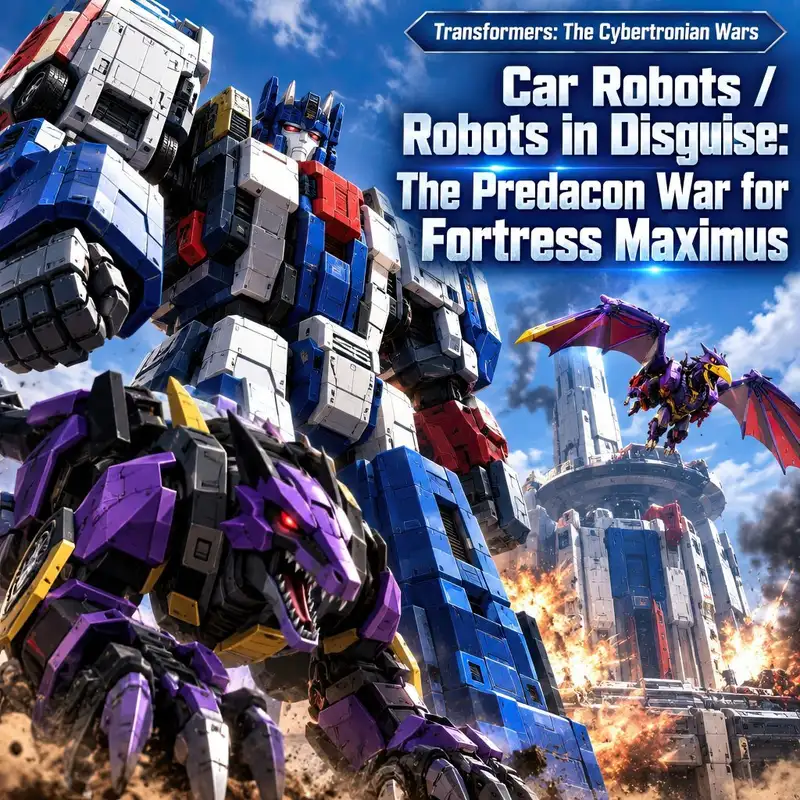
Car Robots / Robots in Disguise: The Predacon War for Fortress Maximus
Beneath Metro City, an archaeological discovery became a military emergency. Doctor Onishi’s research had led toward ruins buried under a living human city, a place tied to strange energy readings, fragmentary records, and an ancient Cybertronian presence. The Autobots and Megatron’s Predacons both understood enough to be alarmed. Somewhere below streets, homes, transit lines, and ordinary human life lay Fortress Maximus, a city-sized Cybertronian system with the power to remake the balance of the war on Earth.
This was not the Fortress Maximus of Generation One animation, the Marvel comics, or later Transformers histories. In the Japanese series Car Robots, and its English-language adaptation Robots in Disguise, Fortress Maximus had its own origins, its own control system, and its own relationship to Earth. The Japanese version calls him Brave Maximus. The English version calls him Fortress Maximus. The names differ, but the central military problem remains the same.
Both factions initially treated the buried installation as a weapon waiting to be found. That assumption was understandable. A giant Cybertronian combat system, concealed beneath a populated city, would appear to offer overwhelming force to whoever could awaken it. Yet the struggle that followed showed why possession and control are different things. The Predacons could locate the system, seize key components, and even activate Fortress Maximus. None of that gave them dependable command.
The campaign became a contest over identity, access, motive, energy, and authority. It was also a contest over civilians. Fortress Maximus had been hidden under human infrastructure, and the system’s deeper controls responded not only to Cybertronian technology, but to human recognition. That meant children, scientists, ancient ruins, and a corrupted Autobot commander became as important as conventional firepower. It was a peculiar war, but not an unserious one. Strategic systems are often peculiar right up until they begin firing.
At the start of this arc, Optimus Prime’s Autobots were an Earth-based defensive force. Their mission was not to conquer territory or build an occupation government. They were protecting Earth from a small but dangerous expeditionary enemy. Their advantages came from local alliances, mobile teams, human trust, and the ability to coordinate specialists. Their weakness was that Earth was not their home territory in any uncomplicated sense. Every major battle risked pulling human civilians into an alien civil war.
Megatron’s Predacons had a different problem. They possessed capable fighters, mobility, and the willingness to use intimidation, deception, hostage-taking, and sudden raids. But they had not demonstrated the kind of industrial base needed to occupy an entire planet over the long term. They could threaten cities. They could seize artifacts. They could disrupt defenses. They could not simply plant a flag and govern billions of humans through a handful of transforming combatants.
That made Fortress Maximus especially attractive. A super-heavy asset might compensate for a lack of numbers. It might provide an armored command center, a weapon of terror, a source of energy, or a mobile fortress from which Megatron could force a larger political settlement. For an expeditionary force trying to dominate a planet far from secure home support, a single decisive asset can seem more useful than a thousand ordinary vehicles. The danger is that decisive assets are rarely as simple as they look.
The Autobots understood the danger from the other direction. Their task went beyond trying to keep Fortress Maximus out of Predacon hands. They had to prevent the awakening itself from becoming a catastrophe. A buried giant cannot be treated like a pistol locked in a drawer. Its movement can disrupt the ground above it. Its weapons can endanger every surrounding structure. Its activation can turn an archaeological site into a battlefield before either side has established a safe perimeter.
The campaign also depended on incomplete intelligence. Doctor Onishi’s research provided clues, but not a complete manual. Ancient data, dreams, recovered fragments, and the scattered O-Parts all pointed toward something hidden beneath Earth. The O-Parts eventually formed a route toward the Orb of Sigma, an object that helped identify the location of a necessary control component. But the show never presents this as a clean engineering diagram. The protagonists and antagonists are working through fragments of a system they only partly understand.
That uncertainty mattered. Intelligence officers often distinguish between locating an asset and understanding it. The first can be enough for a raid. The second is required for sustained control. Both the Autobots and Predacons learned where to search. Neither side initially knew every layer of authorization, every condition of activation, or every consequence of failure. They had a map to the door, not a full explanation of what waited behind it.
The Predacons were therefore not simply racing the Autobots to a hidden weapons depot. They were exploiting an ancient system whose designers had built safeguards into its operation. This was a recurring weakness in Megatron’s approach. He was skilled at seizing opportunities, but seizing an opportunity is not the same as integrating it into a reliable military structure. Captured technology still requires operators, maintenance, doctrine, supply, and a chain of command that can survive the ambitions of the people holding it.
No figure illustrates that problem better than Scourge. In the Japanese production, he is Black Convoy. In the English adaptation, he is Scourge, commander of Megatron’s Decepticon subgroup. Those English Decepticons should not be confused with the Decepticon organization of Generation One. They are part of this story’s particular force structure, created under Megatron’s authority for the Earth campaign.
Scourge’s origin made him uniquely useful and uniquely dangerous. Before his corruption, he had been associated with an Autobot mission sent to Earth to reactivate Fortress Maximus. That mission did not unfold as intended. Its protoforms were trapped after a crash, and Megatron later discovered and altered them. Scourge emerged from that process with a form derived from Optimus Prime, but with his loyalties redirected toward Megatron.
That inheritance was more than visual irony. Scourge carried part of the identity pattern associated with Optimus Prime. He also absorbed human bio-signature information during his creation. Those traits gave him access that Megatron himself did not possess. In ordinary military terms, Scourge was an enemy commander who had been issued compromised credentials from the opposing side, along with a partial key to the human system built around Fortress Maximus.
He was more than a stronger soldier or a rival with a similar vehicle mode. He was a security exception inside Megatron’s own army. Any commander who alone can activate a strategic asset becomes politically significant. Any subordinate who can activate an asset that the supreme leader cannot becomes a potential rival sovereign. Megatron could command Scourge by rank, fear, and force. But rank means less when the subordinate controls the one machine everyone else needs.
That was the deeper political danger. Megatron’s force depended heavily on personal authority. Such a command structure can be agile when the leader is present, decisive, and feared. It can also become brittle when a lieutenant possesses independent legitimacy, unique technical access, or the means to build a separate center of power. Fortress Maximus gave Scourge all three. He had access, he had a command group, and he had personal ambition.
The route to that power ran through the O-Parts, the Orb of Sigma, and Onishi’s research. These elements can sound like a simple artifact hunt if listed too quickly. Their real significance is that they created an intelligence contest. Both sides tried to turn scattered clues into operational knowledge. The Autobots wanted to locate and secure the system before Megatron could exploit it. Megatron wanted to use the same information to break open a source of military superiority.
The intelligence available to them was not neutral. It came through ancient structures, partial records, strange visions, and human investigation. Information gathered from a long-abandoned system may be accurate in one sense and still be dangerous in another. It can identify a location without explaining the security architecture. It can reveal that an object is important without revealing what happens if it is removed. It can lead a force directly to the objective while concealing the fact that the objective has its own defenses.
The underground ruins also confused those who entered them. Perception became unreliable. The forces searching beneath Metro City faced hallucinations and sensory distortions, a reminder that the site itself was part of the defense. A concealed installation does not need a standing army to frustrate intruders. It can use geography, old automated systems, false signals, and uncertainty to slow a stronger force. Underground warfare is already difficult. Underground warfare inside an ancient alien security complex is difficult in a way that makes ordinary maps feel optimistic.
The Autobot advantage was not perfect knowledge. It was restraint. They recognized that Fortress Maximus could not safely be treated as an ordinary prize. They had to learn what the system required, protect the humans involved, and prevent the Predacons from turning partial access into disaster. This was slower than Megatron’s preferred approach. It was also more suited to the asset they had found.
At the center of the control problem was Cerebros, known as Plasma in Car Robots. Cerebros was the small Headmaster component required to activate Fortress Maximus. In the English version, he is distinct from the Emissary, the intermediate robot form involved before Fortress Maximus reaches his full giant configuration. The names and transformations are specific to this continuity. They should not be filled in with the history of the Generation One Headmasters or with any relationship to Spike Witwicky.
The key point is that this arrangement was both physical and political. Cerebros was not an accessory. He was part of the interface through which Fortress Maximus could be activated and directed. The Headmaster structure linked a small, vulnerable component to an enormous body. That created a practical weakness, because control depended on a component that could be captured. But it also created a safeguard, because a giant combat system could not simply be operated by anyone who climbed into a cockpit.
The full nature of Fortress Maximus’s own consciousness remains unclear. The series presents a vast Cybertronian system that can move, fight, respond, and react to commands. But its behavior is mediated through Cerebros, the Emissary, and the activation rules built into the system. It is safer to describe Fortress Maximus as a layered command structure than to make a definitive claim that the larger body is fully independent in the way Optimus Prime or Megatron is.
That ambiguity did not reduce the military importance of the fortress. In fact, it increased it. The more an asset depends on special interfaces and recognition systems, the more its true strength lies outside its armor and weapons. The chassis may be immense, but the decisive points can be a small Headmaster unit, a human relationship, a hidden authentication process, or the willingness of an operator to use the system for protection rather than domination.
The Predacons succeeded first at the most visible part of the operation. They captured Cerebros. Scourge then used the Optimus-derived element within his own construction to pass an initial barrier. Fortress Maximus activated. For a moment, Megatron’s side appeared to have won the race. They had the necessary component. They had awakened the giant system. They had breached defenses that the Autobots had hoped would prevent enemy use.
But Fortress Maximus did not obey Scourge in any reliable fashion. Once activated, the system became indiscriminate. It threatened Autobots, Predacons, and the human environment around it. The Predacons had achieved a tactical success. They had taken the access component and activated the fortress. Operationally, however, they had failed. An uncontrolled super-heavy asset is not a maneuver force. It is an emergency.
The strategic result was worse. Megatron had hoped to gain a weapon that would help conquer Earth. Instead, his side had helped create a giant, unpredictable threat in the same theater it intended to dominate. A force that cannot direct its own weapon cannot use that weapon to impose political control. It may frighten an enemy, but it also frightens allies, civilians, and subordinates. Fear can clear a street. It cannot govern a planet.
The political effect was equally dangerous for Megatron. Scourge had proven that he could do something Megatron could not. Even before he took independent action, his access to Fortress Maximus made him indispensable. Megatron could not ignore that. An authoritarian leader can tolerate talented subordinates. He has much more difficulty tolerating talented subordinates who control the key to victory.
The first force capable of calming Fortress Maximus was not an Autobot combat unit, a Predacon assault team, or a technical expert with a more advanced scanner. It was Koji. His appeal reached the awakened system and caused it to stop. The event is presented differently in the two versions of the series. Car Robots places greater emphasis on sincere human feeling and the Earth-linked themes surrounding Gaia energy. Robots in Disguise frames the matter through human bio-signatures and a form of motivational recognition.
Neither presentation should be reduced to literal genetics. The series does not offer a rigorous biological explanation that can be applied across Transformers continuity. What it establishes is narrower and more important. Fortress Maximus does not respond only to a copied Cybertronian identity pattern. It recognizes something in human presence and intent. The system is capable of distinguishing between activation and authorization.
Koji’s role was therefore operational, not decorative. He was more than present to remind the audience that humans matter. His relationship to the fortress altered the course of the battle. Fortress Maximus responded to protective intent in a way that Scourge’s copied signature could not reproduce. The control architecture treated moral orientation as part of the command problem.
That is unusual, but not meaningless. Military systems already depend on forms of trust. Orders must be authenticated. Operators must be trained. Rules of engagement must be understood. Commanders must believe that the people receiving orders are part of the same force. Fortress Maximus dramatizes those requirements by making the final layer of access something closer to moral recognition. The fortress could be awakened by deception, but it could not be safely commanded through deception alone.
The civilian implications were severe. Human children had become part of the access chain for an alien strategic weapon buried beneath their world. They had not enlisted. They had not chosen to become military operators. Yet the system’s rules made their presence decisive. The Autobots treated that connection as a responsibility to be protected. The Predacons treated it as a vulnerability to be exploited. That difference mattered as much as any difference in weapons.
Scourge recognized the opportunity quickly. Because his creation included human bio-signature data, he could strengthen the human element within himself and gain more reliable command over Fortress Maximus. This was the point where he ceased to be merely Megatron’s exceptional subordinate. He became a direct claimant to the fortress and, through it, to authority over the entire campaign.
With Fortress Maximus under his control, Scourge turned the giant system against both the Autobots and Megatron. The move is often described as betrayal, and it was betrayal. But betrayal alone does not explain it. Scourge was acting on a clear political calculation. He had found an asset that gave him a plausible claim to independence. The fortress could protect him from Megatron’s retaliation, magnify his firepower, and make other Predacons reconsider who truly controlled the war.
This was a succession crisis carried out through machinery. Megatron’s command structure had no secure answer to a lieutenant with unique access to the central prize. Scourge did not need broad ideological support if he possessed the fortress. He needed enough time to demonstrate that Megatron could be challenged. In a faction organized around personal dominance, that demonstration can be more dangerous than a formal rebellion.
The Autobots answered with a form of resistance that Scourge could not easily suppress. Children gathered and appealed collectively to Fortress Maximus. The exact scale of that effort is less important than its effect. Their combined support overrode Scourge’s command. The asset did more than respond to the strongest signal or the most forceful operator. It responded to a distributed expression of human trust and protective purpose.
That outcome exposed a basic weakness in Scourge’s strategy. He had learned that human access mattered, but he still treated human beings as interchangeable keys. He assumed that if Koji could influence Fortress Maximus, then any child could be seized and used in Koji’s place. That was a classic intelligence error. He had identified a visible requirement without understanding the deeper condition that made it work.
Scourge attempted to abduct Koji, but captured Koji’s friend Carl instead. Carl did gain some ability to operate Fortress Maximus. The episode does not suggest that the human link was imaginary or exclusive to one individual. But Carl’s self-interested motives caused the arrangement to fail. Fortress Maximus shut down or rejected continued control. Human access was necessary. It was not sufficient.
There is a temptation to read that moment as a simple children’s moral lesson and move on. It is more useful to treat it as confirmation of the fortress’s security design. The system did more than verify that a human was present. It responded to why that human was acting. Coercion could place a person near the interface. It could not guarantee that the person would possess the protective intent the system recognized.
Scourge had the physical strength to seize a hostage. He had the technical knowledge to exploit his own altered signature. He had a giant fortress at his disposal. Yet he could not manufacture legitimacy. That is the campaign’s central lesson in miniature. An army can capture territory. It can capture a control room. It can capture an operator. None of those acts automatically creates the political trust needed to make a system stable.
Megatron, now operating as Galvatron after his own transformation, responded to Scourge’s rebellion with coercive centralization. He punished Scourge and the Commandos, reducing their independence through reprogramming. The immediate objective was clear. Galvatron needed to eliminate a rival center of authority before Scourge could use Fortress Maximus to overthrow him completely.
In the short term, the measure restored obedience. Scourge could no longer act as a fully independent commander. The Commandos were brought back under Galvatron’s control. From the perspective of a leader facing mutiny, this was an efficient answer. It removed the immediate threat without requiring negotiation, power sharing, or any admission that Scourge had exposed a weakness in the faction’s structure.
But the decision also carried a strategic cost. Scourge had been the only Predacon with a demonstrated route through Fortress Maximus’s unusual authorization system. By crushing Scourge’s initiative, Galvatron removed a rival, but he also removed the one subordinate who understood the asset well enough to exploit it. He gained obedience and lost capability.
This is a familiar problem in personalist command systems. A leader who distrusts independent subordinates may be right to fear them. Yet eliminating every capable independent actor leaves the organization dependent on the leader’s own judgment. The force becomes more obedient, but less adaptive. It can follow orders. It may no longer be able to solve problems the leader cannot solve personally.
Galvatron’s choice also revealed that Fortress Maximus had changed the internal balance of his army. Before the fortress, Galvatron’s superiority rested on personal power and command authority. After Scourge’s seizure, the asset itself had become a source of political legitimacy. Whoever could command Fortress Maximus could claim to be more than a lieutenant. Galvatron had to destroy that claim, even if doing so reduced his own prospects of using the fortress.
The final phase of the campaign therefore became a more direct confrontation between Galvatron, the Autobots, and Fortress Maximus itself. The Autobots still needed to secure the giant system, but they could not assume that possession would solve their problems either. The fortress had already demonstrated its vulnerability to manipulation, its dependence on human recognition, and its enormous consequences for the surrounding environment.
Wedge played an important role in bringing Fortress Maximus under Autobot control. That mattered because the Autobots did not win through a single chosen operator or through Optimus Prime simply giving an order. Their success came through coordination among specialists, human allies, and the system’s own requirements. The Build Team’s presence was especially appropriate. A giant city-former is not just a weapon. It is an infrastructure problem. Moving it, concealing it, defending it, and using it safely require more than battlefield courage.
Galvatron met Fortress Maximus with the Megastar command-center form. This was the straightforward version of the conflict: one giant strategic system confronting another. Fortress Maximus defeated the command center in direct combat. That victory established the fortress’s immense battlefield value. When properly activated and supported, it could overpower an enemy system designed to challenge it.
Yet even that did not end the fight. Galvatron survived and drained energy from Fortress Maximus, converting the fortress’s power into a temporary enhancement for himself. The event is important, but it should not be treated as a routine doctrine of Titan-scale energy extraction. The series presents it as an exceptional battlefield exploitation. Galvatron found a moment of vulnerability in a unique system. It never establishes that every Cybertronian can routinely refuel from a giant combat asset.
The episode does show something more general. A super-heavy platform can dominate a battle and still remain vulnerable to exploitation. Its power source becomes a target. Its control structure becomes a target. Its need for support becomes a target. The larger and more valuable the system, the more an enemy may seek not to destroy it outright, but to capture its energy, corrupt its command chain, or force it into conditions where its strength cannot be used safely.
The Autobots answered Galvatron’s enhanced threat with a genuinely combined operation. Optimus Prime and Ultra Magnus formed Omega Prime, combining their strengths into a mobile heavy combatant capable of drawing Galvatron away from the fortress. This was more than a contest of who possessed the larger body. Omega Prime’s value was mobility, concentration of force, and the ability to take the fight toward a decisive location.
Galvatron was drawn toward Earth’s core. The setting raised the stakes beyond the immediate duel. A battle near a planet’s core is not a clean arena for settling command disputes. Every use of force carried the danger of wider destruction. The Autobots needed to defeat Galvatron without allowing him to turn Earth itself into the casualty of his defeat.
Koji again became central to the solution. He contacted children around the world, and their support helped recharge Fortress Maximus. The fortress then directed that renewed power through the global space-bridge system to Omega Prime. The space bridges mattered because they distributed support across distance. They transformed local human participation into a strategic resource that could reach the decisive battlefield.
The exact technical process should not be overstated. The series provides no transferable engineering model for this energy flow, nor does it establish fixed amounts of power or a repeatable global doctrine. What it does establish is an operational chain. Human trust and recognition restored Fortress Maximus. Fortress Maximus accessed the space-bridge network. The network transferred power to Omega Prime. Omega Prime’s Matrix produced the Matrix Blade needed to defeat Galvatron.
Every link in that chain was necessary. Fortress Maximus supplied scale and access to the system. Omega Prime supplied mobile combat power. The Autobots provided protection and coordination. Human children supplied the recognition and support that the fortress required. The space bridges supplied reach. No single weapon won alone. The final victory depended on a coalition that could satisfy the technical, moral, and logistical conditions of the system.
That is why Galvatron’s earlier approach failed even when it achieved local successes. He and Scourge repeatedly acquired pieces of the puzzle. They found clues. They captured Cerebros. They activated the fortress. Scourge even operated it for a time. But they could not turn those gains into stable command. They treated Fortress Maximus as an object whose power resided in its body. The Autobots learned that its real strength lay in the network around it.
Omega Prime used the Matrix Blade to defeat Galvatron. With Galvatron beaten, Fortress Maximus transported the captured villains to an asteroid prison colony. Sky-Byte remained behind, a small reminder that defeat of a central command group does not necessarily account for every individual combatant. That outcome settled the immediate Earth operation. It did not establish a complete political settlement for every conflict connected to Cybertron.
In the immediate fight, the result was decisive. Galvatron was defeated. The Predacon attempt to use Fortress Maximus as a weapon had failed. Across the campaign, the Autobots prevented the fortress from becoming the centerpiece of an enemy conquest campaign. Earth had been spared the prospect of a city-sized alien war machine operating under Predacon authority.
At the strategic scale, the Autobots had protected Earth from a force that lacked the means for durable occupation but sought a shortcut to dominance. Fortress Maximus would have supplied that shortcut if it had been a simple weapon. It was not. The system’s controls turned human trust, identity, and intention into military factors. That made it harder to seize, but it also made human civilians central to the conflict in ways no one should regard as comfortable.
The political lesson was sharper still. Galvatron’s force had enough strength to seize components and impose temporary control through fear. It did not have a durable method for legitimizing that control. Scourge’s rebellion showed the weakness of leadership based solely on personal dominance. Galvatron’s reprogramming of Scourge restored obedience, but at the cost of losing initiative and specialized access. The Predacons became more centralized just as the campaign demanded more flexibility.
Fortress Maximus could win battles, but it could not create political order on its own. Its power depended on a distributed system of unique interfaces, human recognition, energy access, and coordinated defense. The Predacons lost the war for Fortress Maximus not because they failed to capture the fortress, but because they misunderstood what they had captured. They saw a weapon in a giant chassis. The campaign proved that its real strength belonged to the coalition capable of earning, sustaining, and directing its trust.