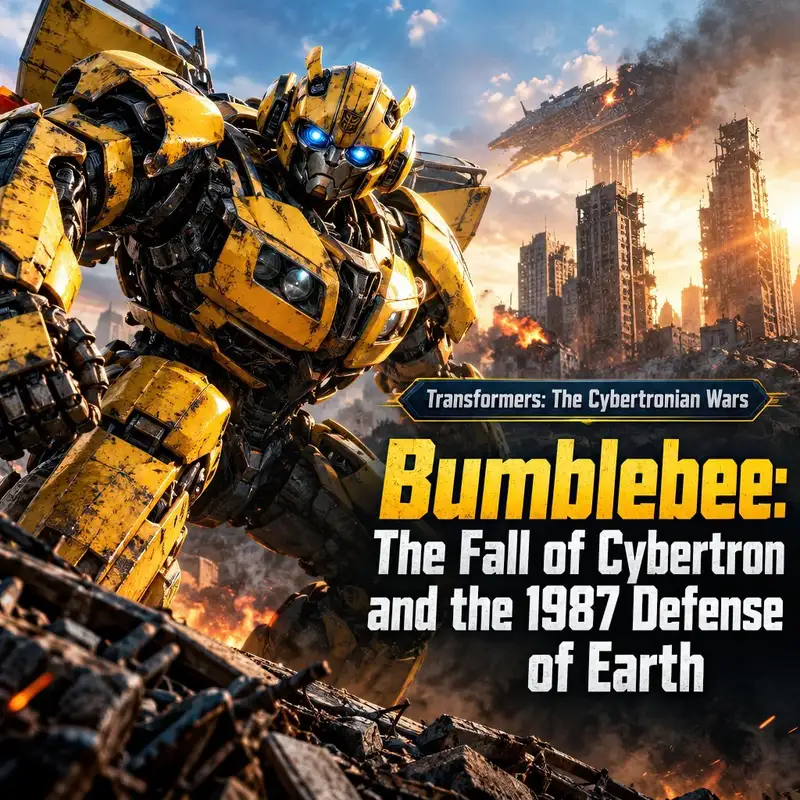
Bumblebee: The Fall of Cybertron and the 1987 Defense of Earth
Charlie Watson reaches the control panel with no military training, no security clearance, and no reason to understand the machinery in front of her beyond one essential fact. It is calling someone. Above the harbor, the Decepticons Shatter and Dropkick have turned Earth’s communications infrastructure into a beacon aimed beyond the planet. If the signal remains active, Earth will no longer be an obscure refuge on the edge of an interstellar war. It will become a known destination for Decepticon forces. Bumblebee is fighting nearby, badly outnumbered by two opponents who arrived with a plan, local assistance, and a far clearer understanding of the stakes than the humans around them. The immediate question is not whether one yellow Autobot can win a duel. It is whether a damaged scout, a civilian teenager, and a human security organization that has only just recognized its mistake can prevent a quiet California town from becoming the opening front of a larger war.
This is the history presented in the Bumblebee film branch, whose 1987 Earth story stands apart from the earlier live-action film chronology. The distinction matters because the events of this film establish their own sequence. Bumblebee arrives on Earth in 1987. Optimus Prime reaches Earth only afterward. Sector Seven has encountered alien machines, but it does not possess a settled history of Autobots, Decepticons, ancient artifacts, or previous battles on American soil. Earth’s first defense against the Cybertronian war begins in confusion. It is not a prepared alliance, a public military campaign, or the arrival of an established Autobot force. It begins with one scout fleeing a lost world, one human institution misreading the situation, and two Decepticons trying to turn that misunderstanding into a strategic breakthrough.
The beacon crisis makes sense only because Cybertron has already ceased to be a secure base for the Autobots. The film opens amid a battle that is not the beginning of the war, nor a complete account of Cybertron’s defeat, but a decisive moment in its collapse. Autobot forces are still organized enough to fight, maneuver, and conduct an evacuation. Their defenders use the cityscape, cover withdrawal routes, and attempt to preserve as many surviving personnel as they can. Yet the Decepticons have gained the initiative. The presence of Starscream, Soundwave, Shockwave, and other Decepticon attackers establishes the scale of pressure facing the withdrawal. It does not provide a complete order of battle or a full map of command. What it does show is enough. The Autobots can no longer guarantee the safety of Cybertron as a home, industrial base, or command center.
Optimus Prime’s decision is therefore not a victory plan. It is a survival plan. He orders an evacuation because holding ground without the ability to sustain it would risk converting a retreat into annihilation. A force can retain courage, discipline, and impressive weapons while still losing the larger contest for territory, repair capacity, energy access, and secure transportation. The Autobots shown in the opening are not helpless. They are withdrawing under pressure because their position has become untenable. The film does not explain the fate of every city, every civilian, every government institution, or every Cybertronian who remains behind. That silence matters. The fall of Cybertron is established as a military and political disaster for the Autobots, but not as the physical destruction of the entire planet or the end of Cybertronian life.
The Decepticons, by contrast, have achieved something more important than a dramatic battlefield advantage. They have denied their opponents a secure center. Once that happens, the Autobot problem changes. It is no longer simply how to defend a city or defeat an attacking formation. It becomes how to remain a functioning political and military movement after losing the world from which that movement operated. A dispersed force needs destinations, communications, concealment, repair, and enough time to reconnect its surviving elements. Without those things, evacuation is only delay. Optimus’s answer is to create a future point of assembly beyond Cybertron. That is why he assigns B-127 to Earth.
B-127 is not sent to conquer the planet. He is not dispatched with an invasion force, diplomatic delegation, or formal agreement with any human government. His assignment is more modest and, under the circumstances, more difficult. He is to reach Earth, assess it, defend it if necessary, and help establish a refuge where Autobots might regroup. In military terms, he is an advance scout operating ahead of the main body. Such a mission depends on discretion. A forward operative must learn enough about the destination to survive there, avoid drawing hostile attention, identify potential support, and maintain some means of reporting or receiving instructions. B-127 arrives with none of the advantages normally associated with a secure deployment. He has no visible maintenance detachment, no established communications network, no protected base, and no reliable knowledge of Earth’s political authorities.
The strategic logic is sound. A defeated force often survives by dispersing beyond the enemy’s immediate reach. But dispersal produces its own dangers. Separate groups can lose contact. A scout can be captured. A safe world can become unsafe the moment its location is revealed. A refuge is useful only if it remains more valuable to its defenders than to the enemy. Earth’s importance in 1987 lies precisely in its obscurity. It is not yet a declared battlefield in the Cybertronian war. That gives B-127 room to operate, but it also means that the humans who live there have no reason to understand why an alien machine has appeared in their territory. His first problem is not Decepticon firepower. It is identification.
B-127 reaches California during a Sector Seven operation. Sector Seven is a secret American organization concerned with extraterrestrial activity. It has armed personnel, vehicles, detention capability, technical specialists, and the authority to respond quickly within its classified sphere. Colonel Jack Burns exercises practical command over the immediate response. From his position, the appearance of an unknown armed extraterrestrial is not a small matter. B-127 is large, powerful, damaged, evasive, and unable to provide a comprehensible explanation. Burns does not know that the visitor belongs to a displaced resistance force. He knows only that something from beyond Earth has landed near a military exercise and is capable of violence.
That initial response is an intelligence failure, but it is not a failure of basic military professionalism. Sector Seven reacts, pursues, and attempts to contain an unknown threat. Those are reasonable actions when information is scarce and the potential consequences are severe. The deeper failure is categorical. Sector Seven recognizes alien technology, but not alien political identity. It has no verified picture of Autobots and Decepticons as opposing factions with different goals. To Burns, there is simply an armed alien machine on American soil. The organization can bring force to bear, but force cannot answer the question of whether the target is an invader, a refugee, a scout, or a warning of something worse.
B-127 escapes the first encounter and adapts to Earth by scanning a local vehicle form. Transformation gives him mobility and concealment, but not invulnerability. A vehicle mode can help an alien refugee travel through human territory without immediately attracting attention. It can also expose him to roads, garages, observers, mechanical failure, and the mundane fact that a vehicle without a driver, registration, or ordinary behavior eventually becomes suspicious. Still, the scanned form gives B-127 his first workable means of disappearing into an unfamiliar environment. He needs that concealment because the more immediate Decepticon threat is already closing in.
Blitzwing intercepts him before he can establish any network on Earth. Blitzwing’s role in the episode is specific. He is a Decepticon tracker and interrogator pursuing a fugitive scout. He is not presented as the architect of the whole Cybertronian war, nor as the commander of every Decepticon force. His purpose is immediate and practical. He wants information, especially information about Optimus Prime and the surviving Autobots. B-127 is asked to reveal Optimus’s location. He refuses. In that refusal, the scout performs the most important duty of his mission. A forward operative who reveals the location of the force he is meant to protect has not just failed personally. He may expose every survivor relying on secrecy.
The fight that follows gives B-127 a narrow tactical success. He uses Blitzwing’s own missile against him and destroys his pursuer. But victory comes at a severe cost. Blitzwing tears out B-127’s voice box and damages his memory systems. The injuries leave him physically impaired, unable to communicate normally, and separated from a coherent understanding of his own mission. This is more than a dramatic alteration of personality. It is an operational catastrophe. B-127 was sent to Earth as an independent scout. Independent scouts require the ability to observe, report, remember instructions, authenticate allies, and make decisions based on a stable sense of purpose. After the encounter with Blitzwing, he survives, but he no longer possesses the full capacity to carry out the task Optimus gave him.
That difference is important. Destroying Blitzwing does not restore B-127’s mission capability. It removes one threat while leaving the underlying problem intact. The damaged Autobot cannot simply contact Optimus, explain his location, or negotiate with humans. He cannot reliably tell a potential ally why he is on Earth. His silence becomes a source of danger because people fill silence with their own assumptions. To Sector Seven, it can look like hostility or deception. To future Decepticon pursuers, it makes him easier to manipulate. To B-127 himself, the broken fragments of his past leave him vulnerable to fear, confusion, and sudden reactions he cannot fully explain.
He survives by becoming inconspicuous. B-127 takes the form of a yellow 1967 Volkswagen Beetle and remains in concealment at a California junkyard. This is a remarkably fragile form of survival for an Autobot assigned to prepare a planetary refuge. His hiding place is not a fortress, command post, or secret base built by Cybertronian engineers. It is a cemetery for human machinery. Yet that ordinary setting provides something a battlefield cannot. It gives him obscurity. A damaged vehicle in a junkyard does not invite the kind of scrutiny that a visible alien warrior would. In a war of pursuit and intelligence, remaining unnoticed can be more valuable than demonstrating strength.
The period of concealment also shows the limits of B-127’s position. He has no evident access to Autobot repair facilities. He is dependent on what can be found, improvised, or provided locally. The film does not establish a detailed energon supply system, a hidden cache of Cybertronian parts, or a network of Autobot agents already active on Earth. It shows something much smaller. A lone machine, injured in an unfamiliar world, survives because he is overlooked. That is not a durable military posture. It is a pause between crises.
Charlie Watson changes that situation when she finds the Beetle and begins working on it. Her contribution is often described in personal terms, and it is personal. She is grieving, frustrated, mechanically capable, and searching for a space where she can act with some independence from the troubles in her family life. But her relationship with B-127 also has material consequences. She provides shelter, tools, discretion, transport, and repair. She restores enough function for him to awaken. In the absence of an Autobot maintenance crew, that support is strategically significant. A scout who cannot move or think clearly is not an advance party. He is a recoverable casualty.
Charlie does not restore B-127 to his former condition all at once. She restores mobility and opens the possibility of recovery. The distinction matters because the Autobot remains damaged, uncertain, and unable to communicate with the clarity his mission requires. She gives him the name Bumblebee, a name that belongs to his Earth experience and to the relationship that forms between them. Before that point, the film identifies him as B-127. The new name is not a replacement for his history so much as an acknowledgment that he is building a new identity in a place where his old designation means nothing to the people around him.
Memo, Charlie’s neighbor, becomes part of the small circle of local support around Bumblebee. He is not a commander, intelligence officer, or combat specialist. His importance lies in the human scale of the refuge. Bumblebee’s first functioning support network consists of young people, a household, a junkyard, and improvised trust. That is not how a military planner would choose to establish a forward base. It is, however, how survival sometimes begins when formal institutions either do not understand the threat or have not yet decided whether the refugee is friend or enemy.
Charlie’s support also has an emotional dimension that should not be separated too sharply from the practical one. B-127 has been isolated, injured, and deprived of the ability to explain himself. Trust helps stabilize him. It allows him to respond to help rather than treating every human contact as an attack. It gives him a reason to remain near people who can assist rather than fleeing deeper into concealment. For Charlie, the relationship creates danger, but also agency. She is no longer merely living beside forces beyond her control. She becomes someone capable of making choices that affect an interstellar conflict. The film keeps this intimate. Earth’s defense does not begin in a national command center. It begins with one civilian deciding that a damaged stranger deserves help.
Bumblebee’s partial recovery eventually restores fragments of memory and reveals the message Optimus Prime left for him. The message confirms the strategic purpose of the mission. Earth is to be defended while the Autobots attempt to regroup. It is not a promised paradise, nor a completed sanctuary. It is a place that might become one if it can remain protected long enough. For Bumblebee, recovering this information gives structure to what had become instinct and confusion. He learns again that he is more than a lost being hiding in a vehicle body. He is part of a larger effort to preserve the Autobot cause after Cybertron’s fall.
Yet recovered information is not automatically secure information. Bumblebee’s damaged voice forces him to communicate through fragments of radio broadcasts and sounds. This method allows expression, but it also means that his communications are indirect, incomplete, and difficult for humans to interpret. A message that helps restore his identity may also create a trail for anyone capable of accessing his systems. The intelligence contest becomes asymmetric. Bumblebee needs time, trust, concealment, and a way to distinguish allies from enemies. His pursuers need only find him, capture him, and extract enough information to understand why he is on Earth.
That is where Shatter and Dropkick become more dangerous than Blitzwing. They arrive not just as hunters, but as an exploitation team. Their objective is to locate B-127, determine the Autobot plan, and use that knowledge to bring larger Decepticon forces toward Earth. They understand the weakness in the human response before Sector Seven does. Humans may have weapons and facilities, but they do not yet know which Cybertronians are which. Shatter and Dropkick present themselves as credible authorities. They speak confidently, identify Bumblebee as a dangerous fugitive, and encourage Sector Seven to see the Autobot as the central threat.
Their deception is effective because it fits the information already available to the humans. Sector Seven has seen Bumblebee fight, flee, and refuse to communicate normally. Shatter and Dropkick arrive offering an explanation. It is false, but it is coherent. This is a familiar intelligence problem. A deceptive account succeeds not only because it is cleverly delivered, but because it organizes scattered facts into a story the target is prepared to believe. The Decepticons do not need to persuade Sector Seven that they are harmless. They need only persuade it that Bumblebee is more dangerous than they are.
Sector Seven thereby becomes an unintentional force multiplier for the Decepticons. The organization contributes surveillance, personnel, detention infrastructure, and access to the territory where Bumblebee is hiding. Its resources are real. Its mistake is deciding whom those resources should serve before it has properly understood the conflict. The Decepticons exploit the authority of the American state without needing to conquer it. They do not build an occupation government or deploy an invasion army. They use local institutions as temporary instruments of pursuit.
This is why first contact is often less about raw capability than classification. A government may possess disciplined soldiers, laboratories, secure installations, and formidable conventional weapons. It can still make a strategically disastrous decision if it cannot identify the actors involved. Sector Seven’s personnel are not foolish because they lack a complete theory of Cybertronian politics. They are operating under secrecy, uncertainty, and pressure. But secrecy can narrow judgment. An organization built around compartmentalization may have very few people empowered to challenge its first conclusion. Once the conclusion is wrong, the machinery of the organization can make that error more powerful.
Dr. Powell begins to recognize that Shatter and Dropkick’s account does not fit the evidence. This is the beginning of the intelligence reversal. It does not come from a grand revelation or a complete understanding of the Cybertronian war. It comes from observation. The Decepticons’ behavior, their interest in Bumblebee’s systems, and their willingness to use human assistance for purposes they have not disclosed begin to expose the gap between their story and their actions. Good intelligence work often begins there. Not with certainty, but with the recognition that a convenient explanation no longer explains what is happening.
By the time Sector Seven understands the scale of its error, Bumblebee has been captured. The Decepticons gain access not only to a prisoner, but to the strategic reason Earth matters. Through Bumblebee’s systems, they uncover Optimus Prime’s message and learn that other Autobots may come to the planet. This is the crucial connection. Before the interrogation, Earth is valuable mainly because it contains a fugitive Autobot. Afterward, it becomes valuable because it may serve as the point where displaced Autobots regroup. The Decepticons are no longer hunting a single scout. They are trying to expose the future refuge that scout was sent to establish.
Their answer is the beacon. The film does not provide a technical manual for its interplanetary communications system. It does not establish exact signal range, power requirements, or the number of Decepticon forces waiting to receive it. None of those details are necessary to understand the strategic effect. The beacon depends on Earth’s existing communications infrastructure, local access, equipment, and time. It turns the planet’s own systems into a tool for bringing the wider war closer. A hidden refuge can survive if it remains difficult to locate. A transmission designed to summon forces removes that advantage.
The Decepticon plan therefore has a fixed vulnerability. Shatter and Dropkick may be powerful combatants, but their operation depends on a physical site that must be assembled, activated, and protected. The beacon is not an abstract threat. It occupies space. It has equipment, access points, surrounding infrastructure, and a limited period during which the Decepticons can defend it. That gives a smaller force a chance. Bumblebee does not need to defeat every Decepticon beyond Earth. Charlie does not need to understand every aspect of Cybertronian technology. They need to stop one transmission before it becomes irreversible.
The final confrontation takes place in a harbor and industrial landscape filled with equipment designed for ordinary human work. Towers, chains, structures, elevation, and heavy machinery become part of the defense. This terrain matters because Bumblebee is not fighting from a position of numerical superiority. He cannot rely on reinforcements from the Autobots. The defenders must use what is available. Industrial terrain can constrain movement, create hazards, offer leverage, and allow a force with limited weapons to redirect the strength of a larger opponent. In this case, the environment becomes an equalizer.
The division of labor is equally important. Bumblebee provides the Cybertronian combat capability. He can engage Shatter and Dropkick directly, absorb punishment that would be fatal to a human, and use the physical environment in ways no human defender could. Charlie’s role is different but no less central to the mission. She reaches the beacon and works to disrupt the transmission itself. Colonel Burns and Sector Seven personnel, having recognized the Decepticons’ deception, shift from pursuing Bumblebee to responding to the actual emergency. They are no longer acting as the core of an established alliance. They are making a rapid correction under crisis conditions.
That correction is not clean or costless. Sector Seven has already helped deliver Bumblebee into Decepticon hands. It has already supplied the pursuers with access and legitimacy they did not deserve. But institutions are not frozen at their first mistake. Burns’ personnel can still contribute once they understand the threat. Their practical value lies in local knowledge, mobility, armed support, and the ability to stop treating the Autobot as the target. The change does not erase the earlier failure. It prevents that failure from becoming permanent.
Bumblebee defeats Dropkick through the use of the industrial environment, turning heavy equipment and a chain into weapons against an opponent whose strength might otherwise be difficult to overcome. The point is not that chains are universally effective against Decepticons, or that Earth machinery can defeat any Cybertronian force. The point is situational. A lone defender learns to use terrain because he cannot manufacture a favorable balance of forces. He uses the space around him to create one. The fight is a tactical success because it removes an immediate threat to the beacon operation.
Shatter remains dangerous because the Decepticon mission is still active. The battle has meaning only as long as the signal remains at risk. Charlie succeeds in disabling the beacon, interrupting the transmission that would have exposed Earth to the wider Decepticon force. Bumblebee then prevents Shatter from continuing the attack, bringing down part of the surrounding structure and crushing her amid the collapsing industrial landscape. The exact mechanics of every impact matter less than the sequence of mission effects. The defenders disrupt the signal, prevent its restoration, and remove the Decepticons who were operating it.
This is the point at which tactical success and operational success meet. Bumblebee defeats individual enemies, but those defeats are not the full objective. The decisive result is that the Decepticons lose their immediate ability to use Earth as a communications platform for reinforcement. A fighter can win a duel and still fail the mission if the beacon remains active. Charlie can destroy the beacon and still face catastrophe if the Decepticons are free to rebuild it immediately. The defenders succeed because they do both. They deny the transmission and break the team assigned to protect it.
The battle also takes place around infrastructure that serves civilian life. That gives the conflict a different character from the fall of Cybertron. The opening evacuation is a war on a world already consumed by Cybertronian fighting. The harbor battle occurs in a human environment not built for alien warfare. The people around Charlie did not choose to become civilians in an interstellar conflict. Their roads, towers, machinery, and waterways become dangerous because rival forces have decided that Earth is useful. The film does not turn this into a broad account of national panic or mass evacuation. Instead, it keeps the civilian cost intimate. A family, a neighborhood, and a town are drawn near a war they barely understand.
Burns’ final decision to let Bumblebee go is therefore politically important. He has seen the Decepticons deceive his organization. He has seen their intention to use Earth as a pathway for further conflict. He has also seen Bumblebee protect human lives rather than exploit them. Burns does not become a public advocate for Autobot settlement, and Sector Seven does not suddenly transform into a transparent civilian institution with a coherent extraterrestrial policy. But he does revise his judgment. He recognizes that Cybertronians are not one undifferentiated threat.
Still, the new partnership remains fragile. There is no public disclosure of Cybertronian factions. There is no treaty between the United States and the Autobots. There is no legal framework for refugee status, detention, repair, technology control, or accountability. The knowledge that Autobots and Decepticons are different is held by a small number of people who have survived an extraordinary event. Secrecy protects Bumblebee from wider panic and exploitation. It also leaves the future dependent on personal judgment rather than durable institutions. If Burns is reassigned, ignored, or overruled, the lesson may have to be learned again.
For Bumblebee, the immediate crisis ends with another transition. He separates from Charlie, adopts a 1977 Chevrolet Camaro form, and moves toward the Golden Gate Bridge area. The change in vehicle form is more than a cosmetic flourish. It marks his movement from improvised concealment in a junkyard toward a more mobile future. He is no longer only the damaged Beetle hidden among abandoned cars. He has survived contact with humans, recovered enough of his purpose to act, and helped preserve the world Optimus selected as a refuge.
When Bumblebee reunites with Optimus Prime and additional Autobots begin arriving, the mission’s larger value becomes clear. Earth has not been won in the conventional sense. No government has surrendered. No Decepticon army has been defeated in a planetary campaign. Cybertron has not been liberated. The Autobot cause remains displaced, and the broader war remains unresolved. But a future operating base has been preserved beyond the reach of the immediate collapse on Cybertron. The Autobots have somewhere to gather that the Decepticons failed to expose in time.
The immediate victory is modest but consequential. Bumblebee, Charlie, and their improvised allies defeat Shatter and Dropkick, stop the beacon, and deny the Decepticons the reinforcement route they need to turn Earth into an open theater of war. Cybertron remains occupied and the larger conflict continues, but the refuge survives long enough for Optimus Prime and additional Autobots to arrive.
Bumblebee’s 1987 defense succeeds because it denies the Decepticons the information and communications advantage required to turn Earth from a hidden refuge into a declared front. One damaged scout does not end the Cybertronian war. He does something more limited and more believable. With help from civilians and a human commander willing to correct a grave misjudgment, he preserves the first conditions under which the displaced Autobots can survive beyond Cybertron.