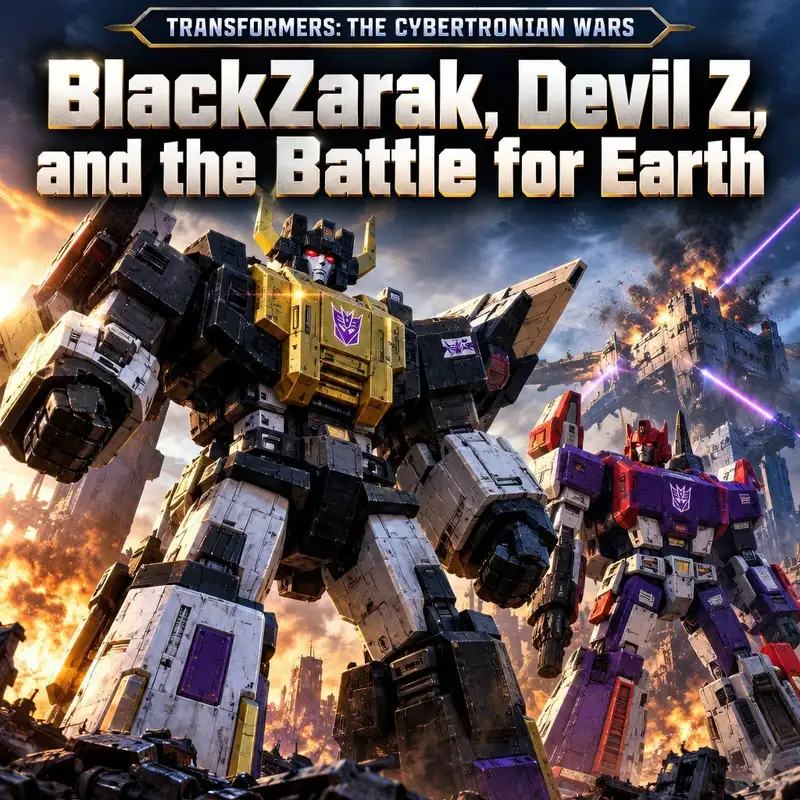
BlackZarak, Devil Z, and the Battle for Earth
BlackZarak’s power was being fed into the Death Para-Machine, a weapon built for more than battlefield advantage. Its purpose was to concentrate destruction on a planetary scale, to turn the war on Earth into an attempt to erase humanity and the Cybertrons defending it. In Super-God Masterforce, the final Destron offensive was shaped by human partners, Transtectors, and Masterforce power. That made this campaign more than a contest between machines. It became a struggle over whether human agency would survive inside a war increasingly designed to consume it.
The apparent balance of power looked grim. Devil Z had acquired BlackZarak, a mobile fortress capable of attacking cities, anchoring large weapons systems, and surviving fights that would have destroyed lesser forces. Yet BlackZarak’s greatest value was more than firepower. He gave Devil Z a body, a command platform, and a visible instrument of terror. The question was whether terror could produce victory, or merely devastation.
The television series leaves BlackZarak’s earlier history largely unexplained. In this account, he should be understood through his role in the final campaign. He is the Destrons’ principal strategic asset, a weapon platform that can move between theaters, support destructive energy systems, and become the physical host for Devil Z itself. Later material gives him additional associations, but those do not control the history told in the main Masterforce television series.
The immediate crisis followed the destruction of the Cybertron base. That attack did more than remove a building from the map. It disrupted the defenders’ communications, protection, and ability to coordinate across Earth. At the same time, Grand Maximus was trapped in space, temporarily unavailable as a transport, mobile base, and heavy combat asset. Devil Z recognized the opportunity. A defensive network already damaged by surprise and displacement could not easily respond to a campaign that moved from one population center to another.
BlackZarak arrived as the Destrons exploited that gap. Overlord joined him in attacks against cities, while human defenses were overwhelmed by the sudden scale and mobility of the threat. The Cybertrons did not lack courage, but courage was not the immediate problem. They lacked the ability to be everywhere at once. A mobile enemy could strike a city, shift position, and force the defenders to choose between pursuit, rescue, and protection of the next likely target.
God Ginrai was delayed by the need to rescue Grand Maximus. That decision mattered. A commander facing a terror campaign is often pressured to seek the enemy’s destruction immediately, especially when civilians are under attack. But abandoning a major support platform can create a larger failure later. Grand Maximus was not a decorative reserve. He was a means of transport, recovery, reinforcement, and survival for the wider Cybertron force.
Ginrai’s eventual return through Grand Maximus’s base mode allowed the defenders to reenter the fight with greater mobility and support. God Ginrai defeated Overlord and helped drive BlackZarak away. It was a tactical success, but not a final victory. BlackZarak withdrew rather than being destroyed, and Devil Z retained the initiative. The defenders had proven that the giant platform could be resisted. They had not yet solved the larger problem of how to stop it from choosing the next battlefield.
That distinction became clearer with the Death Para-Machine. BlackZarak was more than a giant combatant whose value depended on meeting God Ginrai face to face. He could serve as the energy source and delivery system for a prepared strategic weapon. The machine focused his power into a beam intended to destroy humanity and the Cybertrons on Earth. The campaign had crossed a line from raids, coercion, and factional war into deliberate mass-casualty warfare.
The weapon’s existence also revealed a limitation in Devil Z’s apparent superiority. However formidable BlackZarak was, his power still had to be organized. The Death Para-Machine required preparation, a focusing system, a defended position, and time to operate. It was an industrial and logistical project, not a magical extension of one warrior’s will. That meant it could be attacked. It also meant that Devil Z’s campaign depended on infrastructure that could be found, disrupted, or destroyed.
God Ginrai destroyed the Death Para-Machine before a second strike could fulfill its purpose. Grand Maximus was badly damaged in the process and nearly fell toward Earth before being rescued. The defenders had prevented catastrophe, but the cost showed how thin their margin had become. They were using their largest surviving assets to block one weapon system while BlackZarak, Devil Z, and the Destron command structure remained active.
Destroying the machine did not end the campaign. It removed one means of annihilation, not the political purpose behind it. This was a recurring weakness in the Destron offensive. Devil Z treated destruction as though it were equivalent to control. But even a weapon capable of devastating cities cannot govern a frightened population, recruit willing partners, or create a stable order after the attack. It can only make the next act of resistance more desperate.
The limits of terror became personal when BlackZarak attacked China, the homeland of Cancer. Cancer had been associated with the Destrons, and that affiliation shaped how civilians received him. When he tried to warn people of the coming attack, they did not automatically trust him. Their caution was understandable. In a war of shifting loyalties and disguised combatants, a warning from a known enemy can sound like another deception.
Cancer’s position was therefore more difficult than a simple change of sides. He was trying to protect people who had good reason to fear him, while confronting a Destron campaign that regarded their lives as expendable. When BlackZarak attacked, Cancer attempted to save his human friend Jan and became trapped in the destruction. The danger was not an abstract lesson about good and evil. It was a direct encounter with what Devil Z’s strategy meant for the communities from which its own human-linked followers had come.
The Cybertrons’ rescue of Cancer mattered for more than compassion. It established a political difference between their cause and Devil Z’s. They did not demand that Cancer first prove perfect loyalty before helping him. They acted because civilians and former enemies alike could not be abandoned under BlackZarak’s attack. Minerva’s concern for Cancer reinforced that point. A coalition gains strength when it can offer a place to those who have begun to reject the enemy’s purpose.
Cancer’s experience also exposed a problem Devil Z could not solve through fear. Obedience can be extracted in the short term. Loyalty cannot. A commander who treats every subordinate as expendable may obtain immediate compliance, but each act of cruelty teaches survivors that they are merely waiting their turn. By targeting Cancer’s homeland, BlackZarak did more than spread terror among civilians. He helped separate one of the Destrons’ own human partners from the cause he had served.
The next turning point came through intelligence. Clouder offered to guide Shuta to the Destron undersea base. The mission was compromised, and Shuta was used as bait to draw God Ginrai into danger. That failure demonstrated that information from a defector is never automatically secure. The Destrons understood their own base, their surveillance systems, and the value of turning a rescue mission into an ambush.
The undersea base was much more than a convenient hiding place. It was the operational center of the final offensive. It provided concealment, communications, coordination, and access to the infrastructure supporting BlackZarak and Devil Z. An undersea location made conventional detection and direct approach more difficult, but it also concentrated vital functions in one place. A hidden headquarters can preserve command. Once discovered, it can become a vulnerability.
The ambush showed how the Destrons layered their defenses. Overlord attacked Super Ginrai, while King Poseidon threatened Godbomber. The intent went beyond trying to defeat individual opponents. It was to divide the Cybertrons’ supporting systems and prevent them from combining their strengths. God Ginrai’s power depended on coordination. If Ginrai, Godbomber, and their allies could be separated under pressure, the Destrons could reduce a cooperative force to isolated fights.
Cancer intervened against King Poseidon, helping the group escape. That intervention did not erase his previous allegiance or settle every political question around him. It did show that the Destron command structure was no longer secure. The side that had begun the campaign with BlackZarak, Overlord, and a concealed headquarters was now facing defections, divided loyalties, and the possibility that its own personnel might become sources of intelligence for the enemy.
For the Cybertrons, learning the location and character of the undersea base changed the war. Until then, they had largely been responding to a mobile terror platform that chose its own targets. Now they possessed actionable information about the Destrons’ center of gravity. They could plan an assault intended not only to defend the next city, but to disrupt the command and infrastructure enabling the campaign.
The attack on the undersea base brought God Ginrai and Grand Maximus into a deliberate counteroffensive. Cancer and Clouder helped the Cybertrons penetrate the Destron detection network. Their contribution was essential because technology alone did not solve the problem. A detection network can be powerful, but it depends on access, knowledge, and the trust of the people who operate or understand it. The Destrons had built a fortified system, yet their own political failures had opened paths through it.
The assault became a close battle involving the Seacons, the Pretenders, and the surviving elements of the Destron force. The defenders still possessed substantial combat power. BlackZarak was not the only threat, and Devil Z had not yet fully exposed itself. But the attack forced the Destrons to defend their infrastructure rather than freely selecting civilian targets. That shift did not end the danger. It did begin to deny Devil Z the freedom of action that had made the early phase of the campaign so destructive.
Then Devil Z took possession of BlackZarak. The merger was not an ordinary combination between equal partners, nor was it simply a larger mechanical form. Devil Z emerged as the directing intelligence and fused with BlackZarak, joining energy entity, body, weapon platform, and supreme command authority. The result gave Devil Z a more immediate ability to direct destruction through the strongest available Destron asset.
This was the military expression of Devil Z’s political vision. It did not seek cooperation with BlackZarak. It sought possession. The body became a vessel for command, and command became inseparable from coercion. Devil Z’s desired “new lifeform” was not a community of stronger individuals. It was an order in which individuality could be absorbed, overridden, or remade to serve a central will.
God Ginrai represented a very different kind of power, though it should not be romanticized as effortless harmony. Ginrai required Godbomber, Grand Maximus, the Cybertron forces, and the assistance of human-linked allies. His strength was distributed. It depended on coordination between participants who retained their own judgment. That could make the coalition slower, less tidy, and vulnerable to disagreement. It also made it more resilient when one part of the force was damaged or separated.
The contrast was visible during the threatened destruction of the undersea base. Overlord prepared explosives, and the Cybertrons faced a choice between pressing the attack and evacuating those in danger. Wilder and Bullhorn still did not fully trust the Cybertrons, yet efforts were made to save them. That decision had practical value. Rescued enemies might later provide intelligence or assistance. It also had moral value. A force claiming to defend Earth could not treat distrustful human partners as acceptable losses simply because they had once worn the Destron emblem.
Combination, in other words, was not automatically solidarity. Devil Z’s fusion with BlackZarak gave it centralized power, but it was a union of domination. God Ginrai’s strength rested on relationships that could not be reduced to command circuitry. The difference would become decisive once the Destron campaign began consuming its own personnel.
Buster and Hydra provided the clearest example. They concluded that their human forms prevented them from defeating God Ginrai. Devil Z offered a solution by fusing them with their Transtectors and converting them into fully mechanical forms. The reborn Darkwings emerged with increased combat ability, but the conversion carried a deeper meaning. In Masterforce, this was not an ordinary Cybertronian reformatting process or a universal rule about transformation. It was a Devil Z-controlled conversion designed to subordinate human identity to military power.
The immediate result was formidable. Buster and Hydra became stronger opponents, stripped of the limits Devil Z associated with their human-linked existence. Yet that apparent improvement came at the cost of autonomy. Their new forms demonstrated the logic of Devil Z’s program. Human partners were useful only until a more controllable arrangement could replace them. The relationship between person and Transtector, once central to Masterforce power, was being transformed into a system of possession.
Devil Z and BlackZarak then launched a major offensive against North America from the Grand Canyon. The location offered concealment and a dramatic operating position, but it also showed the campaign’s widening geography. BlackZarak no longer needed to remain near the undersea base. He could shift between regions, turning terrain into temporary cover and forcing the Cybertrons to respond across an entire continent.
The Cybertrons had to divide their efforts. Some fought the converted Darkwings and BlackZarak’s forces. Others concentrated on civilian rescue. That was not hesitation. It was the central operational burden of a defensive war against an enemy targeting population centers. A force that ignores civilians may gain short-term freedom to concentrate combat power. It may also surrender the very political purpose for which it claims to fight.
Wilder and Bullhorn eventually aided the Headmaster Juniors during this crisis. Their help did not signal a neat conversion from Destron to Cybertron. It reflected a more immediate recognition that Devil Z’s war threatened everyone who was not fully under its control. Godbomber assisted God Ginrai in defeating Buster and Hydra, but the victory did not reverse their conversion or resolve the broader danger. It revealed what Devil Z meant by strength: increased destructive capability purchased with diminished freedom.
The next stage of the campaign showed why that model was strategically self-defeating. Overlord fought God Ginrai without using his weapons, seeking to prove personal superiority in direct combat. The duel was dangerous, but it also represented a failure of command discipline. Devil Z’s wider objective was to continue a planetary extermination campaign. Overlord instead pursued a personal test of pride.
That is the danger of a hierarchy built on coercion and spectacle. It can make subordinates fear their leader, but it cannot ensure that they will subordinate their own status, anger, or ambition to a coherent strategy. Overlord remained a powerful asset, yet he was not a reliable instrument. His decision to fight on his own terms diverted attention and strength from the broader Destron mission.
The Destron Headmaster Juniors reached their own breaking point after repeated mistreatment. Their revolt should not be mistaken for instant devotion to the Cybertron cause. They acted against their former commanders for reasons shaped by abuse, humiliation, and self-preservation. Their break was political, but it was not yet a settled alliance. In civil wars, defections often begin with rejection of one side before they become support for another.
Their Masterforce bracelets disappeared, and their Transtectors became independent robotic beings. The event had major implications within this series. The bracelets and Transtectors had connected human partners to a system of extraordinary power. Their loss meant that the juniors could no longer be treated simply as operators within a controlled arrangement. The Transtectors now possessed independence, and the old relationship between human partner and combat body had changed.
Meanwhile, BlackZarak continued to devastate North America, and Devil Z ordered the offensive onward into Europe. The Destrons had achieved operational reach. They could strike widely separated regions, exploit terrain, and compel the defenders into constant movement. But reach was not the same as control. Devil Z had no political program for Earth beyond destruction, conversion, and submission. It could terrorize cities, but it could not create institutions capable of governing them.
Europe became the setting for BlackZarak’s next attempt to turn mobility and terrain into victory. Operating from the Matterhorn, BlackZarak used Devil Thunder power against the defenders. The mountain environment gave him natural advantages. Steep terrain complicated approach routes, limited movement, and allowed avalanches to become weapons. A fortress positioned in such ground could force an attacking force to divide and expose itself.
The Cybertrons responded with a multi-axis assault. God Ginrai attacked from the south. The Godmasters advanced from the north. Metalhawk and the Headmaster Juniors approached from the east. The plan recognized that no single direct assault was likely to overcome BlackZarak’s defenses. Pressure had to come from several directions, forcing the Destrons to divide their attention and preventing one route from becoming an easy killing ground.
That plan also carried risks. Dispersed forces require communication, timing, and confidence that other elements will reach their positions. BlackZarak exploited those risks with avalanches and defensive pressure from King Poseidon. The goal was to separate the attackers, isolate vulnerable units, and convert a coordinated offensive into a series of disconnected fights. Mountain warfare has always favored defenders who understand the terrain. In this case, BlackZarak used the landscape as part of his defensive system.
God Ginrai had to move between objectives, rescuing Metalhawk while trying to penetrate the defensive screen created by Buster and Hydra. That was the central difficulty of the operation. He could not focus solely on reaching BlackZarak. The Cybertrons were fighting a campaign that demanded rescue, mutual support, and protection of forces caught in the enemy’s terrain trap. Devil Z had created a dangerous defensive position, but it was still relying on allies whose loyalty had become fragile.
The fracture became unmistakable when Devil Z punished Buster and Hydra for failure. By this stage, they had already surrendered their human autonomy for greater power. Devil Z’s response showed that even conversion did not purchase safety or trust. They had become stronger instruments, but they remained disposable instruments. A command system that destroys or nearly destroys its own useful personnel for failing in difficult circumstances eventually loses the ability to learn from defeat.
Overlord finally turned against Devil Z. This was not a sudden discovery that the Destron cause had become harmless or noble. It was the collapse of elite command loyalty after repeated evidence that Devil Z valued domination over every relationship. BlackZarak defeated Overlord, demonstrating that Devil Z could still impose force. But force could no longer restore the trust that had already been destroyed.
God Ginrai helped Overlord escape. The decision was strategically sensible because an enemy of Devil Z could become a source of disruption or intelligence. It was also consistent with the Cybertrons’ broader refusal to treat every former Destron as beyond rescue. That did not erase Overlord’s past actions. It recognized that the immediate threat was Devil Z’s attempt to destroy or convert every independent participant in the conflict.
Sixknight then appeared to delay BlackZarak. His intervention gave others time, but BlackZarak destroyed him. The loss mattered because it demonstrated the cost of slowing a superior platform long enough for the coalition to survive. Sixknight’s death was not a decorative sacrifice. It marked the point at which the campaign’s violence had stripped away any remaining illusion that BlackZarak could be contained without severe losses.
By the time BlackZarak moved toward Antarctica, Devil Z appeared close to its goal. The plan was to activate or amplify Devil Thunder power against humanity. Antarctica was not chosen merely for spectacle. Its isolated terrain and association with the necessary energy system gave Devil Z an opportunity to prepare a final strike away from crowded urban battlefields, while still threatening the entire planet.
God Ginrai engaged BlackZarak directly. The fight was not a simple trial of individual strength. Ginrai was attempting to prevent a strategic system from becoming active, while BlackZarak was defending both Devil Z’s body and the means of planetary destruction. Ginrai managed to damage BlackZarak, but BlackZarak answered by using the environment. An avalanche buried Ginrai, removing him from the battle without requiring a clean victory in direct combat.
BlackZarak then used Devil Thunder rings to immobilize Ginrai and threatened to convert him into a purely mechanical being. The threat echoed what had happened to Buster and Hydra. Devil Z’s objective went beyond trying to kill opposition. It was to eliminate independent human-linked power by turning it into a controllable machine. In that sense, Ginrai represented everything Devil Z wanted to defeat: a system in which power emerged from partnership rather than possession.
Grand Maximus again proved essential. He detected the disturbance and freed Ginrai. This was the value of a support asset that survives long enough to act. Grand Maximus had been damaged, delayed, and nearly lost earlier in the campaign, yet his presence at Antarctica prevented Devil Z from converting a temporary tactical advantage into a final victory. Great weapons matter. So do transport, detection, recovery, and the ability to reach a trapped ally.
God Ginrai destroyed BlackZarak’s robot head. It was a decisive blow against the physical platform, but the battle did not end. Devil Z survived in a monstrous two-headed form. The moment clarified the relationship between weapon and command. BlackZarak had been the visible center of the offensive, but Devil Z was the directing intelligence behind it. Destroying the platform disrupted the system. It did not automatically destroy the will controlling it.
Overlord made his final choice at that point. Devil Z ordered him to attack Ginrai. Instead, Overlord attacked Devil Z. The decision did not redeem every earlier act, and it came too late to prevent enormous destruction. But it mattered because it denied Devil Z the obedience on which its entire system depended. The commander who had sought absolute control was now confronted by a subordinate refusing the final order.
Devil Z responded by stripping Giga and Mega of their Godmaster powers. It killed them and converted Overlord into an independent robot. This was the final expression of Devil Z’s method. Human partners, bodies, and loyalties were all resources to be removed, altered, or discarded once they no longer served the central will. Giga and Mega’s deaths revealed the cost of serving a system that recognized no obligation to those who had made it powerful.
The final counterstroke came through a temporary union between God Ginrai and the Headmaster Juniors. Their Superforce combined with Ginrai in an exceptional act of shared power. This was not an ordinary combiner mechanism, nor did it establish a general rule for Cybertronian technology. It was a singular response to a singular threat, made possible because the participants chose to cooperate against Devil Z.
That distinction was decisive. Devil Z had spent the campaign forcing bodies and powers into a hierarchy of control. Ginrai’s final strength came from allies whose agency had not been erased. The Headmaster Juniors had rebelled against mistreatment. Overlord had refused the final order. Cancer and Clouder had supplied intelligence. Grand Maximus had rescued Ginrai. Metalhawk, Godbomber, and others had held together under pressure. No single act was sufficient by itself. Together, they made the final attack possible.
Devil Z was destroyed. With its destruction came a revelation about the system that had shaped the war. Devil Z had created or enabled the Godmaster Transtectors and their powers. Once Devil Z was gone, the human partners lost their Masterforce bracelets, and the Transtectors became independent Transformers. The end of Devil Z’s command did not restore the old arrangement. It transformed it.
That aftermath was liberation, but not a complete peace settlement. Earth had been saved from Devil Z’s extermination campaign. BlackZarak had been destroyed as the platform of that campaign. The Destrons’ central command structure had collapsed, and the human-linked systems Devil Z had manipulated no longer functioned in the same way. Yet surviving Destrons remained, and the robotic forces departed Earth to pursue them into space.
The conflict therefore ended with a military victory, not a finished reconstruction. Devil Z was defeated tactically and strategically. Its attempt to annihilate humanity had failed. Its attempt to create a superior lifeform through domination had failed as well. But the series does not present a detailed political settlement for every former Destron, every damaged community, or every transformed relationship between humans and Cybertronians.
BlackZarak’s defeat was not a simple failure of superior weaponry. Devil Z made him devastating by combining mobility, terror, destructive energy, and direct control over human-linked Transtectors. But that same system hollowed out the force that was meant to sustain it. Devil Z treated partners as tools, allies as equipment, and populations as targets. It created a military capable of terror, but incapable of trust, adaptation, or lasting control.
God Ginrai’s side prevailed because its strength remained distributed among allies who could choose to cooperate, rescue, defect, and resist. That coalition suffered losses, made difficult compromises, and never escaped the cost of war. But it preserved the agency that Devil Z tried to erase. In the battle for Earth, that proved stronger than BlackZarak’s firepower.