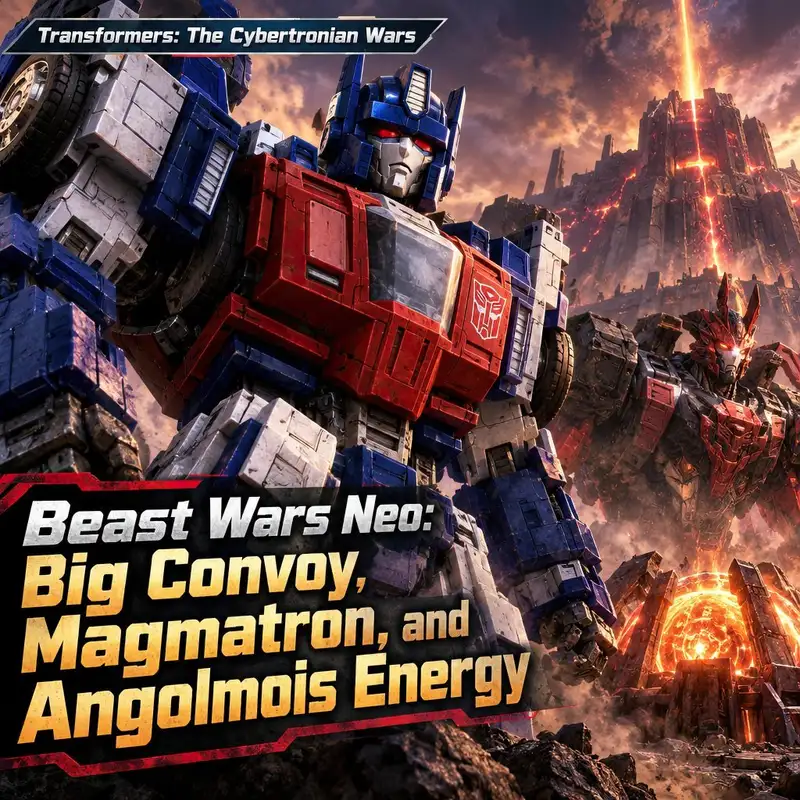
Beast Wars Neo: Big Convoy, Magmatron, and Angolmois Energy
A warning reaches Cybertron too late to be comfortable and too incomplete to be reassuring. Near the planet Gaea, an immense explosion has been recorded. Lio Convoy and his unit have vanished in its aftermath. What remains is a black-box message, transmitted from a commander who may already be beyond rescue. It reports that Galvatron, the Destron leader from the earlier Beast Wars II conflict, had gathered a dangerous substance called Angolmois Energy aboard the artificial planet Nemesis.
Nemesis was destroyed, but destruction did not solve the problem. The energy it carried was scattered through space in sealed capsules. Lio Convoy’s message warns that Angolmois Energy may possess enough power to threaten the universe itself. It is not a full intelligence estimate. It provides no dependable map of every capsule, no explanation of how the energy works, and no current picture of the enemy. It gives Cybertron an objective, but not a plan.
In the Japanese Beast Wars Neo television history, that uncertainty produces an unusual assignment. Vector Sigma and the Convoy Council do more than dispatch an established military formation to recover the capsules. They appoint Big Convoy, an experienced Cybertron commander with a formidable reputation in combat, and order him to train a group of inexperienced recruits while carrying out a galaxy-wide recovery mission.
The contradiction is immediate. Big Convoy is known as a one-man army. The operation requires exactly the opposite of a one-man army. It requires scouts, navigators, guards, investigators, transport personnel, and fighters who can make decisions when their commander is elsewhere. The mission goes beyond trying to find dangerous objects before the Destrons do. It is to create a capable unit while the danger is already in motion.
That makes Beast Wars Neo more than a contest for powerful capsules. Its real subject is command under conditions of incomplete information. What did the Cybertrons and Destrons believe Angolmois Energy to be? What did it actually require of them? And what happens when both sides discover that the prize they are fighting over cannot safely be owned at all?
Big Convoy begins the series as a veteran whose battlefield reputation is not in doubt. His mammoth form gives him great physical strength and resilience, and he is accustomed to meeting danger directly. He can break through an obstacle, confront a powerful opponent, and impose his will on a tactical situation. Those are valuable qualities. They are not the same as building an organization that can survive his absence.
His assignment places him aboard the Gung Ho, a mobile platform for training, movement, and capsule recovery. The series does not provide the sort of specifications that would allow a historian to calculate its range, crew complement, or cargo capacity. What matters is its operational role. The Gung Ho allows a small Cybertron force to move from world to world, investigate uncertain leads, recover dangerous material, and return personnel to a common command structure.
Longrack serves as Big Convoy’s sub-commander. Alongside him are the trainees Colada, Stampy, Break, and Heinrad. They are not an established strike force with years of shared experience. They are a training detachment placed into a real strategic emergency. Their different temperaments and abilities give the unit adaptability, but they also create friction, confusion, and opportunities for the enemy.
This is not a minor administrative detail. In military history, units often discover their real weaknesses when training conditions end and operational pressure begins. A force can look competent in a controlled exercise because it knows the terrain, the timetable, and the chain of command. It looks very different when the objective may be hidden on another planet, the enemy is arriving at the same time, and the object being recovered may be dangerous to touch, transport, or understand.
Big Convoy’s problem is therefore not whether he can defeat individual Destrons. It is whether he can delegate without surrendering responsibility. A commander who does everything personally may appear decisive, especially in a crisis. But that commander also creates dependence. The unit waits for instructions, avoids initiative, and becomes fragile whenever the leader is separated, damaged, deceived, or simply occupied elsewhere.
The scattered Angolmois Capsules make that weakness impossible to ignore. The campaign crosses multiple worlds, including Godbless, Solid, Donovan, and Flame. These locations are more than colorful stops on an interplanetary journey. Each represents a separate recovery problem. The capsule must first be located. Then its nature must be assessed. Then it must be secured against hostile action. Finally, it must be extracted and transported without allowing it to become a weapon in someone else’s hands.
The series never establishes precise distances between these worlds, the number of ships available to either side, or the endurance limits of the opposing forces. There is no reliable basis for turning a few scenes of spacecraft travel into a complete order of battle. But the broad operational reality is clear. This is a distributed search-and-recovery campaign. Mobility, intelligence, local knowledge, timing, and coordination matter as much as raw combat strength.
Possession is not the same as control. A capsule hidden on a distant world is not useful simply because a faction knows it exists. A force must reach it, protect the recovery team, prevent enemy interference, and move the object to a secure location. That movement creates more vulnerabilities. The recovered capsule can be tracked, intercepted, sabotaged, or stolen. A resource war is never just about finding the resource. It is about the chain that carries it from discovery to practical use.
The Cybertrons are not alone in recognizing that Angolmois Energy may alter the balance of power. Magmatron leads the Destron force pursuing the capsules. At first, his objective appears straightforward. If the Cybertrons seek the capsules, then the Destrons must seize them first. If Angolmois Energy is powerful, it can become an instrument of factional advantage. The logic is familiar. Deny the enemy the resource, acquire it for yourself, and force the conflict onto terms you control.
Magmatron is a commander built for that kind of contest. His authority is intensely personal and hierarchical. He is more than one field officer among many. He is the center of the Destron effort, an emperor-like warlord whose own combat capability reinforces his political command. Subordinates such as Guiledart provide practical tactical and engineering value, but Magmatron remains the force’s defining presence.
His body is itself an expression of concentrated power. Magmatron can operate through the dinosaur forms of Landsaurus, Skysaurus, and Seasaurus. These forms can combine into Magmasaurus, giving him a particularly formidable combat configuration. In Beast Wars Neo, that is a demonstrated capability of this individual commander. It should not be mistaken for a universal model of Cybertronian combination, nor for proof that every Destron formation possesses the same flexibility.
Magmatron’s modular configuration offers real tactical advantages. Different forms can approach a problem from different angles, and their combination produces a more powerful direct-combat presence. Yet these advantages solve only part of the mission. They help in a confrontation. They do not explain what Angolmois Energy is. They do not guarantee that a capsule can be safely held. And they do not ensure that a leader has identified the most dangerous actor in the theater.
The confrontation on the planet Flame makes the early shape of the conflict especially clear. Big Convoy and Magmatron meet as opposing commanders in what appears to be a conventional contest between Cybertron and Destron forces. The personal rivalry matters. Both leaders are powerful, and both have reason to treat the other as the principal obstacle to victory.
But Flame also demonstrates the limits of commander-versus-commander warfare. A duel can establish prestige. It can delay an opponent. It can affect morale and perhaps alter the immediate control of a site. It cannot, by itself, locate every capsule scattered across space. It cannot secure transport routes. It cannot interpret a threat hidden within the object of the campaign.
The real center of gravity is not Big Convoy’s mammoth strength or Magmatron’s combined form. It is information about Angolmois Energy. The side that understands what the capsules are, what they can do, and who else is seeking them holds an advantage far greater than any single battlefield victory.
Big Convoy’s trainees gradually force him to confront this reality. A dispersed mission cannot be conducted by a commander who treats every crisis as an invitation to charge ahead alone. The recruits must learn to act together, but Big Convoy must also learn to allow them to do so. Training is not separate from the operation. Training becomes one of the operation’s most important strategic purposes.
Longrack’s role as sub-commander matters because functioning command requires more than a celebrated leader. Someone must help translate broad intent into practical action. Someone must maintain cohesion while the commander is fighting elsewhere. Someone must see the routine details that a warrior focused on the decisive encounter may overlook. In any military formation, these tasks are not glamorous. They are often what makes success possible.
Colada, Stampy, Break, and Heinrad bring different capabilities and different problems to the unit. Their development is more than a matter of gaining confidence or mastering individual techniques. They must learn how their actions affect one another. A scout who rushes ahead may expose the team. A defender who waits for perfect instructions may lose the initiative. A specialist who acts alone may succeed at a narrow task while endangering the larger mission.
The arrival of Mach Kick makes the cost of unit failure more concrete. He has lost his original team to the Destrons. That experience places him in a different emotional and practical position from recruits who have not yet seen a formation broken apart. He understands that a team is not an abstract lesson taught by a commander. It is the difference between having support in a crisis and facing the enemy alone after everyone else is gone.
Survive, an experienced instructor, also serves as a useful critic of Big Convoy’s solitary habits. The criticism is not that Big Convoy lacks courage. No one could make that argument honestly. The criticism is that courage and command are different skills. A leader can be willing to accept personal danger and still fail to build the collective capability needed for a long campaign.
That distinction is especially important in a war spread across distant planets. A commander may be able to arrive at the decisive point eventually. But eventually is not always soon enough. Small teams must be able to identify threats, protect one another, and make sound decisions before reinforcements arrive. The Gung Ho can carry the unit between theaters. It cannot turn a dependent group into an effective one without leadership that encourages growth.
The worlds affected by the capsule hunt also remind us that military competition does not occur in empty space. Angolmois-related events threaten local environments and populations, even though the series does not offer a detailed account of civilian administration, casualty figures, refugee movements, or recovery programs. The absence of those details should not be mistaken for the absence of consequences. A dangerous object recovered from a world is still an object whose presence has placed that world at risk.
For much of the campaign, the Cybertrons and Destrons interpret the conflict through familiar factional assumptions. Each believes the other is the main threat. Each sees the capsule race as a contest in which enemy possession is the primary danger. This is an understandable reading of the evidence available to them. It is also dangerously incomplete.
The Blentrons expose that incompleteness. Drancron, Elphorpha, and Ratorata do not enter the campaign as ordinary Destron reinforcements. They are an independent third force. Their intervention changes the strategic problem because they begin taking Angolmois Capsules from both sides. A contest that had seemed bilateral now has an actor with its own agenda, superior access to crucial knowledge, and no obligation to follow the rules of Cybertron-Destron rivalry.
The Blentrons matter not merely because they are powerful opponents. They matter because they demonstrate that both major factions have misunderstood the campaign. The Cybertrons and Destrons have been fighting over custody. The Blentrons are pursuing purpose. They do more than want the capsules denied to an enemy. They know what the capsules are for.
This is a familiar intelligence failure. Rival powers often become so focused on one another that they classify every new development according to an old framework. A third force appears, and each side initially asks whether it is an ally, a proxy, or an enemy of the other faction. That question may be useful, but it can also delay the more important question: what does this new actor want that neither established side has understood?
The Blentrons exploit that delay. Their ability to seize capsules from both Cybertron and Destron forces reveals a deeper operational weakness. Neither side has created a system capable of protecting the entire chain of discovery, recovery, transport, and analysis. Both have concentrated on defeating each other at individual points. The Blentrons operate across the gaps.
Their intervention also demonstrates the political cost of factional thinking. The Cybertrons and Destrons have reasons to distrust one another. Their rivalry is not imaginary. Yet that rivalry encourages them to treat the conflict as though all threats must fit within the existing division. A power outside that division gains freedom of movement. It can exploit suspicion, delayed coordination, and the instinct to withhold intelligence from a traditional enemy.
Magmatron is among the first to recognize that the Blentrons are connected to something larger and more dangerous than an ordinary capsule raid. His discovery points toward Unicron. The exact path by which he pieces together that connection is less important than the command problem it presents. Magmatron has encountered a threat that does not respond to the tools of conquest he normally employs.
A commander may possess correct information and still fail to change the outcome. Intelligence must be communicated. It must be believed. It must reach the people who can act on it. And it must be converted into a plan before the enemy completes its own plan. Magmatron’s recognition of the greater danger does not instantly produce cooperation with Big Convoy. Old rivalries, incomplete trust, and the momentum of the ongoing campaign remain in place.
That does not make Magmatron foolish. It makes him a leader confronting the limits of his own political and military framework. His authority is built around hierarchy, competition, and Destron advantage. Unicron is not a rival commander whose territory can be seized or whose troops can be absorbed. It is a threat whose success would make factional victory meaningless.
Magmatron’s adjustment should not be confused with a full political conversion. Beast Wars Neo does not present him as suddenly abandoning every ambition or becoming a committed advocate of reconciliation. His response is strategic and situational. He recognizes that survival must come before conquest when conquest would leave no world left to rule.
The full revelation transforms Angolmois Energy from a strategic resource into an existential danger. The energy is tied to Unicron’s survival. The capsules scattered after the destruction of Nemesis are more than stores of unusual power waiting for a victorious faction to exploit. They are part of a process through which Unicron can be restored.
That reversal changes the meaning of every earlier operation. The Cybertrons believed they were recovering dangerous material before the Destrons could use it. The Destrons believed they were acquiring an advantage that could break their enemy’s position. Both assumptions contain part of the truth. Angolmois Energy is dangerous. It can alter the balance of power. But neither assumption goes far enough.
The capsules are not neutral tools. They are connected to an external will and an external purpose. Whoever gathers them may not be mastering the energy at all. They may be serving as part of Unicron’s recovery mechanism. The distinction is crucial. Discovery is not understanding. Custody is not control. Activation is not mastery. A force can seize an artifact or energy source and still be acting according to an enemy’s design.
Unicron’s return is tied to the body of Galvatron, the defeated Destron leader from Beast Wars II. Galvatron and Magmatron must be kept distinct. They are not the same individual, and Beast Wars Neo does not make Magmatron a reincarnation, successor body, or hidden continuation of Galvatron. The use of Galvatron’s body serves Unicron’s immediate manifestation. It does not erase the separate identity of the living Destron commander now confronting the crisis.
Unicron’s objective extends beyond simple battlefield destruction. He seeks restoration, and Cybertron itself becomes central to that threat. The danger goes beyond a powerful enemy attack on the planet. It is that Cybertron may be remade into Unicron’s new body. This is a threat to territory, population, institutions, and identity at once. A world cannot negotiate its way out of becoming someone else’s weapon.
At that point, the capsule race is over. The operational question is no longer who can collect the most Angolmois Energy. It is whether anyone can prevent that energy from completing Unicron’s restoration. The conflict becomes a defense of Cybertron itself, and the old factional framework begins to collapse under the weight of the larger danger.
Lio Convoy returns to the struggle, bringing the warning that began the mission into the present crisis. His role changes from missing commander and delayed source of intelligence to active participant. Yet his return does not remove the hard lessons learned in his absence. Big Convoy’s unit has already been tested. The trainees have faced dispersed operations, hostile raids, internal uncertainty, and the consequences of acting as individuals rather than as a team.
The resulting coalition brings together Big Convoy, Lio Convoy, Magmatron, and forces that had spent much of the series competing for the same objects. This is not peace in any deep political sense. It is an emergency coalition. The parties cooperate because the alternative is not defeat by a rival faction. The alternative is the destruction or transformation of the world that gives their rivalry meaning.
Emergency coalitions are often misread as proof that former enemies have resolved their differences. More often, they demonstrate only that a particular threat has become impossible to ignore. Cooperation can be genuine without being permanent. It can involve courage, shared sacrifice, and practical trust while leaving ideology, memory, and political ambition unresolved.
That is the condition of the alliance against Unicron. The Cybertrons and Destrons do not suddenly become one society. They do not establish a documented postwar constitution, disarmament system, or lasting mechanism for settling their dispute. What they do achieve is more limited and more immediate. They share enough of the strategic picture to act together against a threat that no faction can contain alone.
For Big Convoy, this is the test of everything the mission has required him to learn. He began as an exceptional individual assigned to lead an untested group. By the end, he can no longer define success as personal victory over Magmatron or another enemy. Success depends on whether his team can operate as a team, whether allies can contribute from their own strengths, and whether responsibility can be carried across the entire formation.
For Magmatron, the crisis reveals a different lesson. Personal power remains useful. His strength, experience, and willingness to confront danger do not disappear. But no amount of personal force can command an enemy whose survival depends on consuming every faction. His ambition can only matter if there remains a Cybertron on which ambition can be exercised.
The final decision belongs to Big Convoy, but it is not the act of an isolated warrior pretending that collective effort no longer matters. He uses his Energon Matrix in conjunction with the Big Cannon, transforming it into the Matrix Buster. The weapon’s demonstrated result is decisive. It defeats Unicron’s manifested threat, expels him from Vector Sigma, and restores Cybertron.
The Matrix Buster should not be treated as an ordinary weapon system. Beast Wars Neo does not establish that any commander can reproduce it, that every Matrix has the same function, or that the process offers a routine answer to future threats. It is a unique final act under extraordinary circumstances. Its significance lies not in a list of technical specifications but in what Big Convoy chooses to risk and assume responsibility for.
In the immediate fight, Unicron’s immediate manifestation is stopped. Across the campaign, a scattered capsule race has been transformed into a coordinated defense of Cybertron. Strategically, the planet avoids being remade as Unicron’s body. These are related achievements, but they are not identical. The destruction of an immediate threat does not automatically create a durable peace.
The institutional result is equally important. Big Convoy’s mission has produced something more valuable than a collection of recovered capsules. It has produced a functioning unit. Longrack, Colada, Stampy, Break, Heinrad, Mach Kick, and the others have been tested under conditions no classroom could safely reproduce. Their graduation is meaningful because it reflects demonstrated collective competence.
The final episode’s graduation ceremony therefore carries more weight than a simple ending ritual. It marks the completion of Big Convoy’s own development as much as that of his trainees. He has learned that command is not the art of becoming the strongest figure in every room. It is the work of creating capability in others, giving them the confidence to act, and accepting that a leader’s success may depend on people whose names are not spoken in the final decisive moment.
Cybertron returns to reconstruction, but the series does not provide a detailed account of the political settlement that follows. We do not receive a full record of civilian recovery, resource distribution, prisoner policy, disarmament, or the long-term status of Cybertron-Destron relations. It would be easy to invent such a settlement because the final images point toward restoration. It would also be wrong.
Reconstruction is broader than repairing damaged structures or restoring a master computer. It involves rebuilding trust, deciding who holds authority, repairing supply systems, and addressing the memories left by crisis and conflict. Beast Wars Neo gives us the beginning of that process, not a complete blueprint for it. The return to Cybertron is a victory. It is not proof that every political problem has been solved.
Big Convoy and Magmatron remain rivals. That fact matters because it prevents the final alliance from becoming sentimental. Their cooperation proves that the old framework can be suspended when survival requires it. It does not prove that the framework has disappeared. A common enemy can create a coalition. It cannot, by itself, settle the grievances, ambitions, and competing claims that produced the earlier struggle.
The deeper lesson of Angolmois Energy is that ownership can become a false strategic concept. The Cybertrons and Destrons initially treat the capsules as objects that must be recovered, denied, captured, or weaponized. Those are reasonable categories for an ordinary resource war. But Angolmois Energy is not an ordinary resource. It is bound to Unicron’s return, and its collection serves an external power whose survival depends on the destruction of every faction.
Big Convoy succeeds because he learns that command means creating capability in others, while Magmatron’s experience shows that ambition and personal force cannot command a danger whose survival depends on the destruction of every faction.