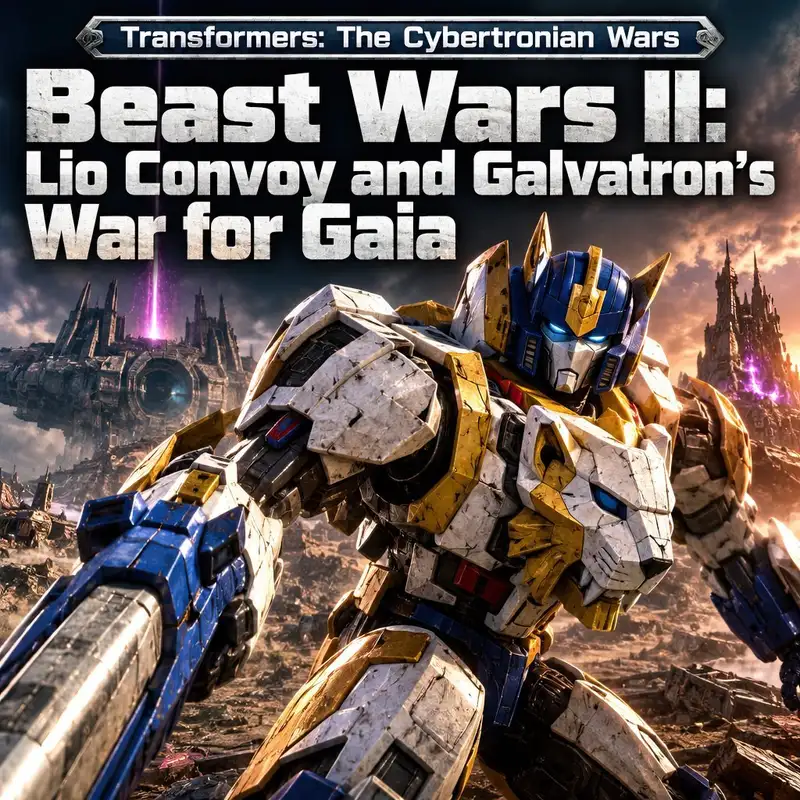
Beast Wars II: Lio Convoy and Galvatron’s War for Gaia
Nemesis did not arrive over Gaia as a conventional invasion fleet. It came as an artificial planet, a machine large enough in purpose to change the meaning of the war beneath it. Galvatron’s design went beyond trying to seize a mine, raid a depot, or capture an enemy supply convoy. Nemesis was meant to draw Angolmois Energy out of Gaia itself and gather that power into a reserve he alone could command.
That made the final crisis more than a military emergency. Gaia’s unusual energy was bound up with a world of wilderness, animal life, ruins, and surviving traces of an ancient civilization. If Nemesis succeeded, Galvatron would not merely possess a weapon. He would decide how the planet’s most consequential resource was accessed, defended, distributed, and used. The struggle became a contest over whether Gaia would remain a living world or become the fuel reserve of an armored dictatorship.
This is the war depicted in the Japanese animated series Beast Wars II: Super Life-Form Transformers. It belongs to the Japanese Generation One and Beast Era branch, not to the North American Beast Wars television history. Familiar faction names and beast modes do not make these events part of the same campaign, and this Galvatron is not the Galvatron of the earlier American animated history.
Gaia is identified as the third planet in its solar system, a world where the natural environment dominates the surface and an older civilization has vanished. Its precise relationship to Earth is left uncertain by the series record. That uncertainty matters less than the fact that both major forces arrive from elsewhere. Gaia is not their homeland. It is a foreign theater whose terrain, history, and energy create the conditions of the war.
Lio Convoy comes to Gaia as commander of a Cybertronian space-police force. Galvatron arrives at the head of a Destron armored force. Both leaders command organized expeditions, both adapt rapidly to an unfamiliar world, and both recognize that Gaia contains advantages unavailable elsewhere. Their difference lies in what they intend to do with those advantages.
Lio Convoy’s mission becomes defensive. He must protect his own personnel, prevent Galvatron from exploiting Gaia, and respond to dangers that threaten the planet itself. His campaign is not passive. Defense on a vast and unfamiliar world requires reconnaissance, mobility, local judgment, and the ability to deny an enemy access to decisive sites. It also requires accepting that no small force can physically occupy every valley, ruin, coastline, and underground passage.
Galvatron’s project is more ambitious and more dangerous. He sees Angolmois Energy as a means to obtain overwhelming power and impose a durable order through that power. The series gives his campaign a political character because he does not seek a temporary battlefield advantage. He seeks monopoly. Once one commander controls the energy that everyone else needs or fears, military superiority can become authority, and authority can become coercion.
The Maximals and Predacons of Beast Wars II are therefore not simply biological categories or inherited labels from another continuity. They are political and military forces operating under particular commanders in this Japanese series. Lio Convoy leads a force organized around protection and cooperation. Galvatron directs an armored command structure built around concentrated power, harsh discipline, and the promise that strength can settle the future.
At first, Gaia presents both expeditions with a basic military problem. Their existing forms and procedures were developed elsewhere. To move effectively, hide, scout, and survive on Gaia, they must adapt to the environment they have entered. Transformation is not a decorative feature in this campaign. It is part of the operational adjustment required by a foreign world.
The Maximals scan Gaia’s animal life and take beast modes suited to its terrain. Those forms offer practical advantages. They allow movement through forests and wild regions, reduce the immediate strangeness of Cybertronian bodies in an animal-dominated environment, and give individual Maximals specialized ways to scout, travel, or approach a contested site. An aquatic form can make a river, lake, or submerged ruin into an avenue of movement rather than an obstacle.
The Predacons adapt differently. They draw on weapons data associated with Gaia’s ancient civilization and acquire machine-based alternate modes. Their approach is revealing. The Maximals adapt to the living environment. Galvatron’s force adapts through the remains of war and technology left behind by a vanished people. Neither method guarantees victory, but each points toward a different relationship with the planet.
A beast mode does not make a Maximal invisible, and a machine mode does not automatically make a Predacon dominant. A tiger, shark, drill vehicle, or armored machine still needs usable routes, reliable intelligence, and access to the objective. Transformation can improve mobility, but it cannot reveal what lies beneath a ruin, determine whether a site contains energy, or ensure that an independent force has not reached it first.
Gaia’s wilderness is therefore military geography. So are its ancient structures, waterways, underground spaces, and abandoned systems. A force that understands these places can move with greater confidence. A force that mistakes a ruin for an empty shell may discover that it contains a weapon, a record, a route, or a source of power. The land is not neutral ground. It rewards those who can read it.
That first contest for initiative concerns information as much as firepower. Both sides search for clues about Gaia’s past and its energy. Both try to deny the other access to useful ground. A successful engagement may secure a path or delay an opponent, but it does not settle the wider campaign. The decisive question is not who wins one encounter. It is who learns enough about Gaia to turn local discoveries into strategic advantage.
Angolmois Energy changes the scale of the conflict. The series presents it as a continuity-specific resource with unusual importance to Gaia. It should not be treated as ordinary energon under another name, nor should later explanations from other Beast Era stories be used to define it here. What matters in Beast Wars II is its strategic value and the danger created by attempts to control it.
Finding energy is not the same as possessing it. A deposit must be located, reached, secured, and defended. It must be moved or concentrated if it is to support a larger military system. Any force attempting this work must protect its routes, maintain equipment, understand the source it is exploiting, and prevent rivals from stealing, destroying, or contaminating the result. Resource wars are rarely settled by discovery alone.
Galvatron understands enough to see that scattered access is not sufficient. If Angolmois Energy remains distributed across Gaia, then every deposit, ruin, and route remains a point of competition. The Maximals can interfere. Independent groups can bargain or raid. Terrain can conceal opportunities and threats. A commander seeking permanent dominance needs to turn a distributed system into a centralized one.
That is why Angolmois Energy becomes a political resource. Its value is not limited to the strength it can provide in battle. Control of it would allow Galvatron to decide who receives access, who is excluded, and who must submit in order to survive. A force that controls the resource also controls the terms on which others can resist. The issue is no longer merely fuel. It is sovereignty.
Gaia’s ecology gives that struggle a moral and strategic dimension. The series does not describe a dense urban civilian society whose government can be conquered by taking a capital. Yet Gaia is plainly not empty terrain. Its animal life, wilderness, and natural systems are the environment in which the conflict unfolds. Treating that world as a warehouse of extractable energy threatens the conditions that make it a world at all.
Galvatron’s early incapacitation might have ended the campaign before this plan matured. It does not. Angolmois-related events restore him, and his revival becomes a genuine turning point. The return of a commander matters when that commander has already provided the campaign with its central strategic idea. Galvatron is more than another armored combatant restored to the field. He is the architect of the attempt to monopolize Gaia’s energy.
This revival belongs only to the history of Beast Wars II. It should not be confused with the reformatting, resurrection, or survival of other characters named Galvatron in other Transformers continuities. Reused names can conceal major differences. Here, the important fact is that Galvatron returns to resume a specific project: the conversion of Gaia’s energy into the foundation of his command.
Centralized command gives Galvatron real advantages. He can maintain a long-term objective while subordinates fight scattered engagements. He can direct armored power toward the sites that matter most. He can impose discipline when short-term opportunities tempt his force away from the larger plan. An expedition with a clear commander can act with speed and coherence, especially when its opponents are divided by terrain and uncertainty.
But centralized command also creates a weakness. The more the campaign depends on Galvatron’s vision, authority, and personal ability to command fear, the less resilient it becomes when those elements are threatened. Subordinates may obey, but obedience is not the same as institutional durability. A force built around one leader can be formidable in combat and fragile in succession.
As the war develops, Gaia becomes more complicated than a two-sided conflict between Maximals and Predacons. The Insectrons, Jointrons, Autorollers, and Space Pirate Seacons all enter the strategic environment with interests of their own. They are not interchangeable reinforcements. Each group alters the balance by creating new sources of intelligence, new competitors for access, and new problems of trust.
For Lio Convoy, these groups create both opportunity and risk. A potential ally may know terrain that his force has not explored. It may control an approach to a ruin or possess a capability useful against a stronger enemy. But cooperation requires negotiation, patience, and a willingness to accept that independent actors will not automatically accept Maximal command. Coalition warfare is never as simple as adding more names to an order of battle.
For Galvatron, third parties are also useful and dangerous. An opportunist can disrupt Lio Convoy’s defenses or provide access to a valuable site. Yet any group drawn to Gaia by Angolmois Energy may become a rival once it recognizes the scale of the prize. A commander seeking monopoly cannot comfortably tolerate independent competitors forever. The resource that attracts allies can also make them unmanageable.
The Space Pirate Seacons make this especially clear. They are more than Predacon auxiliaries waiting to receive orders. Their interest in Angolmois Energy is opportunistic. They demonstrate that a strategically valuable resource draws pirates and free agents as readily as it draws ideological armies. Galvatron’s problem is not only defeating the Maximals. It is preventing anyone else from taking a share of the power he intends to centralize.
The Insectrons and Jointrons likewise show that Gaia contains political space beyond the two major commands. Their presence complicates intelligence assessments. A signal, a weapon discharge, or a movement through a ruin may not belong to the force that either commander expects. In such an environment, certainty is expensive. The side that assumes every unknown actor is either enemy or obedient ally usually discovers the cost too late.
Lio Convoy’s capacity to build cooperation is therefore not simply evidence of good character. It is an operational necessity. His force is not large enough to hold Gaia through occupation. It must gain information, share burdens, and work with groups whose loyalty is contingent rather than automatic. That kind of command takes time. It also creates resilience, because a coalition can act through several centers rather than waiting for one leader’s order.
This does not make coalition warfare easy. Independent allies may have different priorities, different risks, and different ideas about what victory should mean. A local group may defend its own territory while refusing a distant mission. A pirate may join an attack for profit rather than principle. A partner useful in one environment may become unreliable in another. Lio Convoy must manage those differences without pretending they do not exist.
The Maximal defensive method grows from these constraints. Lio Convoy uses a team with varied forms and skills, including reconnaissance, environmental movement, underwater access, and the ability to combine capabilities when circumstances require it. Scuba’s aquatic access, for example, is not just a visual distinction. In a campaign shaped by submerged routes and internal systems, it can provide a path unavailable to heavier or less adaptable units.
The Maximals also benefit from familiarity earned through continued presence. Gaia cannot be defended from orbit or from a single fortress. Its defenders need to understand which ruins matter, where energy can be found, how water and wilderness shape approach routes, and when a local disturbance is a diversion rather than the main effort. This is slow work. It does not produce the drama of a single decisive charge, but it makes defense possible.
Lio Convoy’s problem is one of denial rather than total control. He cannot guarantee that Galvatron will never locate an energy site. He cannot garrison every ancient structure. What he can do is prevent the Predacons from converting local gains into a decisive concentration. A deposit captured for a brief time is not the same as a secure reserve. A route discovered is not the same as a supply line that can survive attack.
This distinction separates tactical success from strategic success. The Maximals may lose ground in one encounter yet preserve the larger defense if Galvatron cannot hold, transport, or exploit what he has found. Conversely, a Predacon victory may look impressive while accomplishing little if it does not move the campaign toward a monopoly. The war for Gaia is decided by systems of control, not by a scoreboard of individual duels.
Galvatron’s answer is Nemesis. Rather than continue fighting over dispersed sites one by one, he seeks to build or deploy a machine that can make every site feed a single center. Nemesis is an artificial planet, but calling it a planet alone understates its military purpose. It is a mobile base, an energy-collection system, a fortress, and a symbol of the order Galvatron intends to impose.
Its logic is clear. Scattered energy creates scattered vulnerabilities. Every mine, ruin, route, or storage point can be contested. If Nemesis can draw Angolmois Energy into itself, Galvatron no longer has to defend Gaia’s resources across Gaia. He can defend one enormous reserve under his direct authority. Concentration promises efficiency, command control, and the ability to apply force at a moment of his choosing.
This is an understandable military solution. It is also a deeply political one. A centralized reserve does more than simplify logistics. It establishes a hierarchy. Gaia becomes dependent on the machine above it, and the machine becomes dependent on Galvatron. Those who oppose him must either seize the center, destroy it, or accept that he has converted their world into a source of power for his regime.
The series supports the idea that Galvatron’s force uses Gaia’s ancient technological remnants and data. It provides no complete account of a vast Predacon industrial economy capable of reproducing every discovery at will. Nemesis should therefore be understood as an exceptional strategic system, not proof that Galvatron can mass-produce artificial planets or Gaia-derived weapons whenever he wishes.
That limitation makes Nemesis more important, not less. A unique system can transform a war, but it also becomes a single point of dependence. If it requires concentrated energy, specialized internal systems, and Galvatron’s direct control, then damage to those systems can threaten the whole strategy at once. The fortress is powerful because everything flows into it. It is vulnerable for the same reason.
Nemesis also changes the psychology of the campaign. A mobile artificial planet looming over Gaia is a declaration that Galvatron no longer recognizes limits imposed by terrain, local actors, or ecological consequence. He is no longer competing for access. He is asserting the right to reorganize the planet around his needs. The political message is as important as the technical mechanism.
Once Nemesis begins drawing Angolmois Energy, the war becomes a planetary emergency. Local engagements still matter, but their purpose changes. A skirmish at a route, ruin, or waterway is no longer just a contest for ground. It may determine whether Maximal and allied forces can approach Nemesis, gather intelligence, establish a path inside, or protect Gaia long enough for sabotage to succeed.
Tactically, individual fighters must survive attacks, reach their objectives, and overcome defenses. At campaign scale, those actions must be coordinated so that infiltration, diversion, sabotage, and direct combat reinforce one another. Strategically, the goal is to stop Nemesis from completing its concentration of Angolmois Energy. Confusing those levels would make the final campaign look like a single fight when it is really a connected assault.
The danger to Gaia is broader than the fate of the Maximal force. Even without a detailed portrait of cities and civilian institutions, the planet’s living environment has become the threatened interest. The extraction system is not selective in a reassuring sense. It treats a world’s energy as material to be gathered elsewhere. The animal life and natural systems that define Gaia have no vote in Galvatron’s project.
Destroying Nemesis from a safe distance is not established as an easy option. A system built to collect and contain extraordinary energy cannot be assumed to fail harmlessly under indiscriminate attack. The defenders must penetrate its structure, identify critical systems, and disrupt the mechanism from within. The final campaign is therefore not simply an assault against a larger enemy. It is an effort to disable a machine without letting its purpose succeed in the process.
The attack on Nemesis depends on several complementary actions. Allied forces create pressure from outside. Others infiltrate the artificial planet. Defenders must respond to immediate threats while preserving the internal systems that make the larger plan possible. A centralized fortress is not secure merely because its outer armor is formidable. It needs functioning power, communications, access control, internal security, and commanders capable of responding to several crises at once.
Scuba’s role in sabotaging Nemesis’s power core is especially important. His contribution demonstrates the value of specialized access and mission focus. A commander can possess overwhelming external firepower and still lose if an opponent reaches the systems that sustain that power. The power core is not just another target. It is part of the mechanism by which Nemesis gathers, holds, and uses Angolmois Energy.
Sabotage does not make the wider battle irrelevant. Infiltrators need a way in. They may need diversions to keep defenders occupied. Allied combatants must prevent Galvatron’s forces from concentrating entirely on the internal threat. The assault works as a campaign because several actions converge on one strategic objective: break the system of concentration before it makes Galvatron unchallengeable.
This is where Lio Convoy’s coalition method proves its value. He does not need every participant to share the same history, faction identity, or political ideal. He needs them to understand the immediate consequence of Galvatron’s success. Nemesis threatens them all, even if they disagree about what should follow its destruction. In war, a coalition often begins with such limited agreement.
Limited agreement is not weakness when it is tied to a clear task. The Maximals and their partners do not have to create a permanent government in the middle of an assault. They have to stop a machine that is draining Gaia’s energy into one commander’s hands. By concentrating on that shared danger, Lio Convoy turns a fragmented strategic environment into a force capable of coordinated resistance.
Galvatron responds by taking the concentration of Angolmois Energy into himself. This increases his immediate combat capability, but it also reveals the final flaw in his command system. The entire campaign has become personal. Nemesis exists to collect the energy. The energy is collected to empower Galvatron. The political order he promises rests not on institutions, consent, or even durable resource administration, but on his ability to remain stronger than everyone else.
Gigastorm’s role sharpens that problem. As Galvatron’s younger brother and subordinate, he is more than another officer in an armored formation. Their relationship carries familial and military significance. Galvatron’s treatment of Gigastorm is harsh, and that harshness reflects a command culture in which loyalty is demanded under pressure rather than cultivated through trust. Yet it would be too simple to claim Galvatron feels nothing for his brother or sees him as disposable.
Gigastorm remains a valued subordinate and a figure with possible succession significance. That is precisely why the relationship matters. A commander who rules through personal dominance may value a capable successor while still making succession nearly impossible. The subordinate must be useful, loyal, and strong enough to sustain the force, but never so independent that he becomes a threat to the leader’s authority.
Such a system can produce ferocious battlefield obedience. It struggles to produce a durable political order. When every important decision flows through one commander, and when advancement depends on surviving that commander’s suspicion, the organization becomes dependent on his continued strength. Galvatron’s strategy requires loyalty, but it leaves little room for institutions that could survive his defeat or restrain his ambitions.
Lio Convoy’s answer is not to create an opposing monopoly over Angolmois Energy. He does not defeat Galvatron by proving that the Maximals can build a more efficient Nemesis. His method remains defensive and cooperative. It aims to deny the centralization of Gaia’s power, preserve access to the planet, and use the capabilities of several fighters rather than making the fate of the world depend entirely on one commander’s control.
The final confrontation includes an exceptional transformation of that resistance. Lio Convoy and Lio Junior combine the power of their Energon Matrices into the Green Warrior form. This is not standard Maximal equipment, and it should not be treated as a universal rule about matrices or a capability every force can reproduce. It is a continuity-specific event in the final crisis of Beast Wars II.
Its importance goes beyond giving Lio Convoy greater power in a duel. The Green Warrior appears at the moment when Galvatron has made the war’s central contradiction visible. He has concentrated Gaia’s energy within Nemesis and then concentrated that power further in himself. The Maximal response succeeds because it is joined to the wider assault already undermining the structure that supports him.
Galvatron’s defeat cannot be separated from the destruction of Nemesis. The artificial planet’s systems are compromised, its power core is sabotaged, its defenders are under pressure, and its energy strategy is collapsing. The battle between commanders matters because both leaders embody the competing projects behind the war. But the duel alone does not explain the outcome. The outcome is made possible by infiltration, sabotage, alliance, and the failure of concentration.
When Nemesis is destroyed, Galvatron loses more than a battlefield position. He loses the machine intended to turn a planet into a controlled reserve. His campaign had sought to convert Angolmois Energy into permanent political leverage. Instead, the very effort to gather everything in one place creates the conditions for a catastrophic reversal. The strongest system in the war proves unable to survive damage at its center.
The immediate result is Galvatron’s defeat and the dispersal or containment of Angolmois Energy in capsules scattered through space. Those capsules matter after the series, but their later history belongs to a subsequent narrative and does not alter the meaning of this ending. Beast Wars II concludes the Gaia campaign with the monopoly broken, not with every consequence resolved.
Nor does the finale establish a detailed postwar government for Gaia. It provides no complete settlement among every faction, pirate group, independent force, and survivor drawn into the campaign. Defeating an extraction system is not the same as building political institutions afterward. The Maximals save Gaia from Galvatron’s immediate design, but the work of defining lasting authority, security, and access remains beyond the story’s final battle.
That limit makes Lio Convoy’s victory more credible. He does not solve every problem by winning a duel. He prevents one commander from making Gaia politically and ecologically submissive through control of its energy. His force succeeds because it treats the planet as more than a stockpile. Gaia’s terrain, waters, ruins, living environment, and independent inhabitants become part of a defense network that Galvatron cannot fully master.
Galvatron’s failure is more than a shortage of firepower. He possesses armored strength, a long-term plan, an artificial planet, and access to concentrated Angolmois Energy. What he lacks is a system capable of turning domination into stable control. Nemesis can collect energy, but it cannot make Gaia obedient. It can gather power, but it cannot erase terrain, local knowledge, independent actors, or the vulnerability created by its own centralization.
Lio Convoy wins the war for Gaia because his campaign recognizes those realities. Coalition warfare, environmental access, reconnaissance, infiltration, sabotage, and exceptional final resistance all matter more than raw power alone. By stopping Galvatron’s monopoly, the Maximals preserve a living planet from becoming the private fuel reserve of one commander’s authoritarian order.