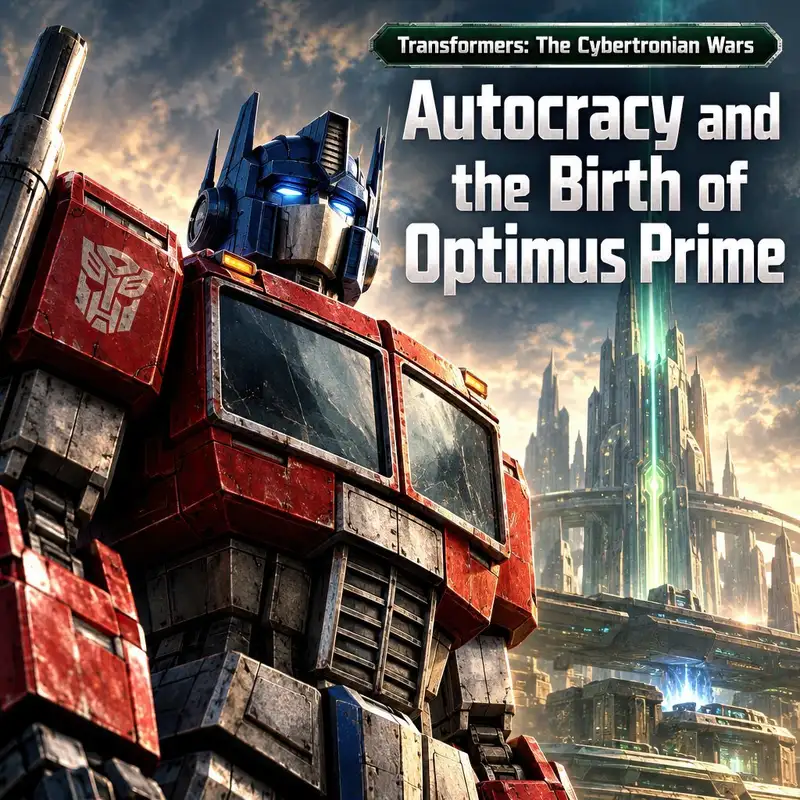
Autocracy and the Birth of Optimus Prime
Nyon became a battlefield because Zeta Prime’s government saw a living city as an energy reserve waiting to be seized. The regime deployed a vamparc weapon, a device built to drain energon on a scale that turned infrastructure, population, and military power into the same target. Hot Rod’s response was not a clean rescue. He destroyed Nyon rather than allow Zeta to control the weapon and the power it could extract. The immediate threat was denied. The cost was a city, and the people whose future had supposedly justified the resistance.
That decision establishes the hard question at the center of this history. How does a security officer named Orion Pax become Optimus Prime? And why does the defeat of an autocrat open the way to a wider civil war rather than a restored peace? In the 2005 I D W Transformers continuity, the answer begins with a government that claimed to preserve order, an opposition that could agree on little except the need to remove it, and a political system so damaged that even victory could not make it whole.
Nyon was more than an atrocity committed in an otherwise orderly conflict. It was the clearest expression of the logic Zeta Prime’s government had adopted. A city could be treated as a strategic asset. Its energon, its transport network, its industry, and its inhabitants all became components of a security calculation. Once a regime accepts that premise, the distinction between protecting the population and controlling it begins to disappear. Resistance forces may defeat that regime, but they inherit the wreckage it leaves behind.
Zeta Prime ruled during Cybertron’s late prewar collapse, after older political institutions had already failed to command broad confidence. The Senate had fallen. Previous leadership had not resolved the deep anger surrounding inequality, exclusion, and political access. In that environment, Zeta could present concentrated authority as reform. He could argue that Cybertron needed discipline, stable command, and firm action against unrest. Those arguments were not unusual in a society frightened by instability. They were also the foundation on which an emergency government could become permanent.
The office of Prime carried immense symbolic weight in this continuity. It was more than a military rank, though it included command authority. It represented continuity, public leadership, and the claim that one ruler could speak for Cybertron as a whole. That made the office useful to Zeta Prime, but it did not make him legitimate simply because he held it. A title can organize obedience for a time. It cannot erase the conduct of the government acting in its name.
Zeta’s state increasingly relied on militarized security, coercive technology, and a broad suspicion of dissent. The government framed opposition as a threat to Cybertronian survival, then treated extraordinary measures as necessary responses to that threat. Control of energon became a tool of politics. So did surveillance, detention, loyalty enforcement, and the ability to deploy force against communities that had ceased to trust the capital. The regime did not collapse because it lacked weapons. It collapsed because weapons became its principal language.
That difference matters in practice. Zeta Prime was not important merely as a cruel individual with access to dangerous machinery. He represented a political failure in which authority had become unable to distinguish between security and domination. The government could still issue orders. It could still move forces. It could still punish opponents. But its legitimacy was shrinking, and every coercive action narrowed the number of Cybertronians willing to believe that the state existed for their protection.
Orion Pax began within that state rather than outside it. He was associated with Iacon’s security apparatus, a figure whose early commitments centered on order and public safety. That position did not make him a secret revolutionary waiting for a dramatic unveiling. It placed him inside the machinery of government, where loyalty to law and loyalty to those exercising power could appear to be the same thing. The crisis came when those loyalties diverged.
For an officer serving a failing regime, disillusionment rarely arrives as a single revelation. It develops through reports that do not match official explanations, orders that seem less defensive than punitive, and evidence that security policy is producing the insecurity it claims to suppress. Orion’s break with Zeta Prime follows that kind of gradual recognition. He does not begin with the certainty later history grants him. He sees fragments of a larger pattern and must decide whether the state’s account of its own conduct remains believable.
This is an intelligence problem as much as a moral one. Governments under pressure often control information tightly, not always because every report is false, but because admitting uncertainty can weaken authority. Orion operates in an environment where official language turns political opponents into threats, threats into enemies, and enemies into targets. The more the regime depends on that language, the harder it becomes for an honest officer to tell the difference between genuine danger and a government protecting itself from accountability.
The central dilemma is therefore constitutional as well as personal. Orion Pax is not choosing between peace and rebellion in the abstract. He is deciding whether obedience still serves the public he believed he was protecting. If the office of Prime can authorize energy theft from a city, political repression, and military violence against Cybertronians who lack meaningful recourse, then fidelity to the office may no longer be fidelity to Cybertron. At that point, remaining inside the system begins to look less like reform and more like complicity.
This is why Orion’s eventual opposition carries a different meaning from simple ambition. He does not seek Zeta’s removal merely to claim Zeta’s position. His problem is that the government has made public order indistinguishable from state coercion. The task before him is more than to defeat a ruler. It is to imagine authority that can defend a population without treating that population as an obstacle to be managed.
Zeta’s regime also lost support from within its own armed institutions. That was decisive. An autocracy can survive street anger for a considerable period if its security forces remain cohesive, supplied, and convinced that they are defending the society rather than one leader. It becomes far more fragile when officers begin to question the mission, when units doubt the intelligence they receive, and when commanders see that emergency authority has become an excuse for actions they cannot justify.
Ultra Magnus and other defecting officers demonstrate this institutional fracture. Their break with Zeta does not mean every soldier suddenly became an opponent of the regime. Nor does it mean the state’s forces ceased to exist. It means the chain of command was no longer politically coherent. Orders issued from Iacon could still be transmitted, but obedience increasingly depended on fear, habit, local loyalty, or the absence of alternatives. A government that cannot explain its actions to its own officers cannot rely on discipline forever.
The New Institute stands in this history as another warning sign. It is associated with Zeta Prime’s system of loyalty enforcement and political control. The point is not that every Cybertronian experienced it in the same way, or that every citizen was equally subjected to its mechanisms. The point is that the regime was building institutions designed not just to govern conduct but to shape acceptable belief. That is a deeper form of insecurity. A state confident in its legitimacy does not need to make independent thought look like treason.
By the time Zeta faced open resistance, his government still possessed the material apparatus of power. It had weapons, fortified positions, command networks, and access to strategic resources. What it no longer possessed was a reliable political base. That made its strength deceptive. Coercion can compel immediate compliance, but it also drives neutrals toward the opposition and turns defectors into organizers. The more force Zeta used to restore control, the more clearly he demonstrated why his opponents believed he had to be removed.
Megatron emerged from this same political collapse, but he drew different conclusions from it. His movement did not invent Cybertron’s grievances. The existing order had excluded people, concentrated power, and failed to offer a convincing path to reform. Many Cybertronians had reasons to reject the institutions that preceded Zeta and the authoritarian methods Zeta later embraced. Megatron’s appeal rested in part on his ability to name that anger and direct it against a system that had lost moral credibility.
That history should not be simplified. Megatron was more than an outsider who wanted destruction for its own sake. He was a revolutionary leader who could speak to real resentment. He offered a movement to those who believed that the old political order had protected privilege, silenced dissent, and asked ordinary Cybertronians to endure conditions imposed from above. A historian who ignores those grievances cannot explain why the Decepticon cause attracted support in the first place.
Yet a credible critique of oppression does not settle the question of what replaces it. Orion Pax and Megatron could agree that Zeta Prime had become intolerable. They could not agree on the political order that should follow. Orion’s developing position centered on lawful authority, public protection, and the need for a government that could regain the consent of the population. Megatron increasingly treated victory, central command, and the destruction of rival power centers as the means by which Cybertron could be remade.
That difference may sound abstract until a regime is actually falling. In practice, it determines who controls the armed forces, who secures the energon supply, who occupies the capital, who decides the fate of prisoners, and who writes the rules after the emergency ends. Anti-regime coalitions often survive because their members postpone those questions. The common enemy is immediate. The future can wait. But when the enemy falls, the unanswered questions become the conflict.
The temporary alliance between Orion and Megatron was therefore an operational necessity, not a reconciliation of political principles. Orion brought knowledge of the state’s institutions and access to officers who had turned against Zeta. His side understood how the government’s command structure worked, where its authority was concentrated, and why portions of the security apparatus might defect at the decisive moment. Megatron brought revolutionary fighters, popular momentum, and a willingness to confront the regime directly rather than wait for reform that would never come.
Together, they could create a threat Zeta Prime could not easily isolate. The regime faced pressure from outside its command structure and fracture within it. That combination matters in any political collapse. An insurgent force alone may be portrayed as criminal disorder. Defecting officers alone may be dismissed as traitors. When both groups coordinate, the government loses its ability to claim that it alone represents stability. Its opponents begin to look like an alternative authority.
But the alliance was unstable from the beginning because it contained no accepted plan for succession. Orion and Megatron shared a target. They did not share a constitution, a command arrangement for the aftermath, or a mutually trusted way to limit power once Zeta was gone. Each likely understood enough of the other to know that the partnership was temporary. Neither could afford to resolve that conflict while Zeta still commanded the weapons and institutions capable of destroying them both.
This was coalition warfare under extreme political pressure. The alliance had to move quickly because delay favored Zeta’s security state. Yet haste made it even less likely that the coalition could negotiate a durable settlement. The same forces that made cooperation necessary also made it dangerous. Orion needed Megatron’s strength to break the regime. Megatron needed Orion’s institutional credibility to make the assault on the capital more than a rebel raid. Their partnership was effective precisely because it joined two incompatible answers to Cybertron’s future.
The assault on Zeta Prime’s citadel in Iacon brought that contradiction into the open. Iacon was more than a convenient location for a final confrontation. It was a capital, a command center, and a symbol of lawful government. Whoever controlled it could claim access to the structures through which Cybertron had been ruled. The battle for Iacon was therefore urban warfare, institutional warfare, and a succession crisis happening at the same time.
Zeta’s vamparc capability intensified the danger. A weapon designed to drain energon could not be treated as a conventional battlefield system. It threatened the energy basis on which Cybertronians lived, fought, repaired themselves, and maintained their cities. Its existence gave Zeta an instrument of terror, but it also revealed the regime’s dependence on exceptional methods. A government that must threaten mass energy extraction to survive has already conceded that ordinary political consent has failed.
The fighting around the citadel exposed the regime’s weakened command. Ultra Magnus’s break from Zeta carried military importance because it denied the Prime unquestioned obedience from figures who had once served within the system. It carried even greater political importance because it showed that opposition to Zeta was not limited to Megatron’s revolutionary movement. Officers who had valued stability could no longer accept the ruler who claimed to embody it.
In the decisive confrontation, Zeta Prime remained dangerous enough to threaten both Orion and Megatron. That is another reminder that political illegitimacy does not make an autocrat harmless. A collapsing regime may be at its most dangerous when it believes defeat will mean personal destruction and the loss of every institution it controls. Zeta still had the ability to inflict enormous damage. The coalition could not just announce a new government. It had to defeat the old one under fire.
Megatron killed Zeta Prime with his fusion cannon. Orion, meanwhile, disabled the vamparc weapon but suffered severe damage in the process. The tactical result was clear. Zeta was dead, and the regime’s decisive energy weapon was neutralized. Across the wider operation, the government’s center of command had collapsed. Its authority could no longer be held together by the figure who had concentrated so much power in his own office.
Strategically, however, the situation remained unresolved. Cybertron had not been unified. Its cities were damaged, its political institutions discredited, its armed forces divided, and its energy systems vulnerable. The overthrow had removed the person at the center of the autocracy, but it had not created an accepted mechanism for choosing what came next. The battle for Iacon ended one regime. It did not settle who could rule without becoming another version of it.
That is why Megatron’s betrayal of Orion Pax must be understood in its timing. He did not turn on Orion before Zeta’s defeat. He turned after their shared objective had been achieved, when the central question changed from how to remove a tyrant to who would control the post-autocratic state. Megatron shot Orion through the chest and cast him down into Cybertron’s depths. It was a brutal personal act, but it was also a political decision.
Megatron was eliminating more than a temporary ally. Orion represented a rival source of legitimacy. He had broken with Zeta’s government from within its own security structure. He had helped bring defecting officers into the struggle. He had acted against the vamparc weapon rather than attempting to control it. If Orion survived and gained political support, he could become the focal point for Cybertronians who rejected both Zeta’s authoritarianism and Megatron’s increasingly centralized revolutionary command.
The assassination attempt therefore exposes the limits of Megatron’s anti-autocratic claim. He had opposed a ruler who treated Cybertron as personal territory and dissent as a threat to be eliminated. At the moment of succession, Megatron chose the same political method. He did not submit the future of Cybertron to a shared process. He did not negotiate a division of authority. He moved to destroy the rival whose existence would constrain his command.
Orion’s survival gave Cybertron a competing claimant at precisely the moment the planet lacked a settled state. His body had been catastrophically damaged, but body damage in this continuity did not automatically settle the question of identity or survival. Recovery depended on circumstances, repair capacity, and, in Orion’s case, an intervention that was anything but ordinary. The event that followed was exceptional even within Cybertron’s own contested political history.
Orion reached the Matrix of Leadership, an ancient source of succession and transformation that had been absent from active political life for a long time. The Matrix restored and reformatted him. Orion Pax emerged as Optimus Prime. The change involved both a new body and a new political identity, but it should not be reduced to either. This was not routine medical reconstruction, and it was not evidence that any damaged Cybertronian could be restored by the same means.
Nor should the Matrix be treated as a universal answer to Transformer history. Its role, nature, and capabilities differ across continuities. Here, it is significant because it connects Orion to a form of leadership older than Zeta’s rule and because it provides a source of authority outside the institutions that Zeta had corrupted. The Matrix makes Optimus Prime possible. It does not make government easy, and it does not guarantee that Optimus will govern wisely.
The political burden of the title was immense. Zeta Prime had made the office of Prime synonymous, for many Cybertronians, with emergency power, coercive security, and the claim that one leader’s judgment could override all other institutions. Optimus inherited that title at the worst possible time. To some, it could represent hope that leadership might be reclaimed from tyranny. To others, it could look like continuity with the very system that had failed them.
This is the difference between symbolic legitimacy and practical legitimacy. The Matrix could identify Optimus as a Prime. It could not repair cities, distribute energon, reunify armed forces, or persuade frightened populations that another Prime would not become another Zeta. Those were political tasks. They required restraint, organization, and the slow rebuilding of trust. A sacred or historical mandate may authorize a leader, but it cannot substitute for consent or competent institutions.
Optimus’s birth was therefore not the arrival of a flawless hero who solved Cybertron’s problems by receiving a new form. It was the beginning of a harder test. Orion had rejected an autocracy because it used public fear to justify unaccountable power. Now, as Optimus Prime, he had to command in an emergency without reproducing the machinery of the emergency state. He had to defend a population while proving that defense did not mean ownership.
The events that followed in Monstrosity make clear that his ascension did not create peace. Optimus did not inherit a unified military, a functioning political settlement, or a population prepared to accept another Prime without question. He inherited fragmented armed groups, damaged infrastructure, shortages, and the habits of a society that had learned to expect power to come through force. The terms Autobot and Decepticon were hardening into political and military identities, but their boundaries and institutions were not yet settled.
That instability affected every decision. A command order could be interpreted as necessary coordination by one group and as the first step toward renewed dictatorship by another. A security measure could be seen as protection or repression depending on who issued it, who enforced it, and whether there was any way to challenge it. Zeta Prime had not just damaged physical structures. He had damaged the public meaning of authority itself.
Optimus also had to confront the surviving tools of the old system. Weapons stockpiles, security networks, command practices, and emergency powers do not vanish when a ruler falls. They remain available to whoever takes control of the capital. That is one of the persistent dangers of revolution. The institutions built for coercion are often efficient in the short term. A new leader may be tempted to use them in the name of stability, especially when enemies remain armed and the population is exhausted.
The question facing Optimus was whether he could create security without governing through fear. That did not require him to abandon force. Cybertron was not in a condition where force could simply be wished away. It required him to distinguish military necessity from political convenience. It required him to accept that authority could not be rebuilt by demanding immediate trust from people who had just watched a Prime turn a city into an energy target.
The emergence of Trypticon became an early and severe test of that command. Trypticon was not an ordinary combatant or a weapon that could be assigned a simple mission. He was a giant-scale Cybertronian force connected to a deeper and more dangerous layer of Cybertron’s history. His awakening created an operational crisis that conventional units struggled to contain. The threat was immediate, but the means to answer it were constrained by energy, access, control, and the condition of the assets available.
Metroplex demonstrated those constraints. Another giant-scale Cybertronian presence might appear, at a distance, to offer an obvious solution. But Metroplex was weakened by low Energon. The problem went beyond whether a vast asset existed. It was whether that asset could be activated, sustained, directed, and brought to bear without creating new vulnerabilities. Size does not eliminate logistics. It magnifies them.
At Harmonex, the effort to contain Trypticon became a reminder that decisive weapons are rarely decisive by themselves. Giant systems require power. They require reliable control. They require maintenance and strategic access. They also create political problems, because any leader able to command them gains enormous coercive potential. In a society recovering from autocracy, that potential can inspire relief and fear in equal measure.
The immediate danger posed by Trypticon could generate temporary unity, but temporary unity is not the same as political settlement. External threats often make centralized command appear indispensable. In some circumstances, it is indispensable for survival. Yet every emergency also gives leaders an excuse to retain powers that were supposed to be temporary. Optimus’s challenge was not only to defeat or contain the crisis. It was to prevent crisis management from becoming the new basis of permanent rule.
While Optimus struggled with those demands, Megatron rebuilt his own position. His removal from the immediate political struggle after the fall of Zeta did not erase the Decepticon movement. It fragmented and competed internally, with figures such as Scorponok seeking control. That fragmentation revealed a weakness in movements built around charismatic command. They can mobilize quickly, but succession becomes unstable when authority depends more on personal dominance than on trusted institutions.
Megatron’s return allowed him to reclaim leadership, but it also showed what kind of organization the Decepticons were becoming. Control did not rest on a broadly accepted political process. It rested on the restoration of a leader capable of dominating rivals and directing force. That may produce unity in the short term. It also ensures that disagreement is treated as a challenge to command rather than a normal part of political life.
Primacy carries that conflict into another stage. Megatron seeks greater power through dangerous forces that threaten Cybertron itself, while Optimus attempts to establish a different basis for authority. The contrast is more than one of strength against weakness. Both leaders understand that power matters in a civil war. The question is whether power is held as a means of defending a political order or whether the political order exists only to validate the leader who holds power.
In their later confrontation, Optimus uses the Matrix to neutralize the malignant force affecting Megatron rather than simply execute him. That choice should not be sentimentalized. It does not erase Megatron’s responsibility. It does not end the war. It does not prove that mercy will always produce reconciliation. It is a strategic decision as well as a moral one. Optimus seeks to deny a catastrophic threat without making political murder the founding principle of his own rule.
Restraint in this context is not passivity. A leader who refuses unnecessary killing still has to protect civilians, preserve forces, and prevent an enemy from exploiting mercy as weakness. The difficulty is that restraint must be paired with effective command. Otherwise it becomes a gesture that leaves others to bear the cost. Optimus’s significance lies not in avoiding force altogether, but in trying to place force within limits that Zeta Prime and Megatron increasingly reject.
That effort remains incomplete. The early Autobot cause is not a finished government with universally trusted laws, clear civilian institutions, and a stable peace process. It is an alternative forming under pressure. Its leaders have to fight, organize, supply, repair, and negotiate while their enemy remains active. They have to persuade Cybertronians that opposition to tyranny means more than replacing one commanding figure with another. There is no easy way to do that after years of political collapse.
The destruction of Nyon returns us to the human, or rather Cybertronian, cost of those abstractions. A city destroyed to deny Zeta Prime a strategic weapon may have been a necessary act under terrible conditions. It was not a triumph to celebrate without qualification. The decision protected Cybertron from one immediate danger, but it also demonstrated how war forces defenders to choose among harms they never wanted. The civilians of Nyon did not experience the event as a lesson in strategy. They experienced it as the loss of a world within their world.
Megatron offered one answer to that crisis. His movement began with genuine opposition to oppression and exclusion, but his methods increasingly centered on personal command, coercion, and the elimination of rivals. He turned revolution into a contest for control over Cybertron itself. In doing so, he repeated the central error of the system he opposed. He treated legitimacy as something that could be secured once military superiority had removed everyone capable of questioning it.
Optimus offered a competing answer, though not an easy or complete one. His authority came through the Matrix, but its real test lay elsewhere. Could he use the title of Prime without hiding behind it? Could he command forces without turning them into instruments of political domination? Could he protect Cybertronians without deciding that their fear entitled him to rule without constraint? Could he build a future in which leadership did not depend on another crisis?
Those questions define the importance of Orion Pax’s transformation. His new body matters. The Matrix matters. The title matters. But none of them is sufficient on its own. Orion becomes Optimus Prime because he survives the failure of an anti-autocratic coalition and accepts responsibility for what comes after victory. He must do more than oppose Zeta Prime. He must demonstrate that the end of tyranny can be something other than a pause before the next tyrant takes control.
In the Autocracy trilogy, Optimus Prime is not born when Orion Pax receives a new body. He is born when Orion accepts that defeating a tyrant is easier than building a political order that does not need one.