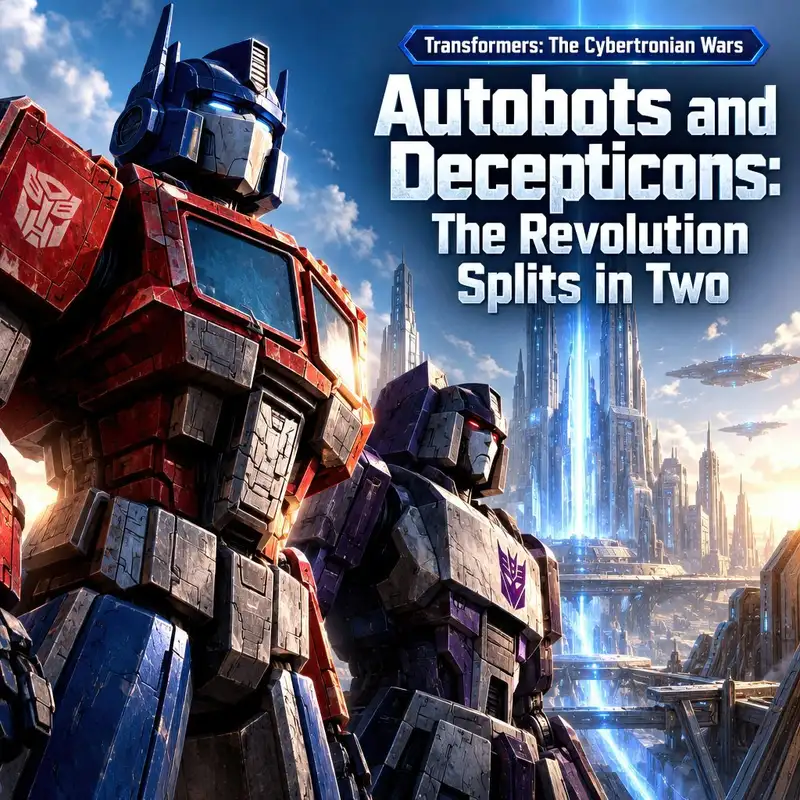
Autobots and Decepticons: The Revolution Splits in Two
A miner was placed under arrest, and a police officer saw that the charge was not the whole story. In the 2005 IDW history of Cybertron, that officer was Orion Pax. The prisoner was Megatron, still known more for labor, writing, and agitation than for commanding an army. Orion did not suddenly become Megatron’s friend, and the two were not lifelong brothers in this continuity. What mattered was simpler and more dangerous. Orion recognized that the state was treating political dissent as a public-order problem because the existing order had already decided whose grievances deserved to be heard.
That arrest did not create Cybertron’s crisis. It exposed it. The Senate possessed the language of law, offices of public authority, and security forces able to enforce its decisions. Yet law without credible accountability can become a method for protecting privilege. Megatron had challenged a system that assigned social value according to function, body type, work, and access to influence. The Senate’s response suggested that it lacked an answer beyond control. Once a government treats criticism as evidence of disloyalty, it begins teaching its opponents that survival may require power outside the law.
Autobots and Decepticons were not separate peoples waiting to discover an ancient biological hatred. They emerged from one Cybertronian society, shaped by the same cities, industries, institutions, and historical memory. Their eventual war began as an argument over what had gone wrong with that society and how it could be changed. Megatron concluded that the system could not be repaired and had to be overthrown by force. Orion Pax came to believe that the system was corrupt, but that power still required public limits, accountable institutions, and some form of lawful legitimacy. The tragedy was that neither path remained untouched by the coercive habits of the old order.
Cybertron’s functionist system was not described with complete consistency across every later comic and flashback. That is common in a long-running continuity reconstructed from memories, propaganda, retcons, and political revelations. The broad pattern is clear enough. Cybertronians were often judged according to the function assigned or expected of them. A body built for mining, hauling, construction, administration, or combat could become a social label as much as a practical role. Opportunity did not flow evenly through the population. Some citizens moved through institutions designed to reward them. Others were expected to keep the energy system, industrial base, and urban infrastructure operating without meaningful influence over the society they sustained.
That arrangement did not mean every senator lived in luxury while every worker lived in identical misery. Cybertron was too large, and its society too varied, for such a simple picture. Some security officers believed they were protecting civilians. Some administrators probably regarded their work as necessary coordination in a complex planetary civilization. Some citizens benefited from stability without seeing the coercion that made stability possible. Others had learned to navigate the system, survive it, or profit from it. But the political structure remained narrow. When those outside the favored order demanded representation, reform, or simply recognition, the Senate showed little capacity to change itself.
The industrial side of that inequality mattered. Mines were not just workplaces. They were sources of energon and raw material, part of the foundation on which Cybertronian life depended. Extraction, transport, refining, maintenance, and repair all required skilled labor. A society that depended on workers while denying them political weight was building resentment directly into its supply system. The same bodies expected to endure dangerous labor also carried the evidence of how little their experience mattered to the ruling class. The issue was not only wages, status, or dignity. It was control over the conditions of existence in a machine civilization.
Megatron’s early appeal came from naming this injustice directly. Before he became the warlord known across the later Great War, he was a miner and political writer. His arguments challenged the Senate’s claim to rule in the interests of all Cybertronians. He argued that a population organized around imposed function could not be genuinely free. He questioned why citizens whose labor powered the planet had so little influence over its political direction. For workers, marginal populations, and those excluded from elite life, that critique had force because it described conditions they already knew.
Ideas mattered before armies did. Megatron’s message did not spread because every listener had witnessed the same abuse, or because every supporter shared one program for the future. It spread through workplaces, private exchanges, public debate, and networks beyond the Senate’s comfort. Political language can create a community before any organization has uniforms, weapons, or a headquarters. It gives isolated grievances a common name. It tells people that their hardship is not personal failure but the result of a system. That can be liberating. It can also become dangerous when a movement begins to believe that only its own victory can redeem everyone else.
Orion Pax encountered Megatron’s political thought and took it seriously. That detail is crucial. The future Autobot leader did not oppose Megatron because he believed the Senate was already just. He saw the corruption, exclusion, and hypocrisy in Cybertronian public life. His divergence was over method and authority. Megatron increasingly treated the collapse of the old order as a prerequisite for any justice. Orion believed that replacing a closed ruling class with an armed movement centered on one leader would not necessarily produce freedom. The disagreement was not between awareness and ignorance. It was between rival answers to the same diagnosis.
Megatron’s radicalization was sharpened by the conditions of industrial labor and the state’s indifference to those conditions. His experiences in mining assignments such as Messatine and Outpost C-12 showed a political system that could consume workers while treating their injuries, grievances, and anger as administrative inconveniences. The precise order of every arrest, transfer, escape, and return is difficult to arrange into a perfectly seamless chronology. Later stories revisit these years from different perspectives. What survives clearly is the pattern. Megatron encountered authority as something distant when workers needed protection and immediate when they challenged the system that exploited them.
That distinction has consequences in any revolutionary crisis. A government can survive criticism if it offers believable means to investigate abuse, reform policy, punish corruption, and share power. It becomes brittle when every complaint is met with surveillance, transfer, intimidation, or detention. The Senate appears to have treated growing unrest as a security failure rather than a political warning. In doing so, it confused order with obedience. It could move workers, police a mine, and enforce a sentence. It could not persuade excluded citizens that the system belonged to them.
The mines also explain why the later conflict could not remain abstract. Energon and industrial output were strategic resources. Whoever directed labor, transport, repair, and production held leverage over the wider planet. Yet workers who sustained those systems did not automatically become a unified revolutionary army. They had families, obligations, fears, and differing views of what change should mean. Some wanted reform. Some wanted escape. Some wanted vengeance. Some likely wanted only a safer shift and a political system that would stop treating them as expendable. A movement that claimed to speak for all of them had to decide whether it would listen to those differences or command over them.
Megatron’s path led toward Kaon, where political exclusion could be transformed into spectacle. The gladiator pits were illegal arenas, but they were not merely entertainment. They offered a public stage outside official respectability. In Kaon, physical strength, skill, endurance, and defiance could generate status that the Senate’s hierarchy had denied. Megatron became visible there in a way he could never have been as an anonymous miner or censored writer. He demonstrated that a citizen marked as disposable by the old order could become a figure of attention, fear, and admiration.
The pits also served practical political purposes. They gathered people who had reason to distrust the authorities, people accustomed to violence, people willing to operate beyond legal protection, and people who understood that official institutions might never defend them. A gladiatorial following was not a conventional army. It lacked the stable supply, transport, command structure, and institutional reach required for a planetary war. But it could provide recruits, local knowledge, informal communications, and a disciplined core willing to accept risk. It gave Megatron a constituency whose loyalty was formed through shared danger and public proof rather than through elections or constitutional procedure.
Combat in Kaon created a particular kind of authority. A fighter who repeatedly survives becomes more than a speaker. He becomes a symbol of resistance, and symbols can make political movements move faster than their institutions can mature. Megatron’s ability to inspire supporters was therefore a strength and a future vulnerability. Personal charisma can unite people who would otherwise disagree. It can also make the movement’s goals inseparable from the leader’s pride, injuries, rivalries, and appetite for control. Once followers believe that one individual embodies liberation, criticism of that individual can begin to look like betrayal of the cause itself.
Kaon’s criminalized underclass also complicates any romantic image of revolution. The city offered sanctuary, recruits, and an audience, but it was not a pure democratic commons. Underground arenas, illicit weapons, local patronage, and protection networks all came with their own forms of coercion. People joined movements for many reasons. Some believed in equality. Some feared the authorities. Some sought a place where their skills mattered. Some wanted protection. Some saw a chance for advancement in a changing order. A revolutionary movement can draw energy from real injustice while still becoming dependent on practices that make accountability harder.
Megatron did not build his movement alone. Soundwave became an important organizer and intelligence figure, while allies such as Rumble and Frenzy helped expand its practical reach. Their activities mattered because revolutionary rhetoric becomes operational power only when someone can communicate, recruit, obtain equipment, move information, and identify supporters. The early Decepticon network was not yet the vast military machine it would become. It was a coalition of dissidents, fighters, criminals, political believers, and opportunists. Its strength came from flexibility. Its weakness was that these groups did not necessarily agree on the society that should exist after victory.
Ratbat reveals one of those contradictions. He was a senator and a wealthy figure within the very elite order Megatron condemned. His support for the rising movement did not make the movement a servant of the Senate, but it did show that instability attracts those who expect to profit from it. Elites sometimes support rebellion because they believe they can direct it, exploit it, or use it against rivals. Revolutionary organizations often need resources from people whose motives are far less principled than their slogans. The question is whether the movement can control such patrons, or whether the patrons eventually shape the revolution.
Megatron’s coalition had another structural problem. It had a strong leader, but no demonstrated constitutional mechanism for limiting him. The movement could act quickly because authority concentrated around his personal reputation. It could respond to threats without waiting for Senate procedure or public debate. That made it formidable against a government trapped in its own bureaucracy. Yet speed is not the same as legitimacy. A movement organized around one commander may overthrow a system of privilege only to replace it with a hierarchy enforced by loyalty, fear, and military necessity.
The Senate answered this challenge with the tools it understood best: surveillance, policing, intimidation, and controlled violence. Sentinel Prime stood at the center of this coercive apparatus through the Security Services. His authority represented more than ordinary law enforcement. It was the fusion of political power and force. The Senate could claim that it was preserving public order, but its security institutions were structurally committed to preserving Senate rule. When public institutions become indistinguishable from the interests of a ruling class, every police action acquires political meaning.
Not every officer within that system appears to have shared Sentinel’s methods or ambitions. Prowl, for example, showed concern about collateral damage and the consequences of excessive force. That matters because institutions are rarely morally uniform. Security personnel can disagree about tactics, legality, or the proper limits of authority. Some may genuinely try to reduce harm. But internal restraint does not remove the wider problem. The Security Services existed within a political order that had already defined dissent as a threat. Even officers who disliked brutality were serving a state that had few peaceful answers to structural injustice.
Later revelations made the Senate’s coercion still more disturbing. The Institute, initially spoken of as rumor and shadow, was tied to memory manipulation, psychological control, and the removal of politically inconvenient individuals. This was not just censorship. It was an assault on the ability to know oneself, remember one’s past, and form independent judgment. A government that can alter memory does not just punish opposition after it appears. It tries to make opposition impossible by interfering with the conditions under which citizens understand their own experience.
The fate of Shockwave provides a grave example. In this continuity, he was not simply the emotionless scientist familiar from other Transformers histories. He had been a politically engaged figure whose opposition to the Senate brought punishment through empurata, a forced bodily mutilation and reformatting, combined with the removal of emotional capacity. The details are horrifying because the state’s purpose was broader than silencing a critic. It sought to remake the critic into something safer for the regime. The Senate was not only protecting offices and privileges. It was asserting the power to govern identity itself.
These revelations were not necessarily known to every miner, police officer, senator, or civilian at the time. Secret repression works partly because knowledge is compartmentalized. A worker may know that someone disappeared. A security officer may know that orders arrive without explanation. A senator may know that dissenting colleagues suddenly become unreliable, silent, or absent. Few understand the full machinery. That uncertainty encourages fear and conspiracy, but it also makes reform harder. A society cannot correct abuses it cannot safely name.
Repression weakened the Senate’s legitimacy, but it did not dictate what would replace it. Governments often make a serious error when they assume that crushing a movement will restore the previous order. Force can scatter a demonstration. It can imprison organizers. It can destroy records. It can intimidate neutral citizens. It cannot answer the political question that produced dissent. In Cybertron’s case, the Senate’s response helped convince many opponents that legal channels were either fraudulent or closed. Yet the collapse of legal channels made militarization more likely for every side, including those who did not want Megatron’s version of revolution.
Orion Pax’s position emerged from that dilemma. He recognized that political authority without accountability was not legitimate simply because it was old, orderly, or adorned with titles. In the period later recalled through “Chaos Theory,” Orion confronted the Senate with questions shaped by Megatron’s own critique. He challenged the assumption that rulers could claim to govern the whole planet while remaining insulated from those who bore the costs of their decisions. It was a significant moment because it showed Megatron’s language of opposition crossing into another political tradition.
Orion’s answer, however, was not to place Cybertron’s future in Megatron’s hands. He sought a public order in which authority could be questioned, institutions could be held to account, and citizens would not need to become gladiators or insurgents to be heard. That was a difficult position. Reformers often need recognition from institutions they also condemn. They must persuade people that law can be made legitimate even when the current law has failed them. They must oppose both repression from above and the temptation to answer every injustice with unrestrained force.
This is why it is misleading to turn Orion and Megatron into simple opposites. Orion did not stand for acceptance of the Senate. Megatron did not begin as a man interested only in conquest. Both saw that Cybertron’s political order was failing. Both understood that workers and excluded citizens had been denied a meaningful voice. Both believed that the old system could not continue unchanged. The split came over the relationship between justice and power. Megatron came to see force under his command as the engine of liberation. Orion believed that liberation without limits on power would merely produce another tyranny.
That disagreement became irreversible as the Senate collapsed and armed organizations took its place. The exact sequence of the Senate massacre, Sentinel Prime’s defeat, the first major uprising, and the formal opening of the Great War has been reframed across several IDW stories. The surviving narrative does not support a clean day-by-day account. It does support the larger sequence. Senate authority failed. Megatron’s followers developed from a dissident network into an armed insurgency. Opponents of that insurgency gathered around a new political and military structure that would become the Autobots.
Zeta Prime emerged as a major figure in that new order. The Autobots did not arise from nowhere as a fully formed popular democracy. They coalesced around defense, administration, and the need to keep Cybertron from being seized by an increasingly militant Decepticon movement. They inherited elements of the infrastructure that had once served the Senate: communications, security personnel, arsenals, transport systems, records, and trained administrators. This gave them a practical advantage. A government in crisis may lose legitimacy while still retaining buildings, supply lines, and people who know how to keep essential systems operating.
The Decepticons faced the opposite logistical challenge. A movement can recruit through anger and fight through improvisation, but it cannot sustain a planetary conflict through rhetoric alone. It needs energon, weapons, repair facilities, secure routes, intelligence, and some control over industry. That means capturing infrastructure, coercing labor, redirecting supply, or winning enough support that workers and technicians join willingly. The transition from revolutionary movement to military power therefore changed Megatron’s organization. It had to become more centralized, more disciplined, and more demanding of obedience.
Both factions claimed to be protecting Cybertron, but they meant different things by protection. For the emerging Autobots, protection meant preventing the collapse of public order and defending civilians from a movement that now used force to impose its will. For Megatron’s Decepticons, protection increasingly meant destroying the institutions and social hierarchies that had made reform seem impossible. The conflict became especially dangerous because each side could point to a real threat. The Autobots could point to insurgent violence and leader-centered command. The Decepticons could point to the Senate’s crimes and the persistence of its security culture.
The Decepticon failure was not that Megatron had identified inequality where none existed. His indictment of caste, exploitation, political exclusion, and elite hypocrisy had real power because it was grounded in Cybertronian experience. His failure was what he built from that indictment. A movement that promised liberation became increasingly organized around his personal authority. Its hierarchy did not disappear. It changed symbols, ranks, and justification. The more Megatron relied on force to achieve political transformation, the more force became the measure of political truth.
This did not happen in a single betrayal of early ideals. It happened through escalation. A leader under threat centralizes decision-making. A movement facing surveillance values secrecy. Fighters who survive repression gain prestige. Rivals become suspect. Civilians become sources of labor, information, or potential disloyalty. Industrial assets become objectives. The distinction between persuading a population and controlling it begins to erode. By the time the Decepticons matured into a war machine, conquest had become more than a means to end functionist injustice. It had become an organizing purpose in its own right.
The Autobot dilemma was different, but it was real. Defending civilians, infrastructure, and political space required organized authority. A faction confronting armed insurgency could not operate as a debating society. It needed commanders, intelligence, transport, weapons, repair capacity, and a chain of responsibility. It needed to decide who could carry arms, who could make emergency decisions, and how to respond when the enemy did not accept legal restraints. Those pressures pushed the Autobots toward militarization even as they claimed to defend a more accountable society.
The danger was that the Autobots inherited not only useful institutions but also institutional habits. Emergency powers can outlast emergencies. Security services trained under a discredited regime may carry forward its assumptions about surveillance, secrecy, and acceptable coercion. A Prime-centered chain of command can act decisively in a crisis, but it can also narrow political authority around exceptional individuals. The Autobots were not morally equivalent to a Decepticon system that increasingly embraced domination and aggressive war. Still, their declared commitment to justice did not automatically make every Autobot institution democratic, transparent, or free of compromise.
This was the deeper political tragedy. The Senate had made reform appear futile. Megatron then made revolution increasingly inseparable from personal military command. The Autobots responded by building an armed order capable of resisting him, but that order could not entirely escape the structures and fears of the world it replaced. Cybertron’s crisis did not produce one clean break between oppression and freedom. It produced two rival institutions, each shaped by the failures that came before.
The people caught between those institutions were not abstractions. Miners, urban workers, technicians, neutrals, low-ranking security personnel, and residents of cities such as Kaon had to live through the transformation of political conflict into armed struggle. A mine could become more than a workplace. It could become a supply objective, a recruiting ground, or a site of coercion. A public arena could become a political rallying point. A transit route could become a military corridor. A citizen who had once avoided politics could find that neutrality no longer protected them from either faction’s demands.
Workers remained indispensable even after armies formed. No side could fight without energon, repairs, weapons, communications, and industrial labor. Control of a factory or mine did not equal the consent of the people inside it. A commander could seize an installation, but technicians still had to operate it. A faction could demand production, but damaged Cybertronians still required medics, spare parts, secure facilities, and time. The coming war would turn Cybertron’s economic life into a military system, but it could not erase the human, or rather Cybertronian, reality that every system depended on people with their own fears, loyalties, and limits.
For civilians, the political vocabulary of liberation and security could become painfully similar when both sides needed compliance. The Decepticons could present themselves as champions of the excluded while demanding loyalty to Megatron’s command. The Autobots could defend public order while asking citizens to accept emergency controls in the name of survival. Some Cybertronians chose a side with conviction. Others chose because the alternative seemed more dangerous. Others remained skeptical of both. The war did not begin because everyone wanted it. It began because the institutions capable of resolving conflict without war had already failed.
By the time the struggle became an open planetary conflict, its original question had narrowed. The early issue had been whether Cybertron could become a society in which function did not determine dignity and political voice. Once armies mobilized, the immediate questions became who held the cities, who controlled industry, who could maintain security, and who could survive the next campaign. Military necessity did not erase the original grievances. It buried them beneath new priorities. That is one of civil war’s cruelest effects. The cause that begins the conflict can become harder to pursue as the conflict grows.
The Senate’s central failure was therefore more than ordinary corruption. Corrupt governments can sometimes survive if they can still reform. Cybertron’s Senate failed because it destroyed credible nonviolent paths for change. It treated dissent as a danger to be neutralized rather than a warning to be answered. It used the machinery of security not only to defend institutions, but to protect the social hierarchy those institutions enforced. By the time the crisis reached the streets and pits of Kaon, the Senate had made its own authority difficult to defend.
Megatron’s central failure was equally consequential. He understood that a system built on exclusion could not be redeemed by polite appeals alone. He saw what many elite Cybertronians refused to see. But he turned a demand for liberation from hierarchy into a movement whose hierarchy increasingly depended on him. His revolution gained strength by challenging the Senate’s monopoly on power. It lost its moral direction when the accumulation of power became its own objective. The Decepticon cause did not become false because its beginnings were unjustly dismissed. It became dangerous because its leader treated his command as the answer to every political problem.
Orion Pax and the Autobots faced the opposite challenge. They tried to transform the critique of the old order into accountable government and public protection. Yet they did so under conditions of collapse, insurgency, and war. Their institutions needed force to survive, and force brought secrecy, centralization, and exceptional authority. The Autobots could resist Decepticon domination without becoming a simple embodiment of democracy. Their history remained a warning that good intentions do not automatically cleanse inherited institutions of their old habits.
The division between Autobots and Decepticons was not destiny written into Cybertronian bodies. It was the result of a political system failing so thoroughly that reform and revolution became armed rivals before either side had built a durable peace. Megatron turned a valid indictment of caste, exploitation, and exclusion into a personal military revolution that increasingly valued control over liberation. Orion Pax carried much of that same indictment into a demand for accountable order, yet the Autobots who emerged from the collapse could not avoid the compromises of armed state power. Cybertron’s war began because its people faced the same injustice and chose incompatible ways to answer it.