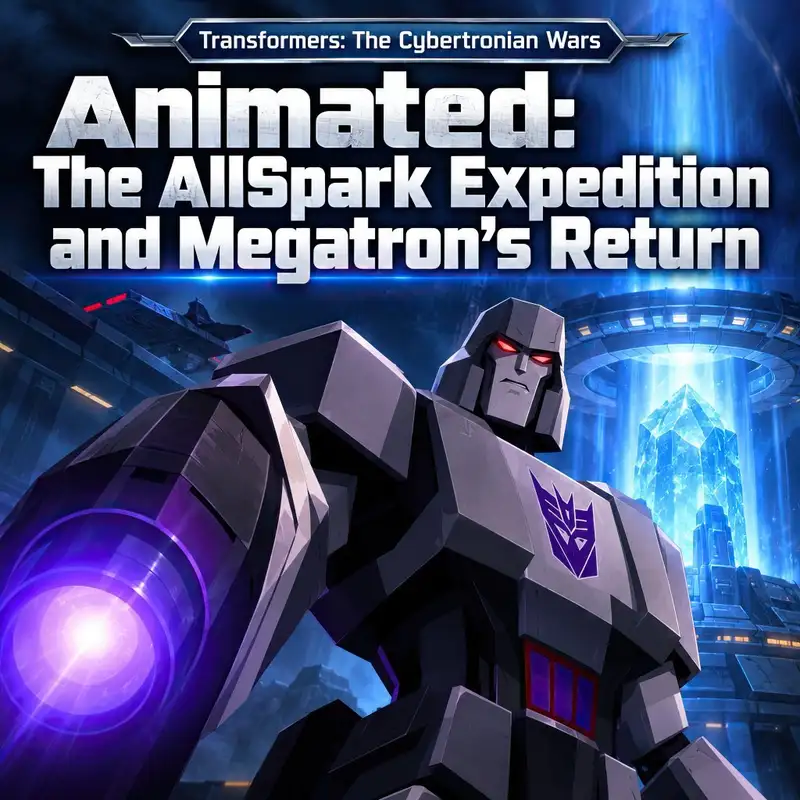
Animated: The AllSpark Expedition and Megatron’s Return
Professor Isaac Sumdac believed he had found the foundation of a technological revolution. Buried beneath the waters near Detroit was an alien mechanical head, damaged but still capable of transmitting ideas far beyond anything human engineering had achieved. Sumdac saw possibility. He saw machines that could think, systems that could transform, and an industrial future waiting to be built. What he did not see, at least not at first, was the political history attached to that head. It belonged to Megatron, the feared leader of the Decepticons in Transformers: Animated. Megatron had lost his body, his ship, his immediate access to his forces, and his route home. He had not lost his memory, his ambition, or his ability to use another civilization’s ignorance against it.
That difference changes the stakes. A commander without a chassis is disabled, but not necessarily defeated. Megatron could still assess his environment, communicate selectively, manipulate Sumdac’s research, and preserve the objective that had brought him to Earth in the first place: control of the AllSpark. His condition was not imprisonment in any secure military sense. It was concealment inside a human laboratory, protected by the very engineer he was exploiting. Sumdac was not a Decepticon collaborator in the political or military meaning of the term. He was a scientist working with knowledge he believed he had discovered. Megatron’s advantage came from the gap between technical access and informed consent.
The reason Megatron lay beneath Earth begins far from Detroit, with a mission that was never intended to become an invasion, an occupation, or even a major battle. It began as technical work. Optimus Prime and his crew were assigned to maintain and repair space bridges, the infrastructure that allowed Cybertronians to cross distances no ordinary vehicle mode could overcome. Their work placed them near strategic routes and dangerous equipment, but it did not make them a battle fleet. Then, in an asteroid field, the crew found the AllSpark.
Optimus Prime’s team was small even by the standards of a field detachment. It included Optimus, Ratchet, Bumblebee, Bulkhead, and Prowl. They brought different skills. Ratchet carried the experience of an older veteran and medic. Bumblebee supplied speed, improvisation, and a tendency to discover trouble slightly ahead of schedule. Bulkhead was a capable technician whose understanding of space-bridge systems would later become strategically important. Prowl brought stealth, infiltration skills, and a more disciplined view of movement and concealment. Optimus commanded them, but this Optimus Prime was not the unquestioned supreme leader of all Autobots. He was a team commander responsible for a difficult assignment and a mixed crew.
That distinction shaped the expedition’s vulnerability. A repair team has tools, technical training, and enough defensive capability to survive hazards and isolated threats. It does not normally have the escorts, redundant security systems, transport capacity, or reserve forces expected when a civilization’s most important artifact suddenly appears in its path. The expedition’s design fit maintenance work. It did not fit custody of an object that could alter the balance of power between Autobots and Decepticons.
The crew’s discovery exposed a common military problem. A mission can change faster than the organization conducting it can change its posture. The Autobots did not leave expecting to secure a political center of gravity. They found one. Once the AllSpark was in their possession, their task was no longer simply to finish repairs and return home. They had to protect the artifact, understand what they could about it, decide where it could be secured, and survive the attention that its discovery would attract.
In this continuity, the AllSpark should not be treated as a borrowed piece of universal Transformers mythology. Its significance comes from what the series shows it doing. It can affect machines. It can interact with Cybertronian technology. Its energy can produce consequences that neither Autobots nor humans entirely understand. That is enough to make it strategically decisive. The precise limits of its power, its full origin, and the industrial meaning of every effect remain uncertain. What matters in the immediate crisis is simpler. Whoever controls the AllSpark may gain access to capabilities no ordinary factory, weapons laboratory, or military depot can reproduce.
For Optimus’s crew, possession created responsibility before it created understanding. They had recovered something dangerous, irreplaceable, and attractive to their enemy. They could not just leave it in an asteroid field. They also could not assume that transporting it made it safe. The artifact had become both cargo and target. It was the kind of discovery that turns a technical expedition into an emergency convoy, except the convoy had no time to assemble and no room to choose a safer route.
Megatron’s arrival transformed the danger into a crisis. His objective was immediate and direct: take the AllSpark before the Autobots could secure it or use it against him. He did not need to conquer Cybertron in that moment. He did not need to destroy every member of Optimus’s crew. He needed the artifact. The presence of Megatron himself indicated how important the prize was. A Decepticon leader does not personally intervene in a remote technical incident unless the stakes justify the risk.
Megatron’s pursuit also revealed a weakness in Decepticon command. He was feared, powerful, and able to impose obedience through personal authority. Yet his organization was not free of rivalry. Starscream, one of his subordinates, saw the chaos surrounding the AllSpark as an opportunity to remove the leader above him. The bomb Starscream placed on Megatron contributed to the disaster that followed. It was not an Autobot masterstroke, and it was not evidence that the Decepticons had been decisively beaten by a stronger force. It was a betrayal inside an already unstable command structure.
That is one of the recurring problems of authoritarian military organizations. Fear can create obedience, but it does not automatically create loyalty, competence, or a stable succession system. A commander who rules through intimidation may discourage open dissent while encouraging secret calculation. Starscream’s action was not a principled revolt against Decepticon policy. It was a personal bid for advantage. Still, its timing mattered. In the middle of a pursuit for the AllSpark, internal treachery deprived Megatron’s force of coherence at exactly the moment it needed it.
The Autobots did not win a clean battle. They escaped a disaster. Faced with Megatron’s attack and the cascading effects of Starscream’s betrayal, Optimus’s crew used a space bridge as an emergency route. The bridge was not a magical solution. It did not guarantee a safe endpoint, a controlled arrival, or a route back. It was simply the available means of avoiding immediate capture or destruction. The crew moved through it because the alternative was worse.
The space bridge changed the geography of the war. It allowed the Autobots to flee their pursuers, but it also displaced the entire conflict to a world that had not chosen to join it. The Autobot vessel emerged near Earth and crashed. Megatron was separated from the main crisis and eventually became the damaged head Isaac Sumdac would recover. The bridge route that had provided escape did not remain available as a secure line of communication, reinforcement, or withdrawal. Both sides were stranded, though not in the same condition and not with the same resources.
From a tactical perspective, the Autobots had prevented Megatron’s immediate capture of the AllSpark. From an operational perspective, they had lost contact with their own wider command structure and crashed on an unknown planet. From a strategic perspective, neither side had achieved its original purpose. The Autobots had not returned the AllSpark to Cybertronian custody. Megatron had not seized it. The war’s decisive artifact, an Autobot team, a Decepticon leader, and the consequences of a failed pursuit had all been scattered across a new theater.
Earth was not an empty refuge. It had cities, industry, civilians, governments, transport networks, and its own technological development. Yet none of those institutions had been consulted about becoming part of a Cybertronian conflict. The crash placed alien military and political problems beneath a human world that did not know the scale of what had arrived. That lack of knowledge would become one of Megatron’s greatest assets.
The Autobots remained in stasis for fifty years near Lake Erie. During that interval, Earth continued to develop. By the time the team awakened, Detroit had become the central urban setting for their new existence. The crew had not selected Detroit as a base after a careful survey of political alliances, supply routes, or defensive depth. They woke there because that was where the accident had left them. Their first requirement was survival. Their second was adaptation.
Their vehicle forms provided mobility and concealment, but concealment was never perfect. To operate in Detroit, the Autobots had to use roads, buildings, industrial areas, communications systems, and human infrastructure. They needed to learn enough about local life to avoid immediate exposure. They also had to respond when threats emerged. A disguised Autobot can hide in traffic. A city under attack forces that same Autobot to reveal itself.
That is how Optimus’s crew began to acquire legitimacy on Earth. They were not initially a formal allied force of any human government. They were not occupiers, and they were not a conventional expeditionary army. They became defenders through action. They rescued civilians, contained disasters, and confronted threats that human authorities could not easily identify, much less counter. Their public interventions made them visible, but visibility also created responsibility. Once Detroit’s population had seen Cybertronians fight to protect it, the Autobots could no longer treat Earth as merely a temporary hiding place.
The civilian cost was built into the situation. Detroit’s residents did not cause the Autobot-Decepticon conflict. They had no role in the AllSpark expedition, Starscream’s betrayal, or Megatron’s ambitions. Yet their city became the location where those decisions played out. Buildings, transport networks, workplaces, and public spaces became terrain in a war imported from elsewhere. The Autobots’ presence reduced some danger, but it also made the planet relevant to enemies seeking them.
Meanwhile, Isaac Sumdac’s work with Megatron’s head created a second front. Sumdac had technological talent and industrial reach. He could study alien systems, build machines influenced by Cybertronian designs, and establish a company capable of turning research into production. What he did not possess was the historical context needed to recognize Megatron as a hostile political leader. Megatron exploited that asymmetry patiently. He did not need to announce himself as a Decepticon warlord. He needed Sumdac to keep working.
This was more than a matter of Megatron commanding human machines by force. It was an intelligence operation. He used secrecy, selective revelation, and technical dependence. Sumdac believed he was extracting ideas from an alien discovery. In reality, Megatron was guiding the work toward his own restoration. The human scientist’s expertise became part of a Decepticon recovery effort without his informed agreement. That is why the situation cannot be understood as an ordinary human alliance with the Decepticons. Sumdac was being used, not recruited into a cause he understood.
Sari Sumdac’s encounter with the AllSpark complicated the balance further. Her security key was altered into a device with remarkable effects on Cybertronian systems and technology affected by the AllSpark. It could heal damaged Cybertronians in circumstances where ordinary repair was not enough. It could activate or transform systems touched by AllSpark energy. The series establishes those effects through events, not through a complete engineering manual. The key is not a universal cure, and it is not proof that any human laboratory could recreate its powers. It is a singular object whose strategic importance becomes clear because Megatron needs it.
The presence of the key meant that the conflict was no longer only about possession of the AllSpark. Megatron needed a body. He needed technical facilities. He needed access to Sumdac’s knowledge and industrial capacity. He needed Sari’s key to activate the reconstruction process. The Autobots, in turn, had to protect both the AllSpark and the person carrying a device that had become operationally indispensable. A single artifact had become a network of dependencies: human science, Cybertronian repair, family trust, secrecy, and physical custody.
Megatron’s position as a disembodied head was therefore less passive than it appeared. He had lost the ability to dominate a battlefield directly, but he had gained a hidden base within Earth’s technology sector. He could influence machines, gather information, and prepare conditions for his return. His early moves on Earth were probes as much as attacks. They tested defenses, sought access to the AllSpark and the key, and demonstrated that the Autobots were trying to defend a city with limited manpower and no guaranteed reinforcement.
The Autobots had advantages of their own. They knew Megatron was dangerous, understood the stakes surrounding the AllSpark, and had developed a working relationship with Sari and Professor Sumdac. Ratchet could provide technical judgment that no human laboratory yet possessed. Prowl could operate with stealth. Bumblebee and Bulkhead could adapt quickly to local conditions. Optimus could keep the team focused on civilian protection even when the temptation to pursue a more direct military solution was strong.
But they were still an improvised defense force. Detroit was not a fortified Autobot enclave. Their base was not connected to a reliable supply chain from Cybertron. They had no large garrison, no established human command relationship, and no certainty about which Decepticons might reach Earth next. Their strength came from flexibility, local knowledge, and their willingness to act. Their weakness was that every crisis could demand more than five Cybertronians could safely provide.
Megatron’s return required more than patience. It required force, security, and coercion. Those needs were met when Decepticon field commanders such as Lugnut and Blitzwing entered the struggle. They should not be treated as the whole Decepticon military, but their presence gave Megatron the muscle needed to move from hidden influence to open operation. Lugnut supplied fierce personal loyalty and battlefield power. Blitzwing provided a different kind of instability, but he remained part of the force supporting Megatron’s restoration.
Starscream also reappeared in this phase, and his behavior made the Decepticon command problem impossible to ignore. He had tried to destroy Megatron. He had every reason to fear what would happen if Megatron regained his body. Yet he temporarily cooperated because the immediate situation left him few better options. This was not reconciliation. It was opportunism under pressure. Starscream could align with Megatron’s operation while still seeking a future chance to remove him.
The reconstruction plan combined several forms of power. Intelligence identified the necessary resources. Human facilities supplied engineering capability. Decepticon personnel provided security and coercion. Sari’s key supplied the unique activation Megatron could not replace through ordinary industrial means. The operation also depended on the Autobots being unable to protect every target at once. They had to defend Sari, restrain hostile machines, monitor Megatron’s influence, and respond to attacks across a city. Megatron needed only one opening.
That opening came when the key was forcibly seized and used to complete the restoration process. Megatron’s return was not mystical resurrection. He had survived the earlier catastrophe as a damaged head. His body was rebuilt through technology, then activated through the key’s demonstrated connection to AllSpark-derived systems. The distinction is important because it explains both the strength and the limitation of his return. He was not restored by destiny. He was restored by a plan requiring facilities, expertise, a rare artifact, and subordinate forces willing to execute the operation.
Once restored, Megatron immediately demonstrated why the Autobots had treated the prospect with such urgency. In direct combat, Optimus’s repair crew could not just overpower him. Megatron’s personal strength, weapons, and experience gave him a sharp tactical advantage. The Autobots were not cowards or incompetent fighters. They were a small technical unit confronting the concentrated force of the Decepticon leader after he had regained his full body. The mismatch was real.
Megatron also punished Starscream for his earlier betrayal. The act served more than personal vengeance. It was an attempt to reestablish discipline within Decepticon ranks. Megatron needed his commanders to understand that treachery would bring consequences. Yet coercion could not solve the deeper problem. Starscream’s betrayal had emerged because Decepticon command depended heavily on rivalry, fear, and personal ambition. Public punishment might suppress open rebellion for a time. It could not create the trust that had never existed.
Megatron’s restored body gave him the means to pursue the AllSpark directly, but control of the artifact still remained contested. The decisive struggle moved to Dinobot Island, where several groups became entangled in the conflict. The Dinobots and Blackarachnia had their own interests and grievances, and their presence complicated the battlefield. Still, the central issue remained the same. Megatron needed the AllSpark as a source of strategic power. Optimus needed to deny him that control.
This was no longer a conventional duel between commanders. It was an artifact-denial operation conducted under extreme pressure. The Autobots could not assume that keeping the AllSpark intact was always safer than preventing Megatron from possessing it. That is one of the hardest decisions in warfare involving unique technology. A commander may be responsible not only for preserving a capability, but for ensuring that the enemy cannot turn it into a weapon of conquest.
Optimus used Sari’s key while the AllSpark was contained within Megatron. The action dispersed the AllSpark and neutralized Megatron temporarily. It was a desperate choice, but not an irrational one. Leaving the artifact concentrated and under Megatron’s control would have created the possibility of a decisive Decepticon victory. Dispersal prevented that outcome. It denied Megatron the ability to carry the AllSpark away as a single, controllable instrument of power.
In the immediate fight, the decision stopped Megatron in the immediate confrontation. Operationally, it disrupted the Decepticons’ plan to secure the artifact and exploit its capabilities. Strategically, it ensured that neither faction retained uncontested possession of the AllSpark. Optimus had prevented Megatron’s victory, but he had not restored the previous situation. The AllSpark was not conclusively destroyed. It was dispersed into fragments across Earth.
That difference would shape everything that followed. A single artifact can be guarded, transported, hidden, or fought over at one location. Scattered fragments create a wider security problem. They can be found by civilians, criminals, scientists, Autobots, Decepticons, or machines with no understanding of what they have encountered. Each fragment may produce a different effect depending on the system it touches. The Autobots had exchanged one catastrophic concentration of danger for many smaller, unpredictable threats.
The consequences reached beyond the artifact itself. Megatron survived again, proving that temporary physical neutralization did not equal the end of his campaign. Professor Sumdac was taken prisoner, and his capture had strategic value. Megatron had learned firsthand what human industry could provide. Sumdac possessed technical knowledge, facilities, and the ability to bridge the gap between Cybertronian concepts and Earth-based construction. As a captive, he became both a human cost of the conflict and a resource Megatron could try to exploit.
The scattered fragments also changed Earth’s technological and biological landscape. Later incidents showed that AllSpark energy could animate construction vehicles and create new dangers. Those machines should not be treated as evidence of a routine or universal Cybertronian birth process. They were products of a specific artifact’s effects under unusual circumstances. Still, their existence demonstrated the scale of the problem. A fragment was not just debris. It could become a new actor, a new weapon, or a new emergency.
Megatron’s longer-term objective also became clearer. Earth was never meant to be the final prize. It was a base, a source of labor and technology, and a staging area from which he hoped to regain strategic mobility. The construction of a new space bridge became central to that ambition. A functioning bridge would not just allow Megatron to leave Earth. It could reconnect the Decepticons to Cybertron, open routes for reinforcement, and make a return to conquest possible.
The attempt revealed that space-bridge warfare depends on more than possessing an idea or a piece of machinery. It requires engineering knowledge, energy, materials, a secure operating site, and people capable of making the system work. Bulkhead’s understanding of bridge technology therefore became strategically important. His expertise was more than a technical curiosity. It was a capability Megatron could exploit if captured or coerced. The same was true of Professor Sumdac’s human engineering knowledge. A bridge is infrastructure, and infrastructure turns specialized knowledge into military power.
The response from Cybertronian institutions was not immediate or simple. When the Elite Guard entered the picture, it initially sought to remove Optimus’s team from Earth and return them to Cybertron. Ultra Magnus and the Guard had reasons to worry about panic, confusion, and the apparent loss of the AllSpark. From their perspective, Optimus’s small team had become entangled in a crisis beyond its original mandate. Institutional leaders often seek to restore control by pulling isolated forces back toward the center.
That judgment was understandable, but incomplete. The actual theater of war was now Earth. Megatron remained active. The AllSpark fragments remained scattered. Professor Sumdac was missing. A potential space-bridge project threatened to reconnect the planet to a broader Decepticon campaign. Leaving Earth would not contain the crisis. It would abandon it. Later evidence forced a change in policy, and Optimus’s crew remained to hunt Decepticons and recover fragments.
The episode’s larger lesson is not that a small team can replace an army or that improvised heroism solves every institutional failure. Optimus’s crew succeeded because it adapted, learned, and remained close to the people affected by the conflict. The Elite Guard brought formal authority and greater resources, but it initially lacked the local knowledge that Optimus’s team had earned through experience in Detroit. The two forms of power needed one another. Field judgment without institutional support can be overwhelmed. Institutional command without local understanding can misidentify where the real war is being fought.
The AllSpark expedition became decisive because it relocated far more than an artifact. It moved the conflict’s central resource, a Decepticon leader, an Autobot team, human technical expertise, and the problem of strategic mobility onto Earth. The space bridge that saved the Autobots from immediate capture also created an accidental deployment to a world unprepared for Cybertronian war. The crash scattered the participants. Fifty years of stasis concealed the danger. Then Megatron turned that concealment into opportunity.
Professor Sumdac’s initial mistake captures the entire crisis. He believed technology could be separated from the politics of the being who created it. Megatron proved otherwise. His body had been broken, but his command purpose survived. He could still manipulate information, recruit or coerce assistance, exploit human industry, rely on subordinate force, and pursue the AllSpark through indirect means. His return was dangerous not just because he regained weapons and mobility. It was dangerous because he had spent years building the conditions for that return.
Optimus’s decision at Dinobot Island prevented Megatron from gaining a single decisive instrument of conquest. But it did not restore peace. By dispersing the AllSpark, he transformed one concentrated threat into a long campaign of fragments, prisoners, bridge projects, and political uncertainty. Earth was no longer a refuge at the edge of the war. It had become the place where every piece of the solution could become a new source of danger.