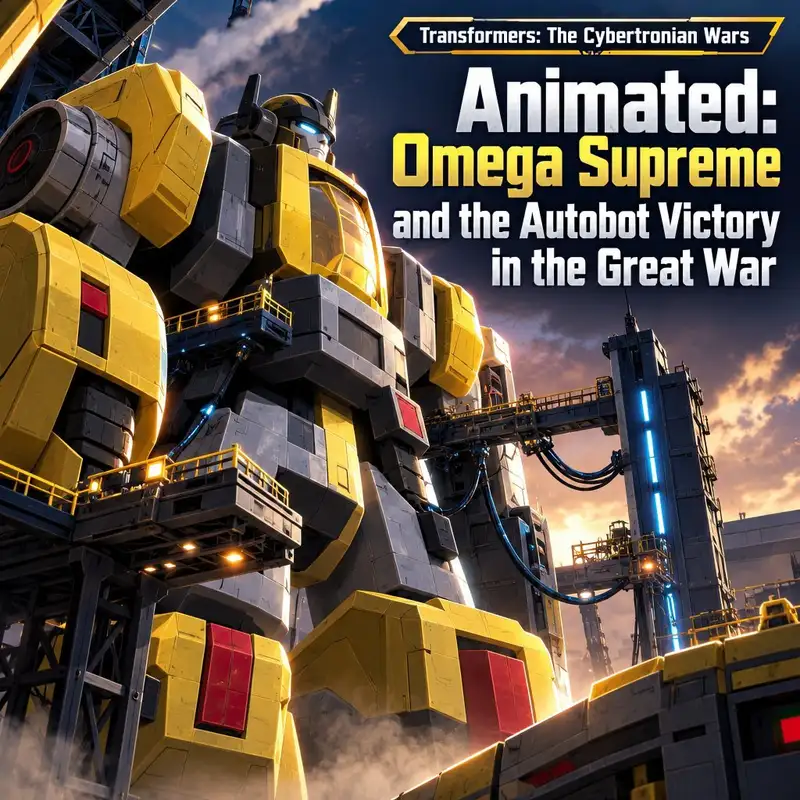
Animated: Omega Supreme and the Autobot Victory in the Great War
Ratchet did not look like the obvious custodian of an Autobot superweapon. He was a medic, a field repair specialist, and a veteran who had already spent too much of the Great War trying to keep damaged comrades alive. Yet when Omega Supreme awakened, it was Ratchet who stood before him. The newly activated giant needed more than a target list. He needed someone to explain who he was, whom he could trust, and what his immense strength was for.
In Transformers Animated, that moment carries more weight than a standard military activation. Omega Supreme was more than a ship, a fortress, or an oversized Autobot soldier. He was all of those things, but he was also a sentient individual. His transformation gave him the reach of a spacecraft and the battlefield presence of a capital-scale weapon. His mind, however, had been deliberately simplified so that he would not hesitate when ordered into combat. The Autobots had built their greatest wartime asset to obey.
The Great War in this continuity survives mostly in fragments. The series establishes that Autobots and Decepticons fought for control of Cybertron, that the Autobots eventually prevailed, and that the peace which followed lasted for many stellar cycles. It does not give us a complete map of fronts, a campaign diary, casualty ledgers, or a final battle in which one faction visibly broke the other. That absence matters. The available record does not support a neat story of one decisive Autobot charge that ended the war.
What it does support is a more complicated account. The Autobots appear to have survived a dispersed and demanding conflict through persistence, strategic mobility, intelligence work, and the preservation of specialists who could sustain their military system. Project Omega was part of that effort. Omega Supreme may have helped make victory possible, but he also reveals what the Autobots were willing to do when ordinary forces no longer seemed sufficient.
The question, then, goes beyond how much damage Omega Supreme could inflict. It is why the Autobot command believed such a being was necessary, how they tried to control him, and why the system built around him remained vulnerable long after the war was supposedly over.
The Great War was a struggle for Cybertron, but it was not confined neatly to Cybertron. Ultra Magnus served as the Autobot supreme commander, and the conflict reached across the galaxy. Later reports from the peace era describe Decepticon uprisings along the galactic rim, stretching Autobot resources nearly to their limit. Those later disturbances do not provide a complete wartime map, but they show the scale of the security problem the Autobots inherited from the war.
A force responsible for distant worlds, space routes, intelligence networks, and vulnerable infrastructure cannot concentrate everywhere at once. It must decide which threat is immediate, which threat can be watched, and which threat may become dangerous if neglected. The Autobots could win a battle on Cybertron and still face sabotage, insurgency, or a Decepticon remnant somewhere beyond the main theater. The war’s political center may have been Cybertron, but its operational burden was wider.
That distinction helps explain why the Autobots’ later peace looked less secure than its public language suggested. A formal victory can remove an enemy government or defeat its principal army. It does not automatically eliminate covert operatives, loyalist networks, hidden laboratories, stolen technology, or populations willing to rise when they believe the old cause has another chance. The Decepticons were beaten as a war-making power, but they were not erased as an idea or as a clandestine organization.
Ultra Magnus’s command therefore faced a familiar problem in civil war. The stronger side needed not only to defeat enemy formations. It needed to protect the systems that allowed it to communicate, move, repair, and identify threats across great distances. A single damaged space bridge, a compromised archive, or an infiltrator with access to classified material could create consequences out of proportion to the size of the immediate incident.
In a dispersed war, intelligence becomes a form of firepower. It tells commanders where to send scarce forces, which ally can be trusted, what technology must be secured, and which apparent victory conceals a future danger. Project Omega was built as a military answer, but its most important vulnerability was never simply armor or weapon range. It was information.
Arcee stood at the center of that problem. Before the war made her an intelligence officer, she had been a teacher. That earlier role becomes important because it establishes her as someone accustomed to guiding others, not just collecting secrets. During the conflict, she became the custodian of information needed to activate Project Omega. In practical terms, that made her one of the most valuable and vulnerable Autobots in the war.
The activation data was not just technical knowledge. It was command authority over a strategic weapon. Whoever possessed it could potentially awaken Omega Supreme, direct him, or deny him to the enemy. That made Arcee a target for Decepticon intelligence. The bounty hunter Lockdown, working on behalf of Decepticon interests, pursued her because extracting those codes could compromise the entire project.
The response was severe. Ratchet used his electromagnetic pulse equipment to suppress or erase Arcee’s memories before Lockdown could obtain what she carried. This was counterintelligence under emergency conditions. The immediate logic is understandable. If the Decepticons captured Arcee’s knowledge, they might gain access to a weapon built to defeat them. The Autobots chose to damage one of their own rather than risk the loss of Project Omega.
But the decision cannot be treated as painless because it was strategically useful. Arcee was not a storage device. Her memories were part of her identity, her professional knowledge, and her personal history. Ratchet’s action protected the project, but it did so by violating the ordinary boundary between medical care and coercive intervention. In war, institutions often discover that their most urgent security decisions are also their most morally compromising ones.
Ratchet himself understood that cost. He was not presented as a commander who casually accepted collateral damage in the name of security. He was a medic forced into a role where preserving one life and protecting many others could not be cleanly separated. The series does not allow the listener to dismiss the memory wipe as a routine procedure. Arcee’s later condition makes the harm visible.
The Decepticons, meanwhile, demonstrated an equally important point. They did not need to seize Omega Supreme in open battle if they could seize the means of controlling him. A classified system can be stronger than an army in the field and still be fragile if its authentication rests on one person, one archive, one set of memories, or one compromised channel.
The attempt to restore Arcee’s memories deepened that vulnerability. Ratchet and Ultra Magnus undertook an open-processor procedure in hopes of recovering what had been lost. The effort was both medical and strategic. They needed to restore a damaged comrade, but they also needed access to information that had been deliberately hidden from the enemy.
Arcee’s internal failsafe changed the situation. Rather than simply returning the Project Omega data to her, it transferred the activation information into Ratchet. Ratchet did not initially understand what he had received. He became, in effect, the accidental custodian of a strategic access system embedded in his own processor.
This was an improvisation born of wartime pressure. It preserved the project’s security in the short term, but it also narrowed the entire chain of control. The access mechanism for a colossal weapon was no longer held by a secure institution with layered oversight. It was tied to individuals who could be injured, captured, deceived, or separated from the rest of the Autobot command.
Project Omega itself appears to have been an extraordinary wartime undertaking. Perceptor and Wheeljack are associated with its construction, operating under Ultra Magnus’s authority. The project was described as a prototype weapon of mass destruction, a phrase that indicates the scale of the Autobots’ desperation as much as the scale of Omega’s armament. This was not a routine vehicle program or a standard reinforcement package.
The Autobots had apparently concluded that their existing forces might not be enough. A war against the Decepticons had reached a point where conventional units, however brave or capable, could no longer guarantee a favorable outcome. Project Omega concentrated immense mobility and force into one platform. In a crisis, that can be strategically attractive. A commander who cannot reinforce every threatened sector may create one asset capable of reaching the sector that matters most.
Omega’s demonstrated capabilities justify that concern. He could function as a vast spacecraft, cross interstellar distances, enter transwarp space, transform into an enormous combat body, and bring heavy firepower to a threatened location. He could also protect and transport smaller Autobots. These abilities gave the Autobots a way to move concentrated strength across distances that might otherwise divide their forces.
Yet Omega’s capabilities should not be exaggerated beyond what the series establishes. He was a prototype. There is no evidence that the Autobots fielded an army of Omega Supremes, maintained a production line for equivalent weapons, or possessed unlimited resources to replace him if he were lost. His existence proves remarkable industrial capacity and specialized scientific skill. It does not prove that the Autobots had solved the broader problem of sustaining giant strategic assets at scale.
A prototype also creates its own logistical burden. It needs rare expertise, secure facilities, maintenance, power, and a command structure that understands its limitations. Omega’s transwarp movement, for example, gave him extraordinary reach, but later events show that such movement could drain his systems. Mobility was therefore not free. The ability to arrive quickly at a distant crisis might leave him weakened at the point where he was most needed.
That is the recurring pattern in the Autobot victory. Every advantage carried a cost. Secure intelligence required secrecy and memory suppression. Strategic mobility required power and maintenance. Centralized command could direct a major project, but it could also place enormous authority in a small number of hands. The Autobots survived these compromises, but survival did not make the compromises disappear.
Omega Supreme’s most consequential limitation was not mechanical. It was cognitive. The Autobots deliberately gave him a simple processor so that he could carry out his mission without hesitation. In military terms, the design sought reliability. A weapon that questioned every order, froze under pressure, or rejected its assigned role might fail in the moment of crisis. Omega was meant to act when commanded.
That decision also required a mentor. Omega needed someone to guide him, teach him, and serve as his command channel. Arcee was originally intended to fulfill that role. Her background as a teacher made the assignment more than a technical convenience. The Autobots understood, at least to some degree, that Omega needed instruction and relationship, not just activation.
After the transfer of the codes, Ratchet assumed that role. This placed a medic in a position that was part guardian, part instructor, and part custodian of strategic authority. Ratchet could not just issue orders and walk away. Omega’s mind had been engineered to depend on guidance. The Autobot who guided him would help shape not only his actions but also his understanding of himself.
The ethical difficulty is plain. The Autobots had created a sentient being whose capacity for independent judgment had been intentionally restricted. They had not built an empty machine. Omega learns, remembers, forms attachments, and responds to those around him. He is capable of trust and distress. Calling his processor simple does not mean he lacks personhood. It means the people who made him constrained his ability to act outside the mission they assigned.
That is a grave form of power. A military organization may argue that an emergency justified it. Ultra Magnus faced a war in which Cybertron itself was at stake, and the Autobots may have believed they had no acceptable alternative. The series does not provide his private deliberations, so it would be wrong to invent indifference or cruelty where the record is silent. But the institutional choice remains visible. Under Ultra Magnus’s command, the Autobots authorized the creation of a living strategic weapon built for obedience.
Ratchet’s relationship with Omega did not remove the coercive foundation of Project Omega. It did, however, alter the character of Omega’s service. Ratchet treated him as someone who needed care, explanation, and companionship. That personal decency mattered. It gave Omega more than a command signal. It gave him a trusted figure who could help him interpret the world beyond his assigned function.
There is a military lesson in that relationship. Discipline and obedience can make a unit responsive, but trust is what allows individuals to act effectively when orders are incomplete, communications fail, or circumstances change. Omega’s dependence on Ratchet was designed into him, but Ratchet appears to have turned that dependence into a bond rather than a purely mechanical control mechanism.
Still, care from one mentor cannot fully correct the structure that created the dependency. Ratchet could teach Omega to trust, but he could not erase the fact that Omega had been made for war. He could give the giant weapon affection and guidance, but he could not guarantee that hostile forces would never exploit the same control system. The individual relationship softened the institution’s harshest edge. It did not make the institution’s choices harmless.
The available evidence suggests that Omega contributed to the Autobot victory in several connected ways. In the immediate fight, he could intervene with overwhelming force against major Decepticon threats. His size, armor, and weapons made him capable of altering a battlefield where smaller Autobots might be outmatched or unable to hold ground.
Operationally, Omega’s ability to travel as a spacecraft and use transwarp movement gave the Autobots a means of concentrating force across distant theaters. In a war that extended beyond Cybertron, that mattered enormously. A unit that can reach a threatened system quickly can reinforce a defense, extract personnel, disrupt an enemy operation, or force the enemy to account for a danger that may appear far from the main line of battle.
Strategically, Omega gave the Autobots an emergency reserve. His mere existence could affect Decepticon planning. An enemy deciding whether to assault a vulnerable target must consider not only the defenders already present, but also the possibility that a capital-scale Autobot weapon could arrive. Deterrence does not require omnipotence. It requires the enemy to believe that a certain action may bring unacceptable consequences.
Politically, Project Omega demonstrated that Autobot command would mobilize extraordinary resources to prevent Decepticon victory. That could strengthen confidence among Autobot forces and sympathetic populations. It could also harden Decepticon determination, because a movement facing such a weapon may conclude that compromise is impossible. Strategic weapons often protect a government while making reconciliation more difficult.
None of this means Omega Supreme won the Great War alone. The series does not support that claim. There is no evidence that one giant weapon destroyed the Decepticon army, captured Cybertron, or dictated a final settlement. The Autobots’ victory appears to have rested on a wider system: commanders who held their forces together, intelligence officers who protected sensitive knowledge, engineers who sustained key infrastructure, specialists who survived long enough to perform their work, and units that continued fighting across a dispersed conflict.
Omega was likely decisive in the way rare strategic assets often are. He could solve problems no ordinary unit could solve. But he could not replace ordinary units, secure every archive, rebuild every city, or make the Decepticon cause vanish. His power was an advantage inside a larger war effort, not a substitute for that effort.
The peace that followed exposed the limits of military victory. The Autobots controlled Cybertron, but Decepticon networks remained active. Their agents could still infiltrate Autobot institutions. Their supporters could still rise in distant regions. Their leaders could still exploit old knowledge and old technology. Victory had changed the balance of power. It had not eliminated the conditions under which conflict could return.
That reality becomes clear during the space-bridge crisis in A Bridge Too Close. Megatron sought to use a space bridge to return to Cybertron and launch a surprise attack while Autobot defenses were under pressure from uprisings elsewhere. The plan was strategically sound in its basic logic. If the main defender is dispersed across distant threats, a sudden attack through a mobility corridor can strike before reinforcements arrive.
Space bridges transform geography, but they do not make geography irrelevant. They depend on technical knowledge, stable endpoints, energy, and control of the infrastructure. Megatron’s effort exploited stolen information and compelled Professor Isaac Sumdac to work on the system. The operation was more than a matter of opening a door between worlds. It required technical coercion and an understanding of where Autobot defenses were weakest.
When the bridge destabilized, the consequences reached Earth. The failure threatened the surrounding human area, turning a strategic mobility system into a civilian danger. This is an important part of the wider Cybertronian war. Earth was not the original battlefield of the Great War, but it became vulnerable because Cybertronian factions brought their infrastructure, rivalries, and unresolved security problems into a populated human environment.
Omega Supreme intervened to contain the crisis. He carried Megatron and Starscream into transwarp space as the unstable bridge collapsed. In the immediate sense, this was a successful defensive action. He prevented a dangerous situation from spreading further and removed two major Decepticon leaders from the scene.
But the action exhausted him. Transwarp movement drained his systems, leaving the Autobot strategic asset weakened. This was not a failure of courage or a contradiction in Omega’s capabilities. It was the cost of employing a high-end mobility system under emergency conditions. He could save the situation, but he could not do so without becoming vulnerable afterward.
That vulnerability changed the balance of power. A strategic weapon that is active, supplied, and connected to trusted command is a deterrent. A strategic weapon that is exhausted, isolated, and dependent on compromised information is an opportunity for the enemy. Megatron understood that opportunity.
In TransWarped, Megatron succeeded in reactivating and manipulating Omega Supreme after the giant’s systems had been depleted. The significance of this reversal lies not only in Megatron’s audacity. It lies in the continuity of an old intelligence failure. The same project that had helped the Autobots win the Great War still depended on secrets that Decepticon operatives had spent years trying to obtain.
Shockwave’s infiltration was crucial. His access to information extracted from Arcee demonstrated that the damage done during the war had never been fully contained. The original effort to protect Project Omega had delayed Decepticon access. It had not made the knowledge permanently unreachable. A covert agent operating inside Autobot space could wait, study vulnerabilities, and exploit a moment when the old chain of custody weakened.
The Decepticons did not defeat Omega through greater force alone. They captured the command problem around him. They recognized that the giant’s strength mattered less than the question of who could direct it. If a weapon’s identity, mission, and authority depend on hidden codes and constrained cognition, then stealing the codes becomes as important as seizing the weapon’s body.
The failure was not solely Ratchet’s, Arcee’s, or Omega’s. It was institutional. The Autobot wartime system had concentrated too much authority in personal knowledge and too much responsibility in a being whose ability to question orders had been limited by design. Individuals did their best within that system. But the system itself had created a single point of catastrophic failure.
Megatron’s subsequent effort to create Lugnut Supreme units showed the wider danger of technological capture. Using Omega-related knowledge, protoforms, Starscream-derived systems, and AllSpark fragments, he produced enormous Lugnut-based copies. The series establishes the result and its immediate threat. It does not provide a complete engineering explanation, a reliable production rate, or evidence of an unlimited factory capable of turning out giant soldiers forever.
That uncertainty is important. Megatron’s program should not be mistaken for a stable industrial revolution. It appears to have been a dangerous improvisation built from unusual components, specialized knowledge, and the particular opportunities available during the Earth crisis. A successful prototype or a handful of massive units does not prove that either side could sustain a permanent army of equivalent weapons.
Even so, the operational effect was severe. The Decepticons had turned an Autobot exception into a weapon of intimidation and urban-scale destruction. Omega Supreme had been conceived as an emergency answer to a desperate war. Megatron attempted to make the underlying idea serve a different purpose: the restoration of Decepticon dominance through spectacle, shock, and concentrated force.
The threat to Earth showed how easily a war can migrate. Human cities and civilians became exposed not because they had chosen to fight the Great War, but because the war’s survivors brought old weapons, old secrets, and old ambitions to their world. The Autobots’ alliance with humans offered protection, but it also made Earth a place where Cybertronian conflicts could be settled at human expense.
The defense against Megatron’s assault required more than a stronger weapon. It required recovering people whose identities and knowledge had been damaged by the war. Ratchet restored Arcee’s memories and brought her fully online. This was more than a medical repair. It was the restoration of an intelligence officer, a teacher, and the person originally intended to guide Omega Supreme.
Arcee’s recovery altered the command situation. She transmitted the necessary codes, breaking Megatron’s control over Omega. The decisive reversal came through restored identity and restored knowledge, not just through a larger blast or a more powerful machine. Omega returned to the Autobots because the personhood and relationship suppressed by wartime damage were finally able to reassert themselves.
That outcome gives the entire Project Omega history a different meaning. The Autobots had treated Arcee’s memories as a place to hide a secret. The Decepticons had treated those memories as an intelligence target. But Arcee was never only the carrier of a code. Her return demonstrated that the security problem could not be separated from the person at its center.
Omega’s liberation also confirms that he was more than equipment. He had been manipulated, but he could be restored to trusted relationships and to a sense of allegiance that was not reducible to raw programming. The series leaves many details of his cognition unexplained, and it would be wrong to claim that he became fully autonomous in every sense. Still, his recovery is morally significant. A sentient weapon had been used against his allies and then returned to them through the recovery of trust and identity.
Around Omega, the wider battle for Earth continued. Optimus Prime confronted Megatron using the Magnus Hammer and a newly constructed flight system. That duel mattered because Megatron remained the immediate leader of the assault. But defeating a commander in combat did not by itself solve the larger technological crisis. The Decepticons had created threats that could outlast one confrontation.
Prowl and Jazz attempted to restore the scattered AllSpark. In this continuity, the AllSpark fragments had specific technological and life-giving significance. They should not be treated as a universal Matrix or as a simple source of unlimited power. Their reconstruction mattered because the fragments could help neutralize the danger posed by Starscream and the Lugnut Supreme threat.
Prowl’s sacrifice in that effort gave the victory its most personal cost. The defense of Earth succeeded, but it did not succeed without loss. A war that relies on extraordinary technology still depends on individuals willing to take risks that machines, codes, and strategic doctrines cannot absorb for them. Prowl’s death was not a decorative tragedy at the edge of a larger battle. It was part of the price paid to deny Megatron the tools of renewed conquest.
Across the wider operation, the Autobots prevented the enemy from holding the decisive assets involved in the attack. They denied Megatron a controlled Omega Supreme, stopped the giant Lugnut-based weapons from establishing permanent dominance, and kept the crisis from becoming a successful bridgehead for a larger Decepticon return.
In the larger war, the failure of Megatron’s operation confirmed that the Decepticons had not regained the capacity to overthrow the postwar order. They could still infiltrate, sabotage, and strike with frightening force. They could still exploit dispersed Autobot defenses and technologies built during the Great War. But they could not convert that moment into lasting control of Cybertron or Earth.
The intelligence outcome was equally important. Arcee’s restored memory and restored agency closed a vulnerability that had begun during the war. The same secret that had been protected through trauma and concealment was finally placed back in the hands of the person most deeply connected to it. That did not erase the original harm, but it prevented the Decepticons from keeping the advantage created by that harm.
The political outcome was less complete. The Autobots had won the Great War and survived a major attempt to reverse its result. Yet both victories relied heavily on fragile individuals. Ultra Magnus had authorized an extraordinary project. Ratchet had carried burdens far beyond his medical role. Arcee had endured memory loss because her knowledge was too dangerous to lose. Omega had been made dependent on mentors and codes. Prowl paid with his life in the final defense.
This is not the picture of a perfectly repaired postwar society. It is the picture of a civilization that has defeated its enemy’s open military challenge while still relying on emergency systems created during the conflict. The Autobots had institutions, command structures, intelligence services, and technological expertise. But the fate of those institutions could still turn on whether a handful of damaged individuals survived, remembered, trusted one another, and acted in time.
For civilians, especially on Earth, that instability had immediate consequences. Human communities were endangered by a conflict whose political origins lay on Cybertron. The damage threatened by the space bridge crisis and the Lugnut Supreme assault was not an abstract strategic concern. It was the risk of alien military technology failing or being weaponized near people who had little control over the decisions that brought it there.
The Autobot victory in Animated was real. It preserved Cybertron from Decepticon conquest and created a period of relative peace. Omega Supreme likely helped make that victory possible because he concentrated mobility, force, and deterrence at a moment when the Autobots needed an answer beyond ordinary military means.
But it was not a clean moral triumph, and it was never a permanent settlement. Omega’s creation exposed the cost of the victory: an Autobot command willing to manufacture a sentient being for obedience, then secure him through personal secrets vulnerable to theft, trauma, and infiltration. The later Earth crisis proved that defeating Decepticon armies did not erase Decepticon networks, stolen knowledge, or the enduring temptation to treat living allies as weapons.