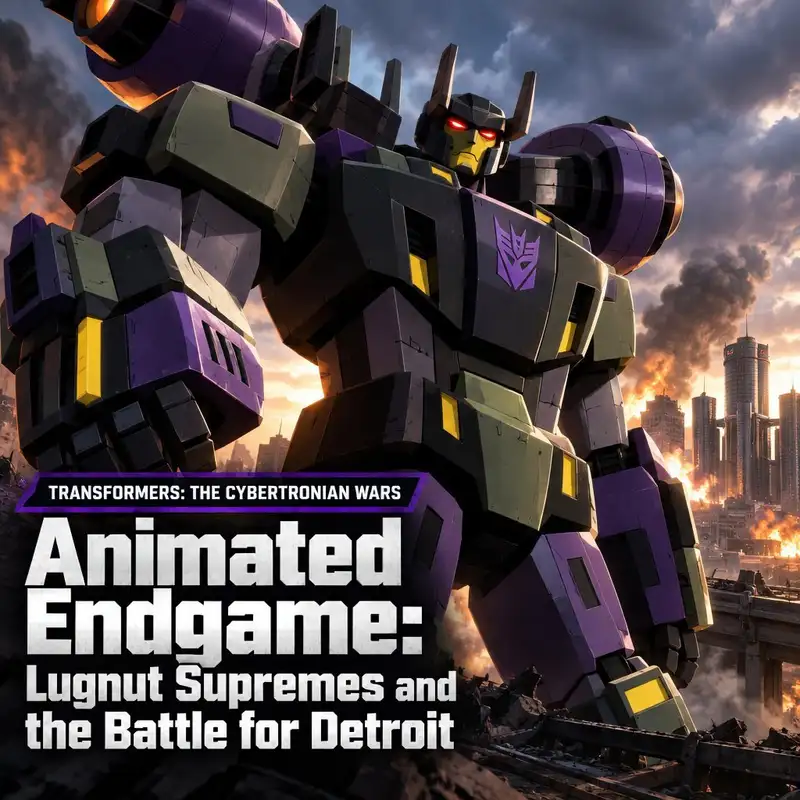
Animated Endgame: Lugnut Supremes and the Battle for Detroit
Three enormous shapes descend toward Detroit, and the city has no practical way to absorb their arrival. They resemble Lugnut in outline, but at a scale that turns familiar streets, towers, and bridges into vulnerable terrain. Their target is not an empty battlefield. Detroit is home to civilians, industry, Sumdac Tower, and the human partners who have become central to the Autobots’ life on Earth. The immediate problem is not whether Optimus Prime can defeat three attackers of that size in direct combat. He cannot count on that. The problem is whether the defenders can keep them away from the city long enough to solve a second crisis far above Earth, on the Moon.
In Transformers Animated, the final battle is spread across three connected theaters. Detroit is the visible battlefield, where the Lugnut Supremes threaten a populated city. The Moon is the recovery site, where Megatron, Shockwave, Arcee, and the captured Omega Supreme are tied together by stolen access codes and damaged memories. The third theater is less visible but more important. It is Omega Supreme’s own command architecture, the recognition data, control systems, and AllSpark-derived technology that determine whether Megatron’s new weapons can act as an army or merely as destructive machines. The Autobots do not win because they possess the larger weapon. They win because they understand that these theaters must be handled separately.
That distinction is the key to Megatron’s failure. The Lugnut Supremes look like the culmination of a Decepticon war plan. They have scale, armor, flight capability, and enough destructive force to threaten a major city. Yet their apparent strength conceals a deeper weakness. Megatron has not built a stable military system. He has assembled a captured asset, copied portions of its design, forced access through stolen information, and placed command in the hands of a single loyal subordinate. He has created an impressive weapon, but he has not created resilience. When the system is challenged by Autobot recovery efforts and Decepticon betrayal at the same time, it begins to come apart.
Megatron’s larger objective is easy to understand. Omega Supreme is more than another powerful Cybertronian. In this continuity, he is a strategic asset of exceptional importance, with abilities and systems that Megatron wants to turn against the Autobots. Capturing Omega gives the Decepticons more than a prisoner. It gives them a potential model for a new class of force. If that model can be reproduced, Megatron no longer has to rely only on dispersed Decepticon fighters, infiltrators, and individual specialists. He can field immense weapons that can devastate targets, intimidate populations, and overwhelm smaller Autobot teams before they can organize a defense.
That ambition has an industrial logic. A single unique weapon can change a battle. A reproducible weapon can change a war. Megatron’s project is therefore not just about revenge against the Autobots or domination of Earth. It is an attempt to alter the balance of power by converting one captured Cybertronian into the basis for a broader Decepticon capability. The protoforms involved in the project suggest that Megatron is trying to create bodies on a large scale. But the finale never establishes that he possesses a mature, distributed production system capable of manufacturing fully autonomous Omega Supremes as routine military units. The Lugnut Supremes are constructed duplicates based on Omega Supreme’s form and systems. They are not just ordinary Omega Supremes with new paint and a new allegiance.
Arcee is central to that problem. She is more than an Autobot captive caught in the Decepticons’ path. She holds the recognition information needed to access Omega Supreme. In military terms, she is the custodian of a critical authentication system. The Decepticons possess the hardware, or at least enough of it to exploit. What they lack is the authority encoded into the machine. They cannot simply order Omega Supreme to obey them because they have captured his body. They need the recognition data that tells the system who has legitimate access.
Shockwave is the Decepticon who makes that theft possible. His earlier infiltration under the identity of Longarm Prime gave him access to Autobot institutions, trust, and information that a conventional assault could not have obtained. The deception is more than a clever disguise. It is an intelligence success with long-term consequences. By presenting himself as a reliable Autobot official, Shockwave gained proximity to the very systems Megatron needed to compromise. His value to Megatron lies not only in technical skill, but in his ability to exploit the Autobot expectation that authority, rank, and recognizable identity can be trusted.
The extraction of Arcee’s information is therefore both technical and coercive. The Decepticons need to recover damaged memory data from a prisoner whose mind has already suffered harm. The operation is not a neutral act of repair. It is the exploitation of a wounded captive for access to a weapon system. The distinction matters because the Decepticon breakthrough rests on a violation of Arcee’s autonomy. Megatron’s plan depends on treating another Cybertronian’s memory as captured material, something to be mined, altered, and used without consent.
Shockwave succeeds in obtaining the information Megatron needs. The Decepticons can now move from possession of Omega Supreme toward imitation. Yet success in intelligence collection does not solve the command problem. Recognition data opens a door. It does not guarantee that those who pass through it understand the system they have seized. Megatron can create the Lugnut Supremes, but the clones do not initially function as a truly independent force. Their command data remains incomplete. The Decepticon leader has the outline of an army, but not the reliable nervous system that would allow that army to operate without constant intervention.
Megatron’s answer is Lugnut. Of all his senior followers, Lugnut is the most politically dependable. He is devoted to Megatron personally and has little interest in independent maneuvering. That loyalty makes him the obvious intermediary. Where Starscream is ambitious, self-serving, and openly unreliable, Lugnut is obedient. Megatron routes control of the Supremes through him because Lugnut can be trusted to execute the leader’s will without hesitation. In the short term, it is an efficient solution. It allows Megatron to deploy his new weapons before he has fully mastered their internal architecture.
But the decision creates a single point of failure. The Lugnut Supremes are immense, but their scale does not make them operationally flexible. Their command structure is centralized through one relay. If Lugnut is disrupted, controlled, deceived, or bypassed, the entire formation becomes vulnerable. A more resilient force would have redundant command paths, independent judgment, secure authentication, and officers able to act within a broad mission. Megatron’s force has none of those advantages clearly established. It has a leader, a loyal conduit, and three giant weapons awaiting instruction.
The first field test offers an impressive demonstration of destructive potential. The Lugnut Supremes attack Darkmount, Megatron’s former prison. The target has symbolic value. It is associated with Megatron’s earlier confinement, humiliation, and opposition to the order that once restrained him. Destroying it proves that the new weapons can erase a fortified location that represents an old political enemy. But a successful demonstration is not a campaign plan. Darkmount is a fixed target. It does not test whether the Supremes can sustain operations, respond to changing intelligence, protect their own command network, or function when their internal political coalition begins to fracture.
From there, the Supremes move toward Earth. Detroit becomes the decisive theater because it combines military and political value. It contains Sumdac Tower, which is associated with Isaac Sumdac’s advanced technology and the Autobots’ Earth-based support network. It contains civilians who cannot simply evacuate at the speed of a Cybertronian fighter. It also contains a city whose destruction would demonstrate Decepticon power before a human audience. Megatron’s plan is not just to win a duel with Optimus Prime. It is to create a shock so visible that resistance appears futile.
Starscream’s place in the project makes that ambition dangerous. He contributes important knowledge to the cloning effort and has his own connection to AllSpark-related technology. Megatron needs his expertise, even though he does not trust him. This is another structural flaw. Critical technical knowledge is concentrated in the hands of a rival who has every reason to resent Megatron’s dominance. A commander can sometimes control an ambitious subordinate through surveillance, punishment, or patronage. But those methods are weak protection when the subordinate is embedded in the design and deployment of the commander’s most important weapon.
Starscream does not approach the Lugnut Supreme project as a loyal Decepticon industrial program. He sees it as an opportunity. His objective is not just Decepticon victory over the Autobots. His objective is Megatron’s removal. That distinction becomes decisive because it changes how he evaluates the weapons. Megatron sees the Supremes as assets to preserve and use. Starscream sees them as disposable instruments that can remove the one figure standing between him and leadership. The same machines serve entirely different political purposes depending on who controls them.
The self-destruct mechanisms hidden within the Supremes are the clearest proof that Megatron does not control his own coalition. Starscream has placed a means of sabotage inside the weapons system before deployment. This is not an enemy raid, an Autobot hack, or a battlefield accident. It is insider action by a senior Decepticon using access granted by the very project Megatron wants to claim as his triumph. The sabotage turns the Supremes from a strategic advantage into a liability. Once Starscream activates the self-destruct systems, their destructive power threatens Megatron as much as it threatens the Autobots and Detroit.
Megatron’s failure, then, is not a simple matter of underestimating Optimus Prime. It begins with the fact that he builds a force around captured technology he only partially understands, stolen access he cannot independently recreate, a loyal intermediary who becomes an indispensable relay, and a technical partner who is also a claimant to his throne. The project is powerful, but its power is brittle. It can destroy buildings. It can terrify a city. It cannot survive the weaknesses within its own chain of command.
The Autobots confront that threat from a position of much smaller immediate strength. Ratchet initially wants to strike at Omega Supreme directly, but Optimus recognizes the problem. The Autobots cannot simply attack Megatron’s Moon position and expect to overpower him. A direct assault would concentrate their limited personnel against an enemy who possesses Omega Supreme, the Supremes, and the advantage of preparation. Optimus does not reject action. He rejects the wrong kind of action. His decision is to divide the crisis rather than trying to solve all of it with one heroic charge.
That division of labor is the Autobots’ most important operational choice. Optimus and Prowl will defend Detroit and delay the Lugnut Supremes. Ratchet, Bumblebee, Bulkhead, and Sari will travel to the Moon, rescue Arcee, and attempt to restore Omega Supreme’s proper control systems. Isaac Sumdac supports the effort with engineering assistance. Optimus receives flight equipment, which gives him a way to meet the Supremes before they can settle into the dense urban environment below. He also carries the Magnus Hammer, a weapon suited to a fight in which mobility, leverage, and immediate stopping power matter more than elegant strategy.
Prowl prepares for a different role. His processor-over-matter ability, linked to the scattered fragments of the AllSpark, may allow him to gather and use materials that ordinary combat cannot. At this stage, however, the capability is a possibility, not a solution. The Autobots do not know how much AllSpark material they can recover, whether it will be enough, or what it can safely accomplish. It is a limited resource tied to a unique and unpredictable artifact. The final battle will depend on it, but it cannot be treated as a standard weapon available to every Autobot unit.
The decision to split the force is an exercise in disciplined command. Detroit needs defenders. The Moon needs a recovery team. Omega Supreme needs a systems solution rather than further damage. No one group can do all three jobs at once. Optimus does not attempt to become the entire Autobot response by himself. Ratchet’s technical knowledge is needed on the Moon. Bumblebee and Bulkhead provide movement, access, and security. Sari’s unusual relationship to AllSpark technology may be essential. Arcee remains the indispensable source of the recognition information that the Decepticons stole and the Autobots must now restore.
Detroit therefore becomes a delaying action. The objective is not to annihilate the Supremes immediately. It is to deny them freedom of movement, keep them away from Sumdac Tower and civilian concentrations, and buy time for the Moon operation to work. This is a more modest objective than total victory, but it is the right one. In urban defense, preventing an attacker from reaching the most vulnerable areas can matter more than destroying every enemy body on the field. The defenders must contain the danger long enough for its underlying command system to be broken elsewhere.
When the three Lugnut Supremes attack, Optimus and Prowl use the air to keep the engagement from becoming an immediate ground assault through Detroit. Their mobility changes the geometry of the battle. Above the city, they can intercept, divert, and force the Supremes to react before those huge bodies reach buildings, roads, and civilians below. Flight does not make them invulnerable, and it does not erase the Supremes’ greater scale. It does, however, allow the Autobots to keep the enemy from choosing the easiest targets.
One Supreme is neutralized in the air. That is a significant tactical success. It reduces the number of attackers and demonstrates that the Supremes are not unstoppable. Yet it does not settle the battle. The remaining two lose their flight capability, but they remain dangerous on the ground. A weapon does not stop being a threat because it loses one mode of movement. Grounded attackers can still advance through a city, destroy infrastructure, threaten the tower, and create a disaster through sheer mass and firepower. The Autobots have won time, not safety.
The Moon operation depends on strategic mobility. The space bridge allows Ratchet, Bumblebee, Bulkhead, and Sari to reach the Decepticon position without undertaking a conventional space voyage. Yet the bridge does not make distance irrelevant. It requires access, coordination, a viable destination, and the ability to act quickly after arrival. A bridge can move a team across vast separation. It cannot guarantee that the team will survive once it emerges, locate its objective, or repair a system whose internal logic remains only partially understood.
Bumblebee and Bulkhead provide security and physical access. Their task is not glamorous, but it is essential. Ratchet cannot perform delicate recovery work while under uninterrupted attack. The team must reach Arcee, protect her, and create enough space for technical action. Ratchet’s role is especially important because the problem is both medical and cybernetic. Arcee has been damaged. Omega Supreme’s control state has been compromised. The relevant data must be recovered, interpreted, and used without causing further harm to either one.
Ratchet adapts his electromagnetic pulse equipment into a tool for data recovery. That improvisation is not a universal answer to every Cybertronian systems problem. It works because Ratchet understands the specific machinery and the specific condition of the people involved. His ability to recalibrate the device reflects medical knowledge, engineering skill, and familiarity with Autobot technology. It also reflects urgency. The Autobots cannot wait for a complete laboratory solution while Detroit is under attack. They need a field-expedient method that is good enough to restore the recognition data before Megatron’s weapons finish their mission.
Arcee’s role remains central throughout. The codes are not just a password that can be copied once and forgotten. They are the means by which Omega Supreme can recognize legitimate command. Returning that recognition data is an act of recovery, not just a technical reset. The Autobots are trying to restore a captured Cybertronian’s agency and return a strategic asset to its proper control. That is why the Moon operation has a different moral character from Megatron’s earlier extraction. The Decepticons exploited Arcee’s damaged memory to seize access. The Autobots work with her to recover what was taken.
The mission also reveals the limits of Megatron’s claimed mastery. He has Omega Supreme’s body and enough information to construct the Lugnut Supremes, but he has not erased the possibility of restoration. His control is dependent on an arrangement that can be reversed once Arcee’s data is recovered and Omega’s systems are reached. This is the hazard of building an empire on captured infrastructure. It may function while the original owners are damaged, scattered, or imprisoned. But if they regain access, the occupying force may discover that possession was never the same as control.
Sari’s presence on the Moon adds another layer to the operation. She discovers protoforms and recognizes a material connection between them and her own unexplained origin. The moment is important, but it must be treated carefully. The finale does not provide a complete explanation of how Sari was created, how she came to Earth, or what every aspect of her relationship to Cybertronian technology means. It confirms that the mystery of her existence is connected to protoforms and to a larger history that remains obscured.
That unresolved discovery matters because Sari is more than an unusual power source for the Autobots to use. She is a person whose identity has been shaped by missing information, hidden technology, and the assumptions others make about her. Her connection to AllSpark-related forces gives her abilities that are operationally useful, but usefulness does not settle questions of belonging, custody, or personhood. In the middle of a campaign centered on captured bodies and stolen recognition codes, Sari’s discovery quietly raises a broader issue. Who has the right to define an artificial life form when the records of its creation are incomplete?
The timing is cruelly appropriate. Sari’s history remains unresolved just as the AllSpark fragments become Detroit’s only defense against catastrophe. Starscream seizes control of the remaining Lugnut Supremes and activates their self-destruct mechanisms. His plan is not to preserve the force, seize the city, or establish a coherent Decepticon government. He wants Megatron dead. The Supremes have been converted from instruments of conquest into bombs designed to eliminate the Decepticon leader and anyone unfortunate enough to be nearby.
The threat is described as extending across a vast area, including both humans and Autobots. The dialogue gives a rough danger radius, but the episode does not provide the technical information needed to turn that warning into a precise calculation of explosive yield. What matters is the operational reality. The threat is far beyond a localized demolition. It could devastate Detroit and endanger a wide civilian population. The danger is no longer limited to where the Supremes stand. Their destruction has become the weapon.
Sumdac Tower has defenses, but its protection is local. A shield around one building cannot protect an entire city. This is a crucial civilian detail. Strategic defense is not the same as protecting a command post or a laboratory. Even if the tower remains intact, the people beyond its immediate protection remain exposed. Detroit cannot be saved by retreating into the strongest available structure. The Autobots must contain the blast itself.
Megatron’s project was meant to make him unchallengeable. Instead, it gives Starscream the means to challenge him on an enormous scale. The irony is not just personal. It reveals a failure of governance. Megatron relies on centralized power because he distrusts independent institutions. He relies on loyalists because he distrusts rivals. He relies on specialists because he lacks their knowledge. Each choice is understandable in isolation. Together, they produce a command system in which every essential function is controlled by someone who may have a reason to betray him.
Prowl and Jazz respond with processor-over-matter, using recovered AllSpark fragments to form a protective field around the self-destructing Supreme. The ability is extraordinary, but it is not limitless. The fragments can be gathered and shaped, yet there are not enough of them to complete the shield at the strength required. This is not a case of the Autobots discovering an easy counterweapon at the last moment. It is a resource crisis. The available material is insufficient, and the clock is running out.
Prowl makes the final contribution himself. He uses his spark to provide the power the incomplete field lacks. The act is not presented as an ordinary form of repair, a convenient transfer of energy, or a maneuver that can be repeated whenever the Autobots face danger. It is a sacrifice. The AllSpark fragments and processor-over-matter create the possibility of containment, but Prowl’s life is what completes it. He gives that life to protect Detroit, the Autobots beside him, and civilians who have no comparable means of defense.
The significance of Prowl’s death lies in the limits it exposes. Transformers Animated has shown unusual forms of recovery, reactivation, and AllSpark influence. Those events do not make death meaningless. The finale does not establish that Prowl can simply be restored through a routine procedure. His body can be carried home. His memory can be honored. But the sacrifice itself cannot be dismissed as a temporary inconvenience. The battle is won because someone accepts a cost that the available technology cannot otherwise cover.
That sacrifice also answers the moral challenge posed by the Supremes. Megatron and Starscream both treat enormous power as an instrument of domination. Megatron wants it to make resistance impossible. Starscream wants it to remove a rival. Prowl uses a smaller, limited power for containment. His objective is not conquest, revenge, or personal advancement. It is the protection of a city and its people. The difference is not that one side uses technology while the other does not. Both do. The difference is the political and moral purpose for which technology is used.
With Omega Supreme restored, the balance shifts. The Decepticon attempt to turn him into the foundation of a new weapons program has failed because the original system has regained proper recognition and agency. The restored Omega helps defeat the remaining threat. The most powerful asset in Megatron’s plan becomes part of the effort that ends it. This is more than a reversal of firepower. It is the restoration of a captured individual and a strategic system to control outside Megatron’s command.
Starscream also loses the AllSpark fragment that had enabled his repeated reactivations in this continuity. Its removal ends that particular advantage. Again, the point is not just that a recurring enemy is finally defeated. The fragment had allowed Starscream to survive and return in ways that distorted ordinary expectations of command accountability. With it gone, his ability to treat destruction as an inconvenience is ended. The conflict becomes more final, not because every political problem has disappeared, but because the specific mechanisms sustaining Megatron’s inner circle have been broken.
Optimus defeats Megatron and chooses capture rather than execution. That decision does not come from naïveté about the danger Megatron represents. By this point, Megatron has organized infiltration, imprisonment, coercion, attacks on civilians, and the attempted deployment of a catastrophic weapons system. Optimus has every reason to see him as a continuing threat. But victory through capture serves a larger purpose. It ends Megatron’s immediate ability to command without turning the moment into a personal killing. It preserves the possibility of accountability and denies the Decepticons the martyrdom that can follow a leader’s death.
The choice also reflects the difference between defeating a commander and solving a war. Killing Megatron might remove an individual. It would not automatically dismantle the Decepticon networks, repair the damage to Cybertronian institutions, or establish a stable postwar order. Capture is not a complete political settlement, but it is more consistent with one. Optimus is trying to stop the immediate threat while refusing to let the final battle become another act of vengeance that reproduces the conflict’s logic.
Shockwave is captured as well. His exposure ends the value of his long deception within the Autobot system. The intelligence advantage he gained as Longarm Prime cannot simply be rebuilt once his identity is known. His capture matters beyond the removal of one dangerous Decepticon. It closes an infiltration channel that had compromised Autobot trust and enabled Megatron’s access to Omega Supreme. Intelligence operations often have a long afterlife, because they damage confidence inside the institutions they penetrate. The Autobots have stopped the infiltrator, but they must now reckon with the fact that their own systems were vulnerable.
Strategically, the Decepticons lose a potential war-changing system. Megatron had hoped to turn Omega Supreme’s capabilities into a reproducible source of superiority. Instead, the project demonstrates that he cannot assume captured technology can be transformed into durable power merely by copying its visible form. The Supremes are formidable, but they cannot replace the institutional foundations Megatron lacks. They do not solve his leadership problem. They expose it.
The political result is more limited. Megatron’s command crisis is contained, and the most immediate Decepticon leadership threat is captured or neutralized. But the finale does not depict a completed peace settlement for Cybertron. It does not show a full reconstruction program, a durable political arrangement, or the resolution of every Decepticon grievance and Autobot wartime institution. Removing a leader and ending a weapons project are necessary conditions for peace. They are not peace itself.
The Autobots return to Cybertron with Omega Supreme, Arcee, rescued protoforms, and Prowl’s body. Each part of that return carries a different meaning. Omega Supreme represents recovered agency and recovered strategic capacity. Arcee represents survival after coercion and the restoration of stolen memory. The protoforms carry forward the unanswered questions surrounding Sari’s origin and the wider status of artificial life. Prowl’s body represents the cost of the victory. The survivors return with proof that they prevailed, but also with evidence that their success cannot be measured only in captured prisoners and defeated machines.
Several AllSpark fragments remain unaccounted for. Sari’s origins remain only partly illuminated. The future of individual prisoners, former Decepticons, and Cybertronian institutions is not fully shown. These are not failures of the battle narrative. They are reminders that an endgame can close one command crisis without resolving every condition that made conflict possible. Detroit is saved. Megatron’s immediate project is broken. But the wider society still has to live with damaged memories, compromised institutions, lost lives, and technologies whose consequences remain uncertain.
Megatron’s defeat comes from mistaking possession of a superweapon for mastery of a system. The Lugnut Supremes offer immense destructive power, but they depend on stolen recognition data, incomplete autonomy, a single loyal relay, and a factional coalition vulnerable to sabotage. The Autobots do not match that scale with a larger weapon. They separate defense, recovery, and containment across Detroit, the Moon, and Omega Supreme’s own systems. Detroit survives, but Prowl’s death makes clear that even a successful endgame can save a city while leaving a civilization’s deeper wounds unresolved.