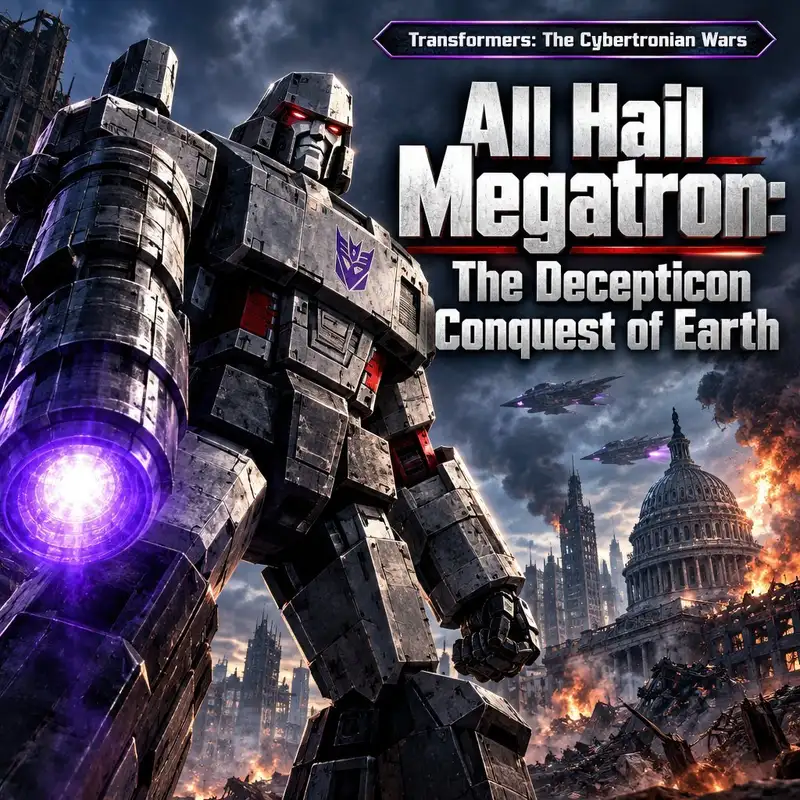
All Hail Megatron: The Decepticon Conquest of Earth
New York had already lost the battle when Megatron made his victory visible. The city’s damaged streets, broken defenses, and frightened survivors were not incidental scenery. They were the point. In this I D W history, the Decepticons did not arrive to make a threat, seize a laboratory, or conduct another covert raid. They arrived openly, destroyed what resisted them, and announced that Earth now belonged to Megatron.
That announcement carried unusual force because Earth’s most capable defenders were gone. The Autobots had been its shield against Cybertronian threats, however imperfectly and however quietly. Their absence did not mean that human governments had no armed forces, no intelligence services, or no will to resist. It meant that the planet faced a prepared Decepticon offensive without the only force known to possess comparable mobility, durability, and knowledge of its enemy.
The question, then, is not whether Megatron could defeat a human tank or shoot down an aircraft. The Decepticons plainly possessed advantages in those encounters. The deeper question is how they converted those advantages into a rapid planetary conquest, and why that conquest, so spectacular in its opening days, failed to become a stable Decepticon order.
The answer begins before the first public attack. Megatron did not conquer Earth through raw firepower alone. He waited until the Autobots were dispersed, compromised, and unable to coordinate a response. He used intelligence failures, personal betrayals, interplanetary separation, concentrated shock power, and terror against civilian targets. By the time human authorities understood the scale of the attack, the strategic conditions had already been arranged in the Decepticons’ favor.
This is the I D W continuity that began in two thousand five, not the animated invasion stories, the live-action films, or the earlier Marvel comic war. Its Earth had already become a place where humans and Cybertronians knew one another, fought beside one another, and sometimes exploited one another. That history mattered. The Decepticons were not attacking an unsuspecting planet that had never heard the name Cybertron. They were attacking a world whose defenses depended heavily on a small and vulnerable Autobot presence.
The immediate background lies in the crisis that pulled the Autobots away from Earth. In the period after Devastation, Autobot forces left to deal with an emergency connected to Garrus-9. The details of that wider crisis matter less here than its strategic consequence. Earth was left without its principal Cybertronian defenders at the precise moment when Megatron was prepared to act.
That was more than an operational inconvenience. It was the removal of a deterrent. Human governments could plan for conventional threats, even extraordinary ones. They could scramble aircraft, deploy ground forces, secure cities, and attempt to protect critical infrastructure. What they could not easily replace was a force that understood Decepticon weapons, Decepticon habits, Cybertronian communications, and the political logic of the war that had followed them to Earth.
The Autobots were not all killed in one opening blow. That distinction is important. Individual soldiers survived. Leaders survived. Specialists survived. But an army is more than a collection of living personnel. It needs command relationships, secure communications, intelligence, transport, repair capacity, and a way to move forces toward the threatened theater. The Decepticons did not need to destroy every Autobot. They needed to prevent surviving Autobots from functioning together.
Megatron’s timing therefore turned an Autobot deployment into a strategic trap. The Autobots had left Earth for a reason. They had not just abandoned it through negligence. Yet once they were drawn away, the distance between Cybertron and Earth became more than geography. It became a barrier to command, reinforcement, and trust. The Decepticons gained the initiative because they could choose when the crisis on one world would become catastrophe on another.
The intelligence breach at the center of the operation made that timing far more effective. Its roots lay in the earlier abuse of Sunstreaker and Hunter O’Nion by the Machination. Hunter was human. Sunstreaker was an Autobot. Both had been subjected to experimentation involving Headmaster technology, a process that bound human and Cybertronian systems in ways neither of them had chosen freely.
In this continuity, that technology should not be treated as a universal model for Cybertronian life. It was a specific and damaging intervention. It left Hunter and Sunstreaker connected through altered bodies, altered systems, and psychological trauma. What had been done to them was not a clever enhancement. It was an exploitation of sentient beings for power, control, and technological access.
Bombshell understood the value of that vulnerability. The Insecticon did not need to conquer Earth by force of personality or conventional command. His role was more intimate and more disturbing. Through Hunter’s altered condition and the connection to Sunstreaker, the Decepticons gained a route into Autobot information and systems. The operation turned one damaged human being into an unwilling point of entry against an entire defense network.
The comics establish the result more clearly than they establish every technical detail. The Decepticons gain access. Autobot units are isolated. Defensive arrangements are compromised. Information that should have been protected becomes useful to the enemy. The exact mechanics of every system breach are less important than the operational effect. Megatron’s forces knew enough, early enough, to strike a scattered enemy before it could understand the full shape of the threat.
Sunstreaker’s part in this betrayal remains one of the story’s most painful elements. He does participate in a betrayal involving Starscream, and his actions materially assist the Decepticon offensive. Yet the precise boundary of his knowledge is not entirely clear. It is difficult to say how much of Megatron’s broader plan he understood before the violence spread across Earth and Cybertron.
That uncertainty does not erase responsibility. Sunstreaker’s anger toward humanity grew from real abuse. He had been captured, altered, and treated as an object by people who believed they could take apart a Cybertronian life and use what they found. Hunter had suffered beside him. Their shared experience gave Sunstreaker reasons to hate the institutions and individuals that had harmed them.
But hatred of abusers is not the same thing as consent to mass destruction. A grievance can explain why someone becomes vulnerable to manipulation. It can explain why trust collapses. It cannot justify helping an invading force place entire civilian populations under threat. The tragedy of Sunstreaker is that he allowed genuine pain to become a weapon in someone else’s war.
Megatron’s larger campaign was designed around that weaponization of weakness. The Decepticons did not treat the invasion as a sequence of heroic duels. They attacked as a combined force. Air-capable units could strike or relocate quickly. Heavy combatants could smash defenses built for human-scale war. Insecticons could spread fear, conduct specialized operations, and exploit their own unsettling form of battlefield presence. Intelligence assets undermined coordination before the defenders could establish a common picture of events.
The campaign also depended on psychological warfare. A city under attack does not need to be completely destroyed to be strategically shaken. It only needs to lose confidence that its institutions can protect it. When communications fail, defenses collapse, and alien attackers move openly through the urban landscape, the immediate question for civilians is not whether a distant government has a plan. It is whether there will be power, transport, medical aid, shelter, or a safe route out before the next attack.
Megatron understood the value of spectacle. He was not trying to hide the Decepticons from humanity. He wanted humanity to see them. Years of covert maneuver, infiltration, and indirect conflict had given way to an assertion of naked authority. The Decepticons would no longer operate as a hunted remnant or a shadow force. They would demonstrate that they could seize a major world and dictate the terms of survival.
That was why New York mattered. The city was more than a convenient location for a battle. It was densely populated, internationally recognizable, tied to communications, commerce, transport, and public authority. An assault there carried meaning beyond the immediate military objective. It told people far beyond the city that ordinary systems of protection had failed in a place where they had expected those systems to hold.
The destruction shown during the conquest establishes severe civilian suffering. Streets are ruined. Infrastructure is damaged. People flee, hide, and lose contact with the institutions that once organized normal life. The story makes clear that the human cost is immense. It does not require an exact casualty figure to understand the scale of the disaster. Precision would be false comfort when the point is the collapse of safety itself.
Urban destruction served Megatron in the short term because it amplified fear. Fear slows decision making. It separates populations from their governments and governments from one another. It encourages authorities to concentrate on immediate survival rather than coordinated resistance. It can make even limited Decepticon control appear absolute, because people judge power by what they can see and what they cannot stop.
But terror has a built-in political weakness. It can compel obedience without producing consent. It can silence public life without creating a functioning society. It can force people underground, scatter them into smaller groups, or make them dependent on whatever local networks remain. An occupier that destroys infrastructure must eventually decide whether it can restore that infrastructure, protect it, and govern the people who rely on it.
The Decepticons were far better prepared to break Earth’s defenses than to demonstrate how they would administer Earth afterward. Human forces fought back where they could. Aircraft, missiles, armored units, and ground forces were not meaningless. They could impose risk, create local delay, and show that the invasion would not be welcomed. But they were confronting opponents with superior Cybertronian durability, transformation-based mobility, and a willingness to devastate the battlefield rather than preserve it.
That difference in purpose mattered as much as the difference in weapons. A human military defending a city must consider civilians, infrastructure, political authority, and the danger of escalating destruction. Megatron’s forces did not share those constraints. They could turn roads, buildings, communications networks, and defensive positions into targets. They could use the physical scale and mobility of their bodies as weapons in environments designed for human life.
The failure of the first defense was therefore not evidence of human cowardice or incompetence. It was evidence of strategic surprise. The defenders were asked to improvise against an enemy that had already selected the moment of attack, penetrated the opposing network, removed the most capable allied force, and prepared to treat an inhabited city as a demonstration ground.
As the first shock passed, human strategy changed. Conventional defense gave way to survival, intelligence collection, local resistance, and the search for a vulnerability. That transition was not glamorous. It required people to work under occupation, to preserve information, to identify which contacts could still be trusted, and to avoid being destroyed before they could affect the larger struggle.
Earth’s fall cannot be understood without looking back to the stranded Autobots. On Cybertron, the surviving forces faced their own crisis. Optimus Prime had been critically injured. Ratchet’s work was no longer simply battlefield medicine. It became an effort to preserve the life and authority of a leader while the organization around him came apart.
The surviving Autobots had personnel, experience, and a moral purpose. What they lacked was a reliable headquarters. Communications were uncertain. Intelligence was compromised. Trust had been damaged by the betrayal. Mobility between worlds had been disrupted. Under those conditions, even capable soldiers could not just decide to return to Earth and make it happen. They had to discover what had gone wrong, survive immediate threats, and restore enough organizational coherence to act.
Jazz, Prowl, Kup, Springer, Blurr, Sideswipe, and the other surviving Autobots represent different functions under strain. Some were trying to investigate. Some were trying to hold a force together. Some were focused on movement, combat survival, or the recovery of damaged comrades. Ratchet had to keep injured personnel alive while working with limited certainty about what had compromised their side.
This was more than a matter of low morale. It was a command failure created by enemy action. An army can endure casualties if it retains a chain of command, secure supply, and a clear mission. It can endure isolation if it can communicate. It can endure uncertainty if it trusts its intelligence. The Autobots were forced to contend with all of these problems at once.
The Insecticons added another layer of danger. Their role in the story is not limited to direct combat. They are connected to the intelligence exploitation that made the larger offensive possible, and they create a form of threat that is difficult to contain through ordinary force alone. They turn damaged bodies, altered systems, and captured personnel into parts of a wider Decepticon apparatus.
Hunter’s fate is the clearest example. He was more than a piece of equipment plugged into a machine. He was a human being caught at the intersection of human experimentation, Cybertronian warfare, and Decepticon exploitation. His altered condition made him useful to forces that did not care whether he remained himself, whether he suffered, or whether there was any meaningful consent in what they were doing to him.
When Sideswipe discovers Hunter’s condition, the story forces the Autobots to confront the human cost of a war that had so often been described in factional terms. There is no clean solution. Hunter cannot simply be extracted from the situation and returned to normal. Sideswipe ends his suffering, an act shaped by mercy, desperation, and the recognition that the damage had gone beyond ordinary rescue.
It is one of the bleakest moments in the campaign because it shows what intelligence warfare can become when bodies and minds are treated as infrastructure. The Decepticons needed access. The Machination had already created an abusive technological link. Bombshell exploited it. The result was not only a successful breach. It was the destruction of a person who had become trapped inside the machinery of war.
That loss also changes the meaning of Sunstreaker’s betrayal. The breach was not an abstract failure in Autobot security. It was built upon suffering that had been ignored, mishandled, or transformed into resentment. The Decepticons were able to use that resentment because they were willing to treat Hunter and Sunstreaker as tools. The Autobots, by contrast, had to confront the consequences of treating damaged allies as people whose pain mattered.
The Cybertron theater therefore explains why Earth remained vulnerable for so long. The Autobots were not absent because they had forgotten the planet. They were cut off by injury, betrayal, hostile control of information, and the loss of dependable movement between worlds. Earth’s defense had become inseparable from a fight to restore Autobot institutional capacity.
The Decepticons also possessed a more obvious form of concentrated power in Devastator. The combiner’s appearance mattered because it brought several Decepticon combatants together into one massive battlefield asset. In a local engagement, that kind of force can break formations, overwhelm defenders built for individual opponents, and turn a defensive stand into a rout.
Devastator’s significance is operational rather than statistical. The story does not establish a vast, standardized army of equally stable Decepticon combiners. It establishes one formidable concentration of force that can make the defender’s problems much worse. Where ordinary troops must coordinate fire and maneuver, Devastator can impose shock through sheer presence, durability, and destructive capacity.
Such an asset is especially useful in the early stages of an invasion. It magnifies the impression that resistance is futile. It can destroy a strongpoint, scatter a formation, or force defenders to choose between exposing themselves and abandoning ground. It also serves Megatron’s larger political purpose. Decepticon power is more than claimed. It is displayed.
Yet even Devastator reveals the difference between winning a battle and governing a planet. A combiner can break a line. It cannot establish courts, restore water systems, negotiate with local authorities, organize food distribution, repair communications, or persuade millions of civilians that the new order deserves obedience. Shock power can open the door to occupation. It cannot by itself make occupation durable.
That distinction sits at the center of Megatron’s victory. The Decepticons controlled territory through force. They controlled public space through fear. They controlled the tempo of events because the Autobots were absent or fragmented. But the story does not show them creating a stable civil administration for Earth. It shows conquest much more clearly than government.
Megatron’s rule depended on personal authority. He was commander, symbol, and source of ideological direction. His presence gave the Decepticon campaign coherence. His victories demonstrated that he could reward success, punish failure, and compel subordinates to think in terms of Decepticon triumph. In a crisis, that kind of concentrated leadership can be effective.
It is also brittle. A system built around one commander must answer difficult questions whenever that commander is absent, injured, challenged, or unable to impose a decision. Who succeeds him? What authority exists apart from him? Which officers obey the cause, which obey the organization, and which obey only the individual who has kept them in line through fear and prestige?
The conquest of Earth exposed those questions rather than resolving them. The Decepticons had no demonstrated political settlement for humanity. They had no visible arrangement that could reconcile conquered populations to their rule. They had not shown how they would manage the enormous burden of holding a damaged planet while fighting a continuing Cybertronian war.
Their industrial and logistical position remains uncertain as well. The story provides no dependable figures for Decepticon force strength, replacement capacity, or the long-term resources required to maintain planetary occupation. A destroyed city may be an immediate victory in terror, but it can also become a liability. Ruined infrastructure cannot sustain commerce, movement, or basic civilian life without repair, labor, and security.
Megatron’s conquest was thus strongest at entry. The Decepticons were prepared for the first blow. They were prepared to exploit confusion and destroy opposition. They were less clearly prepared for the long, unglamorous work that follows. Holding territory requires not only soldiers but information, maintenance, transport, discipline, local knowledge, and some answer to the question of why the occupied should accept the occupier’s authority.
Human resistance began to exploit that weakness. People who could no longer stop Decepticon forces in open battle could still observe, communicate, hide assets, and search for openings. Spike Witwicky’s role in this continuity reflects that evolution. He is more than a civilian friend caught near extraordinary events. He operates as a military and intelligence figure in a struggle where human knowledge of Earth becomes strategically valuable.
The human contribution did not erase the imbalance in combat power. It changed the kind of contest being fought. Resistance does not need to defeat every enemy unit. It needs to survive, preserve contacts, gather intelligence, and identify the point at which the enemy’s advantage can be narrowed. That is difficult work under occupation, particularly when the occupier can transform, move rapidly, and strike with overwhelming violence.
At the same time, the Autobots gradually recovered the means to return. The comics establish the restoration of interplanetary movement and the intervention of surviving allies, including the Wreckers in the wider connected material. The precise technical history of every bridge, ship, or transit system is less important than the strategic result. The Autobots regained mobility. They could once again bring Cybertronian force into the Earth theater.
That return changed the war immediately. Megatron had conquered a planet whose strongest alien defenders were absent. Once the Autobots reappeared, Earth was no longer an occupied target without a peer opponent. It became a contested battlefield. Decepticon units now had to fight an enemy that understood their capabilities, could challenge their command, and could cooperate with human resistance networks.
The Decepticons lost their monopoly on organized Cybertronian force. That did not mean that the Autobots had suddenly become strong, united, or fully recovered. They were still carrying the consequences of betrayal, injury, and delay. But even a weakened Autobot return altered the political message of the occupation. Megatron’s claim that resistance was futile became harder to maintain once resistance had visible allies again.
The internal tension within the Decepticons now became more dangerous. Starscream’s challenge to Megatron was more than a familiar act of personal ambition. It exposed the absence of secure succession rules. Starscream wanted power, but his timing also reflected a real strategic opening. Megatron’s attention had been drawn toward Optimus Prime, toward Earth, and toward the personal contest that had always shaped the wider war.
A command structure built around personal dominance often treats rivalry as a problem to be managed through intimidation. That can work while the leader is visibly invincible. It works less well when the leader must divide attention between an enemy counteroffensive, a damaged occupation, and discontent within his own ranks. Starscream’s move showed that Decepticon unity was conditional, not automatic.
Megatron defeats the immediate challenge through force and through the authority he still holds over the Decepticon cause. His argument, in effect, is that ambition must wait until victory is secure. That argument succeeds for the moment. Starscream returns to the fight. But temporary cooperation should not be mistaken for loyalty. The episode’s deeper point is that Megatron can still command obedience because the Decepticons believe they need him in crisis.
That belief is not the same thing as institutional stability. If a faction must repeatedly be held together by the personal strength of one commander, then every wound to that commander becomes a strategic event. Every rival becomes a possible fracture point. Every battlefield setback becomes an argument about who should rule next.
The final confrontation brings those vulnerabilities together. Human resistance develops or deploys an experimental weapon capable of seriously damaging Megatron. The weapon does not solve the war by itself. It does not defeat the Decepticon army, rebuild the occupied cities, or restore the Autobots’ lost confidence. What it does is create an opening against an enemy who had seemed personally untouchable.
That opening matters because Optimus Prime can exploit it. Their fight is more than a contest of individual strength. It is the collision of two competing command systems. Megatron has built a conquest around his own will, his own survival, and his ability to dominate subordinates and enemies alike. Optimus returns as the leader of a wounded but still functioning alternative, one capable of gathering Autobots and human allies around resistance rather than occupation.
When Optimus defeats Megatron, the immediate military result is significant. The Decepticon leader who made the conquest possible can no longer direct it in the same way. The occupation loses its central source of authority at the moment when it is already under pressure from Autobot return and human resistance.
But this is not a clean liberation. Megatron is defeated, not conclusively removed from history. Starscream recovers his body. The Decepticons withdraw rather than surrender. Their forces remain dangerous, their leadership remains unresolved, and their broader war against the Autobots continues. Earth is not restored because one battle has ended.
The civilians of Earth are left with the aftermath of a conquest that demonstrated how quickly public order can fail when a stronger force strikes at the wrong moment. Buildings can be rebuilt. Systems can be repaired. But fear, displacement, loss, and political distrust do not disappear as quickly as wreckage can be cleared. The Autobots’ return protects Earth from continued Decepticon domination, but it does not erase what the occupation has done.
Megatron’s conquest succeeded because he did not begin by attacking a fully prepared Autobot-human defense. He attacked after Earth’s protectors had been removed, divided, and compromised. He used intelligence access to create surprise, shock forces to exploit it, and terror to make destruction appear like control.
Yet the same campaign failed to produce peace because devastation is not governance. Fear is not legitimacy. And a movement held together by one commander’s authority becomes fragile the moment that commander can be wounded, challenged, or removed.