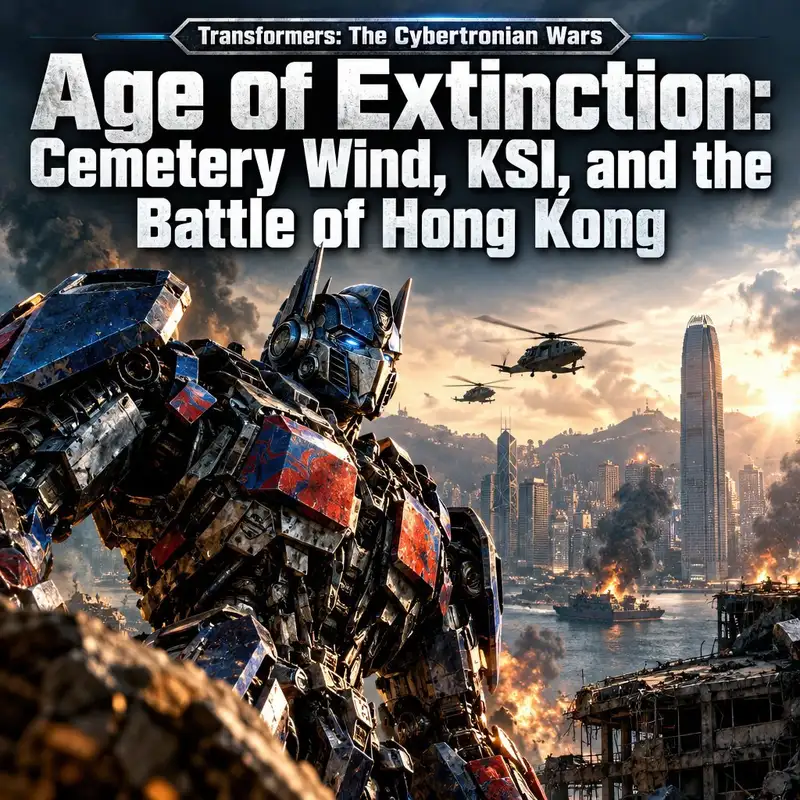
Age of Extinction: Cemetery Wind, KSI, and the Battle of Hong Kong
The Seed was more than a prize in the Battle of Hong Kong. It was a device designed to turn a city into raw material. Galvatron wanted it detonated in the largest urban center he could reach. The result would have been the death of civilians across a wide area, the destruction of infrastructure, and the creation of a vast field of Transformium, the programmable metal Kinetic Solutions Incorporated used to build artificial Transformers. In military terms, this was a weapon of mass destruction paired with an industrial expansion plan. In political terms, it was the endpoint of a system that had already decided sentient Cybertronians could be hunted, dismantled, traded, and remade for human purposes.
That is why Hong Kong matters in Age of Extinction. It was more than the location of a climactic fight between familiar robots. It was where three separate projects collided. Harold Attinger and Cemetery Wind sought to eliminate Cybertronians while concealing their own illegal methods. Joshua Joyce and KSI sought to replace unpredictable alien allies with a human-controlled automated military. Galvatron, carrying the surviving intelligence of Megatron in a form the film does not fully explain, sought to use their industry to build a new Decepticon force. The city became the battlefield because each side believed it could control technology, information, and violence that had already escaped its control.
This is the live-action film history of Age of Extinction, set five years after the Battle of Chicago. That earlier battle had demonstrated both the danger posed by Cybertronian war and the value of Autobot cooperation. Chicago survived because humans and Autobots fought together against the Decepticons and Sentinel Prime’s plan to bring Cybertron to Earth. But military coalitions formed in an emergency often struggle once the emergency appears to be over. The question becomes who retains authority, who bears responsibility, and who decides which former ally is still welcome.
The film presents a post-Chicago political settlement that was never really settled. Congress has ended joint military operations with the Autobots. Surviving Cybertronians are publicly described as having received sanctuary, yet public suspicion remains intense and government agencies encourage citizens to report alien activity. A state facing the aftermath of a devastating attack had legitimate security questions to answer. It needed to distinguish hostile survivors from cooperative ones, recover dangerous weapons, investigate Decepticon networks, and protect civilians from another attack. Those are difficult but recognizable tasks.
What the film does not show is a transparent system for carrying them out. There is no visible public treaty governing Autobot status, no accountable joint command, no credible process for registration or asylum, no disarmament arrangement, and no clear legal protection for civilians who shelter Cybertronians. That absence creates an institutional vacuum. Fear can then be converted into secrecy. Secrecy can be converted into salvage. And salvage can become a source of profit and political power.
Harold Attinger operates inside that vacuum. He presents himself as a defender of humanity after Chicago, a man willing to do what elected institutions and sentimental allies will not. Yet his real position is more complicated and more dangerous. Cemetery Wind is identified as a CIA-associated unit, but its actions are also portrayed as illegal black operations. The film leaves its exact chain of authorization unclear. It would be inaccurate to call it wholly rogue. It would be equally inaccurate to treat it as an openly accountable government force operating under normal law.
That ambiguity is central to its function. Cemetery Wind has access to surveillance, aircraft, armed personnel, intelligence networks, and the authority to move through a frightened country. It can identify targets, raid private property, interrogate witnesses, and seize Cybertronian bodies and equipment. James Savoy, Attinger’s field commander, is the operational expression of that authority. He is not shown conducting a careful campaign to separate Decepticon remnants from Autobots, neutral Cybertronians, or human civilians caught in the middle. He executes a doctrine of elimination.
The distinction matters because counterterrorism depends on discrimination. A force that treats every member of a broad population as a threat gains speed in the short term, but it loses intelligence, legitimacy, and possible allies. Cemetery Wind sees no meaningful difference between an Autobot who defended Chicago and a Decepticon who attacked it. That goes beyond prejudice. It is an intelligence failure built into policy. By erasing distinctions among political factions, individual loyalties, and civilian associations, Attinger turns potential partners into fugitives and turns witnesses into targets.
The consequence is visible in Texas, where Cade Yeager finds a damaged Optimus Prime hidden in an old truck body. Cade is not a government official, soldier, or intelligence officer. He is an inventor and mechanic trying to keep his struggling household together. His discovery shows what postwar policy looks like at the human level. Optimus Prime, once a public ally in the defense of Earth, is now injured, concealed, and dependent on the help of a civilian who does not initially understand what he has found.
Optimus’s condition is strategically important. He is not commanding a large Autobot army with secure bases, supply depots, and diplomatic protection. He is isolated, damaged, suspicious of human institutions, and trying to protect a small surviving group. Bumblebee, Hound, Crosshairs, and Drift are not presented as the advance guard of a massive expeditionary force. They are a scattered remnant. Their immediate task is survival, concealment, and recovery. They have neither territorial control nor the freedom to build a durable defense.
Cemetery Wind’s raid on Cade’s farm confirms that the old alliance is gone. The attack places Cade, his daughter Tessa, and the people around them in immediate danger because they are connected to Optimus. This is what a broad elimination policy does. It expands its target set. Anyone offering shelter, medical help, transportation, or information can become an obstacle to be removed. The operation is no longer only about alien combatants. It is about controlling the human environment around them.
At the same time, Cemetery Wind is not the only force hunting Optimus. Lockdown is pursuing him as well. The distinction between these threats must remain clear. Attinger wants Cybertronians eliminated or exploited in the name of human security and private power. Lockdown is an independent Cybertronian bounty hunter serving the mysterious Creators. He is not a Decepticon officer, and he is not a Cemetery Wind subordinate. His interest in Optimus is transactional and tied to a wider mission whose full purpose is not known to the people making deals with him.
The presence of Lockdown changes the balance immediately. Cemetery Wind has human intelligence resources and state-linked access. Lockdown has superior Cybertronian mobility, a large ship, specialized containment systems, and weapons far beyond ordinary human capability. Attinger believes he can use that power. But an alliance with a stronger outside actor is never free. It creates dependence. The junior partner gains a capability it could not build for itself, then discovers that it cannot define the senior partner’s aims.
Cade and the Autobots eventually uncover the mechanism linking Cemetery Wind to KSI. The hunters are not just destroying Cybertronians. They are recovering their remains and technology, then delivering them into a corporate pipeline. Bodies, components, and downloaded neural information become industrial inputs. The war’s dead are treated not as persons, prisoners, or evidence of possible crimes, but as material for a new weapons program.
Kinetic Solutions Incorporated is a private defense and aerospace firm based in Chicago. It is more than a government arsenal wearing a corporate logo. The distinction matters because KSI’s incentives differ from those of a public military command. Joshua Joyce wants national security, but he also wants commercial relevance, technological prestige, and freedom from dependence on alien partners. The company’s project promises all of those things at once. If KSI can reproduce Cybertronian bodies and manufacture obedient Transformer soldiers, it can offer governments a force that appears powerful without being politically autonomous.
The appeal is understandable. The events of Chicago had made human reliance on Autobots look dangerous. Even grateful allies might ask whether a nation should depend on extraterrestrial warriors whose old civil war keeps reaching Earth. Joyce’s answer is not diplomacy or a regulated alliance. It is substitution. He believes human industry can take the useful parts of Cybertronian technology, remove the uncertainty of Cybertronian will, and produce defenders that answer only to human command.
That belief depends on several assumptions. KSI needs recovered material. It needs Transformium. It needs engineering knowledge drawn from Cybertronian systems. It needs manufacturing capacity to shape new bodies. And it needs some way to make those bodies obey. The company can perform elements of the first four tasks. It can salvage remains, study data, process programmable matter, and construct prototypes. But control is a different matter. Building a body is not the same as creating a mind. Downloading neural information is not the same as understanding identity. Programming behavior is not the same as possessing reliable command authority.
The film is deliberately vague about the deepest mechanics. It does not provide a complete theory of Cybertronian consciousness, memory, or survival after bodily destruction. It would be too simple to say that KSI creates living beings from ordinary metal. The company works with Cybertronian remains, neural material, Transformium, and data that it believes it can organize into human-directed machines. Its engineers are operating in a field where biology, machinery, memory, and personhood overlap. Their confidence exceeds their knowledge.
This is also the ethical center of the KSI project. Joyce speaks as though he is freeing humanity from the burden of alien dependence. But his company’s supply chain depends on the remains of sentient beings killed or captured through Cemetery Wind’s covert campaign. Even if KSI’s engineers believe they are making machines rather than reviving persons, they are still treating Cybertronian bodies and minds as salvageable property. The moral question is not solved by calling the product defense technology.
The political economy of the arrangement is brutally efficient. Cemetery Wind’s hunt produces the raw material KSI needs. KSI’s research gives Attinger a reason to keep hunting. Corporate ambition and secret state violence reinforce one another. Neither institution needs a formal declaration that it is building a new order. The system emerges through contracts, covert transfers, classified access, and the habitual belief that security permits exceptions.
Joshua Joyce does not appear to see himself as a villain. He appears to believe that an automated military could reduce human casualties and place dangerous force under responsible control. This is a familiar argument in weapons development. If machines can take the risk, perhaps soldiers and civilians will be safer. If technology can be programmed, perhaps it can be made more disciplined than living allies. If the state owns the factory, perhaps it owns the outcome.
But KSI’s prototypes are not empty drones in the ordinary sense. They are based on a technology Joyce does not fully understand, derived from a civilization with its own history of war, memory, identity, and factional conflict. The company mistakes technical replication for political control. It assumes that because it can manufacture a body, it can determine the loyalties inside that body. The error is not just scientific. It is institutional. KSI has no serious mechanism for independent verification, no demonstrated safeguard against hostile intelligence, and no ability to distinguish a controllable prototype from a reconstituted enemy.
Galvatron exposes that failure. KSI believes it has produced a human-designed Transformer modeled on Megatron’s data. Instead, the new body becomes associated with Megatron’s surviving consciousness. The film uses language of reincarnation, but the precise process remains unresolved. Whether this is survival, transfer, reconstruction, copying, or some combination of those concepts is not fully established. What matters operationally is clearer. Galvatron possesses independent agency. He is not an obedient product. He is a hostile political actor with access to a weapons program built for him by his enemies.
This is a command-and-control collapse before it becomes a battlefield crisis. Galvatron does not need to defeat KSI’s management through a conventional assault. He emerges from within the production system. He takes control of the other prototypes and turns a corporate demonstration into a mobilization event. The film indicates that he can direct roughly fifty additional KSI prototypes. That figure should be treated as an indication of the local force available in this operation, not as a reliable measure of some global army. Even so, it is enough to change the situation.
Galvatron’s objective is not just revenge against Optimus Prime. He seeks the Seed. With it, he can destroy a major city, generate immense amounts of Transformium, and expand his force far beyond the prototypes already available. This is the moment when KSI’s industrial program becomes a seedbed for a renewed Decepticon-style army. Human industry supplies bodies. Megatron’s surviving intelligence supplies direction. The Seed promises raw material on a catastrophic scale.
The plan reveals the limits of Joyce’s original wager. Automated defense was supposed to spare human lives by removing alien autonomy from the equation. Instead, the project gives a revived enemy access to an industrial base that human institutions built, staffed, and defended. The more KSI succeeds at replication, the more dangerous Galvatron becomes. The company has not eliminated the political problem of Cybertronian war. It has internalized it.
Attinger’s partnership with Lockdown follows a similar pattern. Lockdown offers capabilities Cemetery Wind cannot match. His ship can move forces and prisoners across vast distances. His containment systems can hold Cybertronians whom human facilities could not safely manage. He possesses captive Dinobots, immense Cybertronian heavy assets whose original organization and political status the film does not fully explain. He also carries a magnetic weapon powerful enough to reshape the conditions of an urban battle.
But Lockdown’s capabilities are not under Attinger’s command. The bargain between them is simple in form and disastrous in consequence. Attinger offers Optimus Prime. Lockdown offers the Seed. One Prime for one Seed. The exchange allows Attinger to obtain a weapon of extraordinary strategic value while removing the Autobot leader he sees as the greatest obstacle to his campaign. Yet it also gives Lockdown leverage over the entire operation.
Attinger appears to believe that possession of the Seed will make him powerful. In reality, possession is not understanding. He does not know the wider agenda of the Creators. He cannot reproduce Lockdown’s ship, contain its technology, or compel the bounty hunter to remain loyal once the exchange is complete. His arrangement resembles a state contracting out a vital security function to a stronger foreign force, then discovering that the contractor has its own mission, its own intelligence, and its own timetable.
The Autobots’ response is improvised because their circumstances permit little else. They infiltrate Lockdown’s ship, rescue Tessa, free the Dinobots, recover the Seed, and escape. The operation restores initiative, but not strategic security. The Autobots are still a small force. They have no visible industrial base and no durable support structure. Their success depends on local knowledge, personal courage, Cade’s intervention, and the fact that their enemies are divided by incompatible goals.
The release of the Dinobots is especially important. These are not introduced as a standing Autobot formation with a known chain of command or supply system. They are prisoners aboard Lockdown’s ship. Their liberation gives Optimus access to heavy combat power at the point of greatest need, but it does not solve the wider problem of Autobot weakness. A battlefield reinforcement can change a local balance without creating a stable political order.
The Seed then moves toward China. KSI’s facility in Guangzhou becomes the immediate destination because Attinger transfers the device to Joshua Joyce. This is the moment when Joyce’s corporate project, Attinger’s covert campaign, Lockdown’s bargain, and Galvatron’s rebellion all become physically concentrated around a single object. The Seed is no longer an abstract resource or classified artifact. It is a mobile strategic objective pursued by multiple armed groups.
Galvatron’s break from KSI is now open. He no longer needs to pretend that he is a controllable prototype. He directs the other KSI-built forces to find the Seed and use it against a major city. The movement toward Hong Kong is therefore not an invasion planned around the conquest of China. It is a pursuit operation centered on a weapon whose value depends on urban destruction. The city is selected because its population and infrastructure make it an ideal target for the Seed’s intended effect.
The Chinese central government responds, and fighter aircraft are dispatched toward the crisis. That matters because the battle is not occurring in a political vacuum. Hong Kong is not an empty arena reserved for the protagonists. It is part of a sovereign state with its own authorities, military forces, civilians, roads, buildings, ports, and communications. But the film does not provide enough evidence for a detailed account of Chinese command arrangements or force strength. It would be wrong to claim that Chinese forces decisively defeat the attackers. The ground battle’s decisive actions come from the Autobots, their human allies, the Dinobots, and the breakdown of the enemy coalition.
By the time the fight reaches Hong Kong, the city contains at least four overlapping conflicts. The Autobots need to prevent the Seed from detonating and protect civilians. Galvatron’s prototype force needs to seize it and turn destruction into industrial expansion. Cemetery Wind needs to preserve Attinger’s arrangement, eliminate Cybertronian survivors, and remove witnesses who can expose its operations. Lockdown needs to recapture Optimus and recover the Seed for his own mission. These are not allied objectives. They merely occupy the same battlefield.
That fragmentation is as important as firepower. A force can be large and still be weak if its commanders disagree about the purpose of the operation. Galvatron needs destruction. Attinger needs secrecy and control. Lockdown needs capture and retrieval. The Autobots need protection and denial. None of the hostile factions can fully trust the others. Their temporary intersections of interest create danger, but they also prevent them from forming a coherent coalition.
Hong Kong’s terrain intensifies the problem. Dense buildings, elevated roads, constrained routes, commercial infrastructure, and a large civilian population limit maneuver while multiplying hazards. The Seed is a moving objective. Anyone carrying it becomes a target. Anyone trying to destroy it risks triggering the very catastrophe they are trying to prevent. In such a setting, speed matters, but so do identification, route security, communications, and the ability to distinguish a rescue effort from an attack.
Urban terrain also denies clean separation between military and civilian space. Metal is everywhere. Vehicles, construction materials, rail systems, towers, signs, barriers, and the internal structures of buildings all become part of the battlespace. This matters when Lockdown deploys his magnetic weapon. The weapon does not just create an explosion. It turns the city’s own material environment into a moving threat. Metal objects are pulled through streets and around buildings, disrupting movement and endangering every force in the area.
That is an area-denial effect. It interferes with the Autobots’ ability to maneuver, threatens the humans who are moving with them, and creates chaos that no side can fully control. It also demonstrates Lockdown’s indifference to local consequences. His objective is not the defense of Hong Kong, the survival of its population, or even the success of Attinger’s plan. He is pursuing Optimus and the Seed. The city is simply the terrain through which those objectives are moving.
The Autobots enter this battle badly outnumbered and with limited sustainment. Hound’s experience is the clearest reminder that even Cybertronian warriors do not possess unlimited combat endurance. He runs low on ammunition and energy. This is not a minor detail. The Autobots are fighting far from any visible supply line, without a secure repair facility, reserve force, or industrial support network. They can carry weapons, improvise, and fight with considerable skill, but they cannot assume endless firepower.
That shortage changes the meaning of every engagement. The Autobots cannot simply overpower the KSI prototypes through attrition. They must preserve the Seed, protect their human allies, avoid being captured, and survive long enough for an opening to emerge. Their situation resembles that of a small expeditionary force trapped in a city against a better supplied but politically fractured enemy. Tactical competence matters, but it cannot replace logistics forever.
Cemetery Wind’s position is also deteriorating. Its personnel may be trained and armed, but the unit’s strength depended on secrecy, surveillance, and the ability to strike isolated targets. In Hong Kong, it is exposed inside a large, fast-moving confrontation involving Cybertronian forces it cannot fully command. Its relationship with KSI is compromised. Its relationship with Lockdown is conditional. And its effort to define all Cybertronians as enemy combatants becomes harder to sustain when the Autobots are visibly preventing a mass-casualty attack.
The arrival of the Dinobots shifts the local balance. Optimus defeats Grimlock and gains the Dinobots’ participation in the fight. The film does not provide a full explanation of what political obligation, personal judgment, or command structure follows from that encounter. It is safer to say that the Dinobots join the immediate battle than to describe them as permanently integrated Autobots. Yet their tactical effect is unmistakable. They bring mass, mobility, and shock power to a force that had been struggling to hold ground.
Their intervention helps break Galvatron’s drone force. This is not because size alone guarantees victory. Large assets can be vulnerable, difficult to control, and dependent on the terrain around them. But in this specific moment, the Dinobots give the Autobots enough local superiority to disrupt a force built around numerical advantage and centralized control. The KSI prototypes are dangerous, but they are also tied to Galvatron’s command network and to a plan that depends on quickly securing the Seed.
Once the prototypes lose momentum, Galvatron’s strategy begins to fail. He has not been destroyed, and his force is not necessarily erased from existence. But he cannot complete the decisive act of detonating the Seed in the city. That difference is important. The Autobots achieve mission success by preventing the planned conversion event. They do not achieve a final political settlement with Megatron’s surviving intelligence. Galvatron survives and withdraws, preserving the possibility of renewed conflict.
Cemetery Wind collapses for different reasons. Its defeat is more than a matter of losing a gunfight. Savoy dies during a close-quarters struggle with Cade. Attinger then confronts Cade directly as the wider battle reaches its end. When Attinger threatens Optimus, Optimus kills him. The covert campaign loses its chief political operator at the moment its methods are becoming impossible to conceal.
Attinger’s death does not automatically reveal every document, expose every collaborator, or produce institutional reform. The film does not show a formal investigation, public trial, congressional inquiry, or comprehensive reckoning. But it does show the operational collapse of his system. Cemetery Wind depended on the belief that it could act in darkness, use Lockdown without becoming dependent on him, exploit KSI without being implicated by it, and eliminate Autobots without provoking a wider crisis. Hong Kong destroys those assumptions.
Lockdown remains dangerous even after Attinger falls. His mission has always been distinct from Cemetery Wind’s. He attempts to recapture Optimus and regain control of the Seed. The final confrontation therefore does not represent the defeat of one unified enemy command. It is the last effort of an independent hunter whose objectives have survived the failure of every human arrangement around him.
Cade, Tessa, Shane, and the Autobots intervene. Their role is significant because the battle repeatedly depends on cooperation across categories Attinger’s doctrine had tried to erase. A human mechanic, his daughter, a driver, and a small Autobot force become more effective together than a secret program built on suspicion and coercion. This does not mean informal friendship is a substitute for policy. It means that trust, local knowledge, and mutual recognition can produce capabilities that secrecy cannot.
Optimus kills Lockdown, ending the immediate pursuit. The Seed is not detonated. Hong Kong avoids the conversion event Galvatron intended. The KSI prototype force is routed from the field. Cemetery Wind’s leadership is destroyed. Lockdown’s mission fails. In the immediate fight, this is a clear defensive victory. A city survives an attack designed to make it the raw material for another army.
Operationally, the results are more mixed. KSI loses control of the program it believed would secure its future. Its central assumption, that human engineers could build Cybertronian bodies while retaining human command, has been disproved. Cemetery Wind’s network has been shattered in practice, though the film does not fully map the aftermath. The Autobots have regained some initiative, but they remain a small and damaged force rather than the protected partners they were before Chicago.
Strategically, the dangers remain. Galvatron survives. The Creators remain an external threat, though their motives and identity are not fully known within the events of this film. Earth has demonstrated that it can become the manufacturing base, refuge, prison, and battlefield of a Cybertronian war without possessing the institutions to govern any of those roles responsibly. The immediate weapons crisis is over. The underlying security crisis is not.
Optimus takes the Seed away from Earth and leaves to confront the Creators. That decision removes the device from immediate human reach, but it also means the most experienced Autobot commander departs a planet where the political relationship between humans and Cybertronians remains unresolved. There is no restored public alliance. No new treaty is shown. No durable mechanism appears for distinguishing allies from enemies, regulating advanced technology, protecting civilians, or preventing another covert weapons program from growing in the shadows.
The civilian lesson is equally severe. Hong Kong is saved from the Seed’s planned destruction, but the battle confirms how vulnerable cities become when alien conflict is managed through secrecy. Citizens do not choose to become raw material, cover for covert units, or obstacles in a struggle among competing off-world powers. Yet the institutions around them repeatedly treat the city as a target, a route, a testing ground, or a source of leverage.
The Battle of Hong Kong demonstrates that the failure after Chicago was not just anti-Transformer prejudice, and it was not just uncontrolled alien technology. It was the attempt to manage sentient, politically divided Cybertronians as salvage, software, and secret weapons. Cemetery Wind created the supply chain. KSI built the factory. Megatron’s surviving intelligence turned both into an army. Hong Kong was saved because a small Autobot force, human allies, and newly released heavy assets broke that chain before the Seed could be used, but the film leaves Earth without the accountable institutions needed to prevent the next one.