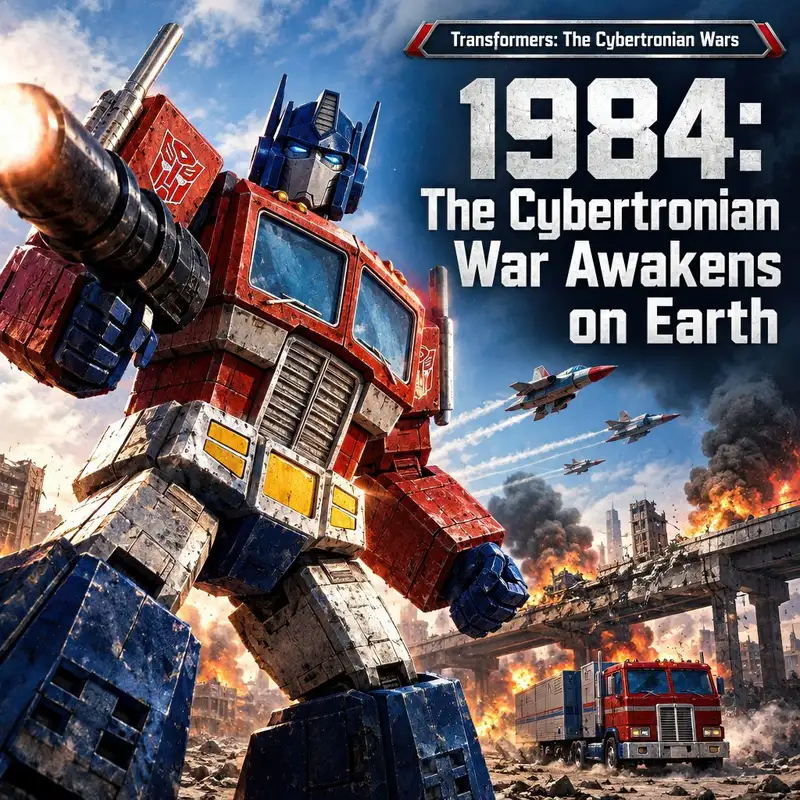
1984: The Cybertronian War Awakens on Earth
On an offshore oil platform in 1984, the Cybertronian war ceased to be somebody else’s distant problem. Decepticons were drawing energy from the installation and converting it into energon cubes. Their work had already damaged the rig. Sparkplug Witwicky and his son Spike were trapped amid collapsing machinery, fire, and open water. Megatron’s force was withdrawing with fuel that could help restore its path to Cybertron. Optimus Prime had a harsh choice. He could pursue the raiders and perhaps deny them their cargo, or he could save two humans who had no part in a war that began far beyond Earth. He chose the rescue.
That decision matters because it defines the character of the Earth war in the original nineteen eighty-four animated continuity. Earth was not initially selected as a Decepticon colony, an Autobot sanctuary, or the target of a planned invasion. It became a battlefield because two exhausted armies crashed there, discovered usable resources, and found themselves unable to leave the other side alone beside them. The oil platform was not just an action setting. It was infrastructure. It was a fuel source, a workplace, and a civilian target. From the first days of contact, the struggle over energon became a struggle over who would bear the cost of Cybertron’s unfinished civil war.
The immediate crisis on the platform began on Cybertron, where the long conflict between Autobots and Decepticons had brought the planet into an energy emergency. The cartoon never provides a detailed economic survey of Cybertron. It never establishes exactly how many mines remained active, how much energon either faction possessed, or how long the war had been underway. What it does show is a civilization in which available energy had become strategically decisive. The war could not continue indefinitely on slogans, courage, or weapons alone. Machines that required energy to move, fight, repair, and travel had exhausted much of the system that sustained them.
The first episode makes this shortage visible through a modest recovery mission. Wheeljack and Bumblebee return with only a small supply of energy conductors. Their find is useful, but plainly insufficient. That detail establishes the scale of the problem. Cybertron’s leaders were no longer managing abundance. They were competing over remnants. A military force without energy cannot maintain its weapons, preserve its mobility, conduct repairs, or operate the ships needed to move beyond its own planet. Even a decisive battlefield victory would have limited value if the victor could not sustain the damaged force afterward.
Optimus Prime’s response was not a final strategy for winning the war. It was an emergency logistical measure. He authorized an expedition beyond Cybertron to search for new energy sources. The immediate purpose was survival and recovery. If the Autobots could find usable power elsewhere, they might regain the ability to continue resisting the Decepticons. In military terms, the expedition addressed a sustainment crisis before it addressed a tactical opportunity. That distinction is important. The Autobots did not depart because they had conquered Cybertron. They departed because their position on Cybertron had become increasingly difficult to sustain.
Megatron understood the danger. An Autobot energy expedition was not just a scouting mission. If it succeeded, it could restore Autobot operational freedom. More fuel meant more repairs, more movement, more capacity to defend territory, and more ability to keep fighting. The Decepticon leader therefore followed the Autobot ship in a cruiser of his own. His decision transformed a desperate search into a pursuit. The Autobots were looking for resources. The Decepticons intended to prevent those resources from strengthening their enemy, and if possible to take them for themselves.
The two sides entered the expedition with different immediate purposes, but both remained tied to the same strategic problem. Cybertron could no longer easily sustain a war of attrition. Every remaining source of energy had political value because it could alter the balance between the factions. A new supply did not need to be vast to matter. It only needed to provide one side with a margin of recovery that the other could not match. In that sense, the pursuit was already a campaign over future capacity, not just a chase between rival ships.
The mission failed before either faction had found a new source of power. The ships encountered colliding asteroids. The Autobot vessel had depleted its weapons and could not effectively defend itself. Megatron’s Decepticons boarded. Combat spread through the ships, and the consequences were more serious than a conventional boarding action. Neither side could maintain secure control of its transport. The struggle that had begun as a contest over energy became a contest inside damaged spacecraft, with both forces endangered by the same loss of mobility.
The important result was not just that the Autobots and Decepticons fought in close quarters. It was that strategic movement collapsed. A ship is more than a vehicle in an interplanetary war. It is a supply system, a command post, a repair facility, and a means of choosing where to fight. Once the ships were damaged and their crews were committed to internal combat, neither faction could decide the next theater on its own terms. They were no longer directing events. They were being carried toward a world neither side had selected.
Both vessels fell to prehistoric Earth. The Autobot ship became embedded in a volcano. The Decepticon cruiser also crashed. The animated story establishes that the crews then remained inactive for approximately four million years. It never provides a fully developed explanation for the mechanics of that dormancy. The point for the history of the war is simpler. The combatants were removed from the strategic map without being defeated. Their weapons, leaders, rivalries, and unresolved objectives were buried rather than settled.
Earth did not become a theater of the Cybertronian war through a treaty, a deployment order, or a deliberate expedition of conquest. It became one through accident. The planet held two opposing forces in stasis while human civilization developed around them. That is one of the central ironies of the nineteen eighty-four story. An advanced machine civilization had crossed interstellar distances in search of energy, yet its next campaign would begin because it had been trapped beneath an unfamiliar world for millions of years.
That environment was twentieth-century Earth. The awakening began when volcanic activity restored the damaged Autobot ship’s systems. The most important of those systems was Teletraan One, the ship’s computer and repair facility. In the premiere, Teletraan One is more than a convenient machine that explains what viewers are seeing: it is the foundation of the Autobots’ return to the field. It launches reconnaissance, examines local technology, repairs damaged Cybertronians, and provides the means by which they acquire forms suited to their new surroundings.
Teletraan One sends a reconnaissance satellite to survey nearby Earth machines. The system records terrestrial vehicles, including aircraft and ground transport, then applies those patterns during repair and reconfiguration. The outcome is one of the defining features of the Earth campaign. Cybertronians who arrived in forms associated with their distant war wake with alternate modes that allow them to move through an industrialized human world. The new forms offer mobility and concealment, but they are also evidence of dependence. The Autobots do not begin their Earth war as a fully deployed expeditionary force. They begin as damaged survivors relying on the remaining capability of a wrecked ship.
The first Decepticon restored is Skywarp. His revival is not a minor technical detail. It gives Megatron’s side the first active presence on the planet and opens a short but consequential window of initiative. Skywarp awakens Megatron. Megatron awakens other Decepticons. Within a very limited period, the faction that had pursued the Autobot expedition is operating again, now surrounded by unfamiliar but potentially useful infrastructure.
The Decepticons understand the situation quickly. They do not need to solve every mystery of Earth before acting. They have a more immediate task: assess what can be taken, what can be destroyed, and what can be turned into transport capacity. The damaged Autobot ship is still vulnerable. Starscream attempts to bury it, hoping to deny the Autobots their base and prevent their return. Instead, his action shifts debris in a way that exposes Optimus Prime to Teletraan One’s repair beam.
What follows is accidental but strategically significant. Optimus is restored, and the Autobots begin to awaken. This is not a carefully planned counteroffensive. It is a recovery born from damaged infrastructure, enemy interference, and fortunate timing. The Autobot force returns to activity because Teletraan One remains functional enough to repair it. Without that system, Earth might have become a Decepticon extraction site before any organized resistance could form.
The episode’s first lesson in military history is therefore an institutional one. Control of a computer, a repair facility, and a stable base can matter as much as control of a weapon. Teletraan One provides reconnaissance, technical adaptation, and medical recovery in one damaged installation. The Autobots remain dependent on it because they have no other established infrastructure on Earth. Their ship is not a ready starship waiting to depart. It is a crippled but functional headquarters, and its survival shapes everything that follows.
The Decepticons have a different advantage. They are quicker to treat Earth as an industrial opportunity. Megatron’s objective remains direct. Acquire energy. Rebuild transport. Return to Cybertron. Restore Decepticon power where the wider war began. Nothing in the initial Earth operation requires him to conquer the planet permanently. Conquest would impose its own burdens. It would require occupation, administration, security, and a way to control a population that had not yet even understood what had arrived. Extraction was cheaper, faster, and more immediately useful.
The Decepticons begin by attacking a power station for construction materials. This act reveals the character of their campaign. They are not just raiding for energon. They are rebuilding an expeditionary capability. Materials are stripped from human infrastructure. A new base is established. Work begins on a space cruiser. The force that had crashed without reliable interplanetary mobility is trying to manufacture its way back into the war. That requires parts, power, labor, protection, and time.
The Decepticon campaign on Earth is therefore industrial as much as military. Their operations combine salvage, engineering, energy conversion, construction, and armed security. A power station is valuable not because it represents human civilization in the abstract, but because it contains energy and materials that can be redirected toward Decepticon recovery. A refinery, rocket installation, or oil platform becomes strategically important for the same reason. Earth’s infrastructure was built for human purposes, but Megatron’s force can repurpose portions of it for an alien war.
The cartoon presents several forms of terrestrial energy as potentially useful. Oil, electrical power, geothermal heat, solar power, and rocket fuel all become part of the early struggle in one way or another. It never establishes a consistent conversion formula. There is no reliable basis for calculating how much human fuel became energon, how many facilities were required to sustain a Decepticon unit, or how long any stockpile would last. What is clear is that Earth possesses enough usable power to become strategically valuable. That is sufficient to change the war.
The Decepticons do not need unrestricted ownership of the planet. They need access to particular sites, enough time to process what they take, and enough military freedom to move their cargo. Their early operations resemble a resource campaign conducted against an opponent who is still rebuilding and a civilian society that does not yet understand the threat. In those conditions, speed matters. A raid that seizes energy and disappears can be more useful than a battle that captures ground but leaves the attackers damaged and delayed.
The oil platform attack demonstrates the limits of that model. Sparkplug and Spike Witwicky are not soldiers, intelligence officers, or officials from a human government. They are civilian workers caught at the point where Decepticon resource extraction intersects with ordinary life. The platform’s oil has value to Megatron’s force, but the site also contains people whose safety depends on the stability of the structure. When the Decepticons damage the installation during their withdrawal, they create a crisis that cannot be understood as an incidental inconvenience.
Optimus Prime’s response is more than an expression of personal kindness: it is a command decision with tactical, political, and moral consequences. Pursuing Megatron might have offered the Autobots a chance to recover stolen energon. Rescuing Sparkplug and Spike means allowing the Decepticons to escape with some of their gains. Yet Optimus recognizes that the immediate responsibility is to save the civilians endangered by the raid. He directs his force toward rescue rather than treating human losses as acceptable collateral damage in a larger alien conflict.
That choice establishes a pattern for the Autobot presence on Earth. The Autobots cannot claim to be defending the planet while abandoning its inhabitants whenever a resource raid creates danger. Their legitimacy depends on what they do when human lives are at risk. Optimus’s decision also has practical consequences. Sparkplug and Spike become the first sustained human allies of the Autobots. They provide local knowledge, access to human society, and a relationship based not on formal diplomacy but on direct experience.
This is the beginning of an alliance, but it is not yet a treaty with humanity. The pilot does not establish a global human response, a military command structure, or a government policy for dealing with Cybertronians. Earth’s major institutions are largely absent from this first encounter. That absence should be taken seriously. The story is not presenting a fully mobilized planet responding to an alien war. It is presenting two civilian witnesses who discover that the conflict is real because it nearly kills them.
The contrast between Optimus and Megatron is clear at the platform. Megatron treats the installation as a source of usable energy. The workers on it are obstacles, risks, or simply irrelevant to the immediate mission. Optimus sees the same place as both a strategic site and a human workplace. The difference is not just sentimental. It shapes each side’s relationship with the population whose world has become the new theater. One faction’s methods create fear and damage. The other faction’s intervention creates trust, though it also draws civilians into dangers they did not choose.
The platform raid also changes the meaning of the Earth campaign. Before it, the Decepticons might have regarded Earth as an isolated supply zone. After it, they face an Autobot force that has reason to protect local infrastructure and people, while the Autobots have local allies who know the terrain, the technology, and the society around them. The war now has witnesses. It has casualties narrowly avoided. It has an emerging political dimension that cannot be understood as only the amount of fuel in an energon cube.
The Autobots interrupt the Decepticon operation, but they do not win a decisive victory. This distinction becomes essential in the final part of the premiere. The Decepticons appear to be buried beneath wreckage. In an ordinary battle narrative, that image might suggest that the threat has been eliminated. But the Decepticons survive. They retain their organization, their leadership, and significant energy resources. The apparent defeat disrupts their momentum. It does not remove them from the campaign.
That survival reflects a larger reality of the Earth war. A force can lose a skirmish, abandon a site, or suffer damage without losing its strategic purpose. Megatron still needs energy and transport. Optimus still needs to prevent Megatron from regaining the means to return to Cybertron with renewed strength. Neither objective disappears because of a temporary battlefield setback. The Decepticons remain capable of planning, gathering intelligence, and launching another operation.
Their cohesion is imperfect. Starscream openly challenges Megatron. He questions his leader’s judgment and seeks opportunities to assert himself. These moments establish that Decepticon command is personalized around Megatron rather than stabilized by an impersonal institution. Megatron’s authority depends on his ability to dominate rivals, deliver results, and make defiance costly. When Starscream pushes too far, Megatron responds with force and humiliation. The message is plain. Debate may occur, but command remains Megatron’s.
The Autobots also face limits. Their revived force is small, their base remains damaged, and their knowledge of Earth is incomplete. They cannot simply guard every power facility, industrial site, and transportation route. The planet is rich in resources precisely because it is large, developed, and full of infrastructure. That gives the Decepticons many potential targets. The Autobots must learn where Megatron is likely to strike, how to reach the site in time, and how to stop an operation without creating even greater danger for humans.
The next major contest becomes a struggle over intelligence and deception. The Autobots attempt to use Ravage and Hound’s holographic technology to mislead Megatron. The purpose is not theatrical trickery for its own sake. The Autobots need to disrupt Decepticon planning, force the enemy into a disadvantageous position, and perhaps turn Decepticon suspicion against its own field assets. In a conflict between forces that can change shape and operate in unfamiliar terrain, information becomes as valuable as armor.
Ravage is particularly useful because he can move through the environment as a small reconnaissance asset. Hound’s holographic capability adds another layer of deception by creating false images that can influence an enemy’s decisions. Together, these tools give the Autobots a way to manipulate what the Decepticons believe they are seeing. Yet the plan depends on Megatron accepting the deception. It does not matter how convincing a false image appears if the enemy recognizes the broader pattern.
Megatron does recognize it. He detects the Autobot ruse and responds with decoys of his own. While the Autobots are drawn toward a false objective, the real Decepticon force attacks the Cape Carlson rocket facility. This operation shows that Megatron’s command is not based solely on raw firepower. He can identify a trap, divide attention, and use the enemy’s expectation against them. The Decepticons may be stranded, but they are not strategically passive.
Cape Carlson matters because the Decepticons require fuel for their rebuilt cruiser. The site offers a means of restoring some degree of interplanetary mobility. Once again, the target is not chosen for symbolic value. It is selected because it supports a concrete operational requirement. Megatron wants to leave Earth with energon and return to Cybertron. The cruiser is the bridge between a successful extraction campaign and a restored Decepticon war effort at home.
The raid succeeds in the limited sense that the Decepticons secure what they need to move their plan forward. But it does not solve their larger problem. The Autobots remain active. The human allies remain present. The Decepticons have not destroyed Teletraan One, eliminated Optimus, or secured Earth’s resources against interference. Their transport plan gives them an option, not a final victory. The Earth campaign remains contested because the enemy can still deny them the freedom to exploit the planet at will.
The pilot therefore ends not with a settled outcome, but with a strategic race. The Autobots possess a damaged but viable base, a recovering force, and their first human partners. The Decepticons possess energon, construction progress, tactical flexibility, and a plan to restore movement beyond Earth. Both sides understand that the other cannot safely be ignored. If Megatron leaves Earth with sufficient energy and no Autobot opposition, the Decepticon position on Cybertron may be transformed. If Optimus allows the Decepticons to establish a secure extraction network, Earth itself becomes the engine of a renewed war.
For that reason, departure cannot end the Earth conflict. Even if one faction can travel away from the planet, it cannot confidently leave the other behind with access to its energy and infrastructure. Earth has become a resource base, a repair zone, a staging area, and a potential sanctuary. The original Cybertronian dispute remains unresolved, but its center of gravity has shifted. The struggle is no longer confined to the depleted world that produced it. It now depends on whether either side can use Earth without allowing the other to gain the same advantage.
The early nineteen eighty-four episodes confirm that this is not a one-time emergency. The Decepticons continue seeking energy and specialized technology. The Autobots continue interrupting those efforts. Repairs, transportation, and communication with Cybertron become recurring strategic problems. The war on Earth develops through raids and counter-raids because neither side possesses the secure supply system or mobility needed to impose a final decision. Every successful operation offers only a temporary improvement in position.
One of the most important later developments involves Shockwave, who remained on Cybertron rather than joining the original Earth landing force. His continued presence matters because it means that the Decepticons are not just a stranded group operating in isolation. They still have a connection, however strained, to the wider war and to Cybertronian infrastructure. In “Transport to Oblivion,” Shockwave’s space bridge becomes part of an effort to move energy and personnel between Earth and Cybertron.
A space bridge changes strategy because it can bypass the long and vulnerable process of conventional travel. But it is not magic in the military sense. It requires a functioning system, usable endpoints, power, and control. It can be disrupted, contested, or used against the side that depends upon it. In the early Earth campaign, the attempt to reconnect the planet with Cybertron reveals what both factions need most: reliable strategic mobility. Earth’s resources matter because they can fuel war, but they also matter because they may restore access to the wider conflict from which both sides were cut off.
The campaign escalates further in “The Ultimate Doom,” when Megatron brings Cybertron into Earth’s orbit. This should not be confused with the events of the original awakening. It is a later development in the nineteen eighty-four season, and it represents a significant change in scale. The earlier raids seek fuel, materials, and transport capacity. The later operation uses planetary disruption as a source of energy and a form of coercion. Earth is no longer simply a place from which resources can be quietly extracted. It becomes the target of pressure on a planetary level.
That escalation shows how an extraction campaign can develop when initial objectives remain unresolved. Megatron’s early logic had been economical. Take what is needed, rebuild mobility, return to Cybertron. But Autobot interference prevents a clean departure and denies him secure control of the resources he needs. The contest grows larger because limited operations do not produce a lasting advantage. A commander unable to secure supply through raiding may seek control through intimidation. The cost, of course, is borne by the world caught beneath the contest.
For the Autobots, the challenge also changes. They are no longer only defending their own chance to return home. They are defending a world whose people are now exposed to the consequences of Decepticon strategy. This does not mean the Autobots suddenly become Earth’s formal government or military guardians in every respect. The early cartoon does not establish such an arrangement. It means that their military problem and their moral problem become inseparable. Denying Megatron energon increasingly requires protecting the places where humans live and work.
Earth also changes the political character of the conflict. On Cybertron, Autobots and Decepticons are fighting over the future of their own civilization. On Earth, they must account for a population that did not create the dispute and has no voice in its original causes. The Witwickys are the first visible example of this problem. Their involvement is personal, but it points toward a larger reality. Human beings will not remain scenery once Decepticon operations begin damaging the systems that keep them alive.
Optimus’s decision at the oil platform therefore has consequences beyond two rescues. It begins an Autobot practice of treating civilian protection as part of the mission. That practice brings practical benefits. The Autobots gain allies who understand local conditions and can help them operate in human society. But it also imposes responsibilities. The more closely the Autobots work with humans, the harder it becomes to regard Earth as merely a convenient base from which to resume a Cybertronian war elsewhere.
Megatron’s approach produces the opposite political effect. By treating Earth’s infrastructure as material to be consumed, he may gain short-term efficiency. He does not need permission from the people whose facilities he raids. He does not need to explain the purpose of the energon cubes being removed from an oil platform or the components stripped from a power station. Yet coercive extraction creates resistance. Every damaged facility, trapped worker, or disrupted community makes it easier for the Autobots to find sympathy and harder for the Decepticons to operate without interference.
The resulting conflict is not a conventional invasion in which one army lands with a plan to occupy a country. It is an unfinished civil war trapped inside another world’s energy system. The Decepticons seek the means to restore their campaign against Cybertron. The Autobots seek to prevent that restoration while preserving their own ability to survive. Both factions adapt to Earth because they must. Neither begins with a complete plan for governing it, and neither can leave it untouched once its resources become part of their struggle.
At close range, the Autobots repeatedly interrupt Decepticon raids. They save civilians, disrupt construction, and deny Megatron easy access to selected targets. In operational terms, however, both sides establish durable footholds. The Autobots retain Teletraan One and the protection of their hidden base. The Decepticons retain their leadership, their energy ambitions, and the ability to launch further missions. Neither force is destroyed. Neither is securely supplied. The war becomes a continuing contest of raids, repairs, deception, and mobility.
Earth becomes indispensable because it offers what exhausted Cybertron no longer reliably can: energy, material, industrial sites, concealment, repair time, and routes back into the larger war. That strategic value immediately creates a political cost. Humans become participants without having chosen the conflict. Sparkplug and Spike are drawn in because their workplace becomes a resource target, and Optimus's decision to rescue them establishes that Autobot strategy on Earth will have to account for civilian lives as well as energon and military opportunity.
The nineteen eighty-four awakening therefore does not bring a finished invasion to Earth. It relocates an unfinished civil war into power stations, oil platforms, rocket facilities, transport networks, and human communities. Every refinery offers Megatron another chance to rebuild the military capacity Cybertron's collapse denied him. Every human alliance gives Optimus another reason to stop that recovery. From the oil platform onward, Earth is no longer scenery around the Cybertronian war. It is one of the systems that will determine whether that war can continue.